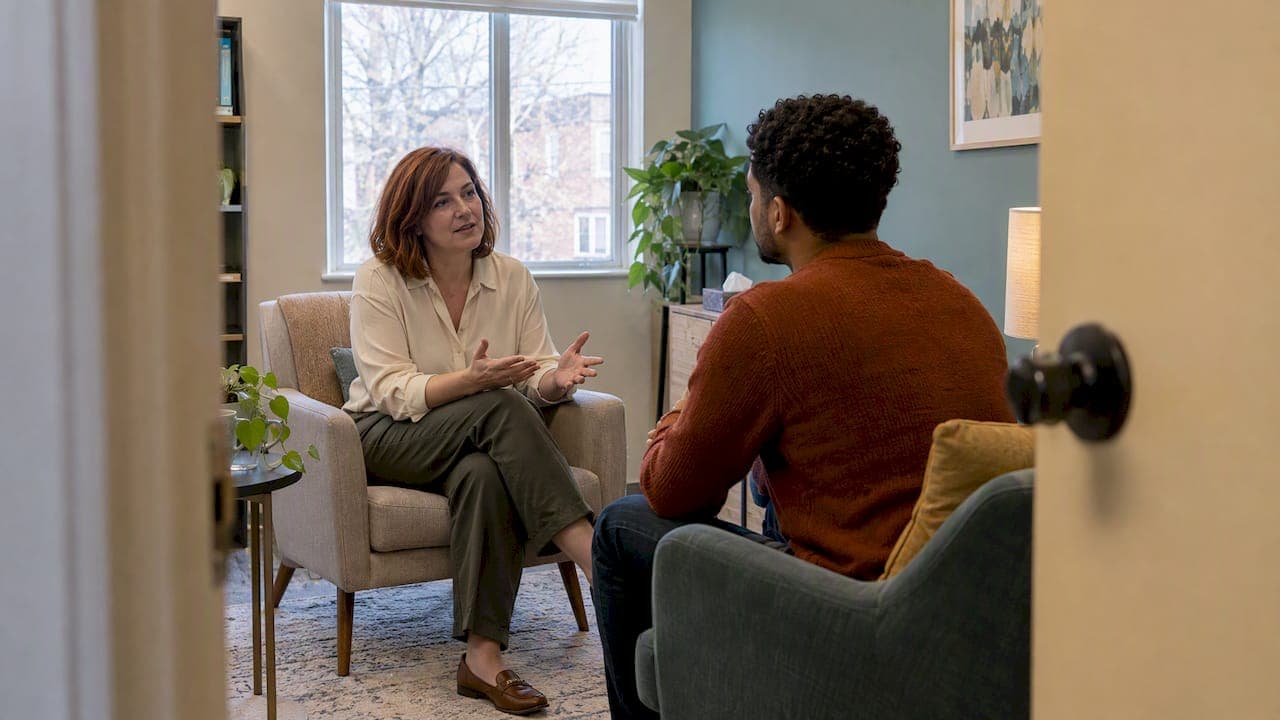
Sex therapy is a structured, talk-based form of psychotherapy. You meet with a trained therapist, alone or with a partner, to understand a sexual concern, explore what is behind it, and practice new ways of connecting between sessions. Nothing sexual happens in the room. Most of the work is conversation, education and small, manageable exercises you do privately at home.
If you are reading this, you may be nervous. That is completely normal. Many people carry a sexual worry for years before saying it aloud, and the idea of saying it to a stranger can feel like too much. This guide walks you through the process stage by stage, so the unknown becomes something you can picture and decide about.
TL;DR
- Sex therapy is talk-based psychotherapy. It never includes sexual activity with or in front of a therapist.
- Expect a first phase of history-taking, then shared goals, a tailored plan, and at-home exercises between sessions.
- Sexual concerns rarely have a single cause, so a good therapist looks at your body, mind, stress and relationship together.
- In Ontario, "sex therapist" is not a protected title, so ask about training, registration and certification.
- Your sessions are confidential, with a few legal limits your therapist must explain at the start.
What sex therapy is, and what it is not
The American Association of Sexuality Educators, Counselors and Therapists describes sex therapy as a subspecialty of psychotherapy that focuses on concerns related to human sexuality. People of many ages, backgrounds and health statuses, partnered or single, may benefit from it.
The concerns people bring are wide ranging. Alberta's health information service lists issues such as sexual desire and orgasm among the problems a counsellor can help with. In our own practice, we also hear about mismatched desire, pain, anxiety about performance, loss of intimacy after a betrayal, and the quiet distance that follows years of unresolved conflict.
What sex therapy is not matters just as much. Most people assume they will be observed or asked to demonstrate something. They will not. Any sexual contact with a therapist, or in their presence, is an ethical breach and often a crime. If a practitioner ever suggests otherwise, leave and report it to their regulatory college.

The sex therapy process, stage by stage
No two therapists work identically, and no two couples or individuals need the same thing. Still, most courses of sex therapy follow a recognizable arc.
Stage 1: A first conversation about trust and fit
Before any intimate detail is shared, a thoughtful therapist spends time on safety. You will talk about how sessions work, what to expect, and how your information is handled. Practitioners know that clients often feel hesitant or embarrassed at the start, so building trust is the priority of this phase.
One point worth knowing: you are in charge of your own pace. You can decline to discuss any topic you are not ready to share, and your therapist should respect that. If you want a broader picture of how a first appointment feels, our guide on how to prepare for your first therapy session covers the practical side.
Stage 2: Assessment and history
The early meetings usually involve an in-depth history. According to the ASTO, at the initial meeting you identify your concerns, how and when the problems developed, and what changes you would like to make. A personal history is taken, exploring your sexual feelings and experiences.
AASECT notes that this phase includes identifying specific concerns, the timeline of the issue, and its physical, psychological and relational components. A therapist may also coordinate with a physician when a medical assessment seems warranted.

That last point deserves attention. Sexual difficulties often have a physical piece: a medication, a hormonal change, a chronic illness, pain. A therapist is not a doctor and should not guess. If you have recently started a new prescription and noticed a change in desire, tell both your therapist and your prescriber. For men in particular, SSRI effects on libido are a common reason to raise the question with a physician rather than assume the problem is only emotional.
With couples, this stage may include individual time with each partner as well as joint sessions. The goal is not to assign blame. It is to understand how each of you experiences the problem.
Stage 3: Naming goals together
Once your therapist understands the picture, you agree on what you are working toward. Goals might be concrete (less pain, more frequent connection, easier arousal) or relational (feeling desired again, talking without defensiveness, rebuilding after an affair).
This step matters because couples often arrive with different goals. One partner wants more frequent sex, the other wants more closeness first. A therapist helps you find a shared direction instead of a winner and a loser. It is one reason sex therapy so often overlaps with couples work.
Stage 4: A tailored plan
Next comes a customized plan. Depending on what you need, it may draw on:
- Education about sexual response, anatomy, and how stress, age and medication affect desire.
- Communication skills for asking, refusing and giving feedback kindly.
- Cognitive behavioural strategies to loosen anxious thought patterns, such as the spiral of performance worry. Our article on reducing performance anxiety during sex explains some of these tools.
- Emotional work on shame, past trauma, resentment or grief.
- Gradual, low-pressure exercises done at home, designed to rebuild comfort with touch and closeness.
A 2023 systematic review and meta-analysis of psychological interventions for sexual intimacy, including education, communication training, CBT and emotional therapy, found a significant positive effect on couples, with large effect sizes for overall sexual satisfaction. The authors also note the review's limits, as the studies it pulls together vary in design. Read it as encouraging rather than as a guarantee.
Stage 5: Sessions and homework
The regular work happens in sessions, but much of the change happens between them. Homework might be a communication exercise, some reading, or educational video to watch alone or together. It is done privately, at home, never in front of your therapist.
Homework is where people sometimes stumble. A missed exercise is not failure. It is information. Bring it back to the next session and talk about what got in the way: tiredness, awkwardness, a lingering argument. That conversation is often the most useful part of the week.
Stage 6: Review, adjust and wrap up
Good therapists check progress regularly and adjust. Some goals shift as you learn more about what is actually happening. When you feel the concern has eased, or you have the tools to manage it, you and your therapist plan an ending. Many people space sessions out before finishing, so the new habits have time to settle.
The research suggests that gains can last. In one 2020 group intervention study with 45 couples, the biggest improvements in satisfaction occurred between the start and the six-month follow-up, which hints that positive changes can hold over time. That was a single, small study, so treat it as a hopeful signal, not a promise.
How many sessions will it take?
Honestly, it varies. AASECT is clear that the number of sessions depends on the complexity of the issue, and that individual cases differ even when the presenting problem is the same. A discrete worry, like situational performance anxiety, may need fewer sessions than a long-standing desire mismatch tangled up with betrayal or trauma.
A realistic approach is to commit to an initial block, review progress together, and then decide. For a sense of how to budget in Ontario, see our article on budgeting two to three months of therapy.
Why a therapist looks at the whole person
Sexual concerns are rarely isolated. Alberta's health information service describes a complex mix of physical, mental and emotional factors, including medication, past trauma, stress and relationship dynamics. That is why sex therapy rarely stays on the symptom alone.
Think of it like a sore knee. You could treat the pain, but if the cause is the way you walk, the pain returns. A relational wound works similarly. When trust has been broken, or resentment has built for years, the bedroom often reflects what is unspoken elsewhere. If you are in a long stretch without intimacy, our piece on low-pressure strategies for sexless marriages may help you take a first step.
This is also why sessions sometimes wander into communication patterns, self-image and family history. It is not a detour. It is usually the work.
Is it normal to talk about sex in therapy?
Yes. Clinicians treat it with the same rigor as any other health concern. The ASTO describes the process as professional and goal-oriented, and talking openly is part of how shame loses its grip.
What helps most is a therapist who is matter-of-fact. Clear language, no judgment, and no pressure to share more than you are ready for. If you do not feel that from a therapist after a couple of sessions, it is fair to look for a better fit.
Confidentiality and its limits in Ontario
What you share is private. Under Ontario's health privacy framework, therapists cannot disclose your information without consent except where the law permits or requires it. The College of Registered Psychotherapists of Ontario sets this out in its confidentiality standard.
The limits are narrow and should be explained during informed consent at the start. They generally include imminent risk of harm to yourself or others, reports of abuse of a child or vulnerable adult, and a court order. In couples work, the ASTO's ethics page notes that the client is often more than one person, and that confidences are not disclosed without the consent of each client. Ask your therapist upfront how they handle information shared by one partner alone. For more, see our article on why therapy is confidential.
What if you develop feelings for your therapist?
It happens more than people admit. When you open up about intimate matters with someone who listens carefully, strong feelings can arise. This is called transference, and it is not shameful.
The ethical rules are clear. The Ontario College of Social Workers and Social Service Workers' code of ethics warns that the professional relationship carries powerful influence that can last long after it ends. A therapist is expected to maintain firm boundaries, seek supervision, and, if the situation cannot be handled safely, end the relationship and help you find another service. You can also raise the feelings yourself. A good therapist will treat them as useful information, not a problem.
How to choose a sex therapist in Ontario
Here is something many people do not realize. In Ontario, psychotherapy is a regulated health profession, but sex therapy is not a regulated sub-discipline, so the title "sex therapist" is not protected. The Board of Examiners in Sex Therapy and Counselling in Ontario, now part of ASTO, was created so that clinicians could voluntarily be certified.
When you contact a therapist, consider asking:
- Are you registered with a regulatory college, such as the CRPO? (Our guide to finding a therapist in Ontario explains how to check.)
- What specific training do you have in sexual concerns, and are you certified through ASTO or a similar body?
- How do you work with couples, and how do you handle information shared by one partner?
- What does a typical plan look like, and how will we know it is working?
- What do sessions cost, and is there a sliding scale?
Cost is a fair question. Psychotherapy in Ontario is often paid out of pocket or through benefits, and we explain what OHIP covers and when you pay in a separate article.
Our perspective at Dewycounselling
We have spent more than 20 years working with diverse clients, and one thing has stayed constant: people rarely come in saying "I need sex therapy." They say they feel distant from their partner, or anxious, or ashamed, or that something changed after a betrayal. Sexual concerns are usually the visible part of a larger story.
That is why we approach this work relationally. We look at communication, history, stress, grief, and what each person is hoping for. We draw on evidence-based approaches and several modalities, and we adjust to the person in front of us, instead of fitting people into a script. Where sexual, infidelity, trauma or financial issues are at the heart of a couple's struggle, we offer specific therapy for them within our couples counselling.
We also believe the first step should be as gentle as it can be. You do not need to arrive with the right words. You can tell us what you are not ready to discuss, and we will start where you are. And if a medical question comes up, we will encourage you to talk to your physician, because good care is a team effort.
— Wayne Dewhurst
Working with us
We offer individual, couples and family therapy in person at two locations and online. In-person and online sessions are $175 per hour, mobile sessions are $225 per hour, and a prepaid annual membership is $1,750 per year. We also offer sliding scale pricing. You can see everything on our services page. If you are partnered and want to work on intimacy together, start with our couples counselling page. If you would rather begin on your own, our individual psychotherapy page is the place.
FAQ
Does sex therapy involve any physical contact or nudity?
No. Sex therapy is a talk-based clinical process, and sexual activity with a therapist or in their presence is an ethical breach. Any physical exercises are suggested as private homework for you or you and your partner at home.
Do I need a partner to start sex therapy?
No. People of all ages and backgrounds, partnered or single, may benefit from it. If you do have a partner, joining sessions can help, but starting alone to understand your own concerns is a valid first step.
How long does sex therapy take?
It depends on how complex the concern is. Even people with the same presenting problem can need different numbers of sessions. Many therapists suggest an initial block and then review progress together.
Is it a problem if I feel too embarrassed to talk?
Not at all. Embarrassment is common, and a good therapist expects it and starts by building trust. You can decline any topic you are not ready to discuss, and you can bring it up later when you feel safer.
Sources
- ASTO: What happens in sex therapy?
- AASECT: Certification FAQs
- Alberta MyHealth: Counselling for Sexual Problems
- Systematic review of marital sexual intimacy interventions, 2023
- CRPO: Confidentiality standard
- ASTO: Ethics
- OCSWSSW Code of Ethics and Standards of Practice
- ASTO (BESTCO): About Us
- SSRI Libido in Men