
Couples therapy is a professional process designed to resolve relationship challenges by improving communication, rebuilding trust, and deepening emotional intimacy. Understanding why couples seek therapy is the first step toward recognizing when professional support can genuinely help. Research identifies communication breakdown, infidelity, life transitions, and emotional distance as the most common triggers for seeking help. Dewycounselling works with couples at every stage, from early commitment to long-term partnerships, using evidence-based methods that produce real, lasting change.
What are the main reasons couples seek therapy?
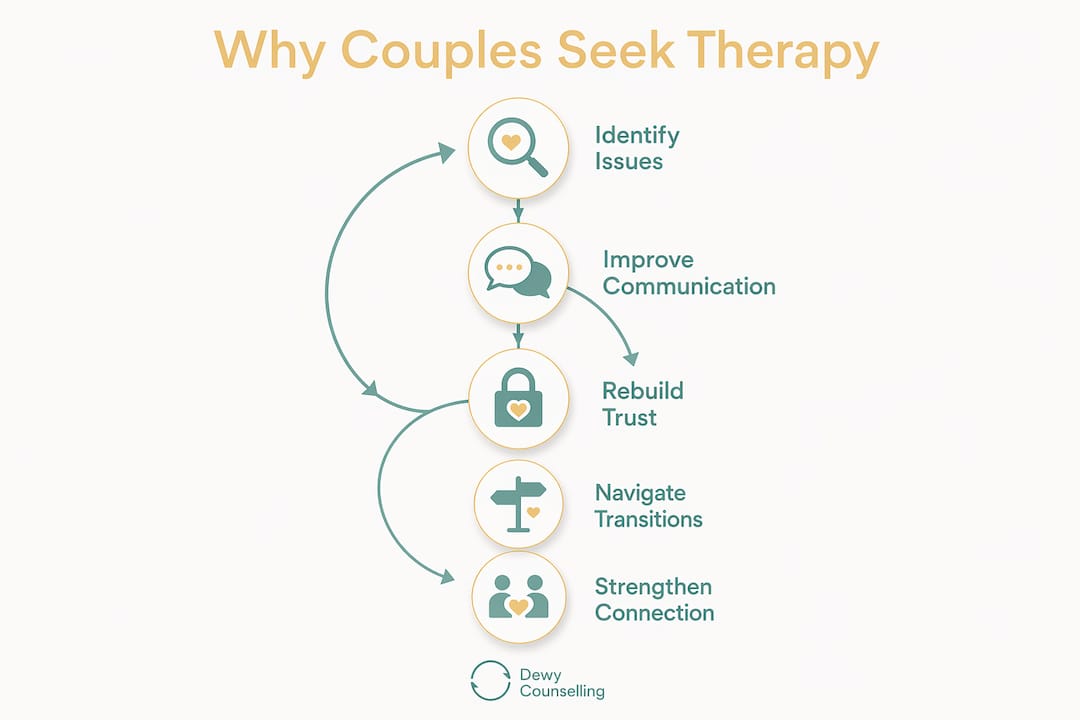
Couples attend therapy for a wide range of reasons, but certain patterns appear consistently. Communication breakdown tops the list, followed by infidelity, major life transitions, emotional distance, and recurring conflicts about money, parenting, or values. Recognizing these triggers early gives couples a real advantage.
Communication breakdown and conflict patterns
Poor communication is the single most cited reason couples go to counseling. When partners stop listening and start reacting, small disagreements escalate into repeated, painful cycles. Over time, those cycles create emotional distance that feels impossible to close without outside help. Therapy teaches couples to interrupt those patterns before they become the default way of relating.
Infidelity and trust repair
Betrayal is one of the most destabilizing relational wounds a couple can experience. Many couples seek therapy specifically to rebuild trust after affairs, though therapy improves the likelihood of repair without guaranteeing it. The process helps both partners understand what broke down, express the full weight of the hurt, and decide together whether to rebuild or part with clarity and respect.
Life transitions and emotional distance
Having a child, changing careers, relocating, or losing a parent can shift a relationship's equilibrium dramatically. Couples often find that the version of their partnership that worked before a major transition no longer fits. Emotional and physical distance can grow quietly during these periods, making it hard to reconnect without a structured space to do so.
Common signs that a couple may benefit from professional support include:
- Repeated arguments that never reach resolution
- Feeling more like roommates than partners
- One or both partners withdrawing emotionally or physically
- A significant breach of trust, such as an affair or financial deception
- Disagreements about parenting, money, or core values that feel stuck
- A major life change that has left the relationship feeling unsteady
Pro Tip: You do not need to be in crisis to benefit from couples therapy. Attending sessions during a stable period builds the communication skills that protect your relationship when harder times arrive.
How does couples therapy help address these challenges?
Couples therapy works by giving partners a structured, neutral space to practice new ways of relating. The most widely researched method is Emotionally Focused Therapy (EFT), which targets the emotional attachment patterns driving conflict. EFT shows a 70–75% success rate for couples achieving significant, maintainable relationship improvements. That figure matters because it means the majority of couples who commit to the process see real results.
The role of a neutral therapist
A therapist does not take sides. The therapist remains neutral, focusing on improving communication and conflict resolution skills rather than deciding who is right or wrong. This neutrality is what makes the space safe for both partners to speak honestly. Many couples find that they can say things in a session that they have never been able to say at home, simply because someone is there to keep the conversation from derailing.
"Expecting a therapist to choose sides is a misunderstanding of how couples therapy works. Effective couples therapy treats the relationship as the client, not either individual. The goal is to build skills, not assign blame."
Evidence-based approaches that produce results
Beyond EFT, therapists draw on methods like the Gottman Method, Cognitive Behavioral Therapy (CBT) adapted for couples, and Imago Relationship Therapy. Each approach uses structured exercises to build empathy, improve listening, and develop conflict resolution skills. Premarital therapy also falls within this category, reducing divorce risk by helping couples assess compatibility and build communication foundations before problems arise. Therapy is not only for relationships in distress. It is increasingly used as a proactive investment at any relationship stage.
Key benefits couples report from therapy include:
- Clearer, calmer communication during disagreements
- Greater empathy for each other's emotional experience
- Practical tools for managing recurring conflicts
- Renewed emotional and physical intimacy
- A shared language for expressing needs without blame
When is the right time to seek couples therapy?
The right time to seek couples therapy is earlier than most couples think. Research shows that couples wait an average of six years after serious problems arise before seeking professional help. Six years is a long time for destructive patterns like contempt and stonewalling to become ingrained. The longer those patterns run, the more intensive the work required to shift them.
The most effective sequence for getting help looks like this:
- Notice the pattern, not just the argument. If the same fight keeps happening with different content, that is a signal worth taking seriously.
- Talk about therapy before it feels urgent. Raising the idea during a calm period removes the stigma of "we're broken" from the conversation.
- Agree on a shared goal. Couples achieve better outcomes when both partners enter with a shared motivation rather than hoping the therapist will validate their individual position.
- Act before withdrawal becomes the norm. Emotional shutdown is harder to reverse the longer it persists.
- Reassess external stressors. Work pressure, financial instability, or untreated depression in one partner can drive relational distress that therapy alone may not resolve. Addressing those factors alongside therapy improves outcomes.
One important boundary: therapy is not appropriate and can be actively harmful in relationships involving domestic violence or coercive control. In those situations, safety planning and specialized interventions must come first.
Pro Tip: If you are unsure whether your relationship needs therapy, ask yourself this: "Are we solving problems together, or just surviving them?" If the answer leans toward survival, that is a clear sign to reach out.
What should couples expect from the therapy process?
Couples therapy sessions typically run 50–60 minutes and focus on communication, mutual understanding, and skill-building. The therapist facilitates the conversation rather than directing it, which means both partners do the real work. Most couples begin to notice shifts within 8–12 sessions, though the timeline varies depending on the complexity of the issues and how consistently both partners engage.
Practical expectations for the process include:
- Sessions feel structured but not scripted. Expect to be guided, not lectured.
- Homework is common. Therapists often assign communication exercises to practice between sessions.
- Progress is not linear. Some sessions will feel harder than others, especially when deeper issues surface.
- Outcomes vary. Therapy can lead to a stronger relationship, a clearer understanding of each other, or a more respectful separation. All three are valid outcomes.
| Format | Best suited for | Key consideration |
|---|---|---|
| In-person sessions | Couples who prefer face-to-face connection | Requires scheduling and travel coordination |
| Online video sessions | Couples with busy schedules or distance barriers | Equally effective for most presenting issues |
| Blended format | Couples who want flexibility | Allows switching based on availability |
| Self-guided modules | Couples supplementing therapy | Works best alongside professional sessions |
Choosing a compatible therapist matters as much as choosing the right format. Look for a licensed professional with specific training in couples or relational therapy, not just general counseling credentials. A good fit between therapist and couple is one of the strongest predictors of a positive outcome.
Key takeaways
Couples therapy works best when both partners enter with shared goals, seek help early, and commit to the process with realistic expectations.
| Point | Details |
|---|---|
| Early help produces better results | Couples wait an average of six years before seeking help, allowing harmful patterns to deepen. |
| EFT is the gold standard | Emotionally Focused Therapy shows a 70–75% success rate for lasting relationship improvement. |
| Therapists stay neutral | The therapist's role is to improve communication skills, not to judge or take sides. |
| Therapy suits all stages | Premarital, early-stage, and long-term couples all benefit from structured professional support. |
| External stressors matter | Addressing factors like financial stress or untreated mental health issues improves therapy outcomes. |
What I have learned from years of working with couples
The couples who benefit most from therapy are rarely the ones in the deepest crisis. They are the ones who come in willing to be wrong about something. That willingness, more than any technique or method, is what makes the difference.
A common misconception I encounter is that therapy is a last resort, something you try when everything else has failed. That framing puts couples at a disadvantage before the first session even begins. Therapy is far more effective as a maintenance tool than as an emergency repair. Think of it the way you would a physical check-up. You do not wait for a serious diagnosis to see a doctor. The same logic applies to your relationship.
Another pattern I see regularly is one partner dragging the other into sessions. When one person enters therapy to prove a point rather than to grow, the process stalls. The research backs this up: shared motivation between partners is one of the strongest predictors of a good outcome. If your partner is resistant, the most useful thing you can do is start with individual therapy to clarify your own needs and goals.
Every couple carries a unique set of dynamics, histories, and blind spots. A tailored approach, one that meets you where you actually are rather than where a textbook says you should be, is what produces real change. Seeking help is not a sign that your relationship has failed. It is a sign that you value it enough to invest in it.
— Wayne Dewhurst
Dewycounselling's approach to couples therapy
Dewycounselling offers couples counseling through both in-person and online formats, making professional support accessible regardless of your schedule or location. Sessions draw on evidence-based methods including Emotionally Focused Therapy, tailored to each couple's specific dynamics and goals.

Whether you are navigating a specific crisis or simply want to strengthen your connection, Dewycounselling's licensed therapists provide a structured, judgment-free space to do that work. Explore the full range of professional therapy services available, including flexible session formats and self-guided modules that complement the therapy process. Reaching out is the first real step toward a relationship that works better for both of you.
FAQ
What are the most common reasons couples go to counseling?
Communication breakdown, infidelity, life transitions, emotional distance, and recurring conflicts about money or parenting are the most common triggers for seeking couples therapy.
How long does couples therapy usually take?
Most couples begin noticing meaningful shifts within 8–12 sessions, though the total duration depends on the complexity of the issues and how consistently both partners engage with the process.
Will the therapist take sides during sessions?
No. A couples therapist remains neutral throughout the process, treating the relationship as the client rather than siding with either individual.
Is couples therapy only for relationships in crisis?
Couples therapy is increasingly used as a preventive measure by early-stage and premarital couples who want to build strong communication foundations before serious problems develop.
What if one partner does not want to attend therapy?
Individual therapy is a productive starting point. Clarifying your own needs and goals through individual sessions often creates the conditions for a resistant partner to become more open to couples work over time.