
Psychotherapy is defined as a structured psychological treatment that targets deep emotional and behavioral patterns through trained personal interaction, while counselling offers shorter-term, solution-focused support for specific life challenges. Both approaches share the goal of improving mental health and well-being, yet they differ meaningfully in depth, duration, and method. Understanding the difference between these two therapy types helps you choose the right support from the start. This guide on psychotherapy vs counselling explained breaks down what each approach involves, how they compare across key dimensions, and what practical criteria can guide your decision.
What are the key characteristics and goals of psychotherapy?
Psychotherapy is a broader treatment that uses psychological methods within a structured professional relationship to change emotional and behavioral patterns. It is not a single technique. It is a category of care that encompasses many different approaches, all aimed at meaningful, lasting change.
Psychotherapy typically unfolds over months or even years. That longer timeline exists because the work involves uncovering deep-seated patterns, not just managing surface-level stress. A person working through childhood trauma, chronic depression, or recurring relationship conflicts needs time to build insight and rewire habitual responses.
The therapeutic relationship sits at the center of effective psychotherapy. Trust between client and therapist is not a soft bonus. It is the mechanism through which change happens. Research consistently shows that the quality of the therapeutic alliance predicts outcomes more reliably than any single technique.
Common psychotherapeutic approaches include:
- Cognitive Behavioral Therapy (CBT): Targets negative thought patterns and their behavioral consequences through structured, goal-oriented sessions.
- Dialectical Behavior Therapy (DBT): Focuses on emotional regulation and interpersonal effectiveness, particularly for chronic conditions like borderline personality disorder.
- EMDR (Eye Movement Desensitization and Reprocessing): Processes traumatic memories by pairing bilateral stimulation with guided recall.
- Psychodynamic therapy: Explores unconscious patterns rooted in past experiences to understand present behavior.
Each modality targets a different need, which is why knowing what is psychotherapy means understanding it as a family of approaches rather than one fixed method.
Pro Tip: Ask any prospective therapist which modality they primarily use and why they think it fits your situation. A therapist who can answer that question clearly is one who has thought carefully about your care.
How does counselling differ in goals, duration, and application?
Counselling is a directive, short-term process focused on practical guidance and coping skills rather than deep psychological exploration. Where psychotherapy asks "why do these patterns keep repeating?", counselling asks "what can you do right now to feel better and function well?"

The duration of counselling typically spans weeks to a few months. That shorter window suits people dealing with a specific, identifiable challenge. Grief after a loss, stress at work, a relationship conflict, or anxiety around a life transition are all situations where counselling can deliver real relief without requiring long-term commitment.
Counselling is also more directive by design. A counselor actively helps you identify practical solutions, build coping skills, and shift your perspective on a current problem. The goal is empowerment through clarity, not excavation of the past.
Situations where counselling is the right fit include:
- Adjusting to a major life change such as divorce, job loss, or relocation
- Managing grief or bereavement in the months following a loss
- Navigating relationship friction that has a clear, recent trigger
- Building stress management skills for a defined period of pressure
- Processing a specific event without a history of recurring emotional conflict
Counselling helps with immediate problems like stress, relationships, and grief for quicker coping, while psychotherapy explores deeper emotional patterns and longer-term change. That distinction is the clearest way to understand counselling vs therapy at a practical level.
What practical criteria help you decide between psychotherapy and counselling?
The decision between counselling and psychotherapy comes down to three factors: the nature of your problem, your goals for therapy, and how long the issue has been present. Getting clear on these three points before your first appointment saves time and sets realistic expectations.
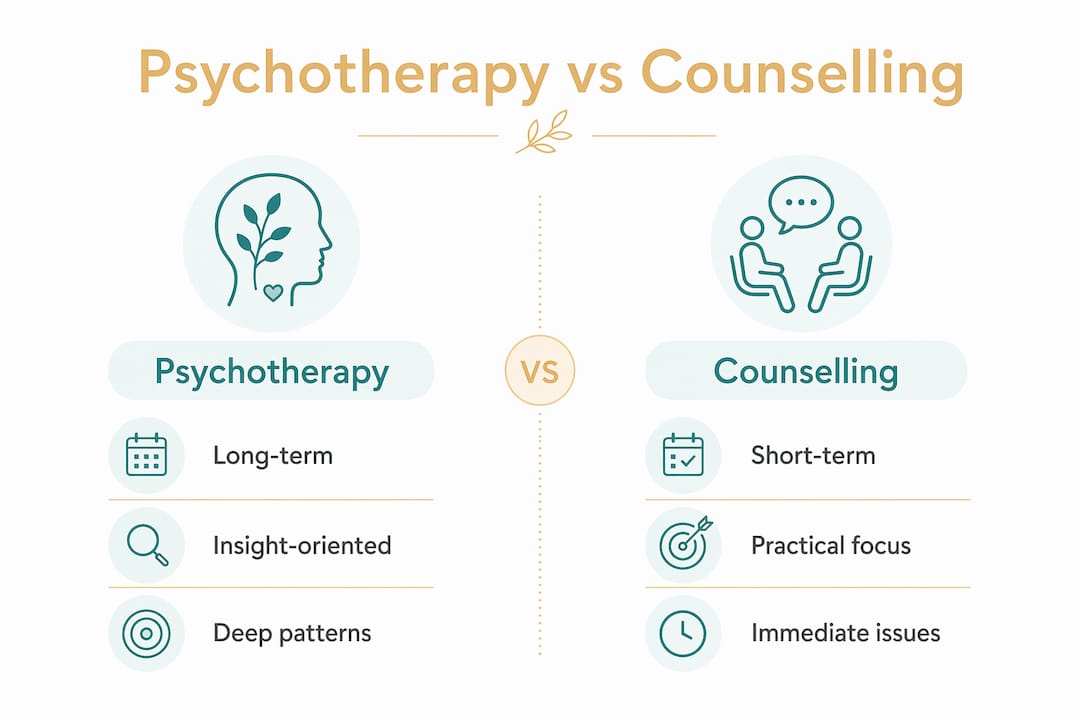
Choose counselling when your concern is specific and recent. If you are dealing with a defined stressor and you want practical tools to cope, counselling is the more efficient path. You do not need years of insight-oriented work to get through a difficult season at work or process a relationship rupture that has a clear cause.
Choose psychotherapy when your struggles are recurring, complex, or rooted in patterns that predate your current situation. Individuals with recurring emotional conflicts benefit more from psychotherapy's deep exploration than brief counselling stays focused on problem-solving. If you have tried to address the same issue multiple times without lasting relief, that is a signal that the roots go deeper than coping skills can reach.
Here is a practical framework for making the decision:
- Name the problem clearly. Is it a specific event or a recurring pattern? Specific events suit counselling. Recurring patterns suit psychotherapy.
- Set a goal for therapy. Do you want to feel better in the next two months, or do you want to understand why you keep ending up in the same painful situations? Short-term relief points to counselling. Lasting behavioral change points to psychotherapy.
- Consider your history. If this issue has shown up across different relationships, jobs, or life stages, psychotherapy is likely the better fit.
- Ask the right question in your first call. Ask clinicians how they conceptualize change, whether through skills and coping or through insight into emotional patterns. That answer predicts session style better than any job title.
- Stay open to adjusting. Therapy is not a fixed contract. Many people begin with counselling and shift to psychotherapy as they recognize deeper patterns. The initial choice does not have to be permanent.
Pro Tip: If you are unsure which approach fits, book a single consultation and ask the therapist directly: "Do you think my situation calls for short-term coping support or longer-term pattern work?" A skilled clinician will give you a clear, honest answer.
How do major psychotherapy modalities compare?
Psychotherapy includes multiple modalities like CBT, DBT, EMDR, and psychodynamic approaches, each tailored to specific needs. Knowing the difference between therapy types at the modality level gives you a sharper lens for choosing care than the counselling vs therapy label alone.
The table below compares the four most widely practiced modalities across key dimensions.
| Modality | Primary focus | Best suited for | Typical duration |
|---|---|---|---|
| CBT | Changing negative thought patterns | Anxiety, depression, phobias | 12–20 sessions |
| DBT | Emotional regulation and interpersonal skills | Borderline personality disorder, self-harm | 6–12 months |
| EMDR | Processing traumatic memories | PTSD, trauma, grief | 8–12 sessions |
| Psychodynamic | Unconscious patterns and past experiences | Recurring relational or emotional conflicts | Months to years |
Cognitive Behavioral Therapy is considered the gold standard for many disorders and engages clients in structured, goal-oriented sessions. That structure makes it one of the most studied and replicated approaches in mental health research.
DBT combines acceptance and change principles, offering both individual and group sessions to teach practical skills. It was originally developed for borderline personality disorder but is now used broadly for emotional dysregulation across many diagnoses.
Modality matters because two therapists can both call themselves psychotherapists and operate very differently in the room. One may use structured CBT worksheets. Another may sit with you in open-ended psychodynamic exploration. Knowing which approach resonates with how you learn and process emotion helps you find a therapist whose style actually fits your needs. Counselling can also incorporate elements of CBT, particularly around coping skills, which is one reason the boundary between counselling and psychotherapy sometimes blurs in practice.
Key takeaways
Psychotherapy targets deep emotional and behavioral patterns through long-term, insight-oriented work, while counselling delivers short-term, practical support for specific current challenges.
| Point | Details |
|---|---|
| Psychotherapy is long-term | It spans months to years and targets recurring emotional or behavioral patterns at their root. |
| Counselling is short-term | It typically lasts weeks to a few months and focuses on coping skills for specific, current issues. |
| Modality matters more than label | Ask about CBT, DBT, EMDR, or psychodynamic approach to understand what actually happens in sessions. |
| Ask the right first question | Ask how a therapist conceptualizes change. Skills-based or insight-based answers predict session style better than titles. |
| Your choice can evolve | Starting with counselling and moving to psychotherapy as needs deepen is common and appropriate. |
Why the label matters less than you think
After years of working in mental health support, the question I hear most often is: "Am I seeing a therapist or a counselor, and does it matter?" My honest answer is that the label matters far less than most people assume. What matters is whether the person sitting across from you understands your goals and has a clear method for helping you reach them.
The counselling vs therapy distinction is useful as a starting map, but it can mislead you if you treat it as a fixed rule. I have seen people spend months in short-term counselling for what was clearly a deep-rooted pattern issue, making slow progress because the approach was too shallow for the problem. I have also seen people commit to years of psychotherapy for a situational stressor that six weeks of focused counselling would have resolved.
The most important thing you can do before your first session is get specific about what you want. Not "I want to feel better." Specific. Do you want to stop having the same argument with your partner? Do you want to understand why you shut down emotionally under pressure? Do you want to get through the next three months without burning out? Each of those goals points to a different kind of support.
Professional accreditation matters too. Look for therapists registered with recognized bodies such as the American Association for Marriage and Family Therapy or the National Board for Certified Counselors. Accreditation does not guarantee a good fit, but it does guarantee a baseline of training and ethical accountability.
The therapeutic alliance, the quality of the working relationship between you and your therapist, is the single strongest predictor of good outcomes across all modalities. If you do not feel heard and respected after two or three sessions, that is useful information. You are allowed to find a better fit. Choosing the right support is not a one-time decision. It is an ongoing act of self-awareness.
— Wayne
Dewycounselling offers professional therapy for real life
Whether you are sorting through a specific stressor or ready to address deeper patterns, finding the right support makes a real difference. Dewycounselling provides individual, couples, and family therapy through both online and in-person sessions, with a team trained across multiple modalities including CBT, DBT, and EMDR.
You can explore the full range of therapy and counselling services to find the approach that fits your situation. For those ready to commit to longer-term work, the psychotherapy services page outlines available modalities and what to expect from each. Dewycounselling also offers self-help video modules for those who want to complement their sessions with structured learning between appointments. Reaching out to Dewycounselling is a straightforward first step toward getting the right kind of support.
FAQ
What is the main difference between psychotherapy and counselling?
Psychotherapy is a longer-term, insight-oriented treatment for deep emotional and behavioral patterns, while counselling is short-term and focused on coping with specific current issues. The core difference lies in depth and duration, not in the quality of care.
How long does psychotherapy typically last?
Psychotherapy spans months to years depending on the complexity of the issues being addressed. Counselling, by contrast, typically lasts weeks to a few months.
Can counselling include psychotherapy techniques?
Yes. Counselling can incorporate elements of modalities like CBT, particularly around coping skills and thought reframing. The boundary between the two approaches is not always rigid in practice.
How do I know if I need psychotherapy or counselling?
If your concern is specific and recent, counselling is usually the right starting point. If you face recurring emotional conflicts or patterns that predate your current situation, psychotherapy offers the deeper exploration those issues require.
What should I ask a therapist before my first session?
Ask how they conceptualize change, whether through skills and coping strategies or through insight into emotional patterns. That single question reveals more about their approach than any professional title does.