
Most couples can plan on roughly 8 to 12 sessions to see measurable change, which works out to about two to three months of weekly meetings. A helpful anchor number backed by research is close to 12 sessions for a standard course. The most practical move you can make right now: ask your therapist for a 12-session plan with a formal check-in at session 8, so you both know what progress should look like before you're halfway through.
TL;DR:
- Short-term therapy, focused on specific issues, typically takes 4 to 8 sessions and may resolve in as few as six sessions.
- Most couples follow a standard 8 to 15 session course, aligning with an approximate three-month timeline for weekly sessions.
- Longer issues like infidelity or trust breakdowns often require 20 or more sessions, extending treatment over several months.
- Factors such as the problem's duration, co-occurring depression, engagement level, issue type, and therapist fit influence the overall length.
- A 12-session plan with an evaluation at session 8 helps keep therapy focused and allows adjustments based on progress.
How Long Does Couples Therapy Take? Session Counts and Calendar Time
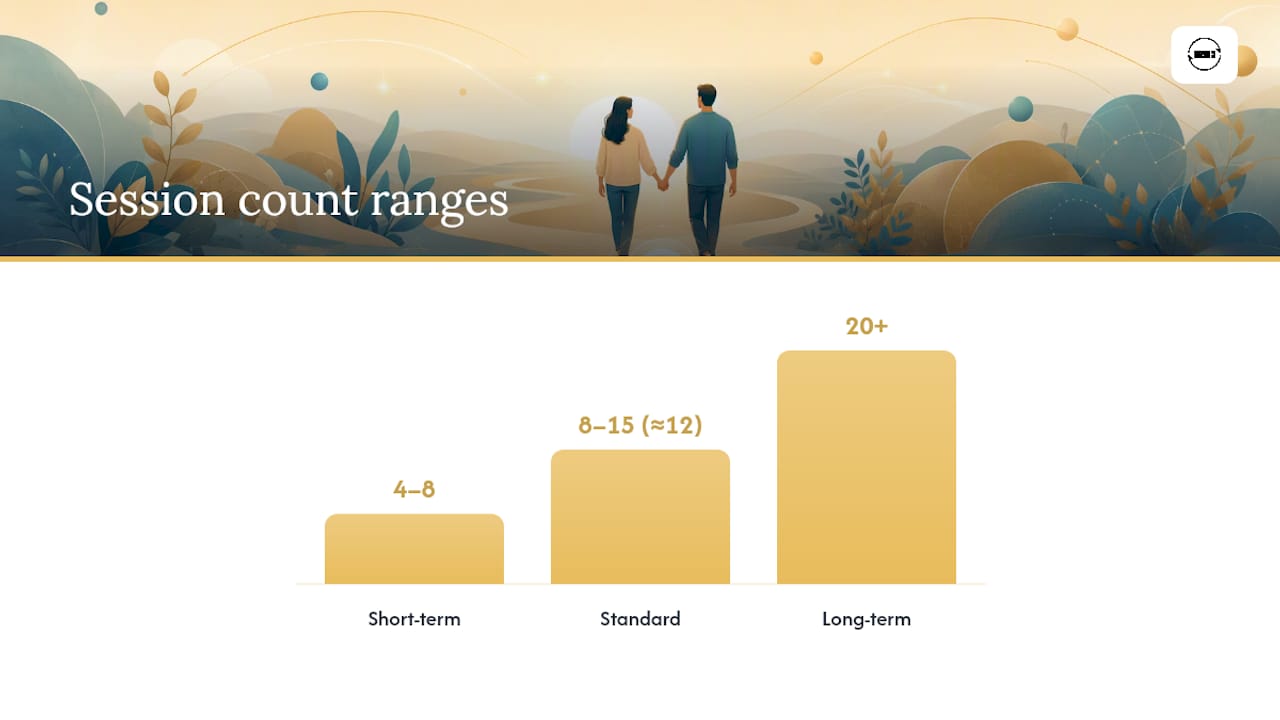
The honest answer is: it depends on what you're solving, but the ranges are more predictable than most couples expect. Therapists generally sort couples therapy duration into three tiers, and knowing which one applies to your situation changes how you budget your time and money.
Short-term (4 to 8 sessions). This fits couples working on one specific, well-defined problem, like improving how you argue about chores or reconnecting after a stressful life event. Psychology Today notes that focused, single-issue counseling can wrap up in six sessions or fewer.
Standard (8 to 15 sessions, midpoint near 12). This is where most couples land. It covers communication patterns, recurring conflict cycles, and rebuilding emotional connection after it's frayed rather than shattered.
Long-term (20 or more sessions). Reserved for attachment injuries such as infidelity, chronic trust breakdowns, or cases where one or both partners are also managing depression or trauma alongside the relationship work.
Here's how those session counts translate into actual weeks on your calendar:
- Weekly sessions at the standard 12-session pace: about 3 months.
- Biweekly sessions at the same pace: closer to 6 months.
- Intensive weekend formats: compress several sessions' worth of work into 1 to 2 days, often used to jumpstart a stalled process.
Session length itself runs 50 to 90 minutes. Some models, like Gottman-based therapy, front-load the process with a longer assessment session, which changes what week one actually looks like compared to week six.
What the Research Says About Couples Therapy Duration
The numbers aren't guesswork. A multilevel study published in the Journal of Marital and Family Therapy tracked naturalistic treatment and found an average length of about 11.7 sessions, landing almost exactly on the standard planning window most clinicians already recommend.
By the numbers: Average couples therapy course ≈ 11.7 sessions (JMFT, 2026), with industry aggregates reporting a broader 12 to 25 session range spanning 4 to 10 months.
The model you choose shapes the shape of that timeline:
- Emotionally Focused Therapy (EFT) often shows meaningful movement by sessions 8 to 12, with full courses typically running 8 to 20 sessions depending on how entrenched the disconnection is.
- The Gottman Method builds in a longer intake, often 85 to 90 minutes, before settling into a working range of roughly 10 to 20 sessions.
- General couples psychotherapy, per the American Psychological Association, gets scaled to the couple's actual goals rather than a fixed script, which is why brief counseling and longer-term therapy get treated as genuinely different services.
The clinical takeaway is simple: ask which model your therapist practices and what course length that model typically runs. A practical guide to therapy types can help you compare EFT, Gottman, and other approaches before your first appointment.
What Makes Couples Therapy Take Longer or Shorter
Your relationship therapy schedule isn't fixed the day you book your first session. Several factors push the timeline in either direction, and most of them are things you can actually influence.
- How long the problem has existed. Patterns you've lived with for a decade take longer to unwind than a conflict that started six months ago. Waiting years before seeking help tends to entrench habits, which is part of why earlier intervention often shortens overall treatment.
- Co-occurring depression or high relationship distress. The JMFT study found that when one partner met relationship distress cutoffs, or both partners met depression cutoffs, treatment ran longer than average. If depression is part of the picture, pairing couples work with individual support often moves things faster than couples sessions alone.
- Engagement between sessions. Couples who actually do the homework, communication drills or scheduled check-ins, tend to see change faster than those who show up weekly and do nothing in between.
- The type of issue. A single communication skill gap resolves faster than an attachment injury like infidelity, which requires rebuilding trust before new skills can even take hold.
- Therapist experience and fit. Therapist-level differences accounted for roughly 7.4% of the variance in treatment length in the JMFT data, a reminder that the working relationship with your clinician matters, not just the technique.
Early Signs Your Couples Therapy Is Working
You don't have to wait until the relationship feels fully repaired to know something's shifting. Certain markers tend to show up early, and they're worth watching for deliberately.
- Fights escalate less often, and when they do happen, you recover from them faster.
- You start catching yourself mid-argument and choosing a repair attempt instead of digging in.
- Homework assignments, like a scheduled check-in or a communication exercise, actually get done and reported back on.
- In session, curiosity starts replacing blame; you ask "why" instead of assigning fault.
- Your therapist points out objective changes you might not have noticed yourself.
Many couples report the first hints of improvement around sessions 3 to 6, with more durable change becoming visible by session 8 to 12. If you want a fuller picture of what progress looks like before you're deep into a course, this rundown of signs your relationship needs therapy is a useful companion read.
Pro Tip: Keep a shared note (a phone app works fine) where you both jot down one small win after each session. Looking back at eight entries is far more convincing than trying to remember whether things have "gotten better" in the abstract.
How to Plan Your Couples Counseling Timeline From Day One
Walking into your first session with a plan changes how the whole process feels. Here's a sequence that works for most couples:
- Start weekly. Weekly sessions build momentum faster than biweekly ones, especially in the first month, when you're still learning the basic communication skills.
- Set a 12-session target with an 8-session checkpoint. This gives your therapist a natural point to show you measurable progress and renegotiate goals if needed, rather than letting therapy drift indefinitely.
- Switch to biweekly once skills generalize. After the initial skill-building phase, many couples taper frequency without losing ground.
- Decide your evaluation criteria upfront. Pick two or three concrete behaviors, like fewer than one major blowup per week, or both partners initiating repair attempts, and use those as the actual measuring stick at session 8.
A few budgeting notes worth factoring in:
- Private-practice fees commonly run $150 to $400 per hour depending on location and clinician.
- Sliding-scale pricing and membership options can make a longer course more affordable if you know early on that you're looking at 15 or more sessions.
- If depression, trauma, or intense distress is part of the picture, expect your therapist to recommend either more frequent early sessions or individual therapy alongside your couples work.
For a walkthrough of what to bring to that first appointment, see how to prepare for your first therapy session.
What Actually Happens in a Couples Therapy Session
Session one and session ten don't look the same, and that's by design. Early sessions front-load assessment: your therapist gathers history, may use structured questionnaires (Gottman-based practices lean heavily on these), and works with you to define what "better" would actually look like.
Once assessment wraps, sessions shift toward the real work:
- Identifying your specific conflict cycle, the pattern that triggers most of your fights.
- Practicing communication and emotional regulation skills live, in the room, with feedback.
- Assigning homework, a scripted conversation, a check-in ritual, that extends the work into your week.
- Reviewing what worked and what didn't since the last session.
As you approach the tail end of a course, sessions often taper from weekly to a maintenance rhythm, monthly or as-needed, rather than stopping abruptly. For a fuller breakdown, how therapy sessions work walks through the structure in more detail.
Why We Build Every Couples Therapy Plan Around a Checkpoint
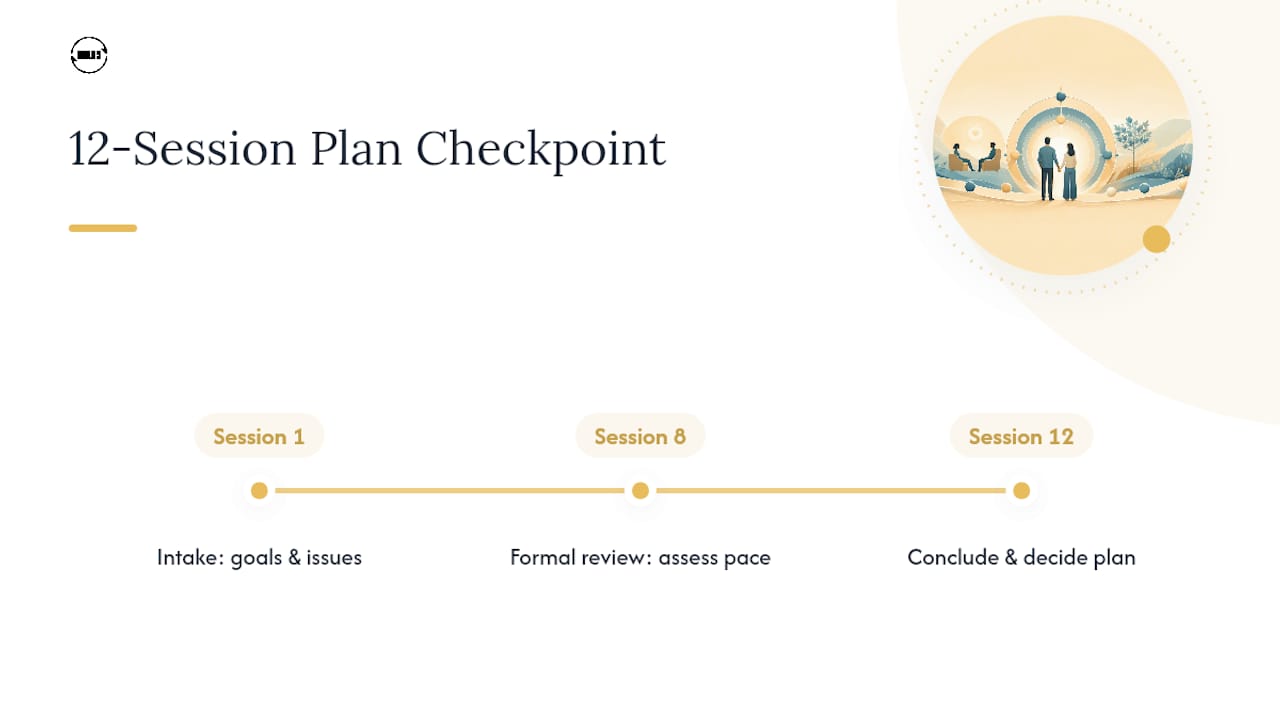
At Dewycounselling, we recommend a 12-session plan with a formal review at session 8 for a reason: open-ended therapy without a checkpoint tends to lose focus, and couples deserve to know whether the work is actually moving the needle. That review isn't a test you pass or fail. It's a moment to look at the specific goals you named at intake and decide honestly whether the pace needs to change.
We'd rather have that conversation directly with you than let you guess. If depression, infidelity, or a long-standing pattern is part of your situation, say so at intake. It changes the plan, and it should.
— Wayne Dewhurst
Ready to Build Your Own Couples Therapy Plan?
Reading about session counts is useful, but nothing replaces a plan built around your actual relationship. Professional counselling services commonly offer in-person and online couples therapy, membership plans, and self-help modules for structured support, often involving a 12-session approach with a mid-course review.

Start by requesting a 12-session plan and an 8-session mid-course review when you book. You'll leave that first conversation with a realistic couples therapy duration for your specific situation, not just a general estimate. Visit the couples counselling page to see modalities offered, including support for infidelity, trauma, and financial conflict, or browse session and membership options to compare formats before you book.
This article is general information, not a substitute for advice from a qualified doctor. Consult a qualified healthcare professional about your own circumstances before acting on anything here.
Sources
- Does Depression and Relationship Distress Predict Longer Couple Therapy Treatment in Naturalistic Settings? - Morgan - 2026 - Journal of Marital and Family Therapy - Wiley Online Library
- How does couples therapy work? | Psychology Today
- Couples Therapy Statistics 2026: Cost, Effectiveness, Trends
- What is EFT? | ICEEFT
- Psychotherapy: Couples and family | American Psychological Association
FAQ
How long does it take to see results from couples therapy?
Many couples notice smaller shifts, calmer arguments, better repair attempts, by sessions 3 to 6. More substantial, lasting change tends to show up by session 8 to 12, which is why that point is a common checkpoint.
What is the 7-7-7 rule for couples?
The 7-7-7 rule is a relationship habit, not a therapy timeline: every 7 days have a date night, every 7 weeks take a weekend away, and every 7 months take a longer trip together. It's a maintenance tool couples sometimes use alongside therapy, not a measure of how many sessions you'll need.
What is the 3-3-3 rule for marriage?
The 3-3-3 rule is a de-escalation technique some counselors teach during conflict: spend 3 minutes doing something physical, 3 minutes doing something mental, and 3 minutes doing something calming before returning to a heated conversation. It's a skill you might practice as homework between sessions, not a fixed schedule for how long therapy lasts.
What is the 2-2-2 rule for couples?
The 2-2-2 rule suggests a date every 2 weeks, a weekend away every 2 months, and a longer trip every 2 years to keep connection active outside of daily routines. Like the 7-7-7 rule, it's a relationship maintenance habit rather than a couples therapy timeline.
How many sessions does couples therapy usually take?
Most couples plan for 8 to 12 sessions for standard concerns, with research showing an average near 11.7 sessions. Brief, single-issue counseling can finish in 6 sessions or fewer, while attachment injuries like infidelity often require 20 or more.
Does Dewycounselling offer a set couples therapy timeline?
Dewycounselling typically recommends a 12-session plan with a formal review at session 8, adjusted to your specific goals at intake. Pricing for in-person and online sessions and couples-specific services is available on the site, since costs vary by format and session type.