
The single most reliable way to increase relationship satisfaction is building small, repeatable habits: positivity, turning toward each other's bids for attention, quick conflict repair, and consistent physical affection that compound week after week. None of these tactics require a dramatic overhaul. They require consistency.
Start with these six today:
- Turn toward bids for connection instead of missing or brushing past them.
- Track your positive-to-negative ratio. The Gottman Institute found stable couples maintain a significantly higher number of positive interactions compared to negative ones during conflict, and an even greater surplus during non-conflict times.
- Respond actively and constructively when your partner shares good news, not just politely.
- Add daily physical affection, a hug held for 20 seconds, a real kiss goodbye.
- Repair fast after conflict rather than letting tension sit overnight.
- Protect your own wellbeing so you have the emotional bandwidth to show up.
Small changes, like a genuine hug or a curious follow up question, tend to shift the emotional tone within days. Measurable change in overall satisfaction usually takes a few weeks of consistent practice, according to research summarized by Shelly Gable and others working in this space. This guide walks through each tactic with scripts, timing, and the research behind it.
Key Takeaways
Relationship satisfaction rises when couples consistently practice a small set of research-backed habits, positivity, turning toward bids, active celebration, physical affection, and fast repair, rather than relying on occasional grand gestures.
| Point | Details |
|---|---|
| Notice and respond to bids | Small daily requests for attention, answered consistently, build the foundation of connection. |
| Aim for the 5:1 or 20:1 ratio | Track positive versus negative interactions weekly to see if warmth outweighs friction. |
| Celebrate good news actively | Enthusiastic, curious responses to good news predict intimacy more than support during hard times. |
| Repair quickly after conflict | Use apology, humor, or validation scripts the same day rather than letting tension linger. |
| Consider guided support when stuck | Dewycounselling's couples counselling pairs Gottman-informed and EFCT methods for couples ready for structured help. |
Your Increase Relationship Satisfaction Guide: The Full Roadmap
You don't need to master every strategy at once. Most couples see the biggest gains from picking two or three tactics and practicing them consistently for a couple of weeks before adding more. Here's the order this guide follows, along with the research anchor behind each one.
- Communication habits. Learning to notice and respond to "bids," the small requests for attention or connection partners send throughout the day, is the foundation. Research from the Gottman Institute ties bid response rates directly to relationship stability.
- Positivity and gratitude. The Gottman Institute's 5:1 and 20:1 ratios give couples a concrete target for how many positive moments should outweigh the negative ones.
- Active constructive responding. Shelly Gable's research on "capitalization," how couples respond to each other's good news, found that enthusiastic, engaged responses predict intimacy and relationship longevity more than almost any other single behavior.
- Physical affection and sexual communication. Consistent, low-key touch is linked to both relationship and sexual satisfaction, according to a Psychology Today review of behaviors that predict closeness.
- Novelty and shared meaning. Psychologist Arthur Aron's self-expansion theory explains why couples who try new things together report more excitement and connection than those who stick to routine.
- Conflict repair skills. Repair attempts, not the absence of conflict, are what separate couples who thrive from couples who stagnate, according to clinician observations reported in Psychology Today.
- Individual wellbeing. Partners who manage their own stress and mental health show up more reliably for each other, according to a psychologist summary published in Men's Journal.
- Knowing when to seek professional support. Evidence-based approaches like Gottman Method work and Emotionally Focused Couples Therapy give couples structured tools when self-directed effort stalls.
A 2026 synthesis from ISSPR pulls together fifteen of these evidence-based tactics, turning toward bids, creating shared meaning, active constructive responding, novelty, gratitude, and repair skills among them, and finds they consistently predict higher relationship satisfaction across different populations and relationship stages. That convergence matters. These aren't competing theories from rival camps; they're the same handful of behaviors showing up again and again across decades of relationship research.
What makes this list different from generic relationship advice is specificity. "Communicate better" is not actionable. "Notice when your partner mentions something that happened at work and ask one follow-up question" is. Every section ahead breaks a research finding into something you can practice tonight, not just understand intellectually. If you've read relationship advice before and thought "sure, but how," that gap is exactly what this guide is built to close.
Communication Habits: Turning Toward Bids and Daily Check-Ins
A "bid for connection" is any attempt, verbal or nonverbal, to get your partner's attention, affection, or support. It can be as small as "Hey, look at this" while scrolling a phone, or as direct as "Can we talk for a minute?" "Turning toward" means responding to that bid with genuine attention rather than ignoring it, deflecting, or responding with irritation.

Gottman Institute training programs teach couples to notice and label bids explicitly, often through a short daily debrief ritual, and find that this practice measurably increases how often partners turn toward each other over time. The skill is trainable, which is good news if you've never thought about your relationship in these terms before.
Here's what turning toward looks like in practice compared to missing the bid:
- Partner says "This traffic is unbelievable." Turning toward: "Ugh, that sounds exhausting, what happened?" Missing it: silence, or a change of subject.
- Partner shows you a photo on their phone. Turning toward: actually looking and asking a question. Missing it: a glance and a "cool" without eye contact.
- Partner sighs heavily after a phone call. Turning toward: "You okay? Want to talk about it?" Missing it: assuming it's not your business and moving on.
Build a daily check-in of about 15 minutes, ideally screen-free, where you each get uninterrupted time to talk about your day. Pair it with three micro-check prompts you can use anytime: "What was the best part of your day?", "What's on your mind right now?", and "Is there anything you need from me today?"
For deeper practice, try a speaker-listener exercise. One partner speaks for two minutes uninterrupted while the other listens. Then the listener summarizes what they heard in one or two sentences before responding. This forces genuine listening instead of the half-attention most people bring to conversation, especially after a long day. Dewycounselling's communication exercises for couples walks through this and several other pair drills in more depth if you want structured scripts to work from.
Pro Tip: Bids often hide inside complaints. "You never ask about my day" is usually a bid disguised as a criticism. Respond to the need underneath, not the tone on top.
Prioritize Positivity and Gratitude: Making the 5:1 Ratio Practical
The Gottman Institute's research on stable couples points to a rough ratio: about 5 positive interactions for every negative one during conflict, and closer to 20 positive interactions for every negative one outside of conflict. That second number surprises most people. It means the bulk of your relationship's emotional bank account gets built during ordinary, low-stakes moments, not during the big romantic gestures.
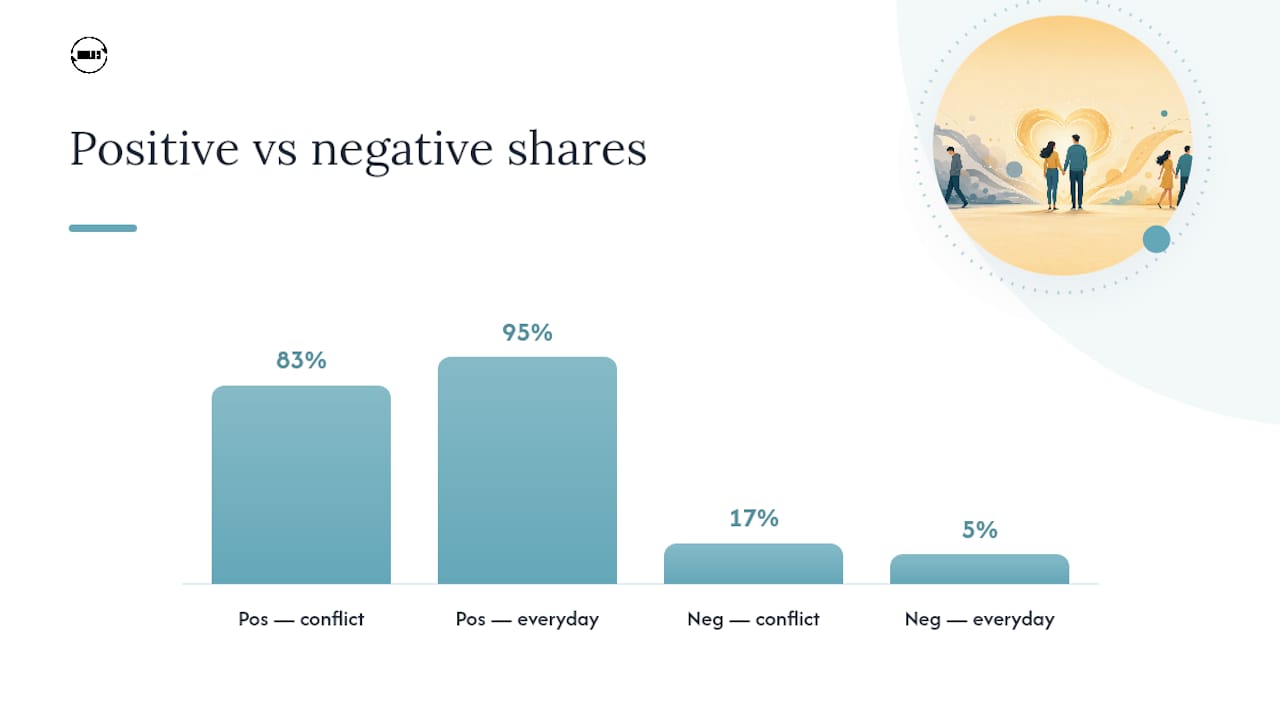
This isn't about faking positivity or avoiding necessary friction. It's about making sure the background hum of your daily interaction, the glances, comments, small favors, tips toward warmth rather than neutral or negative by default.
Three daily gratitude practices make this concrete:
- Specific appreciation. Instead of "thanks for dinner," try "thank you for remembering I don't like cilantro, that's the kind of thing that makes me feel taken care of."
- A short gratitude note. A sticky note on the bathroom mirror or a two-line text midday costs almost nothing and lands surprisingly well.
- A gratitude journal prompt. Once a week, each partner writes down one thing the other did that they appreciated, then shares it out loud.
Beyond formal gratitude, small micro-behaviors add up fast: an unexpected compliment, offering to handle a chore without being asked, a moment of shared humor when the day has been rough. None of these take more than a few seconds, but they're the raw material of the 20:1 ratio.
If you want to check whether you're trending in the right direction, try a simple week-long count. Keep a tally, even a rough one on your phone, of positive versus negative or neutral interactions each day. Most couples are surprised by what they find, either that they're doing better than they thought, or that negativity has crept in more than they'd noticed. Either way, the count itself tends to shift behavior, because you start noticing opportunities for positivity you'd otherwise let pass.
Active Constructive Responding: Celebrating Good News Well
How you respond when your partner shares good news predicts intimacy more reliably than how you respond to bad news. That's the core finding from Shelly Gable's research on "capitalization," the process of sharing positive events with someone else.
Gable's research identifies four response styles. Active constructive responses are enthusiastic and engaged: "That's amazing, tell me everything." Passive constructive responses are supportive but low-energy: "That's nice." Active destructive responses find the downside: "Are you sure that's a good idea?" Passive destructive responses ignore the news entirely and change the subject.
Only active constructive responding is associated with higher intimacy and longer relationship stability. The other three styles, even the ones that aren't outright hostile, tend to leave the sharing partner feeling subtly dismissed, even when nothing overtly negative was said.
Three prompts make active constructive responding easier to practice:
- Ask one specific follow-up question before offering any opinion of your own.
- Mirror their energy level, if they're excited, let your voice and face show it too.
- Save any concerns or practical caveats for a separate conversation, later.
Try a two-minute role-play once a week: one partner shares a real or invented piece of good news, and the other practices responding across all four styles, then discusses which one felt best to receive. Most couples find this exercise a little awkward at first and genuinely useful by the second try. It surfaces habits, like reflexively pointing out problems, that neither partner realized had become the default.
Physical Affection and Sexual Communication That Builds Closeness
Physical affection outside the bedroom predicts satisfaction inside it. A Psychology Today review of behaviors linked to relationship and sexual satisfaction found that small, consistent affectionate acts, not grand romantic gestures, create the strongest bonding cycles over time.
Build a few non-sexual rituals into your daily rhythm:
- A hug held for a full 20 seconds, long enough for your nervous system to actually register it, rather than the reflexive three-second squeeze.
- A real kiss goodbye in the morning instead of a distracted peck.
- A handhold ritual, on the couch, in the car, during a walk, that isn't tied to any particular occasion.
Sexual communication tends to be harder for couples to initiate than physical affection, mostly because of timing and fear of rejection. A few adjustments help. Bring it up outside the bedroom, during a calm moment, not right before or after sex. Ask permission to raise the topic: "Can I bring up something about our sex life? I want us both to enjoy it more." Use curious language rather than critical language: "What's something you'd like more of?" lands very differently than "You never initiate."
Pro Tip: If a direct conversation feels too exposed, try writing down one thing you'd like more of and one thing you appreciate, then trade notes. Some couples find it easier to be honest on paper first.
Novelty and Shared Meaning: Why Third Spaces and New Experiences Matter
Psychologist Arthur Aron's self-expansion theory explains a pattern many couples notice but rarely name: relationships feel most alive when partners are growing and learning together, not just coexisting. Novel shared activities reactivate the same brain chemistry associated with early romantic attraction, which is why a new experience together tends to feel more energizing than a rehearsed date night formula. A 2026 ISSPR synthesis of evidence-based relationship tactics backs this up: small, regular novelty consistently outperforms rare, expensive gestures.
Third spaces, settings outside home and work where couples build shared identity, are worth deliberately seeking out. Consider these options:
- Take a class together in something neither of you already knows, pottery, a language, swing dancing.
- Explore a new neighborhood or town on a weekend morning with no set agenda.
- Cook a cuisine neither of you has made before, together, mistakes included.
- Volunteer for a cause you both care about but haven't acted on yet.
Pair novelty with rituals that reinforce shared meaning over the longer term. A one-week novelty plan might mean picking a single new activity, even something as modest as a different walking route or an unfamiliar restaurant, and trying it together. A quarterly ritual checklist might include revisiting your relationship goals, marking an anniversary with genuine reflection rather than routine, or starting a new tradition tied to a season or holiday. Neither plan needs to be elaborate. The goal is regularity, not scale.
Conflict Repair and Managing Stress: Recovering Faster After Hard Moments
Repair attempts, not the absence of conflict, separate couples who thrive from couples who stagnate. That's a consistent clinical observation reported in Psychology Today, and it reframes conflict itself: the fight isn't the problem. What happens in the ten minutes after the fight is.
Three ready-to-use repair scripts:
- Apology script: "I said that badly. What I meant was..." Own the delivery before you re-explain the point.
- Humor script: A light, well-timed joke that doesn't minimize the issue, said in the right tone, can break tension without dismissing the concern.
- Validation script: "I can see why that upset you, even if I didn't mean it that way." Validation doesn't require agreement, just acknowledgment.
Starting a hard conversation gently matters as much as repairing it afterward. A soft startup means raising an issue with "I" statements and specific observations rather than blanket criticism: "I felt overlooked when the plans changed without a heads-up" lands differently than "You never think about me." If a conversation escalates, a time-out works only if both partners agree in advance on how long it lasts and commit to returning to the topic, not using the break to avoid it permanently.
Watch for what Gottman research calls the Four Horsemen: criticism, contempt, defensiveness, and stonewalling. Each has a counter. Criticism becomes a specific complaint. Contempt gets replaced with genuine appreciation, even in small doses. Defensiveness gives way to taking responsibility for one small part of the issue. Stonewalling gets interrupted by a self-soothing break rather than a wall of silence.

Before any hard conversation, run a quick stress spillover checklist: Am I bringing frustration from work or elsewhere into this? Have I eaten, slept, and had a moment to decompress? Am I ready to actually listen, or just to be heard? A tool like the one Dewycounselling outlines for daily emotional regulation can help build this check into a habit rather than an afterthought.
Pro Tip: If you notice contempt creeping into your tone, eye-rolling, sarcasm, mockery, pause the conversation entirely. Contempt is the strongest predictor of relationship breakdown in Gottman's research, and it needs to be named and stopped, not argued past.
Individual Wellbeing: Why Your Own Habits Shape the Relationship
Partners who manage their own stress and mental health show up more reliably for each other. That finding, summarized by a psychologist in Men's Journal, points to something couples often overlook: relationship work isn't only relational. A depleted, exhausted, under-slept partner has less capacity for patience, curiosity, or repair, no matter how many scripts they've memorized.
A handful of individual habits directly expand relational capacity:
- Consistent sleep, since sleep deprivation reliably increases irritability and reduces emotional regulation.
- Regular exercise, which lowers baseline stress reactivity.
- Individual therapy or counseling for unresolved personal issues that otherwise spill into the relationship.
- Hobbies and interests pursued independently, not as a couple, which keep each partner's sense of self intact.
Separate friendships matter more than most couples realize. A partner who is someone's entire social world tends to build quiet resentment over time, even when both people love each other. Maintaining outside friendships and interests isn't a sign of distance; it's what allows two people to keep choosing each other rather than simply depending on each other. Autonomy and connection aren't opposites here. They're partners.
If you want a structured starting point for building these habits, Dewycounselling's emotional wellness checklist breaks individual routines into specific, trackable steps rather than vague self-care advice.
When to Seek Professional Help and What Couples Therapy Involves
A few concrete signals suggest it's time to bring in a professional rather than continuing to troubleshoot alone:
- Satisfaction has been declining for more than three months with no clear turnaround.
- The same fight repeats without resolution, and repair attempts consistently fail or get rejected.
- Trust has been broken, through infidelity, dishonesty, or a major betrayal, and neither partner knows how to rebuild it alone.
- One or both partners feel emotionally checked out, avoiding conversation rather than engaging in conflict.
- Differing life goals, about children, finances, or where to live, have stalled into gridlock.
Two evidence-based approaches show up consistently in effective couples work. Gottman Method-informed therapy draws on decades of observational research into what stable couples actually do differently, focusing on communication patterns, conflict repair, and building shared meaning. Emotionally Focused Couples Therapy (EFCT) works from attachment theory, helping partners identify the underlying fears and needs driving their conflict cycles rather than just the surface argument. Dewycounselling's guide to emotionally focused therapy explains how that approach unfolds in practice.
Preparing for a first session helps you get more out of it. Come with a rough sense of what you each want to change, not a scripted list of grievances. Ask a prospective therapist about their approach, how they handle sessions where one partner is more vocal than the other, and how they help couples set concrete goals rather than open-ended "communicate better" targets. A PMC review of relationship interventions supports the broader evidence that structured, communication-focused therapy produces measurable improvement, not just temporary relief. Dewycounselling's overview of why couples seek therapy covers these signals and outcomes in more depth.
Three Clinician-Tested Exercises Worth Trying This Week
These exercises draw on the same research covered throughout this guide, adapted into short, repeatable practices.
- Speaker-listener exercise (10 minutes, three times a week). One partner speaks for two minutes uninterrupted. The listener summarizes what they heard before responding. Swap roles.
- Gratitude practice (2 minutes nightly). Each partner names one specific thing the other did that day, with detail, not a general "thanks for everything."
- Repair attempt script (as needed). When a conversation gets tense, one partner says, "Can we pause? I want to get this right." Then use the apology, humor, or validation script that fits the moment.
Track these for two weeks. A good sign of progress isn't the absence of conflict, it's faster recovery after conflict and more moments of turning toward each other without thinking about it. Dewycounselling's practical communication exercises offer additional scripts if you want to keep building from here.
| Point | Details |
|---|---|
| Practice consistency | Ten minutes of speaker-listener practice, three times weekly, builds the habit faster than occasional long talks. |
| Track your ratio | Aim for a rough sense of five positive interactions per negative one during tense weeks. |
| Repair fast | Use an apology, humor, or validation script within the same day rather than letting tension carry overnight. |
Why Couples Give Up Too Early on Good Habits
Most couples abandon a new habit, gratitude notes, daily check-ins, within two weeks, right before it would have started to feel automatic. Progress here is rarely dramatic. It looks like slightly faster recovery after an argument, or a bid noticed that would have gone unanswered a month earlier. Consistency, not intensity, is what actually moves the needle.
Ready for Guided Support? Here's What Couples Counselling Looks Like
Practicing these habits on your own works for many couples, but some patterns, entrenched resentment, a breach of trust, or a conflict cycle that repeats no matter how many scripts you try, benefit from a trained third party in the room. That's the gap couples counselling is built to close.

Dewycounselling offers couples counselling both online and in person, which means you can start this week regardless of your schedule or location. Sessions draw on Gottman-informed and Emotionally Focused Therapy approaches, the same evidence base referenced throughout this guide, tailored to your specific patterns rather than a generic script. This fits couples at any stage: those managing a specific rupture, those who've drifted into routine disconnection, or those who simply want a structured space to build the habits covered here with support.
A first session typically involves each partner sharing their perspective, identifying the patterns that keep repeating, and setting concrete, specific goals rather than vague ones like "communicate better." If you're ready to move past self-directed effort, book an initial session with Dewycounselling and come with one clear example of a recent conflict or disconnect you'd like to work through together.
Frequently Asked Questions
How long does it take to increase relationship satisfaction using these strategies? Small shifts in tone and connection often show up within days of consistent practice. Measurable change in overall satisfaction typically takes a few weeks, and habits like turning toward bids or repairing conflict faster tend to compound the longer they're practiced.
What's the single highest-leverage habit to start with? Turning toward bids for connection tends to have the broadest impact, since it touches nearly every daily interaction. Pairing it with a fast repair habit after conflict covers both the everyday and the hard moments.
Can these strategies work if only one partner is trying? One partner practicing positivity, active listening, and repair attempts can shift the relationship's overall tone, but lasting change usually requires both partners engaged, especially for entrenched patterns like the Four Horsemen. When effort feels one sided for months, that's often a signal couples counselling could help.
Is couples therapy only for relationships in crisis? No. Many couples seek guidance to strengthen a relationship that's stable but stagnant, or to build skills like active constructive responding and soft startups before small issues become major ones. Preventive counselling is common and often more effective than crisis intervention.
This article is general information, not a substitute for advice from a qualified doctor. Consult a qualified healthcare professional about your own circumstances before acting on anything here.
Sources
- PMC article on relationship processes (open access)
- ISSPR blog — 'Relationship satisfaction: 15 evidence-based tips' (2026)