
Emotional regulation is defined as the ability to fully experience emotions without being controlled by them. Most people treat it as a crisis skill, something to reach for only when things fall apart. The truth is that you can improve emotional regulation daily through small, consistent habits that build real resilience over time. Techniques like cognitive reappraisal, emotional granularity, and micro-interventions are not reserved for therapy offices. They belong in your morning routine, your lunch break, and your commute home. This guide gives you the evidence-based tools to make that happen.
What daily habits support better emotional regulation?
The foundation of daily emotional management is not a single practice. It is a set of lifestyle conditions that make regulation possible in the first place. Think of it like soil before planting: without the right conditions, even the best techniques will not take root.
Sleep is the most underrated factor. When you are sleep-deprived, the amygdala (the brain's threat-detection center) becomes significantly more reactive, making it harder to pause before responding. Nutrition and hydration follow closely. Blood sugar crashes and dehydration both amplify emotional reactivity, often before you even notice what is happening.

Physical activity is one of the most clinically supported tools available. Regular exercise of 15–30 minutes per session, at least 3 times per week, leads to sustainable emotional regulation improvements. That is a manageable commitment, and the payoff extends well beyond mood.
Structure also matters more than most people expect. A predictable daily routine reduces the number of micro-decisions your brain has to make, which preserves cognitive and emotional resources for moments that actually need them. Limiting digital overload, especially in the first and last hour of your day, reduces cognitive clutter that feeds emotional reactivity.
| Daily habit | Emotional benefit |
|---|---|
| 7–9 hours of sleep | Reduces amygdala reactivity and emotional volatility |
| 15–30 min of exercise, 3x/week | Builds sustained emotional resilience |
| Consistent meal and hydration schedule | Stabilizes mood and reduces irritability |
| Morning and evening screen limits | Lowers cognitive overload and anxiety |
| Predictable daily structure | Preserves emotional resources for high-stakes moments |
Pro Tip: Set a single "anchor habit" each morning, like making coffee or a short walk, and attach your emotional check-in to it. Consistency with one anchor builds the habit faster than trying to overhaul your whole day at once.
How do you build emotional awareness through daily practice?
Emotional awareness, or the ability to notice and name what you are feeling, is the entry point for all regulation. You cannot manage what you cannot identify. The clinical term for this skill is emotional granularity, and it is more powerful than it sounds.
Precisely labeling emotions reduces their physiological intensity and improves your ability to regulate them. Instead of saying "I feel bad," you might say "I feel embarrassed and a little afraid." That specificity creates a cognitive gap between the emotion and your reaction to it. The emotion does not disappear, but it loses some of its grip.
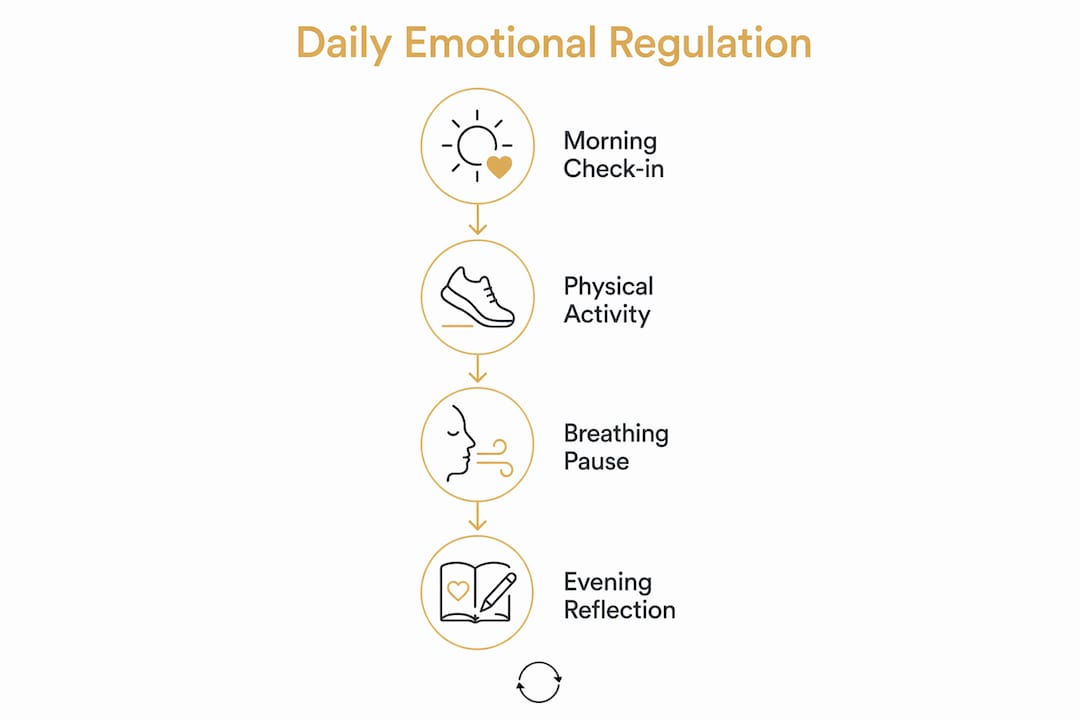
A daily mood check-in is the most practical way to build this skill. Research recommends a 14-day trial of daily noticing and naming exercises, with most people noticing meaningful shifts by day 4 or 5. That is a short investment for a skill that pays dividends for years.
Here is a simple five-step daily awareness practice you can start today:
- Pause for 60 seconds at a consistent time each day, ideally tied to an existing habit like your morning coffee or a midday meal.
- Scan your body for physical sensations: tension in your shoulders, tightness in your chest, or a heavy feeling in your stomach.
- Name the emotion precisely. Move beyond "stressed" or "fine." Try words like "apprehensive," "resentful," "relieved," or "deflated."
- Note the trigger. Ask yourself what happened in the last hour or two that might be connected to this feeling.
- Write it down. Even one sentence in a notes app counts. Externalizing the emotion reinforces the naming process.
Pro Tip: Keep a short emotion vocabulary list on your phone. When you do your check-in, scroll through it. Seeing the words often surfaces feelings you would have otherwise labeled as just "off."
What micro-interventions prevent emotional escalation?
Micro-interventions are brief, targeted practices that interrupt an emotional spiral before it takes hold. They work because they create a gap between stimulus and response, giving you a moment of conscious choice rather than automatic reaction.
Habit stacking, attaching 1–2 minute interventions to existing daily routines, increases long-term consistency more reliably than scheduling separate practice sessions. You do not need a new block of time. You need a new behavior attached to something you already do.
The 3-Breath Pause is the simplest entry point. When you feel a spike of irritation, anxiety, or frustration, stop and take three slow, deliberate breaths before responding. 72% of employees experience burnout at some point, and micro-interventions like this one disrupt emotional spirals early, before they compound into something harder to manage.
The 4-4-8 breathing pattern goes one step further. Inhale for 4 counts, hold for 4, exhale for 8. This breathing technique signals safety to the nervous system and activates vagal regulation, the body's built-in brake for the stress response. It takes under two minutes and can be done at your desk, in your car, or before a difficult conversation.
Cognitive reappraisal is the third essential tool. Reappraisal reduces negative emotions without the hidden costs of suppression, which tends to amplify emotional intensity over time. In practice, reappraisal means asking yourself: "Is there another way to see this situation?" A tense email from a colleague becomes "they may be under pressure" rather than "they are attacking me."
Here is a quick-reference list of micro-interventions for different daily scenarios:
- Work stress: 3-Breath Pause before replying to a tense message
- Social tension: Step away for 90 seconds and do 4-4-8 breathing before re-engaging
- Morning anxiety: Write one sentence naming your current emotional state before checking your phone
- Afternoon slump: A 10-minute walk to reset your nervous system
- Evening rumination: Cognitive reappraisal journaling: write the thought, then write one alternative interpretation
Pro Tip: Stack your 3-Breath Pause onto a habit you already do multiple times a day, like unlocking your phone or sitting down at your desk. The repetition builds the reflex faster than you expect.
How do you stay consistent when emotional regulation feels hard?
Consistency is where most people struggle, not because the practices are difficult, but because life interrupts them. You forget. You feel awkward. You have a bad week and decide the whole effort was pointless. These are normal parts of building any new skill, and they do not mean you are failing.
Self-compassion breaks the stress cycle by treating self-kindness as a necessary part of emotional recovery, not a reward for doing everything right. Harsh self-criticism after a setback actually perpetuates the stress cycle, making the next emotional spike harder to manage. When you miss a day or react poorly, the most productive response is to acknowledge it without judgment and return to your practice.
Tracking your progress makes a real difference. You do not need a formal system. A simple daily tag in a notes app, one word describing your emotional state, gives you visible data over time. After two weeks, patterns emerge. You start to see which situations reliably trigger you, and which practices actually help.
| Challenge | Strategy | Benefit |
|---|---|---|
| Forgetting to practice | Habit stack onto an existing anchor | Removes reliance on willpower |
| Feeling awkward or self-conscious | Start with private journaling before any verbal practice | Builds confidence without social pressure |
| Losing motivation after a setback | Apply self-compassion: acknowledge, then return | Breaks the self-criticism stress cycle |
| Unsure if it is working | Track daily emotional tags for 14 days | Creates visible progress data |
| Feeling too busy | Shrink the practice to 60 seconds | Maintains the habit even on hard days |
Self-care practices for mental health work best when they are treated as maintenance, not medicine. The goal is not to eliminate difficult emotions. It is to build the capacity to move through them without losing your footing.
Pro Tip: Set a weekly five-minute review, not to grade yourself, but to notice what worked. Celebrating small wins builds the intrinsic motivation that keeps the habit alive long after novelty wears off.
Key Takeaways
Improving emotional regulation daily requires consistent small practices, not dramatic overhauls, and the most effective approach combines lifestyle foundations, emotional awareness, and brief micro-interventions applied consistently over time.
| Point | Details |
|---|---|
| Lifestyle is the foundation | Sleep, exercise, and structure create the conditions where regulation techniques actually work. |
| Name emotions precisely | Emotional granularity reduces intensity and creates the cognitive gap needed for conscious response. |
| Use micro-interventions daily | The 3-Breath Pause and 4-4-8 breathing interrupt spirals before they escalate. |
| Self-compassion sustains progress | Treating setbacks with kindness breaks the stress cycle and keeps the habit alive. |
| Track to stay motivated | A simple daily emotional tag reveals patterns and makes progress visible over two weeks. |
What I have learned from watching people build this skill
The most common misconception I see is that emotional regulation is about staying calm. People come in expecting to learn how to feel less. What they actually discover is that the goal is to feel more clearly, with enough space between the feeling and the reaction to make a real choice.
What consistently surprises people is how quickly the small practices add up. The 3-Breath Pause feels almost too simple to matter. But after two weeks of stacking it onto an existing habit, it becomes reflexive. That reflex is the whole point. You are not fighting your emotions. You are building a relationship with them that gives you more say in what happens next.
I also want to name something that does not get said enough: consistency matters far more than perfection. The people who make the most progress are not the ones who practice flawlessly. They are the ones who return to the practice after missing three days, without making it mean something terrible about themselves. Self-compassion therapy is not a soft add-on to emotional regulation work. It is the mechanism that makes long-term change possible.
Emotional regulation is a lifelong skill, not a problem you solve once. The daily habits described here are not a temporary fix. They are the ongoing practice of becoming someone who responds to life rather than just reacts to it. That shift is worth every awkward moment and every missed day along the way.
— Wayne Dewhurst
How Dewycounselling supports your emotional regulation practice
Self-directed practice builds a strong foundation, and professional support accelerates it. A trained therapist helps you identify the specific patterns, triggers, and histories that make your emotional responses feel so automatic and hard to shift.

At Dewycounselling, individual, couples, and family therapy sessions are designed to complement exactly the kind of daily practices covered here. Whether you are working through persistent anxiety, relational tension, or emotional reactivity that keeps showing up in the same situations, professional counselling provides the structured support that makes daily habits stick faster and go deeper. Dewycounselling also offers psychotherapy services in mobile and in-person formats, so access is not a barrier. Reach out when you are ready.
FAQ
What is emotional regulation?
Emotional regulation is the ability to experience emotions fully without being controlled by them. It is a learnable skill built through consistent daily practice, not a fixed personality trait.
How long does it take to see results from daily emotional regulation practice?
Most people notice meaningful shifts within 4–5 days of consistent practice. A 14-day trial of daily noticing and naming exercises is recommended to see the full effect.
What is the best breathing technique for emotional regulation?
The 4-4-8 breathing pattern (inhale 4 counts, hold 4, exhale 8) activates vagal regulation and signals safety to the nervous system, making it one of the most effective tools for calming an emotional spike quickly.
Does cognitive reappraisal actually work?
Cognitive reappraisal reduces negative emotions without the hidden costs of suppression. It works by shifting the interpretation of a situation rather than pushing the emotion away.
When should I consider therapy for emotional regulation?
Therapy is worth considering when daily practices feel insufficient, when emotional reactivity is affecting your relationships or work, or when you want structured, personalized support to accelerate your progress.