
Emotions are critical psychological and physiological responses that shape mental health by influencing how you think, behave, and experience the world around you. The role of emotions in mental health extends far beyond simply feeling happy or sad. Unmanaged emotional states drive anxiety, depression, and a range of mood disorders that affect millions of people globally. Mental disorders account for 1 in 6 years lived with disability worldwide, and severe conditions can shorten a person's lifespan by 10 to 20 years. Understanding how emotions work is not just reassuring. It is the first step toward doing something meaningful about your well-being.
How does emotional regulation influence mental health?
Emotion regulation is defined as the set of processes people use to influence which emotions they have, when they have them, and how they experience and express those emotions. These processes can be adaptive, like cognitive reappraisal, or maladaptive, like expressive suppression. The distinction matters enormously for long-term mental health outcomes.

A meta-analysis of 188 studies involving more than 11,000 cases and 9,600 controls found large effect sizes for impaired emotion regulation across major psychiatric diagnoses. Effect sizes ranged from 0.94 in bipolar disorder to 2.55 in borderline personality disorder. That range tells a clear story: emotion regulation deficits are not unique to one condition. They are a shared vulnerability across the mental health spectrum.
This is why clinicians increasingly treat emotion regulation as a transdiagnostic target. Rather than designing separate interventions for each disorder, therapists can address the underlying regulatory deficits that fuel multiple conditions at once. Two strategies receive the most research attention:
- Cognitive reappraisal: Reframing how you interpret an emotionally charged situation. For example, viewing a job rejection as feedback rather than failure.
- Expressive suppression: Hiding or inhibiting emotional expression. This strategy tends to increase physiological arousal and reduce social connection over time.
Cognitive reappraisal consistently produces better outcomes than suppression. People who use it regularly report lower rates of depression and anxiety, stronger relationships, and greater life satisfaction.
Pro Tip: Keep a brief daily log of which emotion regulation strategy you used in a stressful moment. Tracking patterns over two weeks often reveals whether you default to suppression without realizing it.
The clinical implication is direct: improving how you regulate emotions improves mental health outcomes across diagnoses. Therapy that targets these skills, such as psychotherapy services that integrate cognitive and emotional approaches, addresses the root mechanism rather than just the surface symptoms.
What is the link between emotional awareness and mental well-being?
Emotional awareness is the ability to recognize, name, and understand your own feelings as they arise. Low emotional awareness is a reliable risk factor for anxiety and depression. People who cannot identify what they feel often cannot respond to it effectively, which allows distress to accumulate unchecked.
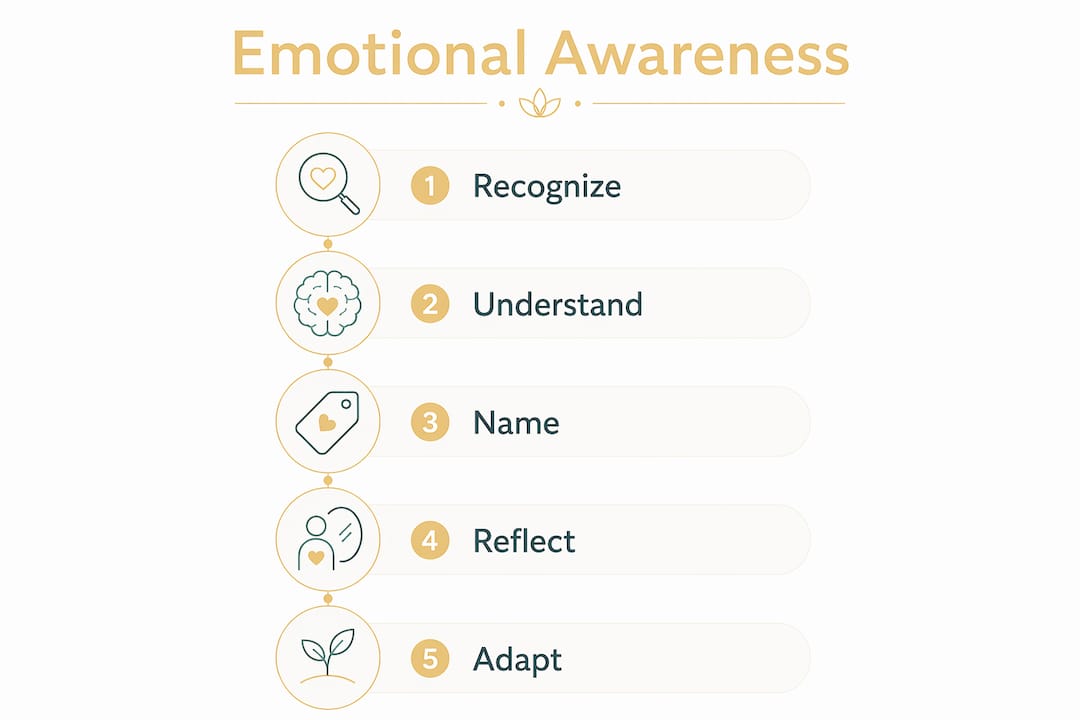
Emotion regulation flexibility, the ability to adapt your regulatory strategy based on context and goals, is more critical to well-being than using any single strategy consistently. Flexibility associates with better daily mood and less distress than rigid, uniform strategy use. This finding challenges the popular idea that there is one "correct" way to handle difficult emotions.
What does flexibility look like in practice? Consider these contrasting responses to the same stressor, a difficult conversation with a family member:
- A rigid responder always suppresses emotion to keep the peace, regardless of the situation.
- A flexible responder might use acceptance in the moment, then cognitive reappraisal later when reflecting on the exchange.
The flexible responder adapts the tool to the task. That adaptability is what mental health research now identifies as a hallmark of genuine psychological well-being, not just the absence of symptoms.
Practical self-monitoring supports this flexibility. Pausing to ask "What am I feeling right now, and what does this situation actually call for?" builds the habit of matching your response to the moment rather than reacting automatically.
Pro Tip: When you notice a strong emotion, try naming it with precision. Instead of "I feel bad," say "I feel ashamed" or "I feel frustrated." Research on affect labeling shows that precise naming reduces emotional intensity and supports clearer thinking.
Mental health through emotional awareness is not a passive process. It requires active attention, honest self-reflection, and a willingness to sit with discomfort long enough to understand it.
How do emotions physically affect your body and mind?
Emotions do not stay inside your head. They move through your entire body, triggering hormonal, cardiovascular, and immune responses that accumulate over time. Chronic negative emotions like anger and hostility trigger biological responses that impair cardiovascular health, including blood vessel stiffening and raised blood pressure. These are not abstract risks. They are measurable physical changes driven by emotional states.
Positive emotional states work in the opposite direction. People who regularly experience gratitude, connection, and meaning show lower rates of chronic disease and stronger immune function. The link between emotional health and physical longevity is well established.
"Mental disorders are among the leading causes of disability worldwide, and the emotional burden they carry extends directly into physical health outcomes." — World Health Organization, 2026
The table below contrasts the physical effects of chronic negative versus positive emotional states:
| Emotional State | Physical Effect |
|---|---|
| Chronic anger or hostility | Blood vessel stiffening, elevated blood pressure |
| Persistent worry or anxiety | Disrupted immune function, elevated cortisol |
| Regular gratitude and connection | Reduced inflammation, stronger immune response |
| Sustained meaning and purpose | Lower chronic disease risk, improved longevity |
The neurobiological mechanism behind these effects involves the hypothalamic-pituitary-adrenal (HPA) axis, which governs the body's stress response. Chronic emotional distress keeps this system activated, flooding the body with cortisol and adrenaline. Over time, that sustained activation damages tissue and suppresses immune defenses. Managing emotional health is, in a very real sense, managing physical health.
What practical strategies support emotional well-being?
Emotional well-being does not emerge from avoiding difficult feelings. It develops through deliberate practice across several domains. The strategies below are grounded in current research and clinical application.
-
Move your body regularly. Leisure-time physical activity significantly mediates the relationship between depression, anxiety, and mental well-being. Even moderate activity, like a 30-minute walk, produces measurable reductions in emotional distress. Physical movement is one of the most accessible and well-supported tools available.
-
Name your emotions with precision. Vague emotional awareness produces vague results. Labeling feelings specifically, moving from "I feel off" to "I feel rejected," activates the prefrontal cortex and reduces the intensity of the amygdala's alarm response. This is sometimes called affect labeling, and it is a core skill in many evidence-based therapies.
-
Practice cognitive reappraisal. When a situation triggers a strong reaction, pause and ask whether a different interpretation is possible. This is not about denying reality. It is about finding a perspective that is both accurate and less emotionally destructive.
-
Channel difficult emotions into meaningful action. Emotional sublimation, the process of directing painful feelings into purposeful activity, is a key marker of thriving rather than merely surviving. Grief channeled into advocacy, anger redirected into creative work, or fear transformed into careful planning are all examples of sublimation in action.
-
Seek authentic human connection. Human-to-human presence remains irreplaceable for deep emotional healing. AI-based wellness tools can offer structure and psychoeducation, but emotional integration requires the kind of authentic, unpredictable connection that only real relationships provide.
- Build at least one relationship where you can speak honestly about your emotional experience without editing yourself.
- Limit passive social media consumption, which tends to increase social comparison and emotional dysregulation.
- Use self-help modules as a complement to human support, not a replacement for it.
Pro Tip: Schedule one "emotional check-in" conversation per week with someone you trust. Consistency matters more than length. Even a 10-minute honest exchange builds the relational foundation that supports long-term emotional resilience.
Key takeaways
Emotion regulation is the single most cross-cutting factor in mental health, affecting outcomes across every major psychiatric diagnosis and every dimension of physical well-being.
| Point | Details |
|---|---|
| Regulation is transdiagnostic | Impaired emotion regulation appears across all major psychiatric disorders, making it a universal therapeutic target. |
| Flexibility beats rigid strategy | Adapting your regulation approach to each situation produces better mood and less distress than using one strategy always. |
| Emotions affect physical health | Chronic negative emotions cause measurable cardiovascular and immune damage; positive states reduce disease risk. |
| Awareness is the foundation | Naming emotions precisely reduces their intensity and opens the door to more effective regulation. |
| Human connection is irreplaceable | Deep emotional healing requires authentic interpersonal relationships, not technology alone. |
Emotions are more complex than "positive" and "negative"
One thing I have noticed working with people across a wide range of life experiences is that the biggest obstacle to emotional well-being is rarely a lack of information. Most people know they should manage stress better or talk about their feelings more. The real barrier is the belief that difficult emotions are problems to be eliminated rather than signals to be understood.
The research on emotional flexibility confirms what I see in practice. Rigid positivity, forcing yourself to reframe every painful experience as a growth opportunity, can be just as harmful as chronic suppression. There are moments when grief deserves to be grief. Anger sometimes carries important information about a boundary that has been crossed. The goal is not to feel good all the time. The goal is to respond to what you actually feel with enough skill and self-compassion that you can keep moving forward.
I also think the mental health field has been slow to communicate how deeply emotions affect the body. People come in managing what they think is a purely psychological problem, and they are often surprised to learn that their chronic headaches, disrupted sleep, or persistent fatigue have a direct emotional component. The dual continuum model of mental health, which treats positive well-being as a separate and buildable dimension rather than just the absence of illness, gives people something to work toward rather than just something to avoid.
The most durable emotional resilience I have seen comes from people who learn to sit with discomfort long enough to understand it, then act from that understanding rather than from the discomfort itself. That takes practice, support, and often a skilled guide.
— Wayne
Professional support for your emotional health and mental wellness
Knowing that emotions shape mental health is one thing. Building the skills to work with them effectively is another, and that process moves faster with the right support.

Dewycounselling offers individual, couples, and family therapy designed to help you develop real emotion regulation skills, not just manage symptoms. Whether you are dealing with anxiety, depression, or relationship stress, the team at Dewycounselling provides both online and in-person sessions tailored to where you are right now. For those who prefer a self-guided starting point, structured video modules offer a practical introduction to emotional awareness and regulation at your own pace. Healing is not a solo process. Dewycounselling is here to walk through it with you.
FAQ
What is the role of emotions in mental health?
Emotions directly shape mental health by influencing thoughts, behaviors, and physical well-being. Chronic emotional dysregulation is a core feature of conditions like depression, anxiety, bipolar disorder, and borderline personality disorder.
How does emotional regulation affect mood disorders?
Impaired emotion regulation appears across all major psychiatric diagnoses, with effect sizes ranging from 0.94 in bipolar disorder to 2.55 in borderline personality disorder, making it a primary therapeutic target.
Can physical activity improve emotional well-being?
Leisure-time physical activity significantly mediates the relationship between depression, anxiety, and mental well-being, offering a measurable protective effect even at moderate levels of exercise.
What is emotion regulation flexibility?
Emotion regulation flexibility is the ability to adapt your regulatory strategy based on the demands of a specific situation. Research shows it associates with better daily mood and less distress than applying any single strategy rigidly.
Why is human connection important for emotional healing?
Authentic interpersonal connection provides the unpredictable, responsive presence that emotional integration requires. Technology and self-help tools can support the process, but they cannot replace the depth of real human relationships.
Recommended
- Professional Counselling Services | Online & In-Person Therapy
- Self-help Modules with High-Quality Video Classes - Self-Discovery Journey — DEWY COUNSELLING
- Mobile Psychotherapy Services - Counselling Burlington Ontario — DEWY COUNSELLING
- Counselling & Therapy Services | Dewy Counselling Burlington — DEWY COUNSELLING