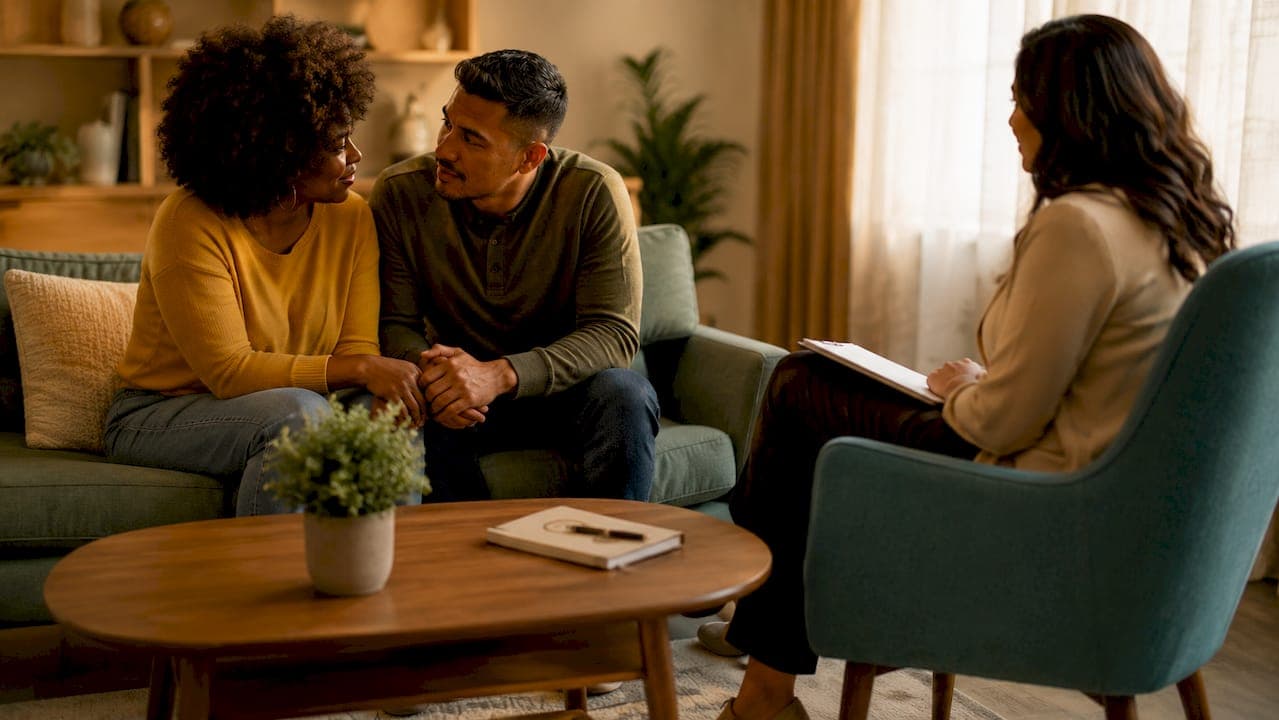
Relationship counselling is defined as a form of psychotherapy that helps partners improve their connection through structured communication, conflict resolution, and emotional understanding. The clinical term used by therapists is couples therapy, and both terms describe the same guided process. At Dewycounselling, this work centers on helping you and your partner break unhealthy patterns, rebuild trust, and develop skills that last well beyond the therapy room. Approaches like Emotionally Focused Therapy (EFT) and the Gottman Method give therapists proven frameworks to guide that process. Counselling applies to married couples, dating partners, and any committed relationship facing strain.
What is relationship counselling and what does it actually do?
Relationship counselling is a therapeutic process where a trained therapist helps two partners examine and change the patterns that keep them stuck. Think of a relational wound the way you would a physical injury. You would not ignore a broken bone and hope it heals on its own. The same logic applies to recurring arguments, emotional distance, or broken trust. A therapist provides the structure to treat the wound directly rather than working around it.
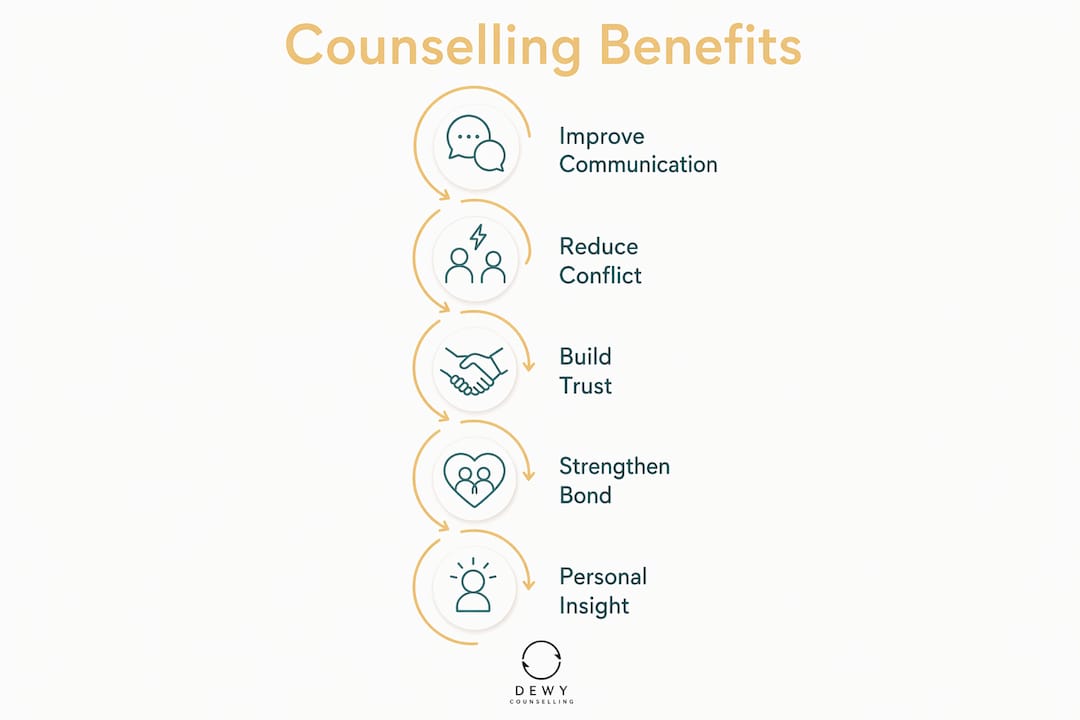
The core goals are consistent across approaches: improve communication, reduce destructive conflict, and strengthen emotional bonds. Counselling is not about proving who is right or wrong. As experts emphasize, the real work is developing new conflict skills that move partners beyond the same circular arguments they have been having for years. That shift alone changes the entire dynamic of a relationship.

Counselling applies at every relationship stage, not only during crisis. Pre-marital couples use it to build a strong foundation. Long-term partners use it to navigate major life transitions like parenthood, career changes, or loss. The breadth of its application is one reason couples therapy has grown into a recognized clinical specialty with its own evidence base and training standards.
What are the key benefits of relationship counselling?
The benefits of relationship counselling are well documented, and they extend far beyond simply "talking things out." Structured therapy produces measurable changes in how partners communicate, handle disagreements, and feel toward each other.
The most cited benefits include:
- Improved communication: Partners learn to express needs clearly and listen without defensiveness.
- Conflict resolution skills: Therapy replaces reactive arguments with structured, productive dialogue.
- Rebuilt emotional connection: Couples report feeling closer and more understood after working through underlying emotional needs.
- Trust repair: After betrayal or infidelity, a therapist provides a safe space to process the relational wound and decide a path forward.
- Preventative strength: Counselling at all relationship stages builds resilience before problems become crises.
The clinical evidence behind EFT is particularly strong. EFT produces significant improvement for 70–75% of couples, with effects that hold over time. That figure means roughly three out of four couples who commit to EFT leave therapy in a measurably better place than when they arrived.
Counselling also helps individuals within the relationship. When one partner gains insight into their own attachment patterns or emotional triggers, the entire relationship benefits. You do not need to be in crisis to gain from this process. Couples who seek support early tend to resolve issues faster and with less accumulated pain.
How does relationship counselling work?
The structure of couples therapy follows a clear progression, though the exact format varies by therapist and method. Understanding what to expect removes much of the anxiety around starting.
- Initial intake session: Both partners attend together. The therapist gathers background on the relationship, identifies the presenting concerns, and explains their approach.
- Individual interviews (when applicable): Some therapists conduct individual sessions after the intake to build a fuller picture of each partner's history. Not all therapists use this format, and protocols vary.
- Ongoing joint sessions: The bulk of therapy happens with both partners present. The therapist acts as a neutral facilitator, not an arbitrator. Their role is to create a safe space for honest exchange, not to take sides.
- Between-session exercises: Therapists often assign practical homework, such as communication exercises or reflection prompts, to reinforce what is practiced in the room.
- Review and closure: As goals are met, sessions taper. The therapist and couple assess progress and plan for maintaining gains independently.
Session duration is typically 50–60 minutes, occurring weekly. Overall therapy lasts anywhere from 3 to 12 months, or roughly 8–20 sessions for EFT-based work. That range reflects the reality that some couples address a specific issue quickly, while others work through deeper, longer-standing patterns.
The therapist's neutral role is one of the most misunderstood aspects of the process. Many couples arrive expecting the therapist to validate one partner's position. Effective therapists resist that pull entirely. Their job is to help both partners feel heard and to guide the conversation toward understanding, not verdict.
Pro Tip: If you feel your therapist consistently sides with your partner, name it directly in session. A skilled therapist will use that observation as material. If the imbalance continues, finding a better fit is not failure. It is good clinical judgment.
What are common techniques used in relationship counselling?
Therapists draw from several well-researched methods, and most practitioners blend approaches based on what a couple needs. The three most widely used frameworks are EFT, the Gottman Method, and Cognitive Behavioral Therapy (CBT) adapted for couples.
Emotionally Focused Therapy (EFT)
EFT focuses on attachment needs. The premise is that most relationship conflict stems from unmet needs for security, closeness, and reassurance. The therapist helps partners identify the emotional cycle driving their arguments and express the vulnerable feelings underneath reactive behavior. EFT's 70–75% improvement rate makes it one of the most evidence-supported approaches in the field.
The Gottman Method
The Gottman Method targets specific communication behaviors. It teaches partners to build "love maps," which are detailed knowledge of each other's inner world, and to recognize what researchers call the "four horsemen": criticism, contempt, defensiveness, and stonewalling. The Gottman Method gives couples concrete tools to interrupt harmful patterns before they escalate.
Cognitive behavioral approaches
CBT-informed couples therapy focuses on identifying and changing dysfunctional thought patterns that fuel conflict. If one partner automatically interprets silence as rejection, CBT helps them examine that assumption, test it against evidence, and replace it with a more accurate interpretation. This approach pairs well with communication exercises for couples that build new habits between sessions.
Therapists tailor these approaches to each couple's specific needs. A couple navigating infidelity needs a different focus than a couple preparing for marriage. The method matters less than the fit between the approach, the therapist, and the two people in the room.
What signs indicate you might need relationship counselling?
Recognizing the right time to seek support is itself a form of self-awareness. Couples often wait far longer than they should, hoping things will improve on their own.
Common signs that counselling for couples would help include:
- Recurring arguments with no resolution: The same fight happens repeatedly, and neither partner feels heard afterward.
- Communication breakdown: Conversations regularly end in silence, withdrawal, or escalation rather than understanding.
- Emotional disconnection: You feel more like roommates than partners, with little warmth or intimacy between you.
- Betrayal or infidelity: Trust has been broken, and you are unsure whether repair is possible without professional guidance.
- Major life transitions: A new baby, job loss, relocation, or illness has shifted the relationship's equilibrium and created new friction.
- One partner wants to leave: Discernment counseling, a specific short-term format, helps couples decide whether to work on the relationship or separate with clarity.
Pro Tip: You do not need a crisis to start therapy. Couples who seek support while the relationship is still functional tend to make faster progress than those who wait until they are in acute distress.
Counselling does have limits. In situations involving violence or coercive control, joint therapy is not appropriate. Safety planning and individual support take priority. A responsible therapist will screen for these dynamics and refer accordingly. Understanding why couples seek therapy at different stages can help you recognize where you stand before your first session.
Key Takeaways
Relationship counselling works because it gives partners a structured, evidence-based process to change the patterns that damage connection and build the skills that sustain it.
| Point | Details |
|---|---|
| Clear definition | Relationship counselling is psychotherapy that improves communication, resolves conflict, and strengthens emotional bonds. |
| Strong evidence base | EFT produces significant improvement for 70–75% of couples, with lasting results. |
| Structured process | Sessions run 50–60 minutes weekly, with therapy lasting 3–12 months depending on the couple's needs. |
| Not only for crisis | Counselling builds relationship strength at any stage, not just when a relationship is failing. |
| Therapist fit matters | A strong therapeutic alliance predicts better outcomes; changing therapists when rapport is absent is encouraged. |
Why I think waiting is the most expensive mistake couples make
The most common thing I hear from couples who finally start therapy is some version of "We should have done this years ago." They are not wrong. By the time most couples seek help, they have spent months or years in the same painful loop, accumulating resentment and slowly eroding the goodwill that holds a relationship together.
There is a persistent misconception that seeking counselling signals weakness or that the relationship is beyond saving. The opposite is true. Asking for help is the clearest sign that you still value what you have built together. Couples who enter therapy with genuine investment, even if one partner is more reluctant than the other, consistently make meaningful progress.
I also want to be direct about something most articles avoid: therapy is not a guarantee. Not every relationship benefits equally, and not every couple is ready to do the work the process requires. A therapist cannot want the relationship more than the people in it. What therapy does guarantee is clarity. You will leave with a better understanding of yourself, your partner, and what the relationship actually needs, regardless of the outcome.
The therapeutic alliance between you and your therapist is not a soft variable. It is one of the strongest predictors of outcome in the research. If you do not feel safe, understood, or respected by your therapist after a few sessions, find someone else. That is not giving up. That is protecting the process.
— Wayne Dewhurst
Dewycounselling offers couples counselling that meets you where you are
Dewycounselling provides professional couples counselling online and in person, designed for partners who are ready to do the real work of improving their relationship. Whether you are navigating a specific crisis or simply want to build a stronger foundation, the approach is evidence-based and tailored to your situation.
Sessions draw on proven methods including EFT and the Gottman Method, delivered by therapists who prioritize your comfort and progress equally. Both online and in-person options are available through Dewycounselling's psychotherapy services, making it easier to fit support into your life. Taking the first step is often the hardest part. Reaching out to Dewycounselling puts a trained professional in your corner from session one.
FAQ
What is the difference between relationship counselling and couples therapy?
Relationship counselling and couples therapy describe the same clinical process. Both involve a trained therapist helping partners improve communication, resolve conflict, and strengthen their emotional connection.
How long does relationship counselling take to show results?
Most couples notice meaningful change within 8–20 sessions. EFT-based therapy typically runs over 3–12 months, with session frequency and duration adjusted as progress develops.
Can relationship counselling help after infidelity?
Yes. Counselling provides a structured, safe space to process betrayal, rebuild trust, and decide together whether repair is possible. A therapist guides both partners through the emotional complexity without taking sides.
Do both partners have to attend every session?
Most couples therapy is conducted with both partners present. Some therapists conduct individual sessions early in the process to gather personal history, but joint sessions form the core of the work.
Is relationship counselling only for couples in crisis?
No. Therapy is a tool for relationship health at any stage. Couples use it to prepare for marriage, navigate life transitions, and strengthen bonds well before any crisis develops.