
The most effective things you can do right now to improve communication with your partner are also the simplest: pause before you speak, listen to understand rather than respond, and schedule a weekly check-in. These three habits, backed by therapists and supported by clinical research, address the root of most communication breakdowns before they compound into something harder to repair.
Here are four immediate steps you can take today:
- Use a soft startup. Begin a sensitive conversation with "I feel..." rather than "You always..." to lower your partner's defensiveness before it rises.
- Practice active listening. Reflect back what you heard before offering your own view: "What I'm hearing is..." gives your partner the experience of being understood.
- Take a 5-second pause. Before responding to something that stings, breathe slowly for five seconds. That brief window interrupts the fight-or-flight reflex and gives you a choice about how to respond.
- Schedule a weekly check-in. Set aside 20–30 minutes once a week to talk without distraction, using a simple prompt: "What's one thing that felt good this week, and one thing I'd like us to talk about?"
Pro Tip: If you notice your heart rate climbing or your thoughts racing before a conversation, self-soothe first. Splash cold water on your face, take five slow breaths, or step outside briefly. Speaking from a regulated state matters more than finding the perfect words.
If conversations regularly end in shutdown, stonewalling, or one partner feeling unsafe, these exercises are still worth trying, but pairing them with professional support will get you further, faster.
Key Takeaways
The most effective way to improve communication with your partner is to combine short daily practices, a weekly structured check-in, and a clear repair sequence, applied consistently over two to six weeks.
| Point | Details |
|---|---|
| Start with one exercise | Pick one practice (the 5-second pause, NVC, or daily appreciation) and track it for two weeks before adding more. |
| Regulate before you speak | Self-soothing before a hard conversation matters more than choosing the right words. |
| Validate before solving | Reflecting and validating your partner's experience before problem-solving prevents most escalations. |
| Repair attempts work | Simple gestures and honest acknowledgment of harm repair ruptures faster than waiting for the perfect apology. |
| Dewycounselling | When patterns repeat despite effort, couples counseling at Dewycounselling provides facilitated repair and real-time skill training. |
What communication exercises for couples actually work?
Therapist-backed exercises work best when they are short, repeatable, and low-stakes enough that both partners will actually do them. The goal is not a single breakthrough conversation but a series of small, consistent practices that build a new relational habit over time.
Daily practices (5–10 minutes)
These three micro-practices are easy to start this week, according to practical guides for couples:
- The appreciation micro-practice. Each morning or evening, tell your partner one specific thing you noticed and appreciated. Not "you're great" but "I noticed you made coffee before I woke up, and it meant a lot." Specificity is what makes appreciation land.
- The single-sentence check-in. At the end of the day, each partner answers one question: "On a scale of 1–10, how are you feeling right now, and what's one word for why?" No problem-solving, no advice. Just presence.
- The 5-second pause. Before responding to anything that triggers a reaction, pause for five full seconds. This is not silence as punishment; it is a deliberate reset.
Weekly routine: the state-of-the-union
Set aside 30 minutes once a week. The structure is simple: each partner shares two appreciations, then one issue they'd like to address. The rule is that the listening partner does not respond to the issue until the speaker has finished and feels heard. Therapist-backed techniques consistently recommend this kind of structured weekly ritual because it prevents small frustrations from accumulating into resentment.

Two structured exercises with scripts
1. The speaker-listener technique
This exercise slows conversation down enough that both partners experience being heard.
- Decide who speaks first (the "speaker") and who listens (the "listener").
- The speaker talks for 2–3 minutes on one topic, using "I" statements only.
- The listener reflects back: "What I heard you say is... Did I get that right?"
- The speaker confirms or gently corrects.
- Switch roles.
2. The NVC (Nonviolent Communication) micro-practice
Nonviolent Communication, developed by Marshall Rosenberg, gives couples a four-part sentence structure for expressing needs without blame:
"When [specific observable event], I feel [emotion], because I need [underlying need]. Would you be willing to [specific request]?"
Example: "When our plans change at the last minute, I feel anxious, because I need some predictability in my week. Would you be willing to give me a heads-up by noon when something shifts?"
Practice this structure once a day on a low-stakes topic before using it for harder conversations. Most couples find it awkward at first; that awkwardness fades after about two weeks of use.
Pro Tip: Start with one practice only. Trying three new exercises simultaneously tends to feel like homework and leads to both partners quietly dropping all of them. Pick the one that feels most natural, track it for two weeks, then add a second.
How do you hold a difficult conversation without it escalating?
The short answer: prepare your nervous system before you prepare your words. Compassionate communication practitioner Michelle Becker emphasizes that the speaker's physiological state matters more than perfectly chosen words. A calm body produces a calm tone, and tone is what your partner's nervous system responds to first.
The four-step model she outlines, centering, curiosity, connection, and compassion, gives you a practical sequence to follow.
Step-by-step: how to prepare and hold a hard talk
-
Center yourself first. Before the conversation, spend two to five minutes in a grounding practice: slow breathing, a short walk, or a body scan. Your goal is to lower your heart rate and access your prefrontal cortex rather than your threat-response system.
-
Choose the right moment. Ask your partner: "Is now a good time to talk about something that's been on my mind?" Timing matters. A conversation started when one partner is hungry, exhausted, or mid-task rarely goes well.
-
Open with a soft startup. Lead with your experience, not your partner's behavior. Use the XYZ structure: "When you did X in situation Y, I felt Z." This keeps the opening factual and personal rather than accusatory.
-
State your need clearly. After describing your experience, name what you actually need: "What I'm hoping for is..." Many arguments persist because both partners are reacting to each other's behavior without ever naming the underlying need.
-
Listen with reflection. When your partner responds, use reflective listening: paraphrase what you heard before adding your own perspective. Validate their experience even when you see it differently: "That makes sense that you felt that way, given what you were going through."
-
Validate before problem-solving. Resist the urge to fix the issue before your partner feels understood. Validation is not agreement; it is acknowledgment. Skipping this step is the single most common reason couples feel unheard even after long conversations.
-
Agree on a small next step. End with one concrete, manageable action: "Can we agree to try X for the next week and check in on how it's going?"
Pro Tip: When a conversation starts going sideways, use a repair attempt immediately. Something as simple as "I don't want to fight about this" or a light touch on the arm signals that you value the relationship more than winning the point. Repair attempts work best when they are accepted, so practice receiving them as generously as you offer them.
A short callout worth holding onto: nonverbal signals, your tone, facial expression, and body posture, carry more emotional weight than the content of what you say. If your words say "I'm listening" but your arms are crossed and your eyes are on your phone, your partner's nervous system registers the body language, not the words.
Why does communication get so hard, and what can you do about it?
Most couples don't struggle to communicate because they lack vocabulary or intelligence. They struggle because conversations trigger physiological responses that make clear thinking genuinely difficult. Understanding this isn't just reassuring. It's the first step toward doing something about it.
Common barriers that derail connection
- Reactivity. When you feel criticized or dismissed, your body activates a stress response. Heart rate rises, thinking narrows, and the part of your brain responsible for empathy and nuance goes offline temporarily.
- Mismatched communication styles. One partner processes emotions by talking; the other needs quiet time first. Neither approach is wrong, but without awareness, they collide.
- Poor timing. Conversations started when one or both partners are tired, hungry, or already stressed tend to escalate faster and resolve less.
- Unresolved history. Old wounds resurface in new arguments. A comment about dishes can carry the weight of a year of feeling unappreciated.
- Mental health stressors. Anxiety, depression, and chronic stress all affect how people hear and respond to their partners. If your partner is navigating depression, what sounds like withdrawal may be a symptom, not a rejection.
The physiology of escalation
When a conversation triggers a threat response, the body enters fight, flight, or freeze mode. Breathing shallows, muscles tighten, and the capacity for nuanced listening drops. Research on emotion regulation and interpersonal functioning supports the idea that practicing self-regulation skills outside of conflict makes them more accessible during it. You cannot learn to self-soothe in the middle of an argument; you build that capacity beforehand.
Practical de-escalation techniques
CISA's de-escalation guidance outlines micro-techniques that translate directly to intimate conflict:
- Controlled breathing. Slow your exhale to twice the length of your inhale (breathe in for 4 counts, out for 8). This activates the parasympathetic nervous system within 60–90 seconds.
- Grounding. Name five things you can see, four you can hear, three you can touch. This pulls attention out of the threat-response loop and back into the present moment.
- Pause and reframe. Step away from the conversation for 20 minutes minimum (not two minutes). Research suggests it takes roughly 20 minutes for physiological arousal to return to baseline after a stress spike.
Statistic: A 2024 survey found that approximately 65% of therapists named communication problems as the most common presenting issue among couples seeking therapy, making it the leading reason couples seek professional help.
Pro Tip: Learn your own early warning signs before a conversation escalates: a tight jaw, a rising voice, a sudden urge to leave the room. When you notice one of those signals, name it out loud: "I'm starting to feel flooded. Can we take a short break and come back in 20 minutes?" That sentence alone can prevent an argument from becoming a rupture.
Small daily habits that make good communication easier
Good communication is less about what you say during a hard conversation and more about the relational climate you build between conversations. Small, consistent habits create the emotional safety that makes honest dialogue possible.
Micro-habits worth adopting
- Daily appreciation. One specific, genuine appreciation per day. Spoken aloud, not texted. The specificity signals attention; the spoken delivery signals presence.
- Device-free windows. Designate 30 minutes each evening, or during dinner, as phone-free time. Undivided attention is a form of respect that many couples have quietly stopped offering each other.
- Single-sentence check-ins. "How are you, really?" asked once a day and genuinely listened to costs almost nothing and builds a steady sense of being known.
- Physical connection. A 6-second kiss, a hand on the shoulder, a brief hug before leaving for work. Physical touch activates the bonding hormone oxytocin and signals safety to the nervous system.
When to do them
Morning works well for appreciation and brief check-ins, when the day hasn't yet accumulated its friction. Evening works for the device-free window and the longer check-in. The exact timing matters less than the consistency. University of Michigan HR guidance for couples recommends building communication habits around existing routines rather than carving out separate time, which reduces the chance of skipping them.
Pro Tip: Pair a new communication habit with something you already do every day, a practice called habit stacking. If you always make coffee together in the morning, use that two minutes for one appreciation each. If you always watch something together at night, make the first five minutes phone-free. The habit piggybacks on the existing routine and becomes automatic faster.
Short practice routines to build your communication muscle
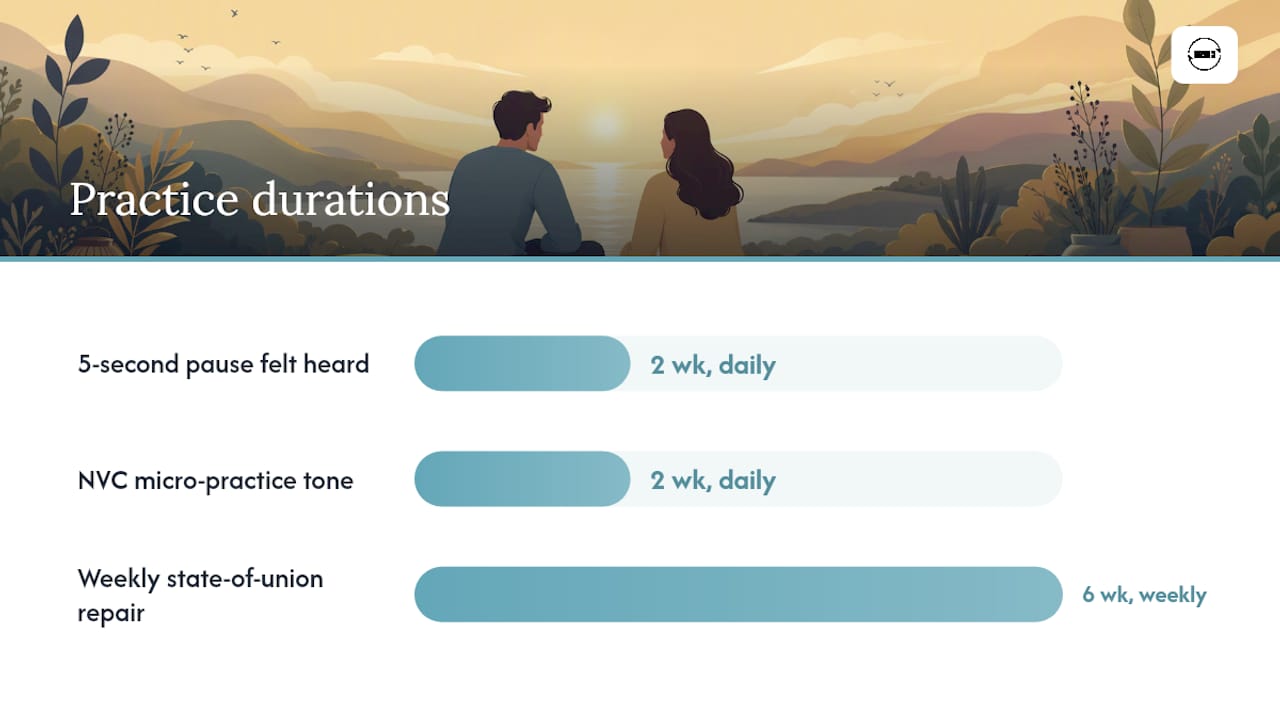
Clinicians often recommend committing to one practice for a defined window before deciding whether it's working. Short experiments, two to six weeks, give you enough data to assess benefit without requiring a long-term commitment to something that may not fit your dynamic.
Two 2-week experiments
Experiment 1: The 5-second pause + reflection Each time you feel a reactive urge to respond, pause for five seconds, then reflect back what your partner said before adding your own view. Track how often you used the pause and how the conversation felt afterward (a simple 1–5 "felt heard" rating works well).

Experiment 2: NVC micro-practice Once per day, express one need or observation using the four-part NVC structure. Start with low-stakes topics. Track whether your partner's responses feel more collaborative over the two weeks.
One 6-week routine: the weekly state-of-the-union
Commit to a 30-minute weekly check-in for six weeks. Each session follows the same structure: two appreciations each, then one issue per partner. After six weeks, structured skill training is associated with measurable improvements in couple functioning in clinical studies, so the timeline is not arbitrary.
| Practice | Duration | Frequency | What to track |
|---|---|---|---|
| 5-second pause + reflection | 2 weeks | Daily, in real conversations | "Felt heard" rating (1–5) after each talk |
| NVC micro-practice | 2 weeks | Once daily, low-stakes topics | Partner's response tone; your comfort with the structure |
| Weekly state-of-the-union | 6 weeks | Once weekly, 30 minutes | Repair attempt count; unresolved issues carried forward |
When to scale up or switch: if after two weeks a practice feels mechanical or is creating more tension, adjust the format rather than abandoning the goal. Sometimes the NVC structure feels too formal; a simpler "I feel X when Y" works just as well. The structure is a scaffold, not a script.
Pro Tip: Track your own experience, not your partner's performance. Noting "I used the pause three times this week" is useful data. Noting "my partner only reflected back twice" turns the exercise into a scorecard, which undermines the safety you're trying to build.
How do you repair communication after repeated breakdowns?
Repeated breakdowns leave a residue. Each unresolved argument adds a thin layer of guardedness, and over time that guardedness becomes the default relational posture. Repair is possible, but it requires a deliberate sequence rather than hoping the next good day will reset things.
The repair sequence
- Acknowledge the harm. Name specifically what happened and its impact: "I know I shut down during that conversation, and I imagine that felt like I didn't care. I did care. I just didn't know how to stay present."
- Offer a genuine apology. A real apology names the behavior, acknowledges the impact, and does not include "but." "I'm sorry I raised my voice. That wasn't fair to you."
- Make a specific repair request. Ask what your partner needs to feel the rupture is addressed: "What would help you feel better about what happened?" Then listen without defending.
- Run a small experiment. Agree on one concrete change for the next week. Keep it small and specific so success is achievable: "This week, I'll ask before I give advice."
Do's and don'ts of repair
- Do accept a repair attempt even when you're still hurt. Accepting is not the same as forgiving immediately; it signals that the relationship is worth protecting.
- Do use simple gestures: a touch, a "I don't want us to be like this," a shared laugh. These are legitimate repair attempts.
- Don't use an apology as a way to end the conversation before your partner feels heard.
- Don't bring up past grievances during a repair attempt. One issue at a time.
- Don't wait for the "right moment" to repair. The longer a rupture sits unaddressed, the more it calcifies.
Verywell Mind's conflict management guidance recommends returning to a conversation after a time-out rather than letting it drop, which is the difference between a repair and an avoidance.
Pro Tip: When your partner makes a repair attempt, even an awkward one, try to receive it. Say "thank you for trying" if you're not ready to fully engage yet. That small acknowledgment keeps the door open.
When does couples therapy actually help?
Therapy helps most when patterns repeat despite genuine effort, when one or both partners feel emotionally unsafe, or when progress stalls and the same argument cycles back every few weeks. At that point, self-guided exercises remain useful, but a skilled therapist provides something exercises alone cannot: a facilitated, safe space where both partners can be heard simultaneously, and where the therapist can interrupt escalation patterns in real time.
About 65% of therapists identify communication problems as the most common reason couples seek help. That figure suggests most couples wait longer than they need to. Therapy is not a last resort; it is a resource that works best when engaged before patterns become entrenched.
What therapy provides
- Facilitated repair. A therapist can hold space for both partners to speak and be heard without the conversation collapsing into reactivity.
- Communication skill training. Approaches like Emotionally Focused Therapy and structured couples counseling teach the same skills covered in this article, but with real-time feedback and professional guidance.
- Safety building. When trust has eroded, a therapist helps establish the psychological safety that makes honest communication possible again.
- Pattern interruption. Therapists are trained to notice the cycle, not just the content of arguments, and to help couples step out of it.
Common therapy approaches
- Couples counseling focuses on communication skills, conflict resolution, and relationship goals.
- Emotionally Focused Therapy (EFT) works with attachment patterns and emotional responses underlying communication difficulties.
- Skill-based approaches (such as the Gottman Method) teach structured exercises and repair techniques within a therapeutic framework.
For a fuller picture of what each approach involves, the types of couples therapy guide walks through the differences clearly.
A short checklist for choosing a therapist
- Ask whether the therapist has specific training in couples work (not just individual therapy).
- Ask what model or approach they use and how it applies to communication difficulties.
- In the first session, notice whether both partners feel heard, not just the one who initiated the booking.
- By session three, you should have at least one concrete skill or exercise to practice between sessions.
- If you don't feel safe or heard by session three, it is reasonable to try a different therapist.
Recognizing signs your relationship needs therapy early makes the decision easier and the outcomes better.
Pro Tip: When booking a first session, tell the therapist your communication goal in one sentence: "We want to be able to disagree without shutting down." That framing helps the therapist structure early sessions around your specific pattern rather than starting from scratch.
What actually shifts when couples do this work
The exercises in this article are genuinely useful, and most couples who practice them consistently will notice a difference within a few weeks. But there is something I observe repeatedly in sessions that no exercise list fully captures: the moment a couple stops trying to win the argument and starts trying to understand the person.
That shift is not automatic. It requires one partner to take a risk, to stay curious when they feel defensive, to ask "what are you actually needing right now?" instead of defending their position. And it requires the other partner to receive that curiosity without suspicion. When both happen at the same time, even briefly, something changes in the room. The tension drops. The conversation slows. People start talking about what actually matters.
What clients often miss in the early weeks is that repair attempts don't need to be eloquent. A hand on the arm, a "I don't want to be fighting about this," a moment of eye contact during a hard conversation, these are legitimate, powerful repair moves. The couples who make the most progress are not the ones who master the NVC script fastest. They are the ones who keep trying to reach each other, imperfectly, consistently.
The daily habits and emotional regulation skills covered here are the foundation. But the real work is relational: choosing, again and again, to stay in contact with your partner rather than retreating into your own defended position.
Dewycounselling supports couples who are ready to go deeper
The exercises here give you a strong starting point. When you want structured support, real-time feedback, and a therapist who can help you both feel heard in the same room, couples counseling at Dewycounselling is the natural next step.

Dewycounselling offers both in-person and online psychotherapy for couples, with sessions designed to build on exactly the kind of communication skills this article covers: soft startups, reflective listening, repair sequences, and the emotional safety that makes all of it possible. Whether you're working through a specific conflict pattern or simply want to strengthen a relationship that already feels good, a therapist can accelerate progress in ways that self-guided practice alone rarely matches. Sessions are available across the U.S. through Dewycounselling's online and in-person therapy options.
If your situation involves safety concerns, please reach out to a crisis line or emergency services before booking a therapy session.
To get started, visit Dewycounselling and book a couples session today.
Sources
These are the primary sources cited in this article, selected for their clinical grounding and practical relevance:
- How to Communicate With Love (Even When You’re Mad)
- How to Communicate Better With Your Partner: 12 Therapist-Backed Techniques | Bondy AI
- 5 Easy Ways To Communicate Better in Your Relationship
- How to Improve Communication Skills in Your Relationship
- Healthy Communication Tips: Managing Conflict in Relationships
- De-Escalation (CISA guidance)
- PubMed entry (related clinical findings)
- PMC article (open access)
This article is general information, not a substitute for advice from a qualified doctor. Consult a qualified healthcare professional about your own circumstances before acting on anything here.