
Supporting a partner through depression means showing up consistently, with patience and compassion, even when progress feels invisible. Depression is a clinical condition, not a mood or a choice, and it responds to professional treatment alongside steady emotional care from loved ones. The person beside you is not withdrawing because they want to. The illness is pulling them inward. Your role is not to fix them but to remain present, encourage professional help, and protect your own well-being in the process. This guide gives you practical tools to do exactly that.
How can you recognize depression's impact on your partner and relationship?
Depression changes behavior in ways that can feel confusing or even hurtful to a partner who does not understand what is happening. Recognizing these changes as symptoms, not personal choices, is the first step toward providing real support.
Common signs that depression is affecting your partner include:
- Withdrawal from conversation and physical affection, even when they previously enjoyed closeness
- Increased irritability or emotional flatness, which can make normal interactions feel tense or distant
- Loss of interest in activities they once found meaningful, including hobbies, socializing, or intimacy
- Disrupted sleep and appetite, which affects energy levels and daily functioning
- Difficulty making decisions or concentrating, which can shift household responsibilities onto you
Depression symptoms like withdrawal or irritability stem from the illness itself, not from dissatisfaction with the relationship. That distinction matters enormously. When you understand that your partner's distance is a symptom, not a statement about you, it becomes easier to respond with empathy rather than defensiveness.
Depression also affects the relationship as a whole. Communication breaks down. Intimacy decreases. Routines that once felt shared can start to feel one-sided. Understanding how depression affects both partners protects the mental well-being of each person in the relationship. The more clearly you see the illness for what it is, the less likely you are to internalize its effects as personal failure.
What small, consistent actions can you take daily to help your partner?
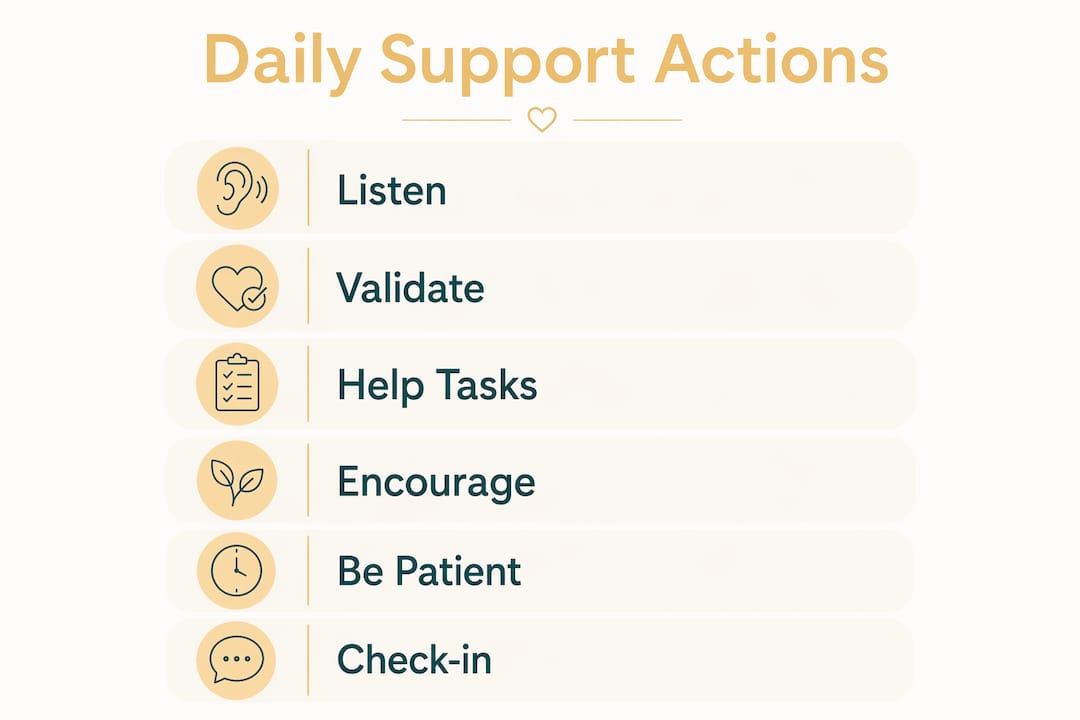
Small, consistent actions are more effective than grand gestures when supporting a partner with depression. A single dramatic act of support rarely moves the needle. What actually helps is showing up the same way, day after day, in ways your partner can count on.
Practical daily actions that make a real difference include:
- Listening without trying to fix. Sit with your partner and let them talk. Resist the urge to offer solutions immediately.
- Validating their feelings. Phrases like "I can see you're struggling" or "That sounds really hard" create emotional safety without minimizing the experience.
- Helping with daily tasks. Cooking a meal, handling a household chore, or picking up groceries removes small burdens that can feel enormous to someone with depression.
- Maintaining gentle routines. Suggesting a short walk or a quiet evening together gives structure without pressure.
- Asking directly what they need. "Would it help if I sat with you?" is more useful than assuming.
- Staying present without hovering. Let your partner know you are available without making them feel watched or managed.
Validation is not the same as agreeing or solving the problem. It simply tells your partner that their feelings are real and that they are not alone. That message, repeated consistently, reduces isolation and builds the emotional safety your partner needs to begin healing.
Pro Tip: Focus on roughly six manageable support actions rather than trying to do everything at once. Selecting a small set of consistent behaviors, as Psychology Today recommends, prevents caregiver fatigue and keeps your support sustainable over time.

How do you encourage your partner to seek professional treatment?
Love and emotional support alone cannot treat the clinical symptoms of depression. This is one of the most important things to accept. Your care matters deeply, but it is not a substitute for therapy, medication, or other clinical interventions. Encouraging your partner to seek professional help is one of the most loving things you can do.
Language matters when raising the topic of treatment. Avoid framing therapy as something broken people need. Instead, position it as a tool that works, the same way physical therapy helps a knee recover after injury.
Phrases that reduce stigma and open the door include:
- "I've noticed you've been struggling, and I want you to have real support."
- "Would you be open to talking to someone who specializes in this?"
- "I'll go with you to the first appointment if that would help."
"Helping someone with depression involves prioritizing their access to professional healthcare, as love and emotional support alone cannot treat the clinical symptoms." — NHS
When your partner is already in treatment, support their adherence. Remind them of appointments without nagging. Offer to drive them. Celebrate small steps, like completing a week of therapy or taking medication consistently. If your partner is resistant to seeking help, couples counseling can be a less threatening entry point, since it frames the conversation around the relationship rather than a personal diagnosis.
Crisis lines and therapy directories are also resources you can explore together. The 988 Suicide and Crisis Lifeline in the U.S. offers guidance not just for people in crisis but for partners who need advice on how to help.
How can you protect your own mental health while supporting your depressed partner?
Caring for a partner with depression takes a real emotional toll. Acknowledging that is not selfish. It is honest, and it is necessary for sustainable support.
Enlisting help from friends, family, and therapists is as powerful and necessary as any direct support you offer your partner. A common mistake is trying to carry everything alone. That path leads to burnout, resentment, and eventually a collapse of the very support system your partner depends on.
Self-care strategies that actually work include:
- Setting realistic limits on what you can provide. You cannot be your partner's therapist, best friend, and caregiver simultaneously without cost.
- Maintaining your own social connections. Isolation compounds caregiver stress. Keep your friendships and outside interests alive.
- Seeking your own counseling. Individual therapy gives you a space to process your experience without burdening your partner.
- Joining a peer support group. Connecting with others who are supporting a loved one with depression reduces the feeling that you are alone in this.
- Scheduling regular time for activities that restore you. Exercise, creative outlets, and rest are not luxuries. They are maintenance.
Pro Tip: If you notice yourself feeling chronically exhausted, resentful, or emotionally numb, those are signs that you need support too. Reaching out to a counselor through mobile psychotherapy services can make professional help more accessible when leaving home feels difficult.
Understanding how depression affects both of you protects the relationship over the long term. You cannot pour from an empty cup, and your partner's recovery benefits from a partner who is also taking care of themselves.
What to do in a crisis: recognizing warning signs and acting fast
Some moments require more than emotional support. Knowing when your partner is in crisis and how to respond can save their life.
Warning signs that indicate a possible suicide risk or severe mental health crisis include:
- Talking about wanting to die or feeling like a burden to others
- Giving away meaningful possessions
- Withdrawing completely from all contact
- Expressing hopelessness about the future with unusual intensity
- Sudden calmness after a period of severe depression, which can indicate a decision has been made
"You do not need to wait for a crisis to occur to contact support. Calling crisis lines yourself can get guidance or help if your partner cannot reach out." — Psychology Today
Contact mental health professionals or emergency resources like the 988 Suicide and Crisis Lifeline immediately if you observe these signs. You can call 988 proactively for guidance even before a crisis fully develops. The line exists for partners and family members too, not only for the person experiencing the crisis.
Do not wait to act out of fear of overreacting. In a genuine emergency, call 911 or take your partner to the nearest emergency room. Remove access to means of self-harm if it is safe to do so. Stay with your partner and speak calmly until help arrives. Preparing a crisis plan with your partner's therapist before an emergency occurs is one of the most practical things you can do right now.
Key Takeaways
Consistent, compassionate support combined with professional treatment gives your partner the strongest foundation for recovering from depression.
| Point | Details |
|---|---|
| Recognize symptoms, not attacks | Withdrawal and irritability are illness symptoms, not reflections of your relationship. |
| Small actions build real support | Daily listening, validation, and task help outperform occasional grand gestures. |
| Professional care is non-negotiable | Emotional support cannot replace therapy or medication. Encourage treatment actively. |
| Protect your own well-being | Enlisting help and setting limits prevents burnout and sustains your support long-term. |
| Act fast in a crisis | Call 988 or emergency services at the first sign of suicide risk. Do not wait. |
What I've learned from watching partners carry this weight
The partners who do this well are not the ones who say all the right things. They are the ones who keep showing up after the hard conversations, after the silence, after the nights when nothing they did seemed to help.
The odds are very high that your partner will get through this bout of depression. Your job is not to cure them. It is to love them through it and keep the relationship intact while they do the work of recovery. That framing takes an enormous amount of pressure off both of you.
What I have seen consistently is that partners who try to do everything alone are the ones who eventually break down. The ones who ask for help, who see a counselor themselves, who lean on their community, those are the ones who sustain their support without losing themselves. There is no medal for suffering in silence, and your partner does not need a martyr. They need someone steady.
Patience is not passive. It is an active choice you make every day to stay present without demanding that your partner recover on your timeline. That kind of love is harder than any grand gesture, and it is exactly what makes the difference.
— Wayne
How Dewycounselling supports partners navigating depression
When one partner is struggling with depression, the entire relationship feels the weight of it. Dewycounselling provides individual and couples therapy designed to help both of you communicate better, set healthy limits, and build the skills that make support sustainable.

Dewycounselling's couples counseling sessions give you and your partner a guided space to work through the relational impact of depression together. For partners who need flexible access to care, self-help modules offer structured, high-quality video content you can work through at your own pace. Weekly podcasts provide ongoing insight and encouragement between sessions. Whether you are looking for one-on-one support or a shared space to rebuild connection, Dewycounselling has a path that fits where you are right now.
FAQ
What does it mean to support a partner through depression?
Supporting a partner through depression means providing consistent emotional presence, helping with daily tasks, and actively encouraging professional treatment. It is not about fixing the illness but about reducing isolation and maintaining connection.
How do I talk to my depressed partner without making things worse?
Use validating phrases like "I can see you're struggling" rather than offering unsolicited advice or minimizing their feelings. Asking directly what kind of support they need is more effective than assuming.
Can my love and support cure my partner's depression?
Love and emotional support cannot treat the clinical symptoms of depression on their own. Professional care, including therapy and sometimes medication, is necessary for clinical recovery.
When should I call a crisis line for my partner?
Call 988 or emergency services immediately if your partner expresses suicidal thoughts, gives away possessions, or shows sudden calm after severe depression. You can also call 988 proactively for guidance before a crisis occurs.
How do I avoid burnout while supporting a depressed partner?
Set realistic limits on what you can provide, maintain your own social connections, and seek individual counseling or peer support. Enlisting help from friends, family, and professionals is as important as the support you give directly.