
A therapy session is a structured, collaborative process where you and a trained therapist explore your thoughts, feelings, and behaviors to support meaningful personal change. Understanding how therapy sessions work before you begin removes a lot of the uncertainty that keeps people from seeking help. Psychotherapy, the clinical term for this practice, is not passive. It requires your active participation, your honesty, and your willingness to engage. Research confirms that the therapeutic alliance accounts for approximately 12% of the variance in successful therapy outcomes. That number tells you something important: the relationship you build with your therapist is one of the most powerful tools in the room.
How therapy sessions work: the basic structure
A standard therapy session typically lasts about 50 minutes and is scheduled weekly, though frequency and length can shift based on your needs and the therapeutic approach your counselor uses. That 50-minute window is not arbitrary. It gives enough time for meaningful exploration without pushing past the point where productive conversation becomes exhausting.
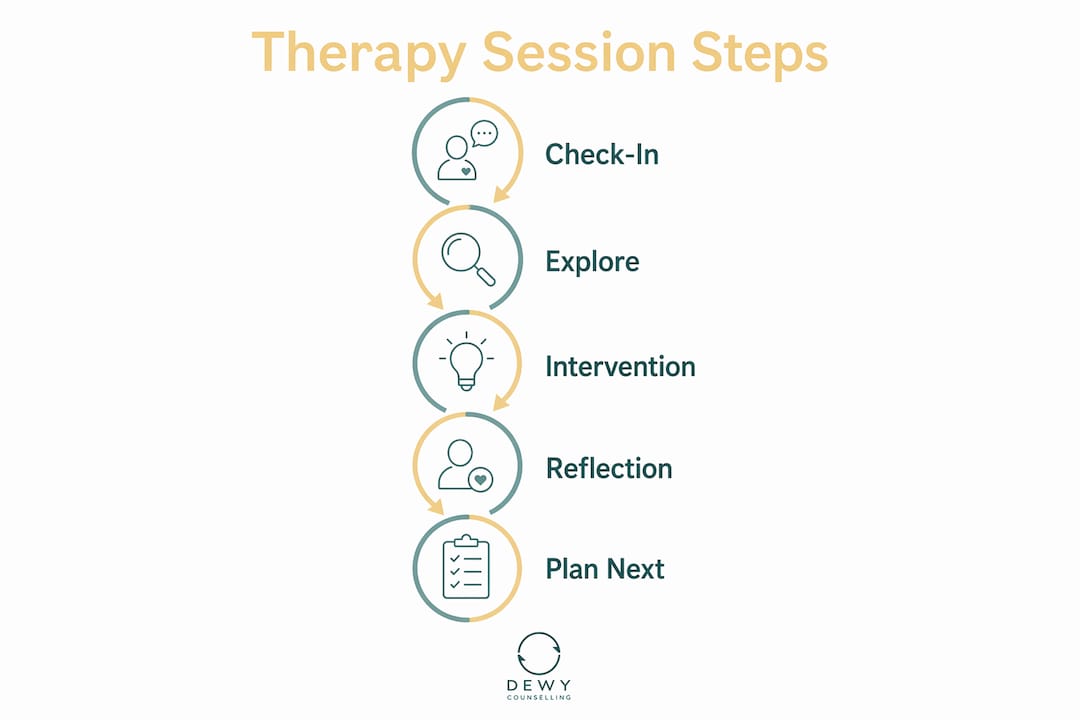
Most sessions follow a recognizable flow, even when the content varies widely:
- Check-in. Your therapist opens by asking how you have been since your last session. This is not small talk. It orients both of you to what is most present for you right now.
- Exploration. You and your therapist dig into the material that surfaces, whether that is a recent conflict, a recurring thought pattern, or an emotion you cannot quite name.
- Intervention. Your therapist introduces a technique, reflection, or reframe to help you process what has come up. This might be a question that shifts your perspective or a skill from a structured approach like Cognitive Behavioral Therapy (CBT).
- Reflection. Near the end of the session, you pause to notice what felt significant. This consolidates the work you did together.
- Planning. Your therapist may suggest something to practice before the next session, a homework task, a journaling prompt, or a mindfulness exercise.
Therapy holds space for all emotional states, including confusion and not knowing where to start. You do not need a perfectly organized problem to bring to your first session. Showing up as you are is enough.
Pro Tip: Write down one or two things on your mind before each session. You do not need a full agenda. Even a single sentence gives you a starting point when the room goes quiet.

Why the therapeutic alliance shapes every outcome
The therapeutic alliance is a dynamic, evolving partnership built on mutual trust, shared goals, and agreement on how you will work together. It is not just warmth or rapport. It has three specific components: the emotional bond between you and your therapist, your shared agreement on therapy goals, and your shared agreement on the tasks used to reach those goals.
"The quality of the client-therapist relationship and agreement on goals and tasks predicts positive change more reliably than any single technique. Therapy is not something done to a client. It is something built with one." Common Factors: Relationship and Structure
The therapeutic alliance accounts for ~12% of variance in therapy outcomes, with the therapist's individual effect adding another 5–9%. Together, these relational factors outweigh the contribution of any specific technique. That means choosing a therapist you feel genuinely comfortable with matters more than finding someone who specializes in a particular method.
One practice that strengthens the alliance is measurement-based care. Tracking your progress concretely through brief check-in questionnaires increases transparency, builds hope, and allows your therapist to adjust the approach when something is not working. It turns therapy from a subjective experience into a shared, data-informed process.
| Alliance component | What it looks like in practice |
|---|---|
| Emotional bond | You feel safe enough to say something uncomfortable |
| Goal agreement | You and your therapist agree on what you are working toward |
| Task agreement | You both accept the methods being used to get there |
| Progress tracking | Regular check-ins show whether the work is moving in the right direction |
What is your role in making therapy work?
Clients are the primary drivers of therapeutic change. Your therapist provides the structure, the skill, and the relationship. But your readiness, engagement, and expectations shape the outcome more than any technique your therapist applies. This is one of the most important things to understand before you begin.
Effective therapy clients tend to share a few common qualities:
- Readiness to change. You do not need to feel fully ready. But a genuine openness to the possibility of change predicts better outcomes than arriving with the goal of proving therapy will not work.
- Active participation. Therapy is not a place to wait for insight to arrive. Asking questions, pushing back, and naming what feels off are all part of the work.
- Realistic expectations. Therapy is a process, not a quick fix. Most people notice meaningful shifts after several weeks of consistent sessions, not after one conversation.
- Engagement with homework. Client resistance to between-session tasks is a consistent predictor of poorer outcomes. Practicing skills outside the session is where much of the real change happens.
- Emotional honesty. Bringing your actual experience, not a polished version of it, gives your therapist accurate material to work with.
Therapy is also a place where you can name what is not working. If a technique feels wrong for you, say so. If you feel misunderstood, raise it. That kind of direct communication does not derail therapy. It deepens it.
Pro Tip: After each session, spend five minutes writing down one thing that stayed with you. This simple habit reinforces what you processed and helps you carry insights into your daily life.
What techniques do therapists use in sessions?
Therapy integrates structured techniques alongside supportive listening, and the specific tools your therapist uses depend on your goals, your history, and what the two of you agree will be most helpful. No single approach works for everyone. A good therapist adapts their methods to fit you, not the other way around.
The most widely used approaches include:
Cognitive Behavioral Therapy (CBT) focuses on identifying and changing unhelpful thought patterns. Sessions involve structured exercises where you examine the connection between thoughts, feelings, and behaviors.
Dialectical Behavior Therapy (DBT) builds skills in four areas: mindfulness, distress tolerance, emotional regulation, and interpersonal effectiveness. It is particularly effective for people who experience intense emotional swings.
Eye Movement Desensitization and Reprocessing (EMDR) is a trauma-focused approach that uses bilateral stimulation, often guided eye movements, to help the brain reprocess distressing memories.
Mindfulness-based approaches teach you to observe your thoughts and feelings without reacting to them automatically. These techniques appear across many therapy styles and are especially useful for anxiety and stress.
| Approach | Best suited for | Core session activity |
|---|---|---|
| CBT | Anxiety, depression, negative thinking | Thought records, behavioral experiments |
| DBT | Emotional dysregulation, self-harm | Skills training, diary cards |
| EMDR | Trauma, PTSD | Bilateral stimulation with memory processing |
| Mindfulness-based | Stress, anxiety, chronic pain | Breathing exercises, body scans |
Therapy is more about a safe, attuned relationship than symptom reduction alone. Techniques work best when they are delivered inside a strong therapeutic alliance. Without that foundation, even the most evidence-based method loses much of its power.
Key Takeaways
Therapy sessions work because they combine a structured process, a strong therapeutic relationship, and active client participation to create the conditions for real, lasting change.
| Point | Details |
|---|---|
| Session structure matters | Most sessions follow a check-in, exploration, intervention, reflection, and planning flow. |
| The alliance predicts outcomes | The client-therapist bond and goal agreement account for roughly 12% of therapy success. |
| Clients drive change | Your readiness, honesty, and engagement shape outcomes more than any single technique. |
| Techniques are tools, not cures | CBT, DBT, and EMDR work best when delivered inside a strong therapeutic relationship. |
| Authenticity beats performance | Showing up as you are, including confused or uncertain, is exactly what therapy is designed for. |
What I have learned from sitting with people in their first sessions
People often arrive at their first therapy session with a quiet fear that they are doing it wrong. They worry they will not know what to say, or that their problems are not serious enough, or that they should have figured this out on their own by now. I want to be direct with you: none of that is true, and therapists know it.
What I have found, both in my own experience and in the research that guides this field, is that the clients who make the most progress are rarely the ones who arrive with the clearest problems. They are the ones who stay curious. They ask questions. They push back when something does not land. They treat therapy as a collaboration rather than a performance review.
The early sessions are not about solving anything. They are about building enough trust that the real work becomes possible. That takes time, and that is completely normal. Expecting a breakthrough in session two is like expecting a physical wound to heal before the inflammation has settled. The process has its own pace, and respecting that pace is part of the work.
Emotional honesty in sessions matters far more than arriving with the right words. If you feel stuck, say you feel stuck. If you feel nothing, say that. Your therapist is not waiting for you to perform insight. They are waiting for you to show up as yourself. That is the only thing that makes the work real.
— Wayne Dewhurst
Dewycounselling is here when you are ready to begin
Deciding to start therapy is a meaningful step, and having the right support makes all the difference. Dewycounselling offers individual, couples, and family therapy through both online and in-person sessions, designed around the collaborative, client-centered approach described throughout this article.

Whether you are working through anxiety, relationship challenges, or simply want to understand yourself better, Dewycounselling's therapists meet you where you are. The process is personalized, the environment is supportive, and the goal is always your growth. You can also explore self-help modules to build skills between sessions. Reach out to Dewycounselling to learn more or book your first consultation.
FAQ
How long does a typical therapy session last?
A standard therapy session lasts approximately 50 minutes and is usually scheduled once per week. Frequency and length can vary depending on your needs and the therapeutic approach being used.
Do I need to know what to talk about before my first session?
No. Therapists expect clients to arrive without a scripted plan or perfectly articulated problems. Showing up with uncertainty or confusion is completely normal and gives the therapist useful information about where you are right now.
What makes therapy actually work?
The therapeutic alliance, meaning the bond between you and your therapist and your shared agreement on goals, accounts for roughly 12% of therapy outcomes. Your own readiness and active participation are equally critical factors.
How is therapy different from just talking to a friend?
A therapist provides structured techniques, clinical training, and a professionally boundaried relationship that a friendship cannot replicate. The session structure, evidence-based methods, and consistent focus on your goals make therapy a distinct and purposeful process.
How many sessions does it take to see results?
Most people notice meaningful shifts after several weeks of consistent sessions, though this varies widely by individual and presenting concern. Engaging with between-session homework and maintaining realistic expectations both accelerate progress.