
How to prepare effectively for your first therapy session
Walking into therapy for the first time is an act of courage. The most effective way to prepare for your first therapy session is to handle the logistics early, clarify what you hope to gain, and arrive with an open mind rather than a rehearsed script. When you take care of the practical details ahead of time, you free up mental space for the conversation that actually matters.
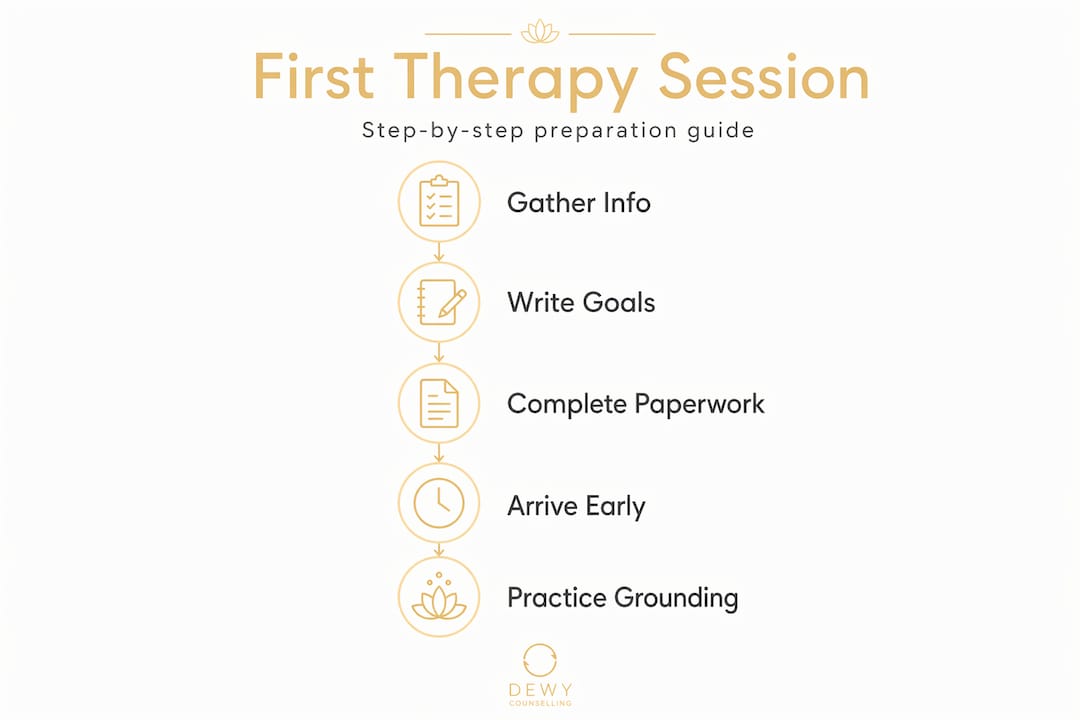
Start by gathering the documents your therapist's office will likely need:
- Your insurance card and any relevant policy information
- A list of current and past medications, including dosages
- Any prior clinical records or referral letters you have on hand
- Your therapist's address, parking details, and contact number
- A notebook for capturing thoughts, questions, or suggestions during the session
Beyond the paperwork, writing down your goals and the topics you most want to address gives the session direction from the start. You don't need a polished agenda. Even a vague sense of what you want to work on helps you and your therapist move forward efficiently. Think of it less as homework and more as a quiet conversation with yourself before the real one begins.
Pro Tip: Arrive 10–15 minutes early if paperwork hasn't been completed online. That buffer keeps you calm and gives you a moment to breathe before the session starts.

What actually happens during the intake process?
The first therapy session is not where breakthroughs happen. Think of it as a structured conversation designed to help your therapist understand who you are, what brought you in, and where you want to go. As the American Psychological Association notes, the first session can feel like a "game of 20 questions," and that framing is worth holding onto so you don't walk out feeling like nothing was resolved.
Here is what you can typically expect:
- Paperwork and consent forms: If you haven't completed intake forms online, you'll fill them out before the session begins. These cover your history, current concerns, and emergency contacts.
- Confidentiality and policies: Your therapist will explain what stays private and the limited exceptions, such as risk of harm, as required under HIPAA regulations.
- Fees and session structure: Therapists clarify fees, session length, and cancellation policies during this first appointment so there are no surprises later.
- Background questions: Expect questions about your family history, sleep, appetite, relationships, and what specifically prompted you to seek help now.
- Goal-setting: Toward the end of the session, you and your therapist will begin sketching out what you hope to accomplish together.
Bringing your medication list and insurance information streamlines this process considerably. The intake is the foundation of your entire therapeutic relationship, not a hurdle to get past. Your therapist is building a picture of your life, and every detail you share, even a small one, adds texture to that picture.
Understanding how therapy sessions work before you arrive can also reduce the uncertainty that makes the first appointment feel daunting.
How do you emotionally prepare for therapy?
Nervousness before a first therapy session is not a sign that something is wrong. It is a sign that you are taking something seriously. The Association for Behavioral and Cognitive Therapies describes the first session as a mutual consultation, meaning you are also evaluating whether this therapist is the right fit for you. That reframe alone can shift the dynamic from "I'm being assessed" to "we're figuring this out together."
A few strategies that genuinely help:
- Journal before the session. Spend 10 minutes writing about what's been weighing on you. You don't need to share what you write; the act of putting words to feelings loosens them up.
- Name your fears. If you're worried about crying, being judged, or not knowing what to say, acknowledge those fears explicitly. They tend to shrink when you look at them directly.
- Let go of the performance pressure. There is no correct emotional response in a first session. Feeling calm, tearful, or even numb are all valid starting points.
- Create a comfortable physical space. If your session is virtual, find a private, quiet room. If it's in person, wear something you feel at ease in.
- Remind yourself of the purpose. Therapy builds self-awareness rather than delivering direct advice, and that process takes time. One session is the beginning, not the whole story.
Pro Tip: If anxiety spikes in the waiting room, try a simple grounding exercise: name five things you can see, four you can hear, and three you can physically feel. It takes under two minutes and genuinely settles the nervous system.
Therapy is a collaborative partnership, and your therapist is trained to guide the conversation. You don't need to arrive with everything figured out. Showing up honestly is enough.
What questions and topics should you bring to your therapist?
Preparation doesn't mean scripting the session. It means arriving with enough clarity to participate actively. Arriving with flexible discussion points rather than a fixed narrative lets the conversation breathe and allows for the kind of authentic sharing that actually moves therapy forward.
Consider preparing around these areas:
- Your primary concern: What is the one thing that, if it changed, would make the biggest difference in your daily life? Start there.
- Recent patterns: Have you noticed changes in your sleep, mood, relationships, or ability to concentrate? These details give your therapist clinical context.
- Your therapy goals: Even a rough answer to "what do I want to feel or do differently?" is more useful than a blank slate.
- Your history with therapy: If you've seen a therapist before, what worked and what didn't? That information helps your new therapist calibrate their approach.
- Questions for your therapist: Don't hesitate to ask about their therapeutic approach, how they typically structure sessions, or how they handle situations where you feel stuck.
Some useful questions to ask your therapist directly include: "What does your approach to therapy look like?" "How will we know if we're making progress?" and "What should I do between sessions if something difficult comes up?" These aren't intrusive. They are the questions of someone who takes their own healing seriously.
Setting boundaries is also part of this preparation. You have the right to say "I'm not ready to talk about that yet," and a skilled therapist will respect that without pushing. Learning about different therapy approaches ahead of time can help you ask more informed questions about what your therapist uses and why.
How do you evaluate your first session and decide what comes next?
The hour after your first therapy session can feel like a lot. Exhaustion is common, and so is a strange mix of relief and vulnerability. The first session often functions more like an assessment than a problem-solving conversation, so feeling like "we didn't fix anything" is not a red flag. It's the expected outcome.
What you're actually evaluating is fit and foundation:
- Did you feel heard? You don't need to feel completely comfortable yet, but a sense that the therapist was genuinely listening matters.
- Did their values seem compatible with yours? The Association for Behavioral and Cognitive Therapies recommends discussing values in the first session, because a significant mismatch in worldview can limit progress.
- Were you able to be at least somewhat honest? Even partial honesty in a first session is a good sign. Full openness usually takes a few sessions to develop.
- Do you have questions or concerns? Bring them to the next session. Therapists expect and welcome feedback, especially early on.
If something felt off, name it. You can tell your therapist directly: "I felt a little guarded when we talked about X" or "I wasn't sure how to answer that question." That kind of transparency is not a complaint. It's the material therapy is made of. And if, after two or three sessions, the fit still feels wrong, it's reasonable to look for someone whose style aligns better with how you process and communicate. Therapy works best when you actively participate and feel genuinely comfortable enough to do so.
For those starting therapy for the first time, reading about what to expect in therapy can make the evaluation process feel less uncertain.
Key Takeaways
Preparing for your first therapy session means handling logistics, clarifying your goals, and arriving with an open and honest mindset rather than a polished performance.
| Point | Details |
|---|---|
| Logistics matter | Bring insurance information, a medication list, and any relevant clinical documents to streamline the intake process. |
| First sessions are assessments | Expect rapport-building and background questions, not immediate problem-solving; exhaustion afterward is normal. |
| Emotional preparation counts | Journaling before the session and releasing the pressure to "perform" vulnerability helps you show up more authentically. |
| Fit is a two-way evaluation | Use the first session to assess whether the therapist's values and approach align with your needs, not just the reverse. |
| Dewycounselling offers a supported start | Dewycounselling provides individual, couples, and family therapy with both online and in-person options for those ready to begin. |
Dewycounselling gives you a supported, personal start to therapy
Starting therapy is one of the most meaningful steps you can take for your mental and emotional health. Dewycounselling offers individual, couples, and family therapy designed to meet you where you are, whether you're working through a specific challenge or simply trying to understand yourself better. Sessions are available both online and in person, so the logistics of getting started don't have to be another source of stress.

What sets Dewycounselling apart is the warmth and clinical depth that each session carries. You won't be handed a generic treatment plan. You'll work with a therapist who takes the time to understand your history, your goals, and the pace at which you're ready to move. If you've read this far and feel ready to take that first step, book your first session with Dewycounselling today. You've already done the hardest part by deciding to begin.