
Psychotherapy is defined as a structured, evidence-based process in which a licensed mental health professional helps you address emotional, behavioral, and relational challenges through talk therapy and skill-building. The major types of psychotherapy explained in clinical practice include Cognitive Behavioral Therapy (CBT), Dialectical Behavior Therapy (DBT), psychodynamic therapy, Acceptance and Commitment Therapy (ACT), and Eye Movement Desensitization and Reprocessing (EMDR). Each approach targets different mental health challenges, from anxiety and depression to trauma and relationship conflict. Evidence-based psychotherapies produce measurable improvement in about 75% of consistent attendees. That figure alone makes understanding your options one of the most practical steps you can take for your mental health.
What are the types of psychotherapy explained for anxiety and depression?
CBT is the most researched form of talk therapy in the world. It works by helping you identify the connection between your thoughts, feelings, and behaviors, then teaching you to challenge distorted thinking patterns that fuel anxiety and depression. When you believe "I always fail," CBT gives you tools to test that belief against real evidence and replace it with something more accurate.

CBT typically requires 6–20 structured sessions, making it one of the shorter commitments in psychotherapy. That time-limited structure appeals to people who want clear goals and measurable progress. Sessions usually last 50 minutes, and your therapist will assign homework between appointments, such as thought records or behavioral experiments.
CBT is the gold standard for anxiety disorders, OCD, and PTSD, with an extensive clinical research base supporting its effectiveness. That status reflects decades of randomized controlled trials, not just clinical opinion. If you are dealing with panic attacks, social anxiety, or intrusive thoughts, CBT is typically the first modality a clinician will recommend.
Key features of CBT include:
- Structured sessions with a clear agenda each week
- Thought records to track and challenge negative thinking
- Behavioral activation to break cycles of avoidance and low mood
- Exposure exercises for anxiety and phobias
- Relapse prevention skills built into the final sessions
Pro Tip: Ask your therapist in the first session to share a rough treatment plan. CBT works best when both of you agree on the goals and the timeline from the start.
How does Dialectical Behavior Therapy address emotional regulation?
DBT was developed by psychologist Marsha Linehan specifically for people with borderline personality disorder, a condition marked by intense emotional swings and difficulty maintaining stable relationships. The therapy has since expanded to treat chronic suicidality, eating disorders, and severe emotion dysregulation in adolescents and adults. DBT's core insight is that some people experience emotions far more intensely than others, and they need a different set of skills to manage that intensity.
DBT is best supported for borderline personality disorder and chronic emotion dysregulation, with evidence showing it reduces self-harm and improves treatment retention compared to standard care. That outcome matters because people with these conditions often drop out of other therapies before seeing results. DBT's structure is designed to keep you engaged.
The four skill modules DBT teaches are:
- Mindfulness: Observing your thoughts and feelings without judgment
- Distress tolerance: Getting through a crisis without making it worse
- Emotion regulation: Understanding and reducing the intensity of difficult emotions
- Interpersonal effectiveness: Asking for what you need while maintaining self-respect
DBT usually follows a one-year model with weekly individual sessions and weekly group skills training. That dual format is more demanding than most therapies, both in time and cost. Out-of-pocket session costs typically range between $100 and $250, so a full DBT program represents a significant financial commitment worth planning for.
Pro Tip: If full DBT is not accessible in your area, ask about DBT-informed therapy. Many clinicians use the skill modules without the complete program structure, and the skills alone can be genuinely life-changing.
How do psychodynamic and humanistic therapies work?
Psychodynamic therapy traces its roots to Freudian psychoanalysis, but has evolved considerably. The modern version focuses on how unconscious patterns, early attachment experiences, and unresolved emotional conflicts shape your current relationships and behavior. Rather than teaching specific skills, it helps you develop insight into why you keep repeating the same painful patterns.
Humanistic therapy, particularly the person-centered approach developed by Carl Rogers, operates on a different premise. It holds that you have an innate drive toward growth and that the right therapeutic environment, one built on empathy, unconditional positive regard, and genuine warmth, will allow that growth to emerge naturally. The therapist does not direct the process; you do.
Both approaches tend to be open-ended, meaning there is no fixed session count. Some people find meaningful relief in 12–20 sessions. Others engage in longer-term work spanning a year or more, particularly when the goal is deep personality change or healing from complex relational wounds. These therapies suit people who feel that their struggles are rooted in identity, meaning, or long-standing relational patterns rather than a specific diagnosable condition.
Key distinctions from structured therapies like CBT include:
- Less homework between sessions; the work happens in the room
- Emphasis on the therapeutic relationship as the primary vehicle for change
- Exploration over instruction; you uncover insights rather than learn techniques
- Longer duration on average, reflecting the depth of the work
If you are curious about how psychotherapy differs from counseling in terms of depth and scope, that distinction often maps directly onto the difference between structured and exploratory approaches.
What are the emerging psychotherapy methods worth knowing?
Several newer approaches have built strong evidence bases and address challenges that older models were not designed for. The table below summarizes four of the most widely used.
| Therapy | Core Principle | Best For | Evidence Status |
|---|---|---|---|
| ACT (Acceptance and Commitment Therapy) | Accept difficult thoughts; act on your values | Depression, anxiety, chronic pain | Comparable effect sizes to CBT |
| EMDR | Process traumatic memories using bilateral stimulation | PTSD, trauma | First-line treatment per US Department of Veterans Affairs |
| Internal Family Systems (IFS) | Mind contains multiple "parts"; heal internal conflict | Trauma, self-criticism, complex PTSD | Growing evidence base |
| Somatic therapy | Trauma is stored in the body; release through body awareness | Trauma, dissociation | Emerging clinical support |
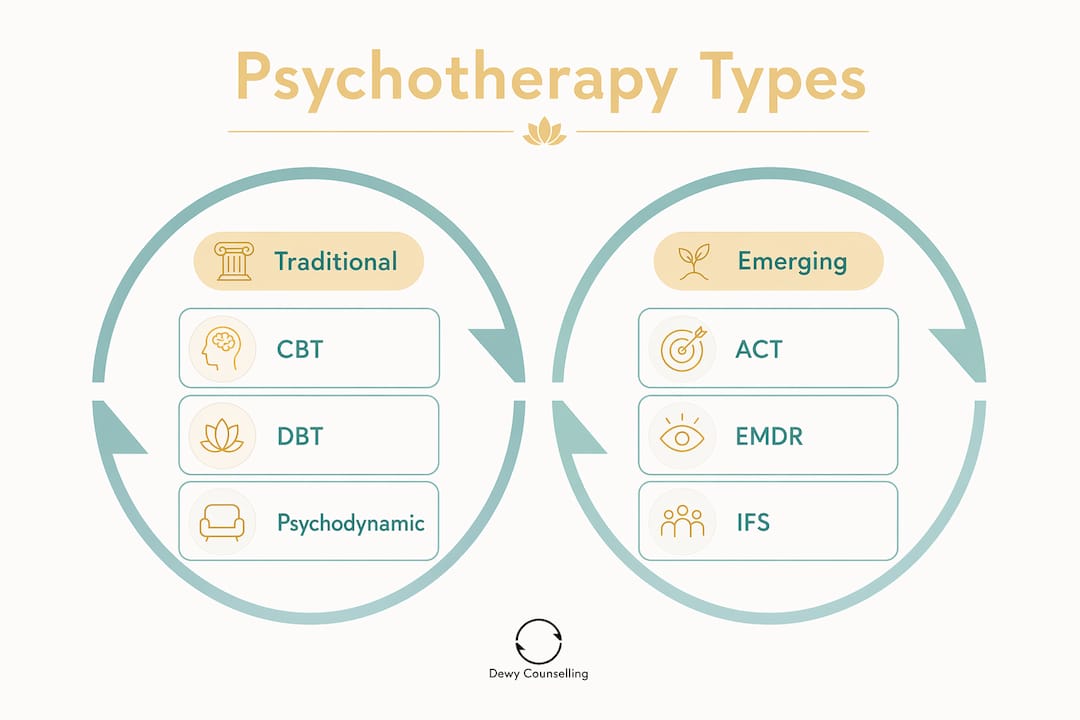
ACT focuses on psychological flexibility and acceptance rather than challenging thoughts directly. That distinction matters because some people find thought-challenging exhausting or counterproductive. ACT teaches you to hold difficult thoughts lightly and redirect your energy toward living in line with your values, regardless of what your mind is telling you.
EMDR is recognized alongside CBT as a first-line PTSD treatment by the US Department of Veterans Affairs. It uses bilateral eye movements or tapping while you briefly recall traumatic memories, allowing the brain to reprocess those memories so they lose their emotional charge. Many people report significant relief in fewer sessions than traditional trauma-focused CBT.
Internal Family Systems therapy views the mind as a system of distinct "parts," each with its own perspective and emotional role. The goal is to help your core Self lead those parts rather than be overwhelmed by them. IFS is particularly well-suited to people dealing with deep self-criticism or complex trauma histories.
How do you choose the right psychotherapy for your needs?
Matching your mental health challenge to the right modality is the most practical starting point. CBT is the first choice for anxiety, OCD, and depression. DBT fits best when emotion dysregulation is severe. EMDR or trauma-focused CBT addresses PTSD most directly. ACT works well for chronic conditions where acceptance of ongoing difficulty is part of the goal.
That said, therapeutic alliance is the strongest predictor of psychotherapy success, often more impactful than the modality itself. A skilled therapist you trust and feel understood by will produce better outcomes than the "correct" therapy delivered by someone you cannot connect with. The relationship is the treatment, in many ways.
Practical factors to weigh when choosing:
- Condition match: Does research support this modality for your specific challenge?
- Session commitment: Can you realistically attend weekly for 6 months or a year?
- Cost: Session costs vary by modality, ranging from $100 to $250 out of pocket per session
- Format preference: Do you want structured skill-building or open-ended exploration?
- Therapist fit: Do you feel genuinely heard after the first two or three sessions?
If therapeutic alliance does not develop after 3–4 sessions, switching clinicians or modalities is advisable. That is not failure. It is good clinical judgment. Understanding what actually works in therapy can help you evaluate your progress with more clarity and confidence.
Key Takeaways
The most effective psychotherapy is the one that matches your specific condition, fits your life practically, and is delivered by a therapist you genuinely trust.
| Point | Details |
|---|---|
| CBT is the most researched modality | CBT is first-line for anxiety, OCD, and depression, typically requiring 6–20 sessions. |
| DBT targets emotion dysregulation | DBT combines individual and group sessions over roughly one year for complex emotional challenges. |
| Therapeutic alliance predicts outcomes | Your connection with your therapist matters more than the specific modality you choose. |
| Emerging therapies fill important gaps | EMDR, ACT, and IFS address trauma and chronic conditions where older models fall short. |
| Cost and commitment shape access | Out-of-pocket session costs range from $100 to $250; plan for the full duration, not just the first few sessions. |
Why the "right" therapy is less obvious than it looks
I have worked with people who arrived convinced they needed CBT because they had read it was the gold standard. Some of them were right. Others needed something slower and more relational, something that made space for grief or identity questions that a structured protocol was never designed to hold. The research on therapy outcomes consistently shows that most well-delivered therapies produce similar results when the therapist is skilled and the relationship is strong.
The misconception I encounter most often is that choosing the wrong therapy type is a serious mistake. It rarely is. What matters far more is whether you show up, whether you feel safe enough to be honest, and whether your therapist is genuinely tracking your experience rather than running through a protocol. Therapy is not advice-giving but a structured process focused on emotional regulation, coping skill development, and deeper insight. That distinction changes what you should expect from the first session onward.
My honest recommendation is this: start with the modality that research supports for your primary challenge, but hold it loosely. If it is not working after a month or two, say so. A good therapist will adjust. The people who get the most from therapy are not the ones who picked the right modality on the first try. They are the ones who stayed curious, stayed honest, and kept showing up.
— Wayne Dewhurst
Dewycounselling offers therapy that fits your actual life
Finding the right approach to your mental health is clearer when you have a skilled, licensed therapist guiding the process alongside you.

Dewycounselling offers individual, couples, and family therapy with licensed therapists trained across multiple modalities, including CBT, DBT-informed approaches, and trauma-focused therapy. Sessions are available online and in person in Burlington, Ontario, so you can access support in the format that works for your schedule and comfort level. If you are ready to take that first step, the psychotherapy services page outlines what to expect and how to get started. You do not need to have everything figured out before you reach out. That is what the first session is for.
FAQ
What is talk therapy, and how does it differ from medication?
Talk therapy is a structured process where a licensed professional helps you address mental health challenges through conversation, skill-building, and emotional insight, without medication. It targets the root patterns behind symptoms rather than managing them chemically.
How many sessions does psychotherapy typically take?
Session counts vary widely by modality. CBT typically runs 6–20 sessions, while DBT follows a one-year model. Open-ended approaches like psychodynamic therapy have no fixed endpoint.
Is CBT or DBT better for anxiety?
CBT is the first-line treatment for most anxiety disorders, with the strongest clinical evidence base. DBT is more appropriate when anxiety is paired with severe emotion dysregulation or self-harm.
What if I try therapy and it does not feel right?
If a strong therapeutic connection has not formed after 3–4 sessions, switching therapists or modalities is a reasonable and clinically supported step. Poor fit is one of the most common and most fixable barriers to progress.
Can different therapy approaches be combined?
Yes. Many skilled therapists draw from multiple modalities, tailoring their approach to your specific needs. This integrative style often produces better outcomes than rigidly following a single protocol.