
Sexual performance anxiety is the fear of not measuring up during sex, and it's common enough that most people encounter it at some point in a relationship. It's also treatable. Tonight's first step is small: try slow, deliberate breathing before intimacy, or suggest a low-pressure moment of touch with your partner that has no goal attached to it.
TL;DR:
- Performance anxiety often causes symptoms like erectile problems, reduced lubrication, or premature ejaculation that improve when alone but worsen with a partner.
- Psychological factors such as unrealistic expectations from media, relationship stress, past trauma, and high-stakes situations commonly trigger performance anxiety.
- Differentiating between anxiety and physical conditions involves tracking performance patterns, ruling out medical issues, and monitoring symptoms beyond three months.
- Evidence-based strategies like cognitive behavioral therapy, sensate-focus exercises, and reframing arousal as excitement are most effective in reducing performance anxiety.
- Partners can alleviate pressure by emphasizing intimacy over performance, avoiding comparisons, and practicing low-pressure touch and communication, with professional help if issues persist beyond three months.
What does performance anxiety sex look like in the body?
Performance anxiety shows up differently depending on who's experiencing it, but the underlying wiring is the same. For men, it often means erection problems, trouble maintaining arousal, or ejaculating sooner than intended. For women, it tends to show up as reduced lubrication, difficulty reaching orgasm, or a sense of being physically present but mentally checked out, a phenomenon therapists call "spectatoring."
The mechanism is physiological, not a character flaw. Anxiety triggers stress hormones like epinephrine and norepinephrine, which constrict blood vessels and reduce the blood flow and lubrication arousal depends on. Your body is doing exactly what it's built to do under threat. It just doesn't know the "threat" is your partner waiting for you to finish undressing.
Common signs include:
- Erection difficulty or trouble staying aroused
- Premature ejaculation or delayed orgasm
- Reduced lubrication or physical desire
- Mentally narrating or judging your own performance mid act
- Function returning fine when alone, but not with a partner
Pro Tip: If you notice your mind drifting to "am I doing this right?" mid intimacy, that's spectatoring, not disinterest. Naming it out loud, even just to yourself, can loosen its grip.
What causes sexual performance anxiety?
Most cases trace back to a mix of psychological pressure and situational triggers rather than one single cause. Pinpointing which of these applies to you makes the strategies in later sections far more effective.
- Performance mindset. Pornography and cultural myths set unrealistic scripts for how sex "should" look and how long it "should" last.
- Relationship strain. Unspoken resentment, mismatched desire, or a partner's unintentional pressure can raise the emotional stakes of every encounter.
- Past experience. A history of rejection, criticism, or trauma can prime the nervous system to expect failure.
- General anxiety and stress. Work stress, generalized anxiety disorders, and body image concerns don't stay contained to one part of life.
- Substance use. Alcohol and certain medications interfere with both arousal and confidence.
- New or high-stakes situations. A new partner, an anniversary, or "trying to conceive" pressure can turn a normal night into a test.
None of these causes are permanent traits. They're patterns, and patterns respond to intervention.
Is it performance anxiety or erectile dysfunction?
The clearest signal is context. If everything works fine solo but stalls with a partner, that pattern points to a psychological cause rather than a physical one. A quick triage sequence helps clarify what you're dealing with:
- Track the pattern. Does arousal or function work fine during masturbation but not partnered sex? That gap usually means anxiety, not anatomy.
- Apply the three-month rule. Occasional trouble is normal. Difficulties lasting beyond three months warrant a conversation with a physician.
- Rule out medical contributors. Diabetes, cardiovascular disease, low testosterone, and medications like antidepressants or blood pressure drugs can all cause similar symptoms.
- Prepare for the appointment. Note when problems started, whether they're situational, and any medications or health conditions, so your clinician can evaluate efficiently.
What actually works to reduce sexual performance stress?
The strategies that hold up are ones that retrain attention and expectation, not just willpower. Layer these together rather than picking one and hoping it fixes everything overnight.
- Reframe the physical sensation. Reappraising arousal as excitement rather than fear changes how your nervous system interprets a racing heart. It's a small mental shift with a real effect: the same physiological signal, read differently.
- Use CBT to catch catastrophic thoughts. Cognitive behavioral therapy trains you to notice thoughts like "I'm going to fail" and challenge them before they spiral. Our guide to cognitive behavioral therapy breaks down how this works in practice.
- Ground yourself in sensation. Box breathing (four counts in, four held, four out) or a 3-3-3 sensory check (three things you see, hear, and feel) pulls attention out of your head and back into your body.
- Practice sensate-focus exercises. These involve non-goal-oriented touching sessions, sometimes over several nights, that gradually reintroduce sexual elements without pressure to "perform." Graded exposure paired with cognitive reframing tends to reduce situational anxiety faster than reassurance alone.
- Try stop-start technique for premature ejaculation. Pausing stimulation near the point of climax, then resuming once arousal drops, builds tolerance and control over repeated practice.
- Change the bedroom setup. Remove the clock. Widen the definition of sex to include oral, manual stimulation, or toys, so intercourse isn't the only measure of success.
- Use medication or devices as a bridge, not a cure. PDE5 inhibitors, lubricants, or vibrators can break the anxiety-dysfunction cycle short term, but relying on medication alone can reinforce a dependence mindset instead of resolving the underlying fear.
Psychological interventions produce medium-to-large reductions in performance anxiety symptoms, and CBT paired with exposure-based exercises is the combination with the strongest evidence behind it.
How can partners lower the pressure?
Partners usually want to help but end up raising the stakes without realizing it. A few short scripts change that dynamic fast:
- "I care about being close to you, not about how tonight goes."
- "Let's try something low-key tonight, no expectations either way."
- "There's no rush. We have time."
Beyond words, small behavioral shifts matter more than grand gestures. Set aside "no-pressure windows" where touch is affectionate but not headed anywhere specific. Build in regular non-sexual affection, like a hand on the back or a long hug, so intimacy doesn't only happen in high-stakes moments. Shared sensate-focus practice works best when both partners treat it as an experiment, not a test.
Avoid performance-focused praise ("that was amazing, you lasted so long") since it subtly reinforces the scoreboard mentality. Skip comparisons to past partners entirely. If a partner responds to these difficulties with ultimatums or contempt, that's a signal the issue has moved from private anxiety into relationship harm, and it's worth involving a professional.
When should you see a professional about performance anxiety?
A few signals mean it's time to move past self-help and bring in a clinician or therapist: difficulties lasting more than three months, distress that's affecting your mood or self-esteem, tension building between you and your partner, or any suspicion the cause might be medical rather than psychological.
Several treatment paths have solid evidence behind them:
- CBT for performance anxiety targets the catastrophic thinking patterns that fuel the cycle.
- Sex therapy works directly with the physical and relational patterns behind arousal difficulties.
- Couples therapy addresses relationship dynamics, especially when pressure or resentment has built up over time. Our communication exercises for couples offer a starting point for that work.
- Pelvic-floor physiotherapy can help when physical tension contributes to pain or difficulty, particularly for women.
A physician or sexual-health clinic evaluating persistent symptoms will typically check medication side effects, hormone levels, and cardiovascular risk factors before treating it as purely psychological. CBT and exposure-based methods remain the most evidence-informed psychological approaches available, and medication, when used, works best as a short-term adjunct rather than the whole plan.
A therapist's take on treating performance anxiety
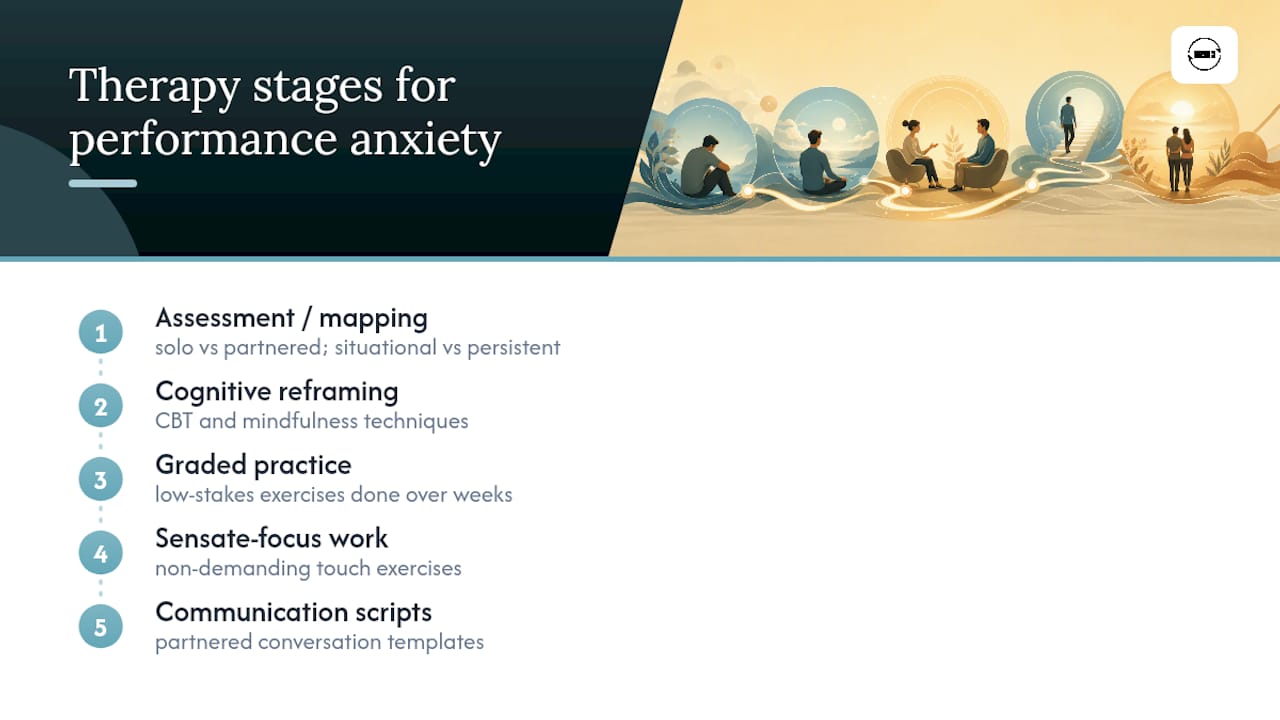
At Dewycounselling, sexual performance anxiety comes up constantly in both individual and couples sessions, and it rarely responds well to advice alone. What tends to work is structured practice: cognitive reframing paired with graded, low-stakes exercises done consistently over weeks, not a single breakthrough conversation. Wayne Dewhurst has worked with individuals and couples navigating exactly this pattern, using evidence-based approaches including CBT and mindfulness-based techniques, delivered both online and in person.
Therapy for this issue typically starts with mapping the pattern (solo versus partnered, situational versus persistent), then builds toward sensate-focus work and communication scripts partners can use together. If you're ready for that kind of structured support, you can explore Dewycounselling's therapy services or book directly through Dewycounselling.
— Wayne Dewhurst
This article is general information, not a substitute for advice from a qualified doctor. Consult a qualified healthcare professional about your own circumstances before acting on anything here.
Sources
- What Is Sexual Performance Anxiety and How Can One Manage It? - ISSM
- Performance anxiety and erectile dysfunction — Healthline
- How to Overcome Sexual Performance Anxiety — Cleveland Clinic
- Systematic review/meta-analysis on interventions for performance anxiety - PMC