
Therapy is confidential because federal law, state statutes, and professional ethical codes legally require therapists to protect everything you share in a session. Under the Health Insurance Portability and Accountability Act (HIPAA), your session content, clinical notes, diagnoses, and billing records are classified as protected health information (PHI). Professional bodies like the American Psychological Association (APA) layer additional ethical duties on top of that legal floor. The result is a system designed to give you a genuinely safe space to speak honestly, without fear that your words will reach your employer, your family, or anyone else.
Three things to know from the start:
- Legal protections: HIPAA sets the federal baseline for PHI in mental health settings; state laws often go further.
- Ethical duty: Licensed therapists are bound by professional codes (APA, NASW, ACA) that treat confidentiality as a core clinical obligation, not just a legal checkbox.
- Main exceptions: Confidentiality can be broken in a narrow set of circumstances: imminent risk of harm to yourself or others, suspected child or elder abuse, and valid court orders. Your therapist is required to tell you about these limits before your first session begins.
Why confidentiality is the foundation of effective therapy
Confidentiality is not a bureaucratic formality. It is the structural condition that makes honest disclosure possible, and honest disclosure is what makes therapy work.
The concept of the therapeutic alliance describes the bond of trust and collaboration between a client and therapist. Research consistently links a strong alliance to better treatment outcomes across virtually every therapeutic modality. Confidentiality is what allows that alliance to form. When you believe your therapist cannot share what you say, you are far more likely to bring the material that actually needs attention: the shame, the secrets, the thoughts you have never said aloud. Without that assurance, most people self-censor, and self-censorship is the single biggest obstacle to meaningful progress.
Research bears this out. Perceived confidentiality predicts disclosure depth and, through disclosure, treatment outcomes. Conversely, a perceived breach, even a minor one, is strongly associated with reduced disclosure and higher dropout rates. The stakes of getting this right are clinical, not just legal.
Therapists also maintain confidentiality through behavioral boundaries you may not always see. They typically do not acknowledge clients in public without the client's lead, avoid connecting with clients on social media, and will not confirm to a third party that someone is even receiving therapy. These practices protect something deeper than information: they protect your sense of safety in the relationship. When you know your therapist holds that boundary firmly, you can focus on what actually works in treatment rather than managing what might leak out.
What confidentiality actually covers in your therapy sessions
The scope of protection is broader than most people realize. Confidentiality in psychotherapy covers not just what you say in a session but an entire category of clinical and administrative information.
Protected categories typically include:
- Everything you disclose during sessions (thoughts, feelings, experiences, relationships)
- Clinical notes, progress notes, and psychotherapy notes
- Your diagnosis and any test results
- Appointment logs and scheduling records
- Billing records and insurance claims
- Contact information and identifying details
One protection that surprises many people: a therapist should not confirm or deny that you are a client at all. If your employer calls asking whether you attend therapy, the ethical response is to neither confirm nor deny your status. The duty of confidentiality extends to the fact of treatment itself.
| Record Type | Client | Insurer (with consent or billing) | Court (with valid order) | Third Party |
|---|---|---|---|---|
| Session content / progress notes | Yes | Limited | Possible | No |
| Psychotherapy process notes | Yes | Generally no | Possible | No |
| Diagnosis and treatment plan | Yes | Yes (for billing) | Possible | No |
| Appointment logs | Yes | Limited | Possible | No |
| Billing records | Yes | Yes | Possible | No |

Supervision and consultation add a layer worth understanding. When a therapist consults a supervisor or colleague about your case, that conversation is ethically required to use the minimum identifying information necessary. Supervisors may need clinical information for oversight purposes, but a well-trained clinician removes or obscures identifiers whenever possible.
Pro Tip: Ask your therapist at intake whether they keep separate psychotherapy process notes distinct from general progress notes. Process notes, which capture your therapist's personal impressions and session observations, receive stronger HIPAA protections than standard progress notes and are generally not accessible to insurers.
The U.S. legal and ethical rules that protect your privacy
The framework protecting your therapy records operates on three levels: federal law, state law, and professional ethics. Understanding how they interact helps you know exactly where your protections come from.
HIPAA is the federal floor. Passed in 1996, it establishes minimum standards for how covered entities (including licensed mental health providers) handle PHI. In psychotherapy, HIPAA covers session content, clinical records, billing, and electronic communications. It also requires your provider to give you a Notice of Privacy Practices at your first visit, explaining how your information is used and what your rights are. The HHS Office for Civil Rights enforces HIPAA and handles complaints when violations occur.
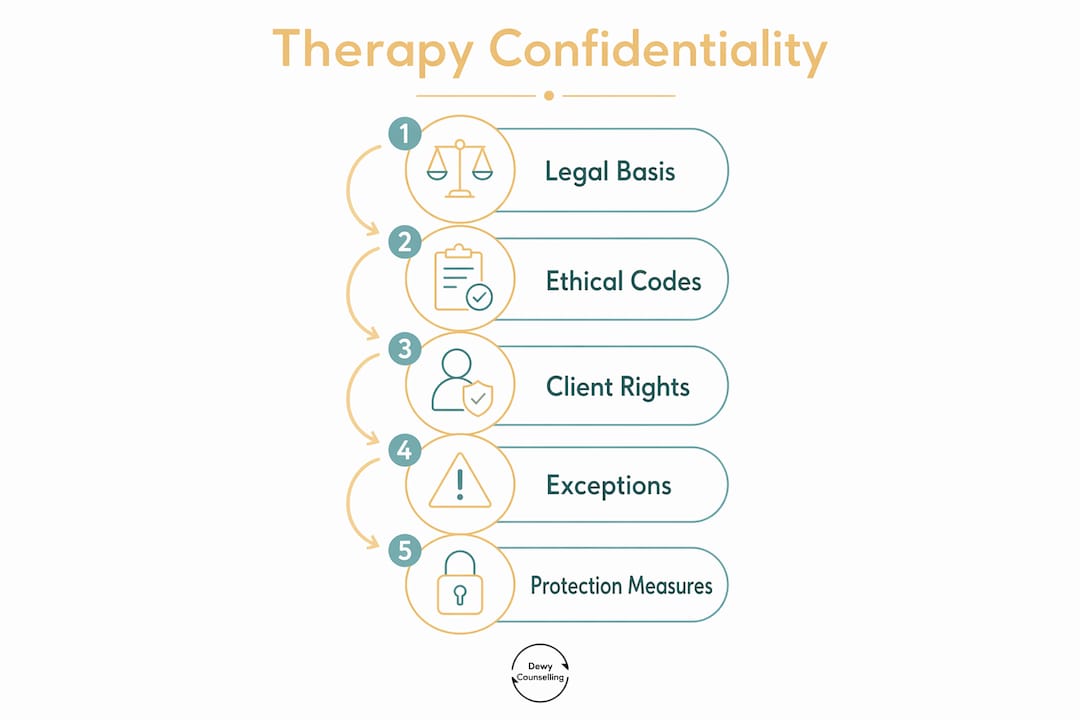
Professional ethics codes go further still. The APA's Ethics Code, the American Counseling Association's (ACA) Code of Ethics, and the National Association of Social Workers (NASW) Code all treat confidentiality as a foundational duty, not merely a legal compliance item. These codes require therapists to actively protect client privacy, not just avoid obvious violations.
State law adds the third layer. California's Confidentiality of Medical Information Act, for example, provides protections that exceed HIPAA's baseline in several respects. Many states have specific mental health privacy statutes that are more restrictive than the federal standard. When state law is more protective than HIPAA, the more protective standard applies.
In everyday practice, this framework shows up in the consent forms and privacy notices you sign at intake. Those documents are not boilerplate. They are the legal and ethical mechanism through which your therapist fulfills their duty to inform you of your rights before treatment begins.
When a therapist can break confidentiality
The exceptions to confidentiality are real, but they are narrow. Therapists are generally mandated to break confidentiality in four primary scenarios, and each one reflects a situation where a competing duty, usually the protection of life, outweighs the duty of privacy.
-
Imminent risk of harm to yourself. If you express a serious, credible, and imminent intent to end your life, your therapist may contact emergency services or a designated contact to prevent that harm. The key word is imminent: passive ideation or historical suicidal thoughts do not automatically trigger this exception. The clinician assesses the specificity of the plan, access to means, and the immediacy of the risk.
-
Imminent danger to an identified third party (duty to warn/protect). Following the landmark Tarasoff v. Regents of the University of California ruling, most states require therapists to take reasonable steps to protect an identifiable potential victim when a client makes a credible threat. This might mean warning the intended victim, contacting law enforcement, or both. State laws vary significantly in how this duty is defined and triggered.
-
Suspected child, elder, or dependent adult abuse or neglect. Licensed therapists are mandated reporters in every U.S. state. If you disclose information that gives a therapist reasonable cause to suspect abuse or neglect of a minor, an elderly person, or a dependent adult, they are legally required to report it to the appropriate child or adult protective services agency. This obligation exists regardless of whether you consent.
-
Valid court orders and subpoenas. A court can compel disclosure of therapy records or testimony. Even here, therapists typically consult legal counsel and may assert privilege on your behalf before complying. Not every subpoena automatically overrides confidentiality; a court order is required in most circumstances.
Beyond these four, there are permissive disclosures where therapists may share limited information without your explicit consent: billing and payment processing, certain public health reporting requirements, and national security matters under federal law. These are narrower still and vary by state.
How therapists decide what to disclose and how they limit it
When a potential exception arises, a well-trained therapist does not act unilaterally or immediately. The decision follows a structured clinical and ethical process.

The first step is assessment: How imminent is the risk? How specific is the plan? Is there an identifiable victim? Has the client expressed willingness to engage in safety planning? These questions shape whether an exception is genuinely triggered or whether the situation can be managed within the therapeutic relationship. Many situations that initially appear to require disclosure can be addressed through collaborative safety planning without any breach.
If disclosure is warranted, the minimum necessary standard governs what gets shared. This principle, embedded in both HIPAA and professional ethics, means sharing only the facts required to address the specific risk, with only the parties who need that information. A therapist reporting a credible threat to law enforcement does not hand over your entire clinical file. They share what is relevant to the immediate safety concern.
Documentation follows every disclosure decision, whether or not a breach ultimately occurs. The therapist records the clinical reasoning, the consultation process, and the specific information shared. When it is legally permitted and clinically safe to do so, the therapist also informs you that a disclosure was made and why. That transparency, even after the fact, is part of preserving the therapeutic relationship.
Pro Tip: If you are ever concerned that a disclosure might be required, ask your therapist directly: "What would you do if I told you X?" A good clinician will walk you through their decision process honestly, which itself can reduce anxiety and strengthen trust.
Confidentiality with minors, couples, and family therapy
The rules shift meaningfully when therapy involves more than one person, or when the client is a child or adolescent.
Minors and parental access. Parents generally have the legal right to access their minor child's therapy records, since they hold the consent authority for treatment. However, most states allow therapists to use clinical judgment to protect certain disclosures, particularly for adolescents, when sharing information could harm the therapeutic relationship or the minor's safety. Adolescents may feel betrayed if confidentiality limits are not clearly explained from the start, which is why skilled clinicians address this directly in the first session, with both the teen and the parents present.
A common approach is to negotiate a confidentiality agreement at intake: parents agree to receive general progress updates rather than session-by-session content, and the therapist agrees to notify parents if safety concerns arise. This structure protects the adolescent's ability to disclose honestly while keeping parents appropriately informed.
- State laws vary on the age at which minors can consent to their own mental health treatment (often 12–16, depending on the state).
- Therapists should explain confidentiality limits in age-appropriate language, revisiting them as the relationship develops.
- Parental access to records does not mean unlimited access to session content; therapists can often distinguish between administrative records and process notes.
Couples and family therapy. When two or more people attend therapy together, confidentiality in couples therapy becomes more complex. Information shared in a joint session is generally not confidential from the other participants in that session. If one partner also meets individually with the same therapist, most clinicians establish a clear policy at the outset about whether those individual disclosures can be brought into joint sessions.
The clearest protection is a written policy, established at intake, that spells out exactly how the therapist handles information shared in individual versus joint sessions. Ask for this in writing before your first couples or family session.
Records, billing, insurance, and telehealth: what you should know
Insurance involvement changes the privacy picture in ways that are worth understanding before you file a claim.
When you use health insurance to pay for therapy, your insurer receives at minimum a diagnosis code and service dates. Explanation of Benefits (EOB) statements are sent to the policyholder, which means if you are on a family plan, the primary policyholder may see that mental health services were billed. Insurers are bound by HIPAA, but they do receive limited clinical information as part of the claims process. Paying out-of-pocket eliminates insurer access entirely, though it does not guarantee complete privacy in all other respects.
Telehealth introduces its own set of privacy considerations. HIPAA-compliant telehealth platforms use end-to-end encryption and business associate agreements to protect your sessions. General consumer video tools like FaceTime or standard Zoom are not HIPAA-compliant and should not be used for therapy without specific safeguards in place. Your therapist should obtain your informed consent for telehealth that explicitly addresses the risks of remote sessions, including the possibility of being overheard in your own environment.
Pro Tip: Before your first telehealth session, ask your therapist which platform they use and whether it is HIPAA-compliant. Also ask about their policy for email and text communication: unencrypted email and standard SMS are not secure channels for sensitive clinical information.
A few practical questions worth asking your therapist or billing staff:
- Who at this practice has access to my billing records?
- Will my insurer receive my diagnosis? Will they receive session notes?
- If I receive an EOB, can I request that it be sent to a specific address?
- What platform do you use for telehealth, and is it encrypted?
What to do if you're worried about confidentiality
If you have concerns about your privacy before or during therapy, you have both the right and the practical ability to address them directly.
- Ask your therapist at intake. Request a clear explanation of their confidentiality policy, including the specific exceptions that apply in your state. A competent clinician will welcome this conversation.
- Request the written privacy policy. Under HIPAA, your provider is required to give you a Notice of Privacy Practices. Read it. If anything is unclear, ask for clarification before signing.
- Document your conversations. If you raise a concern verbally, follow up with a brief written note or email summarizing what was discussed. This creates a record if questions arise later.
- Consider paying out-of-pocket. If insurer access to your diagnosis or service dates is a significant concern, self-pay removes that layer of disclosure. Ask about sliding-scale fees if cost is a barrier.
- Know your rights under HIPAA. You have the right to access your own records, request corrections, and receive an accounting of disclosures. These rights are enforceable.
If you believe a breach has already occurred, the HHS Office for Civil Rights accepts HIPAA complaints online. Your state licensing board handles complaints about professional ethics violations. In serious cases, consulting a privacy attorney is a reasonable step. Understanding how therapy sessions work from the start, including the privacy policies, puts you in the strongest position to protect yourself.
What happens when confidentiality is breached
A breach of confidentiality, whether intentional or negligent, carries real consequences for the clinician involved.
For the therapist, consequences can include a licensing board complaint leading to suspension or revocation of licensure, a malpractice claim in civil court, professional discipline from their credentialing body, and lasting reputational harm. State licensing boards take these complaints seriously, and the investigation process is formal and documented.
For you as the client, the reporting pathway depends on the nature of the breach. A HIPAA violation is reported to the HHS Office for Civil Rights. An ethics violation is reported to the relevant state licensing board (for psychologists, licensed counselors, social workers, or marriage and family therapists, each has its own board). If the breach caused concrete harm, a civil claim for damages may be available with the help of a privacy attorney.
Pro Tip: If you suspect a breach, start a written log immediately. Record the date you became aware of the disclosure, what information was shared, with whom, and any communications you have had with the therapist or practice about it. This documentation is the foundation of any formal complaint or legal action.
Privacy protections generally survive the end of therapy. In many jurisdictions, they continue even after a client's death, meaning clinicians must handle records according to both ethics and law long after the therapeutic relationship has ended.
Key Takeaways
Therapy is confidential because federal law (HIPAA), state statutes, and professional ethical codes create overlapping legal and ethical obligations that protect your session content, records, and clinical information to enable safe, honest disclosure.
| Point | Details |
|---|---|
| Legal and ethical basis | HIPAA sets the federal floor; state laws and APA/ACA/NASW ethics codes add stronger protections. |
| Scope of protection | Session content, diagnoses, notes, billing, and even the fact of treatment are all protected. |
| Four main exceptions | Imminent self-harm, imminent harm to others, mandated abuse reporting, and valid court orders. |
| Minimum necessary standard | When disclosure is required, therapists share only what is needed, with only the parties who need it. |
| Dewycounselling's approach | Dewycounselling provides HIPAA-compliant, confidential individual, couples, and family therapy with privacy policies explained at the first visit. |
Confidentiality in practice: a clinician's perspective
What the legal framework cannot fully capture is how confidentiality feels from inside the room. Clients rarely arrive ready to say the hardest thing. They test the water first, sharing something moderately difficult and watching to see what happens. If the therapist holds that disclosure carefully, the client moves a little deeper. That gradual process of trust-building is only possible because confidentiality is not just a policy but a lived commitment the therapist demonstrates session after session.
The exceptions to confidentiality are the moments that test that commitment most directly. When a client discloses something that triggers a mandatory reporting obligation, the clinical task is not simply to comply with the law. It is to do so in a way that preserves as much of the therapeutic relationship as possible: explaining what is required, why, and what will happen next. Consultation with a colleague or supervisor before acting is not hesitation; it is the ethical standard. And documenting the decision carefully, including the reasoning and the consultation, protects both the client and the clinician.
The conversations that matter most are the ones that happen at the very beginning: explaining confidentiality clearly, answering questions honestly, and revisiting the limits when the work brings the client close to them. Clients who understand the framework from the start are not less likely to disclose. They are more likely to, because they know exactly where the boundaries are and can trust that the therapist will honor them.
Confidential therapy at Dewycounselling: your next step
Privacy is not a feature at Dewycounselling. It is the condition that makes the work possible. Dewycounselling offers individual, couples, and family therapy with HIPAA-compliant records, a clear Notice of Privacy Practices at your first visit, and a genuine commitment to explaining confidentiality limits before treatment begins, not after.

Whether you are navigating a personal crisis, working through relationship challenges, or simply ready to talk to someone who will hold what you share with care, Dewycounselling is here. Sessions are available online and in person, so you can access confidential therapy in the format that feels safest for you. Ready to take the first step? Visit Dewycounselling to book your first session and ask every question you have about privacy before you begin.
Useful sources and further reading
For readers who want to go deeper on the legal or clinical detail, these are the most authoritative sources to consult.
- HHS Office for Civil Rights (HIPAA): The primary federal authority on HIPAA compliance and your rights as a patient. File complaints and access plain-language guidance at hhs.gov. Use this for questions about federal privacy rights, EOBs, and reporting violations.
- APA Ethics and Confidentiality: The American Psychological Association's topic page on confidentiality in psychotherapy covers the ethical framework, HIPAA interaction, and consumer-facing explanations of your rights.
- CDC HIPAA Overview: The CDC's public health law program provides a clear overview of HIPAA for consumers and practitioners, including what the law covers and what it does not.
- PubMed / peer-reviewed literature: For the clinical evidence base on confidentiality, disclosure, and therapeutic outcomes, PubMed indexes the relevant peer-reviewed research. Useful if you want to understand the research behind why confidentiality predicts treatment outcomes.
- State licensing boards: For ethics complaints or questions about state-specific confidentiality rules, contact the licensing board for the relevant profession (psychology, counseling, social work, marriage and family therapy) in your state. Rules vary, and your state board is the authoritative source for your jurisdiction.
- HIPAA compliance for practices: For a practical explanation of how HIPAA applies to small practices and telehealth settings, the HIPAA compliance guide from HimShield covers technical safeguards and informed consent requirements in accessible language.
This article is general information about confidentiality in therapy and does not constitute legal or professional advice. For questions specific to your situation, consult a licensed mental health professional or a qualified attorney.