
Most sexless marriages can improve with therapist-informed, partnered steps: honest communication, small nonsexual gestures, and intimacy scheduled rather than left to chance. The best move right now is a single low-pressure conversation, something as simple as saying you miss feeling close. If the silence around sex is tangled up with coercion, fear, or abuse, skip the conversation and reach out to a local support line first.
TL;DR:
- Mismatched libido, stress, mental health, medications, and unresolved conflict often layer together to cause a sexless marriage, making tailored approaches necessary.
- Couples strategies like scheduled intimacy, shared activities, and nonsexual touch outperform solo efforts in rebuilding desire and emotional closeness.
- Effective timing and gentle communication are essential for discussing sex without defensiveness, with non-confrontational prompts helping mutual understanding.
- Persistent resentment, physical pain, trauma, or medical issues indicate when professional therapy or medical evaluation should supplement self-help efforts.
- Rebuilding trust and emotional safety through consistent small gestures lays the groundwork for renewed physical intimacy and lasting relationship satisfaction.
What Causes a Sexless Marriage, and Which Cause Fits Yours?
A marriage doesn't go sexless for one tidy reason. It's usually two or three factors layered on top of each other, and figuring out which ones apply to you determines what actually helps.
The most common drivers show up again and again in couples therapy:
- Mismatched libido, where one partner wants sex weekly and the other monthly, with neither drive being "wrong"
- Chronic stress, from young kids, aging parents, or a demanding job that leaves nothing left for connection
- Mental health conditions, particularly depression and anxiety, which blunt desire directly
- Medications, especially antidepressants and blood pressure drugs, which are well-documented libido suppressants
- Undiagnosed medical issues, from thyroid imbalances to hormonal shifts around menopause or andropause
- Unresolved conflict or resentment, where sex becomes the casualty of everything unsaid
- Past trauma, including sexual trauma that predates the relationship
- Aging and body changes, which can shift both desire and confidence for either partner
One distinction matters more than any single cause on that list: the difference between spontaneous desire and responsive desire. Spontaneous desire shows up unprompted, that classic "in the mood out of nowhere" feeling most media portrays as the default. Responsive desire works backward. Arousal builds after physical closeness starts, not before it. Dr. Laurie Mintz research on responsive desire and erotic sexuality notes that in many long-term relationships, this is the dominant pattern, which is exactly why waiting to feel like it can leave a couple waiting indefinitely.
If your marriage has gone quiet, you're in more company than it feels like. Some survey-based estimates suggest that roughly 10% to 20% of married couples report having sex fewer than ten times a year, though definitions of "sexless" vary widely across studies. That range doesn't make the ache smaller, but it does mean you're not dealing with something rare or shameful.
What Therapist-Backed Strategies Actually Rebuild Intimacy?
Research on couples navigating desire discrepancy points to one clear pattern: partnered strategies beat solo ones. A mixed-methods study of 229 participants found that couples who used communication, shared activities, and negotiated sex reported higher sexual and relationship satisfaction than those who managed the mismatch alone, through avoidance or private workarounds. Doing this together, even imperfectly, outperforms doing it silently.
Here's a stepwise approach that mirrors what a sex therapist would likely walk you through:
- Map the small steps first. The Gottman Institute recommends rebuilding from nonsexual closeness upward: a hand on the back, a longer hug, showering together without pressure for it to lead anywhere. Skipping straight to sex after months of distance rarely works because it demands too much too fast.
- Schedule a sensual date, not just a sex date. Put thirty minutes on the calendar for closeness with no fixed goal beyond touch and attention. Removing the ambush effect removes a lot of the anxiety.
- Expand what counts as intimacy. Cooking together, a shared bath, reading in the same bed instead of separate rooms. These rebuild the emotional footing that sexual intimacy usually needs underneath it.
- Try alternative forms of sexual activity if intercourse itself feels loaded, whether from pain, performance anxiety, or just rustiness. Massage, mutual touch, or oral intimacy can lower the stakes while keeping connection alive.
- Build a low-pressure touch ritual, something as small as a ten-second kiss goodbye or a hand held during a movie, that happens daily regardless of whether it leads anywhere further.
The scheduling piece deserves emphasis because it sounds unromantic until you try it. Negotiating a compromise frequency tends to reduce resentment and often restores the small affectionate gestures, a hand on the shoulder, a kiss before work, that had quietly disappeared. Waiting for spontaneous desire to reappear on its own timeline is often the very habit keeping couples stuck.
Pro Tip: If a scheduled sex date arrives and one of you genuinely isn't in the mood, don't cancel outright. Downgrade it to the nonsexual version, cuddling, a massage, ten minutes of real conversation, instead of skipping the ritual entirely. Consistency matters more than any single session going "right."
Give any new approach a real trial period, something like six to eight weeks, with a brief check-in at the halfway point. Ask each other two questions: does this feel forced, and does it feel like anything is shifting? Adjust from there rather than abandoning the whole plan after one awkward week.
How Do You Talk About Sex Without It Turning Into a Fight?
Timing decides more of this conversation than the words themselves. Bringing up your sex life right after a rejected advance, or right before bed when everyone is tired and vulnerable, sets the conversation up to fail before it starts. Pick a neutral moment: a weekend walk, a car ride, somewhere side-by-side rather than face-to-face, which tends to lower defensiveness.

Use I-statements instead of accusations. "You never want me anymore" invites a defensive shutdown. "I miss feeling close to you, and I'd like us to figure this out together" invites a partner in instead of putting them on trial.
A few openers that tend to work better than a cold confrontation:
- "I miss feeling close to you. Can we try setting aside time this week, even just to reconnect physically without pressure?"
- "I've noticed we've drifted on this, and I don't want either of us to feel blamed. Can we talk about what's going on?"
- "I'm not trying to pressure you. I want to understand what would actually feel good for you right now."
Add one sentence establishing a boundary or safety plan up front, something like agreeing that either partner can pause a conversation or a touch session at any point without it being treated as rejection.
Once the conversation opens, propose something concrete rather than leaving it vague: a trial period, a rough frequency to aim for, and a rule that if a scheduled moment needs to move, it gets rescheduled within 48 hours rather than quietly dropped. Plan a short check-in, five minutes, weekly, to see how the trial is landing for both of you.
When Do You Need a Therapist Instead of a Conversation?
Self-help conversations solve a lot, but not everything. Certain signs mean it's time to bring in a professional rather than keep troubleshooting alone:
- Any hint of coercion or pressure around sex, from either partner
- Resentment that keeps resurfacing no matter how many good conversations you have
- Physical pain during sex that hasn't been medically evaluated
- A history of sexual trauma affecting present intimacy
- Suspected medical or hormonal causes, especially alongside medication changes or new physical symptoms
Couples therapy, sex therapy, and a medical assessment solve different problems. Couples therapy addresses the relational patterns, the resentment, the communication breakdowns, the emotional distance. Sex therapy focuses specifically on the sexual relationship itself: desire discrepancy, performance concerns, and rebuilding physical connection. A medical evaluation rules out or treats biological causes; when low desire coincides with new symptoms or a medication change, a doctor's visit belongs on the list before or alongside therapy.
Expect early sessions to focus on mapping the problem's history and each partner's perspective, with concrete exercises starting within the first few weeks. Meaningful shifts in communication often show up within a couple of months; rebuilding the sexual relationship itself typically takes longer and moves in stages, not a single breakthrough.
What Exercises Does a Therapist Actually Assign?
Clinical work on desire discrepancy rarely starts in the bedroom. It usually starts with structured exercises that rebuild the groundwork sex depends on:
- Communication exercises that teach couples to raise sensitive topics without triggering a defensive spiral, often modeled on structured listening formats rather than free-form venting.
- Sensual mapping, a Gottman-style tool where partners chart which kinds of touch feel safe, neutral, or loaded, so neither partner is guessing.
- Scheduled intimacy with built-in check-ins, the same trial-and-review structure described earlier, but guided by someone trained to catch patterns you might miss on your own.
- Deeper work on emotional intimacy when the disconnect runs beneath the physical one, since sexual closeness rarely recovers while emotional distance stays untouched.
These exercises work because they're small, specific, and repeatable rather than a single dramatic conversation meant to fix everything at once. A therapist's role is largely to keep both partners accountable to the process when motivation dips, which it will.
How Does a Sexless Marriage Affect Each Partner Emotionally?
The partner with higher desire often carries a quiet, persistent grief, a sense of being rejected even when nothing was said outright. That can curdle into resentment, or into a shrinking self-esteem that makes the next attempt at initiating feel riskier than the last.
The lower-desire partner often carries something just as heavy: guilt, pressure, and a creeping sense of inadequacy for not wanting something they feel they're supposed to want. Some describe dreading affectionate gestures because they fear being misread as an invitation they don't intend.
Left alone, both experiences tend to compound. The higher-desire partner stops initiating to avoid another rejection. The lower-desire partner relaxes, relieved by the silence, without realizing that silence is its own kind of message. Within a year or two, many couples describe feeling more like roommates than partners, sharing logistics but not much else.
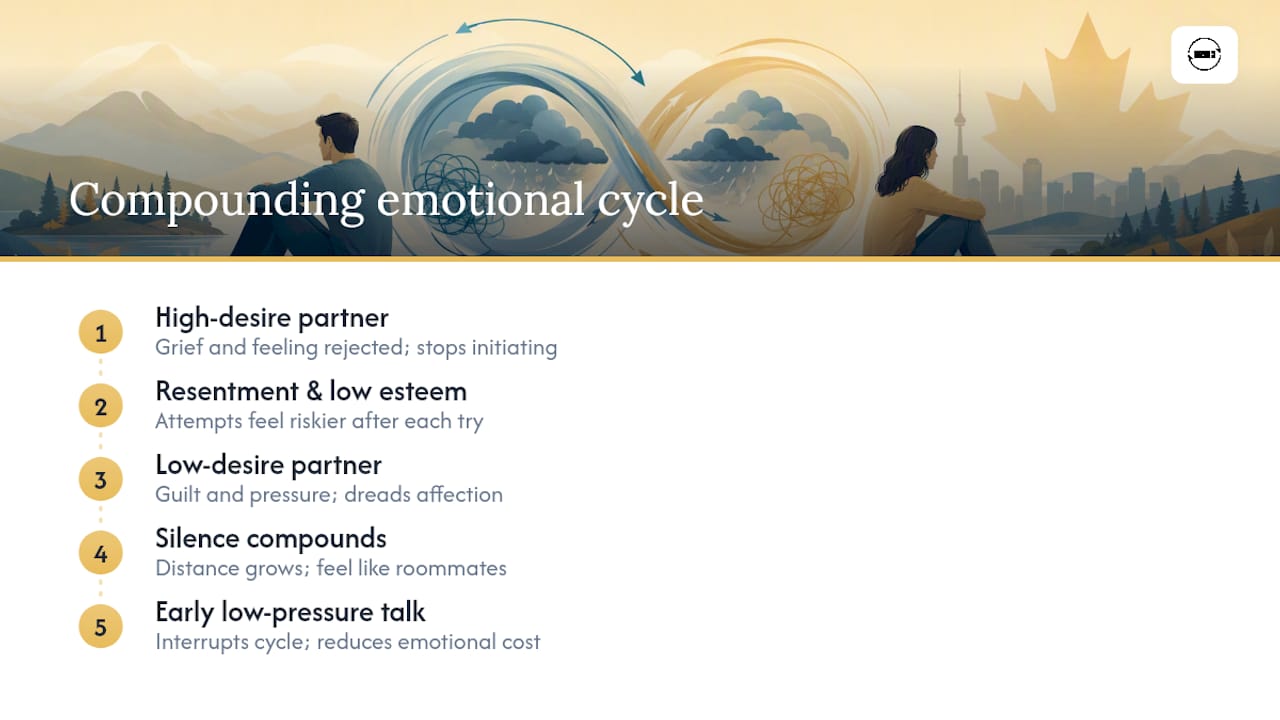
None of this means the marriage is broken beyond repair. It means the emotional cost of staying silent is real and compounding, which is exactly why an early, low-pressure conversation matters more than waiting for the "right" moment that rarely arrives on its own.
Why Trust and Emotional Connection Come Before Sex Returns
Sexual intimacy rarely rebuilds itself on a foundation of unresolved hurt. If one partner feels dismissed, criticized, or unheard outside the bedroom, that same guardedness follows them into it. Rebuilding trust isn't a separate project from rebuilding your sex life. It's the same project, and it usually needs to come first.
Small, consistent gestures do more here than grand ones. Following through on a small promise, listening without immediately defending yourself, apologizing without qualifying it, these rebuild the sense of safety that physical closeness depends on. Couples who skip this step and try to force sexual reconnection often find it feels hollow or short-lived, because the underlying disconnect never actually closed.
External pressures make this harder than it sounds. Parenting responsibilities eat the hours where intimacy used to live. Work stress leaves little emotional bandwidth by the time both partners are finally alone. Phones and screens fill the exact quiet moments, before bed, over coffee, that used to hold conversation. None of these factors are anyone's fault, but naming them out loud, "we've let our phones replace our evenings," tends to open the door to change faster than silently resenting the pattern.
A Therapist's Honest Take on Hope and Timelines
The couples I think about most aren't the ones in crisis. They're the ones who've gone quiet for so long that neither partner remembers who brought up the topic last. That silence is heavier than conflict, in some ways, because there's nothing to point to and say "this is the problem."
What tends to shift things isn't a grand gesture. It's one honest conversation, followed by small, repeated efforts over several weeks. Early sessions with a couple counsellor often surface relief before anything else, simply because someone neutral is finally naming what both partners have been avoiding. An initial consultation carries no obligation beyond showing up once and seeing whether the process feels workable for you both.
— Wayne Dewhurst
How Dewy Counselling Can Help You Move Forward
You don't have to figure out whether your issue is stress, mismatch, or something medical before you book a first session. That's part of what a trained couples counsellor helps you sort out, together, instead of guessing alone at 11 p.m. after another quiet night.

Counselling services are available in both online and in-person formats, so scheduling around kids, shift work, or a partner who's hesitant about "going to therapy" doesn't have to be a barrier. Sessions are confidential, and the first conversation is typically about understanding your specific situation rather than diving into a fixed program. Many couples come in expecting an interrogation and leave surprised at how much relief comes just from having a neutral third party in the room. If the strategies in this article feel like the right direction but hard to execute alone, couples counselling is the practical next step, and booking an initial session costs you nothing but an hour of your evening.
This article is general information, not a substitute for advice from a qualified doctor. Consult a qualified healthcare professional about your own circumstances before acting on anything here.
Sources
- Strategies for Mitigating Sexual Desire Discrepancy in Relationships - PMC
- Responsive desire and erotic sexuality — Psychology Today (Dr. Laurie Mintz)
- Mismatched sex drives: Relationships and coping - Medical News Today
FAQ
Can separate bedrooms help with a sexless marriage?
Separate bedrooms can help temporarily if sleep issues (snoring, mismatched schedules) are the actual problem, but they often accelerate emotional distance if used to avoid the underlying intimacy issue instead of addressing it.
How do you spice up a sexless marriage?
Start with nonsexual touch and scheduled closeness rather than jumping straight to novelty; expanding what counts as intimacy, gentle communication exercises, and negotiated frequency tend to work better than a single dramatic change.
Can a marriage survive being sexless?
Yes, many marriages recover meaningfully once couples address the underlying cause together, since partnered strategies like communication and negotiated intimacy are linked to higher satisfaction than avoiding the topic.
How long without intimacy is too long in a marriage?
There's no universal cutoff; what matters more is whether both partners feel the current pattern is acceptable. If one partner feels persistent distress or resentment building, that's the signal to act, regardless of the exact timeframe.
When should raising sexual health topics involve outside guidance?
If concerns about STI testing or sexual health come up alongside a discussion of resuming intimacy, clear guidance on raising the topic can make that specific conversation less awkward for both partners.