
Self-awareness in therapy is the clinically guided process of learning to observe your own thoughts, emotions, behaviors, and patterns with enough accuracy that you can actually change them. It goes well beyond everyday introspection, which tends to be unstructured and often misleading. Researcher Tasha Eurich's internal/external model, the Agency-via-Awareness meta-process in psychotherapy, and the clinical work practiced at Dewycounselling all point to the same conclusion: awareness built inside a therapeutic relationship produces a kind of agency that self-reflection alone rarely achieves.
Three things to understand from the start:
- Internal awareness covers your values, emotions, thought patterns, and physical sensations.
- External awareness is how you actually come across to others, which often differs sharply from how you think you come across.
- Embodied awareness connects intellectual insight to felt, somatic experience so that change becomes possible, not just understood.
Pro Tip: If you've ever left a therapy session feeling like you finally "got" something about yourself, that moment of recognition is awareness becoming agency. The goal is to make that happen more reliably, not just occasionally.
What does self-awareness mean in a clinical context?
Therapists work with at least two distinct types of self-awareness, and the difference between them shapes how sessions are structured and what homework you might be assigned.

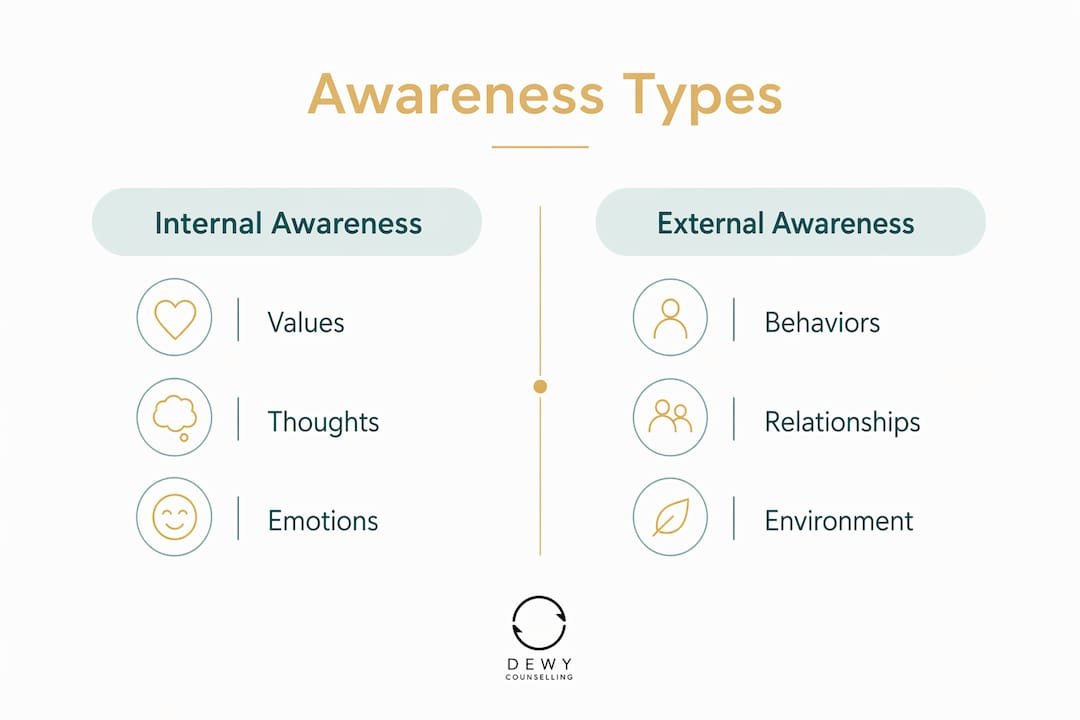
Internal self-awareness refers to how clearly you understand your own values, emotional states, habitual thought patterns, and behavioral tendencies. It is the inward lens. External self-awareness is how accurately you understand the way other people experience you, your tone, your impact, your relational habits. Eurich's research found that roughly 95% of people believe they are self-aware, while only about 10–15% demonstrate accurate self-knowledge when actually assessed. That gap is exactly what therapy is designed to close.
A third dimension, embodied awareness, matters enormously in clinical work. Clients can describe their feelings in precise language and still not feel them in any meaningful way. Therapists use body-focused practices like the body scan and interoceptive attention to link cognitive understanding with somatic experience, because behavior change tends to follow felt insight rather than intellectual insight.
| Dimension | What it covers | Clinical focus |
|---|---|---|
| Internal awareness | Values, emotions, thought patterns, physical sensations | Journaling, thought records, emotion labeling |
| External awareness | How others experience you; your interpersonal impact | Therapist feedback, role-play, structured input |
| Embodied awareness | Felt, somatic experience of emotions and states | Body scan, interoceptive attention, mindfulness |
| Reflective awareness | Deliberate, structured self-inquiry | "What" questions, behavioral experiments |
Two named frameworks appear frequently in clinical practice. The Johari Window, developed by psychologists Joseph Luft and Harrington Ingham, maps what you know about yourself against what others know, highlighting the "blind spot" quadrant that therapy specifically targets. Eurich's model adds a research-grounded distinction between the two awareness types and emphasizes that most people are stronger on one than the other, rarely both.
Pro Tip: Ask "what" rather than "why" when you reflect on your behavior. Research on the introspection paradox shows that "why" questions tend to generate plausible-sounding stories rather than accurate insight, while "what" questions stay anchored to observable data. "What was I feeling right before I snapped?" is more productive than "Why am I like this?"
Why does self-awareness matter in therapy?
The payoff of building self-awareness in therapy is concrete and well-documented. Higher self-awareness correlates with better decision-making, stronger relationships, higher job satisfaction, and more effective communication. In clinical terms, it also predicts better treatment outcomes across a range of presenting concerns, from anxiety and depression to relational conflict.
The Agency-via-Awareness framework from psychotherapy research offers a useful way to understand why. When a therapist helps you explore, attend to, and reflect on your experience, awareness increases. Increased awareness produces agency, the felt sense that you can actually do something differently. That agency then motivates further exploration, creating a self-reinforcing cycle. Awareness is not just a nice side effect of therapy; it is the mechanism through which therapy works.
A few specific benefits are worth naming:
- Emotional regulation: Clients who can label their emotions with specificity, what researchers call emotional granularity, show better regulation and clearer self-awareness. Lisa Feldman Barrett's work links nuanced emotion labeling to measurably better mental health outcomes.
- Relational clarity: External self-awareness helps you understand how your behavior affects the people around you, which is often the missing piece in recurring conflict.
- Reduced rumination: Structured therapeutic inquiry replaces unproductive "why" loops with behavior-focused reflection, which reduces anxiety rather than feeding it.
Self-awareness is also a skill, not a fixed trait. Research confirms that structured interventions, including therapy, feedback, and guided practice, reliably expand it. That is genuinely encouraging if you feel stuck. Learning more about how therapy improves daily life can help you see how these gains translate outside the session room.
What are the signs that self-awareness may be low?
Low self-awareness rarely announces itself. It tends to show up in patterns that feel external, like other people's reactions, recurring problems, or a persistent sense that things just keep going wrong.
- Repeated relational conflict with different people. When the same argument or dynamic appears across multiple relationships, the common thread is usually something about your own patterns rather than everyone else's behavior.
- Defensiveness to feedback. A strong, immediate urge to explain, justify, or dismiss what someone has observed about you often signals a blind spot rather than an inaccurate observation.
- Difficulty naming emotions precisely. Defaulting to "fine," "stressed," or "upset" for nearly every emotional state suggests limited internal awareness. Emotions have texture; vague labels flatten it.
- Repeating the same mistakes. Not learning from a pattern, despite genuinely wanting to, often means the pattern hasn't been fully seen yet.
- Surprise at others' reactions. When people consistently respond to you in ways you didn't expect or intend, your external self-awareness may not match reality.
- Confusing self-criticism with self-awareness. This is one of the most common misconceptions. Harsh self-judgment ("I'm terrible at relationships") feels like insight but is actually a form of rumination. Genuine self-awareness is curious and specific, not punishing and global.
The introspection paradox is relevant here: more time spent thinking about yourself does not automatically produce more accurate self-knowledge. Unstructured rumination can actually reduce awareness and increase anxiety. Therapy provides the structure that makes introspection productive rather than circular.
Which therapeutic approaches build self-awareness most effectively?
Several evidence-based modalities explicitly target self-awareness, each approaching it from a slightly different angle. Understanding which one your therapist uses, and why, can help you engage more actively with the work.
Cognitive Behavioral Therapy (CBT)
CBT targets internal awareness by helping you identify automatic thoughts, the rapid, often unconscious interpretations that drive emotional reactions. Thought records make these visible by asking you to write down the situation, the thought, the emotion, and the evidence for and against the thought. Behavioral experiments then test whether your assumptions hold up in practice. CBT techniques have strong RCT support for improving insight and emotion regulation across anxiety, depression, and relational difficulties.

Acceptance and Commitment Therapy (ACT)
ACT builds awareness through cognitive defusion (learning to observe thoughts rather than fuse with them) and values clarification (identifying what genuinely matters to you versus what you've been conditioned to pursue). It targets both internal awareness and the embodied experience of psychological flexibility.
Mentalization-Based Therapy (MBT)
Mentalization is the capacity to understand your own and others' behavior in terms of underlying mental states: intentions, feelings, desires, and beliefs. MBT explicitly trains this capacity, which is why it is particularly effective for relational difficulties and attachment-related patterns. It builds both internal and external awareness simultaneously.
Mindfulness-Based Approaches
Mindfulness practices, including the body scan and present-moment attention exercises, develop embodied awareness. They train you to notice physical sensations, emotional states, and thought patterns as they arise, without immediately reacting to them. This observational stance is foundational to almost every other self-awareness technique.
Dialectical Behavior Therapy (DBT)
DBT's mindfulness module directly addresses self-awareness by teaching clients to observe and describe their experience without judgment. The "wise mind" concept, the integration of emotional and rational mind, is essentially a model of balanced self-awareness.
Therapist-facilitated feedback
Structured feedback from a therapist, including observations about in-session behavior, patterns noticed over time, and sometimes recorded session review, accelerates external self-awareness in ways that self-assessment alone cannot. Role-play and interpersonal process work serve a similar function.
| Modality | Awareness type targeted | Core practice | Evidence base |
|---|---|---|---|
| CBT | Internal | Thought records, behavioral experiments | Strong RCT support |
| ACT | Internal, embodied | Defusion, values clarification | Strong RCT support |
| MBT | Internal, external | Mentalizing exercises, relational reflection | Strong clinical consensus |
| Mindfulness | Embodied | Body scan, present-moment attention | Strong RCT support |
| DBT | Internal, embodied | Observe/describe skills, wise mind | Strong RCT support |
| Therapist feedback | External | Session observations, role-play, recording review | Clinical consensus |
Practical exercises you can use between sessions
Self-awareness built only inside the therapy room tends not to transfer. These exercises are designed to be used between sessions, brought back to your therapist, and refined over time. They are not a substitute for professional care; they are the homework that makes sessions more productive.
1. The "what" journaling prompt (15 minutes daily)
Each evening, write responses to three questions:
- What emotion did I feel most strongly today, and where did I feel it in my body?
- What triggered it, and what thought came immediately before the feeling?
- What did I do in response, and what would I do differently?
The goal is specificity, not volume. Three honest sentences beat three paragraphs of vague reflection.
2. The 10-minute body scan
Lie down or sit comfortably. Starting at the top of your head, slowly move your attention down through your body, noticing any tension, warmth, tightness, or numbness without trying to change it. This practice builds interoceptive awareness, the ability to notice what your body is telling you about your emotional state. Research on emotional regulation consistently supports body-based practices as a foundation for self-awareness.
3. A one-week behavioral experiment
Choose one behavior you want to understand better, for example, how you respond when someone disagrees with you. For seven days, track:
Bring the completed table to your next session. The pattern across seven days is usually more revealing than any single incident.
4. Emotion granularity practice (5 minutes)
When you notice an emotion, resist the first label that comes to mind and try to find a more specific one. "Anxious" might actually be "anticipatory dread," "low-grade irritability," or "social self-consciousness." Research on emotional granularity links this kind of nuanced labeling to better regulation and clearer self-knowledge.
Pro Tip: Keep a short emotion vocabulary list on your phone. The role of emotions in mental health is well-documented, and simply having more words available changes what you can notice.
5. The "compassionate observer" check-in
Once a day, pause and ask: "If a trusted friend were watching me right now, what would they notice?" This brief external-perspective shift activates external self-awareness without requiring another person to be present.
How do therapists measure progress in self-awareness?
Progress in self-awareness is real and observable, but it rarely looks like a straight line. Knowing what to expect at different stages helps you stay with the process when it feels slow or uncomfortable.
Short-term markers (weeks 4–8):
- You begin noticing emotional reactions in the moment rather than only in retrospect.
- You can name at least two or three distinct emotions where you previously used one generic label.
- You start catching yourself mid-pattern, even if you can't yet change the behavior.
- Homework completion becomes more consistent, which itself signals growing engagement.
Medium-term markers (months 3–6):
- Behavioral experiments produce surprises, meaning your predictions about how situations will unfold start to be tested and revised.
- Others in your life notice changes in how you communicate or respond, even before you do.
- You begin to distinguish between self-criticism and genuine self-observation.
- The benefits of weekly therapy sessions become more tangible as patterns become clearer across sessions.
Therapists track progress through several channels: session observations (changes in how you describe your experience), homework completion and quality, behavioral indicators reported from daily life, and sometimes validated self-report measures of insight and emotion regulation. None of these is a precise instrument; together, they build a picture.
If progress feels stalled, raise it directly. Ask your therapist: "What are you noticing about my self-awareness compared to when we started?" That question itself is an act of external self-awareness, and most therapists will welcome it.
Why therapist self-awareness matters for your care
Your therapist's self-awareness shapes the quality of your therapy in ways that are easy to underestimate. A therapist who hasn't examined their own biases, emotional reactions, and blind spots can inadvertently steer sessions toward their own comfort rather than your growth.
Consider a straightforward clinical example: a therapist who has unresolved discomfort with anger may consistently redirect clients away from exploring their own anger, framing it as something to "manage" rather than understand. Without supervision or self-reflection, that pattern can persist across dozens of sessions without either party naming it.
Practices that keep therapists self-aware include:
- Peer supervision and consultation: Regular review of cases with colleagues surfaces blind spots that solo practice cannot.
- Personal therapy: Many training programs require therapists to undergo their own therapy, and many experienced clinicians continue it voluntarily.
- Recorded session review: Watching or listening to sessions reveals patterns in a therapist's behavior that are invisible in the moment.
- Systematic client feedback: Research on therapist self-awareness links therapist use of structured client feedback to stronger therapeutic alliance and better outcomes.
The therapeutic relationship is itself a mirror. When a therapist is genuinely self-aware, they can use their own reactions to your material as useful clinical data rather than noise to suppress. That kind of attuned presence is one of the things that makes therapy different from a good conversation with a friend.
How Dewycounselling approaches self-awareness in sessions
At Dewycounselling, building self-awareness is woven into the structure of therapy from the first session, not treated as a separate goal to get to later.
In practice, sessions typically begin with awareness-oriented intake questions: "What patterns do you keep running into?" "How do you usually know when you're stressed?" "What do the people closest to you say about how you show up in conflict?" These questions are designed to surface both internal and external awareness gaps from the start, so the work can be targeted rather than general.
Homework is assigned with specific, measurable goals. A client working on external self-awareness might track reactions from others across a week. A client building internal awareness might use the "what" journaling prompts described above and bring their responses to the next session for collaborative review.
A note on confidentiality: when session recordings or written homework are used as part of the therapeutic process, informed consent is obtained in advance. Clients are told exactly how the material will be used, who will have access to it, and what their rights are. Transparency about process is itself a model of the self-awareness Dewycounselling aims to build.
- Individual therapy: Targets internal and embodied awareness through CBT, ACT, mindfulness, and mentalization techniques.
- Couples therapy: Focuses on external self-awareness, specifically how each partner's behavior lands on the other, alongside communication and relational patterns.
- Online and in-person options: Both formats support the same awareness-building work; the choice depends on your schedule and preference.
Pro Tip: At your first appointment, ask: "How will we know if my self-awareness is growing?" A good therapist will have a concrete answer, and that conversation will set the tone for measurable, purposeful work. Learn more about what to expect in sessions before you go.
Key Takeaways
Self-awareness in therapy is a trainable skill, not a fixed trait, and the evidence consistently shows that structured, therapist-guided practice produces real, measurable change.
| Point | Details |
|---|---|
| Two core awareness types | Internal awareness (your inner world) and external awareness (your impact on others) are both trainable through therapy. |
| The accuracy gap | Research suggests that while about 95% of people believe they are self-aware, only about 10–15% actually demonstrate accurate self-knowledge, making guided feedback essential. |
| Awareness drives agency | The Agency-via-Awareness meta-process shows that increased awareness produces agency, which then motivates further growth. |
| Progress has a timeline | Short-term gains (weeks 4–8) include in-the-moment noticing; deeper behavioral change typically emerges over months 3–6. |
| Dewycounselling's approach | Dewycounselling integrates awareness-building from the first session through targeted intake questions, structured homework, and evidence-based modalities. |
What realistic progress actually looks like
One thing I want to say plainly, because most articles skip it: the early stages of building self-awareness in therapy often feel worse before they feel better. When you start noticing your patterns more clearly, you also start noticing how often they've been running your life without your permission. That recognition can bring a wave of discomfort, sometimes even a temporary spike in anxiety. This is not a sign that therapy is failing. It is a sign that awareness is working.
What I observe in clients who stay with the process is a gradual shift from that initial discomfort toward something more like curiosity. The patterns don't disappear overnight, but the relationship to them changes. Instead of being swept along by a reaction, you begin to catch it earlier, name it more precisely, and occasionally choose a different response. Those small moments of choice are the real measure of progress, far more than any dramatic breakthrough.
The stumbling blocks are predictable: expecting insight to automatically produce change (it doesn't, without behavioral practice), confusing self-criticism with self-awareness (they feel similar but move in opposite directions), and losing patience with the pace. Therapy is not slow because therapists are being cautious. It is appropriately paced because genuine self-knowledge, the kind that actually changes behavior, takes time to become embodied rather than merely understood.
Ready to build self-awareness with professional support?
Knowing what self-awareness is and how to develop it is a meaningful first step. Taking that work into a structured therapeutic relationship is where real, lasting change tends to happen.
Dewycounselling offers individual psychotherapy online and in-person, designed to help you move from intellectual understanding to genuine, embodied change. Whether you're navigating anxiety, relational patterns, or a persistent sense that something keeps getting in your way, the awareness-building work described in this article is exactly what sessions are built around. For couples dealing with recurring conflict, couples counselling targets external self-awareness directly, helping each partner see how their behavior lands and what shifts are possible.

You can bring the journaling prompts, the behavioral experiment table, or any of the exercises from this article to your first session. They give your therapist a head start on understanding your patterns and help you arrive with something concrete to work from. Visit Dewycounselling to explore service options and book your first appointment.
Useful sources and further reading
The sources below are the primary references used throughout this article. Each one is worth reading directly if you want to go deeper into the evidence or share it with a clinician.
-
Agency via Awareness: A Unifying Meta-Process in Psychotherapy (PMC): A peer-reviewed paper explaining how awareness functions as the central mechanism across different therapy modalities. Particularly useful if you want to understand why therapy works at a process level, not just a technique level.
-
What Self-Awareness Really Is (and How to Cultivate It) (HBR): Tasha Eurich's research summary, covering the internal/external distinction and the finding that most people overestimate their self-awareness. Accessible and well-cited.
-
How to Build Genuine Self-Awareness: A Research-Based Guide (Simply Psychology): A thorough overview of the introspection paradox, emotional granularity, and practical techniques. Good for readers who want a structured, evidence-grounded introduction.
-
Therapist Self-Awareness and Perception of Actual Performance (PMC): Research on how therapist self-awareness relates to client outcomes and alliance quality. Relevant if you want to understand what to look for in a therapist.
-
Compassionate Self-Awareness (Anxiety Therapy SD): A clinician-facing resource on approaching self-awareness with self-compassion rather than self-judgment, which is an important distinction the article's section on signs of low self-awareness addresses.
-
Cognitive Behavioral Therapy Overview (Anxiety Therapy SD): A practical overview of CBT techniques relevant to building internal awareness, including thought records and behavioral experiments.
This article is general educational information, not professional mental health advice. For guidance specific to your situation, consult a licensed therapist or mental health professional.