
Start today with one small action: take three slow breaths before your first cup of coffee and write down one thing you're grateful for. That's it. Do that every morning this week, notice how you feel by day five, and you'll have already begun to build daily mental wellness habits that compound over time. Both the American Psychiatric Association and the National Institutes of Health confirm that small, repeated lifestyle behaviors, not dramatic overhauls, are what actually move the needle on emotional health.
Your week-one plan:
- Morning (2 minutes): Three slow breaths plus one written gratitude note
- Midday (1 minute): A mindful pause, one full breath before checking your phone
- Evening (2 minutes): A brief body scan or a short journal entry on what went well
Measure success simply: did you do it? Consistency beats perfection every time.
Key Takeaways
Building daily mental wellness habits works best when you start small, stay consistent, and match your habits to your actual schedule rather than an ideal one.
| Point | Details |
|---|---|
| Start with one habit | Pick one small action and repeat it daily for two weeks before adding more. |
| Sleep is foundational | Consistent recommendations for adequate adult sleep underpins every other mental wellness habit. |
| Adherence beats habit choice | A 2026 meta-analysis found that sticking with any evidence-based practice matters more than which one you choose. |
| Habit stacking reduces friction | Attach new habits to existing daily anchors like brushing teeth or morning coffee. |
| Seek help for red-flag symptoms | Persistent low mood, functional decline, or thoughts of self-harm warrant professional support, not more self-help. |
Why do small daily habits produce real mental-health gains?
The logic is straightforward: small actions repeated daily accumulate into measurable change, the same way small deposits build a savings account. The APA groups lifestyle behaviors into six categories, including physical activity, sleep, nutrition, mind-body practices, social connection, and avoiding harmful substances, and notes they can both prevent and treat mental health conditions when sustained.
A 2026 meta-analysis covered by Psychology Today compared 12 well-being interventions across many randomized controlled trials and found that multiple ordinary practices, including exercise, mindfulness, and positive-psychology techniques, all improved subjective well-being. The key differentiator was not which habit someone chose. It was adherence.
What to expect on a realistic timeline:
Minimum daily targets supported by health bodies:
| Habit | Minimum effective dose | Source |
|---|---|---|
| Sleep | recommendations for adequate adult sleep | Simply Psychology |
| Movement | a daily period of moderate physical activity | Mayo Clinic |
| Mindfulness | as little as 5–10 minutes daily, but even shorter practices (as brief as 1–3 minutes) reliably lower stress | Mindful |
What are the core evidence-backed habits you should practice daily?
The NIMH recommends six self-care practices as the foundation of good mental health. Here's what each looks like in practice, with one tiny action you can try today.
-
Movement/exercise. Even a 10-minute walk lifts mood and reduces cortisol. Pair it with a podcast or music to lower the friction. Evidence: Health authorities typically recommend about 30 minutes of moderate movement daily as a mood-stabilizing dose.
-
Nutrition and hydration. Start with one glass of water before coffee. Skipping meals destabilizes blood sugar and mood together.
-
Social connection. The NHS five-steps framework places "connect" at the top of its evidence-backed list. One genuine conversation per day counts.
-
Gratitude and positive psychology. Writing three specific things you're grateful for activates reward circuits and shifts attention away from threat-scanning. Specificity matters more than length.
-
Stress management. Identify your top daily stressor and assign it a 10-minute "worry window" rather than letting it bleed through the day.
Pro Tip: Pick two habits from this list, not seven. Trying to change everything at once is the most common reason people abandon mental wellness routines within two weeks.
How do you make new mental wellness habits actually stick?
The single most effective tactic is to attach a new habit to something you already do every day. This is called habit stacking, and it works because your brain already has a strong neural pathway for the anchor behavior. You're borrowing that momentum rather than building from scratch.
Simply Psychology's review of habit formation confirms that environmental design and consistent triggers outperform willpower as a long-term strategy. Willpower is a finite resource; a well-placed cue is not.
Sample habit stacks:
- After brushing teeth at night: 3-minute body scan or gratitude journal
- After pouring morning coffee: One slow breath and a single written intention
- Before opening email: 60-second mindful pause, eyes closed
Environmental design matters too. Put your journal on your pillow. Set a phone reminder labeled "one breath" at 2 PM. Move your running shoes to the front door. These small environmental nudges reduce the decision load that kills new routines.
For tracking, a simple paper habit tracker or a notes app works well. Apps like Daylio or Streaks add a visual accountability layer. If you've missed three or more days in a row, that's a useful signal to check in with a clinician rather than push harder alone. You can also explore balancing wellness habits with work demands for practical scheduling guidance.
Pro Tip: When a reminder stops working, change it. Mindful.org notes that habit triggers fade when they become invisible. Rotate your cues every few weeks to keep them fresh.
Sample morning, midday, and evening routines you can copy
These routines are designed to fit real schedules. Choose one and start tomorrow.
Morning routine (5–10 minutes)
- Wake at a consistent time (even on weekends)
- Three slow breaths before picking up your phone
- Write one gratitude note (one specific sentence)
- Drink a glass of water
- Optional: a 10-minute walk outside
Midday reset (3–5 minutes)
- Step away from your screen
- One minute of box breathing
- Ask yourself: "What do I need right now?" and act on the answer
Evening wind-down (10–15 minutes)
- Dim lights 30 minutes before bed
- Brief body scan or progressive muscle relaxation
- Write down one thing that went well today
- No screens for the final 15 minutes
Micro-habits to scatter through the day:
- Mindful sip: drink one glass of water with full attention, no multitasking
- Breath anchor: one slow breath every time you open a new app
- Gratitude check: three-question prompt at lunch ("What went well? Who helped me? What am I looking forward to?")
Pairing movement with a reflective element, such as a values-focused walk where you think about what matters most to you, tends to produce stronger well-being outcomes than movement alone, according to the Psychology Today meta-analysis. For more emotional regulation exercises to pair with these routines, Dewycounselling's blog has a practical guide.
What should you do when your routine breaks down?
Setbacks are not failures. They're data. Every person building a mental wellness routine will miss days, lose motivation, or hit a stretch where nothing feels worth doing. The goal is a shorter recovery time, not a perfect streak.
| Barrier | Practical fix |
|---|---|
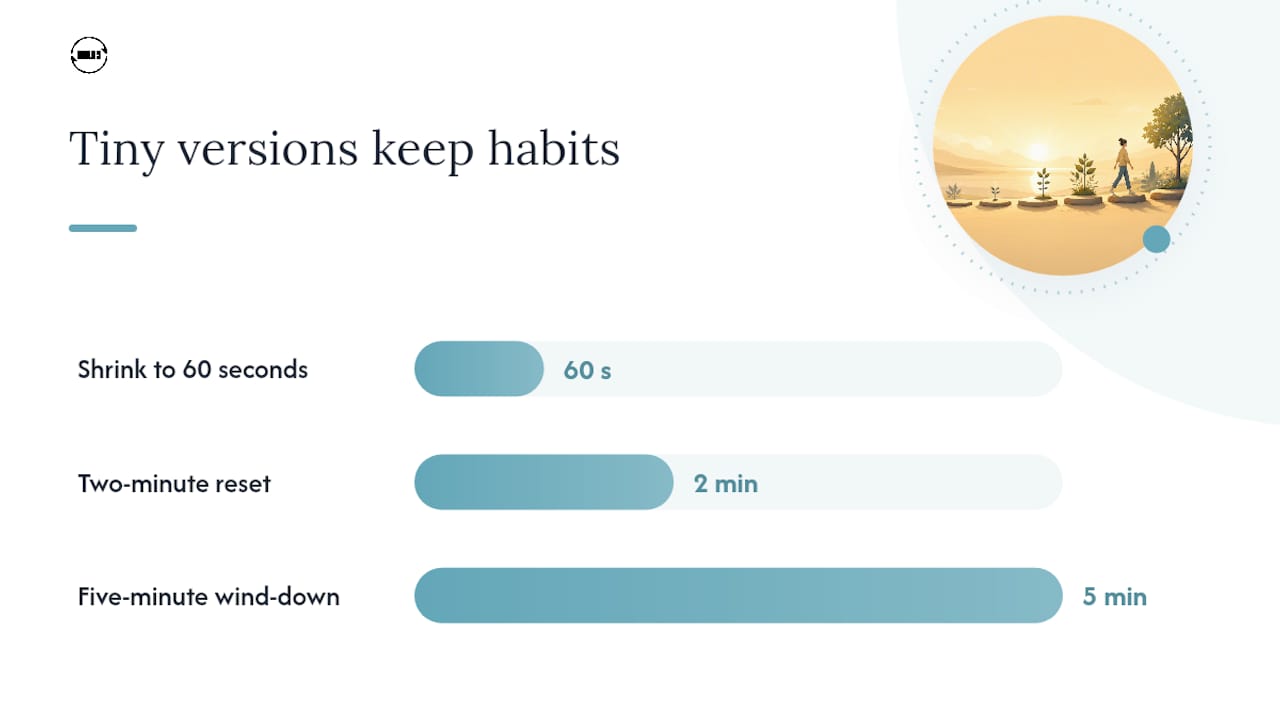
| "I don't have time" | Shrink the habit to 60 seconds; do it anyway |
| Low energy or low mood | Do the physical version only (walk, stretch, water) |
| Forgot for several days | Restart with one habit, not all of them |
| Decision fatigue | Pre-decide the night before; lay out your cues |
| Shift work or irregular schedule | Anchor habits to events (after waking, before first meal) rather than clock times |
| High-stress job | Use the midday reset as a non-negotiable two-minute break |
Parents with young children often find the evening wind-down hardest to protect. A five-minute version, just the body scan and one gratitude note, preserves the habit without requiring ideal conditions.
Pro Tip: On your lowest-energy days, do the two-minute version of your habit. Showing up in a reduced form keeps the neural pathway alive and makes full recovery faster.
When do daily habits stop being enough?
Daily self-care habits are powerful, but they are not a substitute for clinical care when symptoms become severe. If you notice any of the following, reach out to a mental health professional promptly.
- Persistent low mood or hopelessness lasting more than two weeks
- Significant changes in sleep, appetite, or concentration that don't respond to habit adjustments
- Withdrawal from relationships or activities you previously valued
- Thoughts of self-harm or suicide
When you do see a clinician, bring a brief log: how long symptoms have been present, current medications, and your sleep and exercise patterns for the past two weeks. That context helps your provider move faster.
Habit work and clinical treatment are not either/or. The APA explicitly notes that lifestyle interventions complement psychotherapy and medication rather than replace them. For a clear overview of what treatment options look like, Dewycounselling's guide on mental health treatment is a useful starting point. Readers in recovery will also find the self-care in recovery guide directly relevant.
Why Dewycounselling's guidance is worth trusting
Dewycounselling is a psychotherapy practice led by Wayne Dewhurst, providing individual, couples, and family therapy both in-person and online. The guidance in this article draws on the same evidence base that informs clinical sessions at Dewycounselling: peer-reviewed research, public-health frameworks from the APA, NIH, NIMH, and SAMHSA, and direct clinical experience with clients navigating anxiety, depression, relationship stress, and recovery.
Dewycounselling's services include therapy for depression, anxiety, addiction, and relationship conflict, as well as self-help modules and therapy membership packs for clients who want structured support between sessions. If you're ready to pair daily habits with professional guidance, Dewycounselling's therapy services are available online and in-person.
A clinician's perspective on what actually works
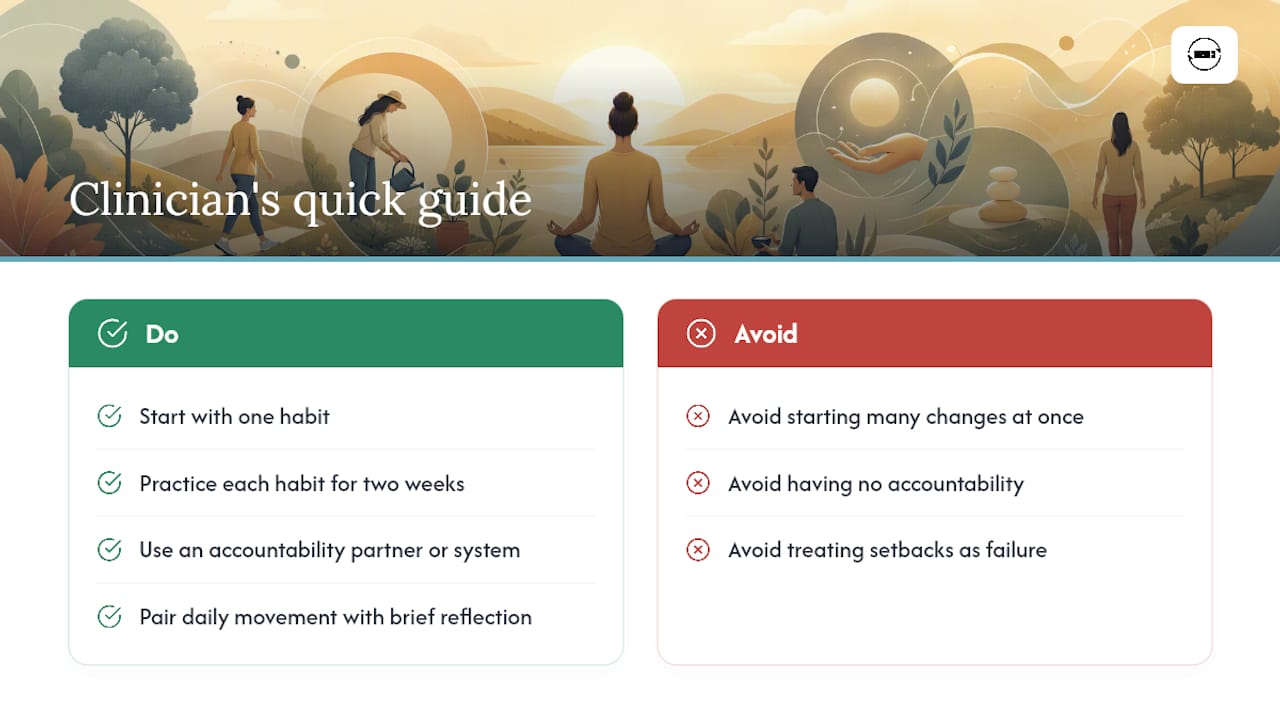
What stands out most in practice is how rarely the habit itself is the problem. Clients who struggle to maintain mental wellness routines almost always cite one of two things: they started with too many changes at once, or they had no one to be accountable to. The clients who make the most durable progress typically start with one habit, practice it for two weeks until it feels automatic, and then add a second.
Setbacks are handled best when they're treated as neutral information rather than evidence of failure. A missed week is not a relapse. It's a prompt to ask what got in the way and whether the habit needs to be smaller, simpler, or better anchored to an existing cue.
The most consistent clinical observation: combining a daily movement habit with even one brief reflective practice, whether that's gratitude journaling, a mindful walk, or a short breathing exercise, produces noticeably better outcomes than movement alone. That aligns directly with what the meta-analysis evidence shows.
If you're working with a therapist, bring your habit log to sessions. It gives your clinician concrete material to work with and turns your daily practice into part of the therapeutic process rather than something separate from it.
Sources
- Lifestyle to Support Mental Health — American Psychiatric Association
- Caring for your mental health — NIMH
- How to Find a Well-Being Habit You'll Actually Stick With — Psychology Today
- Mindful
- Emotional wellness toolkit — NIH
- Five steps to mental wellbeing — NHS