
Mental health is the foundation of well-being that enables you to cope with stress, build meaningful relationships, and function fully in daily life. The World Health Organization identifies mental disorders as responsible for 1 in 6 years lived with disability worldwide, with severe cases shortening life expectancy by 10–20 years. That scale makes mental health not a personal preference but a public health priority. For people in Ontario navigating work, family, and community pressures, understanding why mental health matters is the first step toward protecting it.
Why mental health matters: the foundation of well-being
Mental health is defined as a state of well-being in which a person realizes their own abilities, manages normal life stress, works productively, and contributes to their community. This definition, grounded in the WHO framework, goes far beyond the absence of a diagnosed condition. It describes an active, living resource you draw on every single day.
A 90% consensus among 122 global experts identifies six essential factors of positive mental health: connection, autonomy, purpose, mastery, stability, and happiness. That level of agreement across disciplines is rare. It signals that positive mental health has a clear, measurable structure, not just a vague feeling of "doing okay."
Mental health also operates on a dual continuum, meaning positive well-being and clinical disorders can coexist. You can live with anxiety and still build strong relationships. You can experience depression and still find moments of purpose. This nuance matters because it removes the all-or-nothing thinking that stops many people from seeking support before a crisis arrives.
How does mental health affect physical health?
Mental health and physical health share the same biological systems. Chronic stress from poor mental health is directly linked to higher rates of cardiovascular disease, diabetes, and stroke. These are not abstract risks. They are measurable outcomes that show up in emergency rooms and family doctors' offices across Ontario every day.

The connection runs deeper than stress hormones. A multidimensional framework integrating circadian rhythms, social connections, resilience, and cognitive performance shows that mental health operates through biological, psychological, and social layers simultaneously. Disrupting one layer affects all the others.
Mental health interventions that target sleep, movement, and social environments function as systemic biological treatments, improving cognitive stability alongside physical health. That means a good night's sleep or a regular walk with a friend is not just self-care. It is medicine for your brain and body at the same time.
Key physical and cognitive benefits of good mental health include:
- Stronger immune response and lower inflammation markers
- Better memory consolidation and sharper decision-making
- Improved creativity and problem-solving under pressure
- Reduced risk of chronic illness through regulated stress responses
- More consistent energy and motivation throughout the day
Pro Tip: If you are struggling with sleep or low energy, treat it as a mental health signal, not just a physical one. Addressing both together produces faster, more lasting results.
How does mental health shape your relationships?
Mental health directly shapes how you attach to others, communicate your needs, and sustain empathy over time. When your mental health is strong, you bring more patience, presence, and emotional availability to the people you love. When it is strained, even small conflicts can feel unbridgeable.
Poor mental health increases the risk of relationship stress, social withdrawal, and, in severe cases, family breakdown. Isolation compounds the problem because connection is one of the six essential factors of positive mental health. Losing social bonds does not just feel painful. It actively erodes the psychological resources you need to recover.
Building and protecting your relationships is one of the most direct ways to invest in your mental health. Here are four practical steps that support both:
- Name your emotional state before a difficult conversation. Saying "I feel overwhelmed right now" gives your partner or friend context and reduces reactive conflict.
- Schedule regular low-pressure connection time. A weekly walk or shared meal creates a consistent attachment anchor, even during stressful periods.
- Ask for support before you reach a breaking point. Early requests for help preserve relationships far better than crisis-driven conversations.
- Set boundaries with compassion, not distance. Clear limits protect your energy without cutting off the connection you need.
Pro Tip: Couples and families who seek professional counseling early, before conflict becomes entrenched, report stronger communication outcomes than those who wait for a crisis.
What is the impact of mental health on work and daily life?
Mental health has a measurable impact on how well you perform at work and how fully you engage with daily responsibilities. Workers who maintain good mental health are 12% more productive compared to average workers. That gap compounds over weeks and months into a significant difference in career outcomes and personal satisfaction.
The economic cost of poor mental health falls mostly on lost productivity, not direct healthcare spending. Absenteeism and presenteeism, showing up to work but functioning below capacity, drain individuals and organizations quietly. Many people accumulate these losses long before they seek help or even recognize the problem.
| Mental health state | Work impact | Daily life impact |
|---|---|---|
| Strong mental health | Higher focus, creativity, and output | Consistent routines and meaningful engagement |
| Mild strain | Reduced concentration and motivation | Difficulty managing minor stressors |
| Significant distress | Frequent absences and errors | Withdrawal from social and family activities |
| Untreated condition | Chronic disengagement and burnout | Loss of purpose and daily functioning |
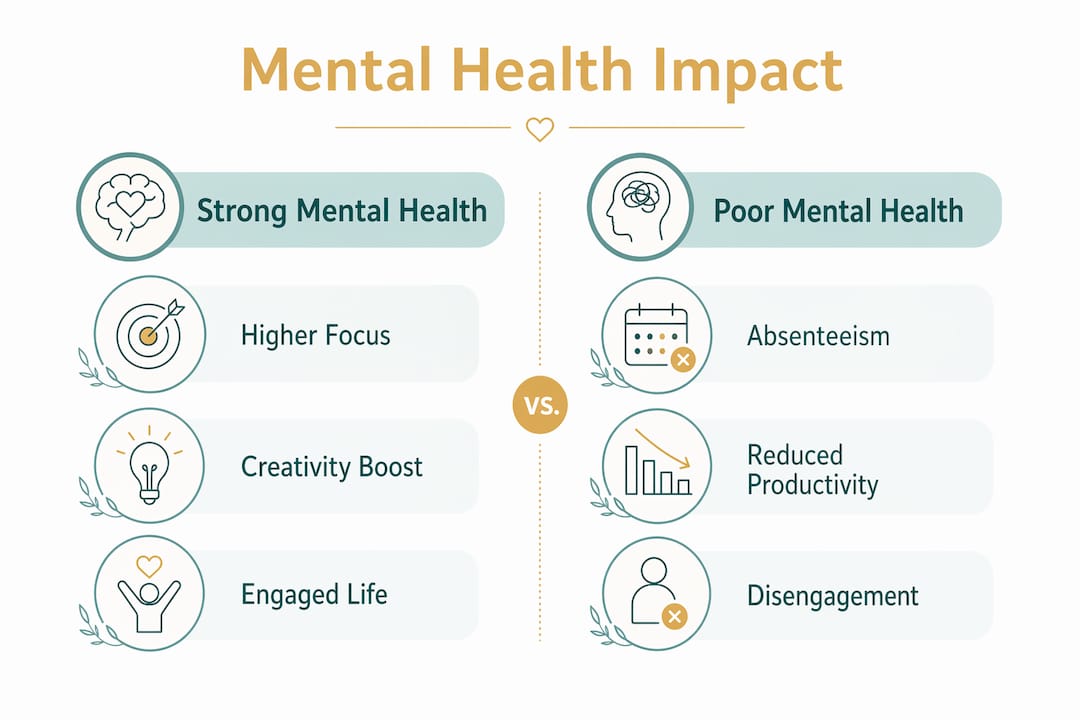
Early intervention prevents invisible productivity losses and long-term disengagement from work and life. Catching mental health challenges early, through therapy, lifestyle changes, or community support, costs far less in time, money, and suffering than waiting for a full breakdown.
What does positive mental health look like and how do you build it?
Positive mental health is not constant happiness. It is the psychological and social capacity to manage life's demands, even during adversity. That distinction matters because many people wait to feel "better" before investing in their mental health, when the investment itself is what creates the capacity to feel better.
The six essential factors identified by global experts provide a practical framework:
- Connection: Meaningful relationships with others and a sense of belonging
- Autonomy: The ability to make choices that reflect your values
- Purpose: A sense of direction and meaning in daily activities
- Mastery: Confidence in your ability to handle challenges
- Stability: Predictable routines and a sense of safety
- Happiness: Moments of genuine positive emotion and satisfaction
Mental health care built on these six factors is proactive, not reactive. You do not wait for a crisis to build autonomy or seek connection. You practice these daily, the same way you brush your teeth or exercise.
Practical ways to strengthen each factor include setting one meaningful goal per week to build purpose, joining a community group to strengthen connection, and working with a therapist to develop mastery over emotional responses. Psychotherapy, particularly approaches used at Dewycounselling, addresses all six factors within a structured, supportive relationship. That is what separates professional care from self-help alone.
| Approach | Best for | Limitation |
|---|---|---|
| Self-directed practices | Building daily habits and stability | Limited support during acute distress |
| Peer support groups | Strengthening connection and belonging | Not a substitute for clinical care |
| Professional psychotherapy | Addressing all six factors with expert guidance | Requires commitment and access |
The multidimensional nature of mental health means no single approach covers everything. The most effective path combines daily habits, social connection, and professional support when needed.
Key Takeaways
Mental health is a measurable, active resource that shapes physical health, relationships, productivity, and daily functioning, and it can be built intentionally through connection, purpose, and professional support.
| Point | Details |
|---|---|
| Mental health is foundational | It underpins physical health, relationships, and productivity, not just emotional state. |
| Six essential factors exist | Connection, autonomy, purpose, mastery, stability, and happiness define positive mental health. |
| Physical health is directly linked | Poor mental health raises the risk of cardiovascular disease, diabetes, and stroke. |
| Productivity loss is real | Workers with good mental health are 12% more productive; losses accumulate before help is sought. |
| Early support changes outcomes | Seeking care before a crisis preserves relationships, work performance, and long-term well-being. |
Mental health as a daily practice, not a last resort
I have worked with enough people to know that the biggest barrier to mental health care is not access. It is the belief that you have to be in crisis before you deserve support. That belief costs people years of quiet suffering and missed connection.
Mental health is not a destination you reach after fixing everything that is wrong. It is a practice you maintain the same way you maintain your physical health. You do not wait for a heart attack to start walking. You should not wait for a breakdown to start talking.
What I find most compelling about the six-factor framework is how ordinary the building blocks are. Connection. Purpose. Stability. These are not clinical concepts. They are the things you already know matter. The research simply confirms what your gut has been telling you. The gap is not knowledge. It is permission to act on what you already know.
Ontario residents have access to real support, including psychotherapy services that meet you where you are, online or in person. The most important step is treating your mental health as a priority before circumstances force you to.
— Wayne
Mental health support available in Ontario
Dewycounselling provides individual, couples, and family therapy for people in Ontario who are ready to invest in their well-being before a crisis demands it.

Whether you are managing relationship stress, work pressure, or simply want to build stronger emotional resources, Dewycounselling offers flexible online and in-person sessions designed to meet your life. The self-help modules and weekly podcasts extend support between sessions, making care accessible on your schedule. Professional therapy at Dewycounselling addresses all six essential factors of positive mental health within a structured, compassionate relationship. Visit Dewycounselling to learn more or book your first session.
FAQ
Why is mental health important for physical health?
Poor mental health is directly linked to higher rates of cardiovascular disease, diabetes, and stroke through biological pathways including chronic stress and inflammation. Treating mental health improves physical health outcomes at the same time.
What are the six factors of positive mental health?
Global experts identify connection, autonomy, purpose, mastery, stability, and happiness as the six essential factors. These are supported by a 90% consensus among 122 researchers worldwide.
How does mental health affect relationships?
Strong mental health supports empathy, communication, and emotional availability, while poor mental health increases the risk of conflict, withdrawal, and social isolation. Connection is itself one of the six core factors of positive well-being.
Can you have good mental health and a mental disorder at the same time?
Yes. Mental health exists on a dual continuum, meaning positive well-being and clinical conditions can coexist. You can live with a diagnosed condition and still build meaningful relationships and a purposeful life.
When should someone in Ontario seek professional mental health support?
Seek support before a crisis, not after. Productivity losses and relationship strain accumulate long before symptoms become severe, and early intervention through psychotherapy produces better outcomes than waiting.
Recommended
- Professional Counselling Services | Online & In-Person Therapy
- Self-help Modules with High-Quality Video Classes - Self-Discovery Journey — DEWY COUNSELLING
- Mobile Psychotherapy Services - Counselling Burlington Ontario — DEWY COUNSELLING
- Counselling & Therapy Services | Dewy Counselling Burlington — DEWY COUNSELLING