
Work-life balance is defined as the ongoing process of managing professional demands alongside personal needs in a way that protects your mental and physical health. This is not a fixed destination you reach once and maintain effortlessly. It requires constant adjustment, self-awareness, and deliberate choices. The 2026 NAMI-Ipsos Workplace Mental Health Poll shows an 11-percentage-point rise in employees reporting feeling "very stressed" since 2024. That number signals a real and growing crisis for working professionals who want to balance work life mental health without sacrificing career progress.
Why does work-life balance matter for mental health?
Poor work-life balance is a direct cause of burnout, anxiety, and depression. These are not abstract risks. They are measurable outcomes tied to specific work patterns that millions of professionals experience every week.
Working more than 55 hours weekly is linked to elevated risks of stroke, anxiety, and depression, regardless of how much sleep you get. That finding matters because it removes the common excuse that you can simply "sleep it off" after a brutal work week. The damage accumulates at the neurological and cardiovascular level.

The physical toll is equally serious. Logging three or more hours of daily overtime carries a 60% higher heart-related health risk. Your heart does not distinguish between a deadline and a threat. Chronic stress activates the same physiological response either way, raising cortisol, increasing blood pressure, and straining the cardiovascular system over time.
The psychological effects compound the physical ones. Professionals who consistently neglect personal time report higher rates of:
- Anxiety and persistent worry tied to unresolved work demands
- Emotional exhaustion that bleeds into relationships and home life
- Cognitive fatigue that reduces decision-making quality at work
- Depression, which research links directly to the absence of restorative hobbies and personal time
Conversely, professionals who protect personal time and engage in hobbies show measurably lower rates of depression. Recovery is not a luxury. It is a biological requirement for sustained performance.
What strategies help professionals create healthy work-life integration?
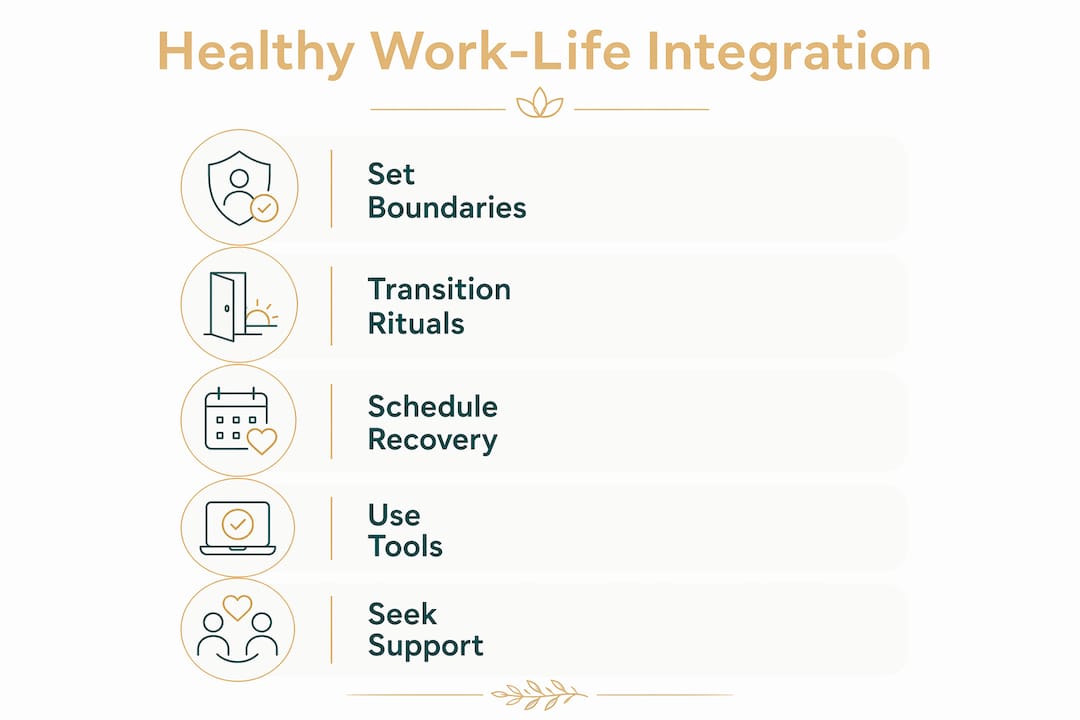
Healthy work-life integration is not about splitting your day in half. It is about creating conditions where work and personal life can coexist without one constantly cannibalizing the other.
The 2026 NAMI-Ipsos poll found that 95% of caregivers identify flexible scheduling as critical for mental health, and 86% cite support groups as essential for maintaining balance. Flexibility is not a perk. It is a structural requirement for sustainable performance.
Here are the most effective strategies professionals use to build healthy work-life integration:
- Set firm work boundaries. Define a clear end time for your workday and communicate it to colleagues. Boundaries only work when they are visible and consistent.
- Create a workday transition ritual. A short walk, a specific playlist, or even changing clothes signals to your brain that work mode is over. This is especially critical for remote workers whose physical environment does not change between roles.
- Practice psychological detachment. Mastery experiences used as active recovery, such as learning an instrument or taking a cooking class, improve mental restoration more effectively than passive rest like scrolling your phone.
- Use mindfulness during personal time. Quality of presence during limited personal time improves both work efficiency and life satisfaction. Being fully present for one hour with your family beats a distracted evening spent half-checking email.
- Schedule recovery time as non-negotiable. Treat personal restoration the same way you treat a client meeting. Put it in your calendar and protect it.
Pro Tip: If you struggle to stop working at a set time, try the "shutdown complete" ritual described by productivity researchers. At the end of your workday, say aloud or write down: "Shutdown complete." This verbal or written cue trains your brain to release work-related rumination and transition into personal time.
The self-help modules offered by Dewycounselling provide structured, video-based tools that help professionals build exactly these kinds of habits with professional guidance behind them.
How do you recognize and overcome common work-life balance challenges?
The biggest obstacle most professionals face is not a lack of knowledge. It is hustle culture, the pervasive belief that overwork signals commitment and that rest is weakness.
This cultural pressure creates an "always-on" default that is genuinely difficult to escape. Notifications arrive at 10:00 PM. Colleagues send messages on weekends. Managers reward visible effort over actual results. The result is a workforce that feels guilty for resting, even when rest is exactly what the body and mind need.
"Managers play a critical role in shifting workplace culture from hustle to rest. When leadership models healthy boundaries, burnout drops and job satisfaction rises across the entire team."
— Psychology professor, as cited in Georgia Magazine
Managers actively supporting boundaries is one of the most powerful levers for reducing staff burnout. Individual effort matters, but organizational culture sets the ceiling. If your manager sends emails at midnight, your personal boundary-setting will always feel like swimming upstream.
Common mistakes professionals make when trying to improve their balance include:
- Skipping self-care during busy periods. This is exactly when self-care matters most, not least.
- Treating balance as a reward. You do not earn rest by finishing everything. Everything never finishes.
- Relying on willpower alone. Systems and rituals outperform willpower every time. Build the structure first.
- Ignoring early burnout signals. Persistent fatigue, irritability, and declining work quality are warning signs, not personality flaws.
Chronic stress left unaddressed does not plateau. It escalates into clinical burnout, which requires significantly more time and support to recover from than early intervention would have. Recognizing the signs early and responding with concrete changes is the most effective form of self-care for employees in high-demand roles.
What does a sustainable work-life balance routine look like?
Work-life balance is a dilemma to manage, not a problem to solve once and forget. That reframe changes everything. It means you stop measuring success by whether you have "achieved" balance and start measuring it by whether you are actively tending to it.
A sustainable routine has three core components: structure, recovery, and flexibility. Structure gives your day predictability. Recovery restores your capacity to perform. Flexibility allows the routine to survive real life without collapsing under pressure.
Recovery time built into the workday strongly correlates with better self-rated health and increased resilience, based on research with Swedish healthcare workers. Short breaks between tasks, a real lunch away from your screen, and a defined end to the workday are not inefficiencies. They are performance investments.
The table below shows how a sustainable routine shifts across different life phases:
| Life phase | Balance priority | Practical adjustment |
|---|---|---|
| Early career | Skill-building | Set learning goals with defined off-hours |
| Parenting years | Family presence | Protect evenings; use flexible scheduling |
| High-demand project | Temporary intensity | Plan explicit recovery weeks after sprints |
| Career transition | Reflection and rest | Reduce commitments; increase personal time |
| Stable mid-career | Maintenance | Audit quarterly and adjust as needed |
Pro Tip: Every three months, do a 10-minute "balance audit." Ask yourself: Am I sleeping enough? Am I spending time on things that matter outside work? Am I feeling resentful or energized? Your honest answers tell you where to adjust before a small drift becomes a full crisis.
Organizations that take this seriously see real results. The Mental Health at Work Index, drawing on data from 149 organizations representing 2.75 million workers across 25 industries, shows that formal mental health strategies with measurement produce lower turnover and higher engagement. Balance is not just good for you. It is good for the business.
Key Takeaways
Protecting your mental health at work requires treating balance as an active, ongoing practice rather than a permanent achievement.
| Point | Details |
|---|---|
| Balance is a process | Treat work-life harmony as something you manage continuously, not a goal you reach once. |
| Overwork carries real health risks | Working more than 55 hours weekly raises stroke, anxiety, and depression risk regardless of sleep. |
| Rituals support transitions | A daily end-of-work ritual helps your brain shift from professional to personal mode effectively. |
| Active recovery beats passive rest | Mastery experiences like learning a skill restore mental energy better than scrolling or TV. |
| Organizational culture matters | Managers who model healthy boundaries reduce burnout across their entire team. |
What I've learned about balance after years of watching professionals struggle
The professionals I work with most often arrive not at a breaking point, but at a slow simmer. They have been managing too much for too long, and they have convinced themselves that this is just what work looks like now. That belief is the first thing that needs to change.
What I have observed consistently is that the people who improve their mental health at work do not do it by working less. They do it by working differently. They build rituals. They protect specific hours. They stop treating rest as something they have to earn. That shift in mindset is more powerful than any productivity app or scheduling trick.
The other thing I want to say plainly: balance looks different at different points in your life, and that is completely normal. A 28-year-old building a career and a 45-year-old managing a family and a promotion are not going to have the same routine. Comparing your balance to someone else's is a losing game. The only useful comparison is between where you are now and where you want to be.
Seeking professional support is not a sign that you have failed at managing your own life. It is a sign that you understand the value of your mental health enough to invest in it. The professionals I see who make the most lasting changes are the ones who combine their own efforts with structured support. Neither alone is as effective as both together.
— Wayne
Professional support for your mental health and work-life balance
Dewycounselling offers individual, couples, and family therapy designed to help you build the communication skills and personal practices that make balance sustainable. Whether you are dealing with work stress, relationship strain, or the quiet exhaustion of doing too much for too long, professional support makes the path forward clearer.
The psychotherapy services at Dewycounselling are available both online and in-person, making it practical to access support around your schedule. If you are ready to move from managing stress reactively to building genuine mental wellness, professional counseling is the most direct route there. You do not have to figure this out alone.
FAQ
What is the definition of work-life balance?
Work-life balance is the ongoing process of managing professional responsibilities alongside personal needs to protect mental and physical health. It is not a fixed state but a dynamic practice that requires regular adjustment.
How does poor work-life balance affect mental health?
Poor balance directly increases the risk of burnout, anxiety, and depression. Working more than 55 hours weekly raises the risk of stroke and mental health disorders regardless of sleep quality.
What are the most effective work life balance tips for professionals?
Setting firm work boundaries, creating end-of-day transition rituals, and scheduling recovery time as non-negotiable are the most effective starting points. Psychological detachment through mastery activities also significantly improves next-day performance.
How do I know if I am experiencing work burnout?
Persistent fatigue, growing irritability, declining work quality, and emotional detachment from your job are the primary burnout indicators. These symptoms signal the need for immediate changes in workload and recovery habits.
Can therapy help with work stress and mental health?
Yes. Structured therapeutic support helps professionals identify patterns, set boundaries, and build sustainable coping strategies. Dewycounselling provides both individual and couples therapy to address the personal and relational dimensions of work stress.
Recommended
- Professional Counselling Services | Online & In-Person Therapy
- Counselling & Therapy Services | Dewy Counselling Burlington — DEWY COUNSELLING
- Mobile Psychotherapy Services - Counselling Burlington Ontario — DEWY COUNSELLING
- Self-help Modules with High-Quality Video Classes - Self-Discovery Journey — DEWY COUNSELLING