
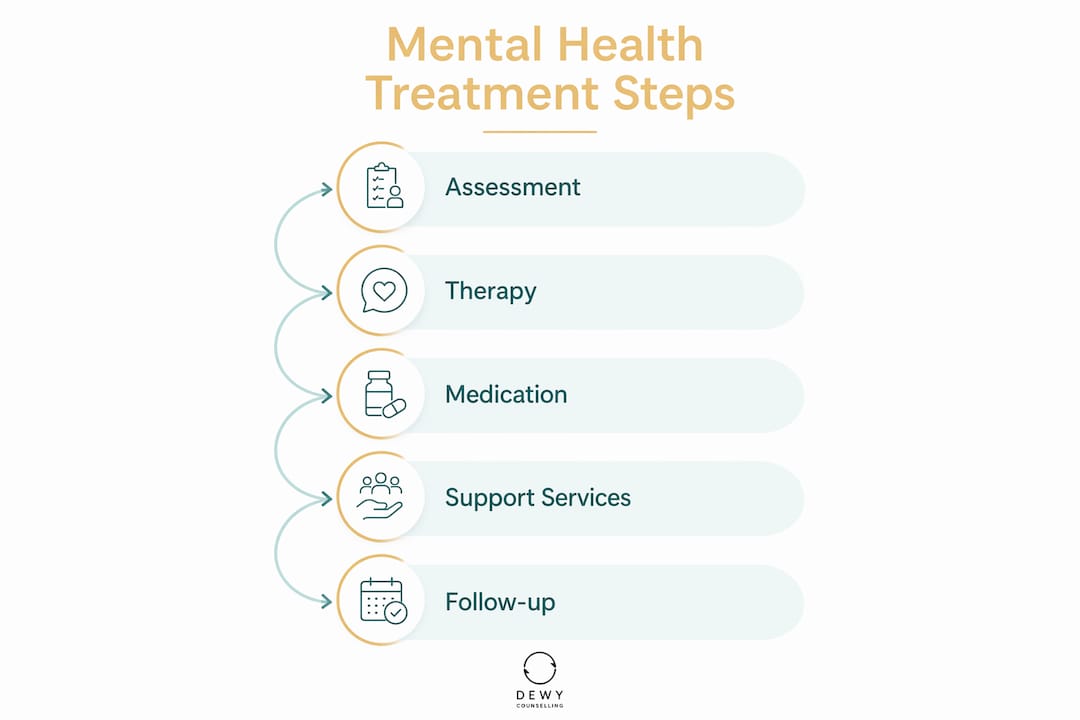
Mental health treatment is defined as a set of evidence-based professional interventions designed to reduce symptoms, restore functioning, and improve quality of life for people living with mental health conditions. These interventions include psychotherapy, medication, and support services, often used in combination. Approximately 22% of U.S. adults are affected by mental illness, with over 5% experiencing serious conditions like schizophrenia or major depressive disorder. That scale means millions of people are actively searching for answers about care. Understanding what mental health treatment actually involves is the first step toward getting the right support.
What is mental health treatment and why does it matter?
Mental health treatment refers to any professional, evidence-based approach used to address emotional, psychological, or behavioral difficulties. The two primary methods are psychotherapy and medication, though support services, peer programs, and psychoeducation also play meaningful roles. Treatment is not reserved for crisis situations. Mental health care is a proactive, ongoing approach to well-being, not just emergency intervention.
Psychotherapy, also called talk therapy or counseling, is the most widely used form of treatment. Psychotherapy is a collaborative process in which a trained professional helps clients identify and change unhelpful thoughts, feelings, and behaviors. The terms "counseling" and "psychotherapy" are often used interchangeably. What matters more than the label is whether the approach matches your goals and needs.

Medication is another major treatment option, particularly for conditions like major depression, bipolar disorder, anxiety disorders, and schizophrenia. Antidepressants, mood stabilizers, anti-anxiety medications, and antipsychotics each target different biological mechanisms. Medication does not cure mental illness, but it can reduce symptoms enough to make therapy more effective.
Support services round out the picture. These include peer support groups, case management, crisis lines, and psychoeducation programs that teach people and their families about specific conditions. Think of these as the scaffolding that holds up the core treatment work.
What are the main types of mental health therapy?
The types of mental health therapy available today are more varied than most people realize. Each approach targets different psychological mechanisms and suits different conditions.
- Cognitive Behavioral Therapy (CBT): CBT identifies the link between distorted thoughts and unhelpful behaviors. It is the most researched therapy for anxiety, depression, and OCD, and it produces measurable results in a short time frame.
- Dialectical Behavior Therapy (DBT): DBT was developed for borderline personality disorder and teaches four core skills: mindfulness, distress tolerance, emotional regulation, and interpersonal effectiveness. It is now used for eating disorders, self-harm, and chronic suicidality.
- EMDR (Eye Movement Desensitization and Reprocessing): EMDR is a trauma-focused therapy. 84–90% of single-trauma PTSD cases no longer meet diagnostic criteria after just three 90-minute sessions. That result is striking and makes EMDR one of the most efficient trauma treatments available.
- Interpersonal Therapy (IPT): IPT focuses on improving communication patterns and resolving interpersonal conflicts. It is particularly effective for depression linked to grief, role transitions, or relationship difficulties.
- Psychodynamic Therapy: This approach explores how past experiences and unconscious patterns shape current behavior. It tends to be longer-term and works well for people with complex or recurring relational difficulties.
- Humanistic Therapy: Humanistic approaches, including person-centered therapy, prioritize self-acceptance and personal growth. The therapist creates a nonjudgmental space where you can explore your values and identity.
Pro Tip: If you are unsure which therapy type fits your situation, ask a potential therapist to explain their primary approach and how it applies to your specific concerns. A good therapist will welcome that question.
Combining medication with psychotherapy often produces better outcomes for serious mental illnesses than either treatment alone. This is especially true for major depressive disorder and anxiety disorders, where medication reduces symptom intensity while therapy builds lasting coping skills.
What does a typical therapy process look like?
Many people avoid therapy because they do not know what to expect. The structure is more predictable than most assume.
- Initial assessment: The first one or two sessions focus on gathering your history, identifying your goals, and establishing a working diagnosis if relevant. This is also when you and your therapist assess whether you are a good fit.
- Goal setting: You and your therapist agree on specific, measurable goals. For CBT, this might mean reducing panic attacks from daily to weekly. For IPT, it might mean improving communication with a partner.
- Active treatment phase: This is the core work. Sessions typically run about 60 minutes, and CBT and Interpersonal Therapy are structured as 12–16 weekly sessions. Each session builds on the last.
- Between-session practice: Evidence-based therapies require active homework and skills practice outside of sessions. In CBT, this might mean keeping a thought record. In DBT, it means completing a diary card. Skipping this step slows progress significantly.
- Review and adjustment: Around the midpoint of treatment, you and your therapist review progress. If goals have shifted or the approach is not working, the plan changes.
- Termination and maintenance: Short-term therapies end with a planned final session that reviews gains and prepares you for maintaining progress independently.
The therapeutic alliance, meaning the quality of the relationship between you and your therapist, predicts treatment success more strongly than the specific therapy type. That finding has been replicated across decades of research. If you do not feel safe, heard, or respected, it is worth raising that concern or finding a different therapist.
Pro Tip: Track your mood and symptoms between sessions using a simple journal or a mood-tracking app. Bringing that data to your therapist gives both of you a clearer picture of what is actually changing.
Short-term therapies differ meaningfully from open-ended approaches. Structured, time-limited protocols are tailored to specific conditions rather than indefinite sessions. Knowing this upfront helps you commit to the process rather than wondering when it will end.
How is mental health treatment tailored to individual needs?
No two treatment plans look the same. A licensed mental health professional builds your plan around your diagnosis, symptom severity, personal goals, cultural background, and practical circumstances like schedule and finances.
Here is how treatment typically adapts across common conditions:
- Anxiety disorders: CBT with exposure therapy is the first-line recommendation. Treatment focuses on gradually confronting feared situations while building tolerance for discomfort.
- Depression: CBT or IPT combined with antidepressants is the most researched approach for moderate to severe depression. Mild depression often responds well to therapy alone.
- PTSD: EMDR and Trauma-Focused CBT are both strongly supported. The choice depends on the nature of the trauma and the person's readiness to process it directly.
- Serious mental illness (SMI): Conditions like schizophrenia or bipolar disorder typically require a combination of medication, psychotherapy, and community support services. Treatment is longer-term and more intensive.
| Condition | Primary therapy | Medication role |
|---|---|---|
| Anxiety disorders | CBT with exposure | Adjunct (SSRIs, SNRIs) |
| Major depression | CBT or IPT | Often combined |
| PTSD | EMDR or Trauma-Focused CBT | Supportive |
| Bipolar disorder | Psychoeducation, CBT | Central |
| Schizophrenia | Supported employment, CBT | Central |
Evidence-based practice means your therapist follows protocols that have been tested in clinical trials. Manualized treatments, where the therapist follows a structured session guide, produce more consistent outcomes than loosely defined approaches. That does not mean therapy feels robotic. A skilled therapist adapts the protocol to your personality and pace while staying true to the evidence.
Treatment is also not only for people in crisis. Therapy supports personal growth and improved functioning well beyond illness treatment. Many people seek therapy to improve relationships, build confidence, or process life transitions like divorce, career change, or grief.
What are the common challenges and misconceptions about mental health treatment?
The biggest obstacle to care is not access or cost, though both matter. Stigma remains the primary barrier preventing people from seeking mental health treatment, even when effective options are available. Many people still associate therapy with weakness or assume it is only for people with severe psychiatric conditions.
Several other misconceptions keep people stuck:
- "Therapy takes years." Most evidence-based therapies are short-term. CBT for anxiety typically concludes in 12–16 sessions. You are not signing up for an indefinite commitment.
- "The right therapy type is everything." The therapeutic relationship predicts outcomes more than the modality. Finding a therapist you trust matters more than finding the "perfect" technique.
- "Medication means I've failed." Medication is a medical tool, not a moral verdict. For many conditions, it creates the neurological stability needed for therapy to work.
- "I should feel better immediately." Therapy requires time and active participation. Progress is often nonlinear, with some weeks feeling harder than others before things improve.
Pro Tip: If you feel stuck after four or five sessions, say so directly. A good therapist will adjust the approach rather than continue with something that is not working.
Engaging effectively in treatment also means practicing self-care strategies in recovery between sessions. Sleep, physical activity, and social connection all support the biological and emotional changes therapy is trying to produce. Treatment works best when it is part of a broader commitment to your well-being.
Key Takeaways
Mental health treatment works best when it combines the right therapy type, a strong therapeutic relationship, and consistent practice between sessions.
| Point | Details |
|---|---|
| Treatment is evidence-based | Approaches like CBT, DBT, and EMDR have strong clinical trial support for specific conditions. |
| Therapy is typically short-term | Most structured therapies run 12–16 sessions, not indefinitely. |
| The relationship drives outcomes | The therapeutic alliance predicts success more than any specific technique. |
| Medication and therapy combine well | For serious mental illness, combining both produces better results than either alone. |
| Stigma is the main barrier | Recognizing stigma as a barrier, not a truth, is the first step toward seeking care. |
What I have learned about mental health treatment after years in practice
People often arrive at therapy expecting the therapist to fix them. That expectation, while understandable, misses what treatment actually is. Therapy is not something done to you. It is something you do with a skilled guide.
The most consistent pattern I have seen is this: the people who make the most progress are not the ones who found the "right" technique. They are the ones who found a therapist they felt genuinely safe with and then showed up willing to do the work between sessions. The therapeutic alliance is not a soft, feel-good variable. It is the engine of change.
I also want to push back on the idea that treatment is only for people who are struggling severely. Some of the most meaningful work I have witnessed happens with people who are functioning well by most external measures but feel disconnected, unfulfilled, or stuck in patterns they cannot name. Therapy gives those patterns a language and a path forward.
If you are considering treatment, do not wait for a crisis to justify it. The benefits of weekly therapy sessions extend well beyond symptom reduction. They include clearer thinking, stronger relationships, and a more grounded sense of who you are. That is worth pursuing at any point in life.
One more thing: finding the right therapist sometimes takes more than one attempt. That is not failure. That is the process working exactly as it should.
— Wayne Dewhurst
How Dewycounselling supports your mental health care
Dewycounselling provides professional, licensed therapy for individuals, couples, and families, both online and in person. Whether you are managing anxiety, depression, relationship difficulties, or simply want to grow, the team at Dewycounselling builds a treatment plan around your specific goals, not a generic template.

Flexible scheduling and mobile psychotherapy options mean care fits your life rather than the other way around. If you are ready to take that first step, professional therapy services are available now through Dewycounselling, with options for both in-person sessions and secure online appointments. You can also learn more about the specific psychotherapy services offered to find the right fit for your needs.
FAQ
What is mental health treatment in simple terms?
Mental health treatment is any professional approach, including therapy, medication, or support services, used to reduce symptoms and improve daily functioning for people with mental health conditions.
What is psychotherapy and how does it work?
Psychotherapy is a talk-based, collaborative process where a trained therapist helps you identify and change unhelpful thoughts, feelings, and behaviors. It is the most widely used form of mental health treatment.
How long does mental health treatment typically last?
Most structured therapies like CBT and Interpersonal Therapy run 12–16 weekly sessions of about 60 minutes each. Open-ended approaches may last longer depending on individual needs.
Can therapy help without medication?
Therapy alone is effective for many conditions, including mild to moderate anxiety and depression. For serious mental illnesses, combining therapy with medication typically produces better outcomes.
How do I know if I need mental health treatment?
If your thoughts, emotions, or behaviors are interfering with work, relationships, or daily life, professional support is worth pursuing. Treatment is also appropriate for personal growth, not only diagnosed conditions.