
Talk therapy is a professional mental health treatment that uses structured conversation between a client and a trained therapist to promote emotional healing and personal growth. The clinical term for this practice is psychotherapy, and the two phrases are used interchangeably throughout the mental health field. Through guided dialogue, you gain the space to express difficult emotions, identify unhelpful thought patterns, and build stronger coping skills. For people in Ontario navigating anxiety, depression, relationship strain, or simply a desire to understand themselves better, psychotherapy offers a clear and evidence-based path forward.
What is talk therapy and how is it defined?
Talk therapy is defined as a category of psychological treatment where conversation itself is the primary tool for change. Unlike medication, which targets brain chemistry directly, psychotherapy works by reshaping how you think, feel, and respond to the world around you. The NHS describes talking therapies as structured treatments delivered by trained professionals across a range of formats, including individual sessions, group work, couples therapy, and family sessions. That breadth matters. It means psychotherapy is not a single rigid method but a family of approaches, each with its own focus and technique.
The goal is not for a therapist to tell you what to do. The therapeutic relationship works because a skilled counselor creates a safe, non-judgmental space where you find your own solutions through collaborative conversation. Being truly heard, without fear of judgment, is itself a mechanism of healing. That insight shapes every credible model of psychotherapy practiced today.

What are the main types of talk therapy?
Several distinct modalities exist within psychotherapy, each targeting different psychological needs. Cognitive Behavioral Therapy (CBT) focuses on identifying and changing distorted thought patterns that drive anxiety, depression, and other conditions. Psychodynamic therapy uncovers unconscious conflicts rooted in past experiences. Humanistic therapy centers on self-actualization and unconditional acceptance. Interpersonal therapy addresses relationship patterns and communication breakdowns. Mindfulness-based approaches teach present-moment awareness to reduce stress and emotional reactivity.
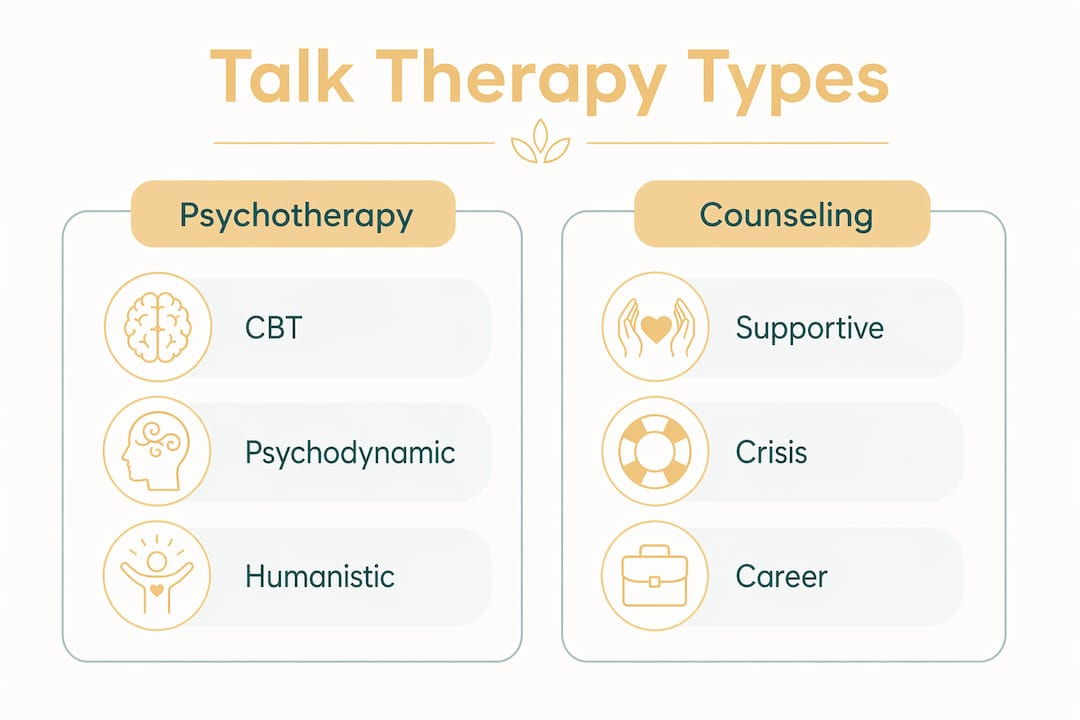
One distinction that confuses many people is the difference between counseling and psychotherapy. Counseling tends to be short-term and solution-focused, addressing present-day challenges like grief, work stress, or a specific relationship conflict. Psychotherapy is typically longer-term and explores deeper psychological layers, including unconscious patterns and early life experiences. Understanding which one aligns with your goals helps you choose the right fit from the start.
| Type | Primary Focus | Typical Benefits |
|---|---|---|
| Cognitive Behavioral Therapy (CBT) | Changing unhelpful thought patterns | Reduced anxiety, depression, and phobias |
| Psychodynamic therapy | Unconscious conflicts and past experiences | Deeper self-understanding and emotional insight |
| Humanistic therapy | Self-acceptance and personal growth | Improved self-esteem and life satisfaction |
| Interpersonal therapy | Relationship and communication patterns | Stronger connections and conflict resolution |
| Mindfulness-based therapy | Present-moment awareness | Stress reduction and emotional regulation |
Sessions can be delivered in-person, by video, or by phone, which increases access for people across Ontario, whether you live in a city or a rural community. Group formats offer peer support alongside professional guidance. Couples counseling and family therapy extend the work into relational systems, not just individual minds.
How does talk therapy work in practice?
The therapeutic process begins with a trained therapist listening carefully and without judgment. Your role is to express your thoughts, feelings, and experiences as openly as you can. The therapist's role is not to give advice or direct your choices but to reflect, question, and guide you toward your own understanding. This collaborative dynamic is what separates psychotherapy from a conversation with a friend or a self-help book.
Specific techniques vary by modality but share common mechanisms. CBT uses cognitive restructuring, where you learn to challenge automatic negative thoughts and replace them with more accurate ones. Psychodynamic work uses free association and reflection to surface unconscious material. Mindfulness-based techniques train attention and reduce emotional reactivity. Across all approaches, emotional expression itself plays a healing role. Naming a feeling reduces its intensity, a process supported by decades of neuroscience research.
- Active listening: The therapist reflects back what you say to deepen your self-awareness.
- Cognitive restructuring: You identify distorted beliefs and test them against evidence.
- Mindfulness practice: You learn to observe thoughts without being controlled by them.
- Emotional processing: You work through difficult feelings in a regulated, supported environment.
- Behavioral experiments: You try new responses to old situations and evaluate the results.
Therapy provides an emotionally regulated environment separate from everyday life, which is precisely what makes lasting behavioral change possible. You are not just venting. You are practicing new ways of thinking and responding in a space designed for that purpose.
Pro Tip: The single strongest predictor of therapy success is the quality of the relationship between you and your therapist. If you do not feel safe or understood after two or three sessions, it is reasonable to try a different counselor.
What are the benefits of talk therapy for mental health?
The benefits of psychotherapy extend well beyond symptom relief. Talk therapy treats anxiety, depression, phobias, and PTSD while also supporting personal growth in people who do not have a diagnosed condition. That second group is larger than most people realize. Many individuals seek therapy to improve communication, build resilience, or work through a life transition like divorce, career change, or grief.
The evidence base is strong. Approximately 75% of people who engage in talk therapy report statistically significant improvement in mood, anxiety reduction, and coping skills after six months. That figure reflects a broad population, not a best-case scenario. It means that for most people who commit to the process, measurable change is the expected outcome, not the exception.
"The act of being truly heard in therapy creates profound healing, empowering clients to discover their own path to wellness." — psychiatrymagazine.com
Beyond symptom reduction, psychotherapy builds skills that transfer into every area of life. You develop stronger self-awareness, which improves decision-making. You build communication skills that strengthen relationships. You gain coping strategies that hold up under real-world pressure. These are not temporary fixes. They are durable changes in how you relate to yourself and others. For people in Ontario managing the pressures of work, family, and daily life, those skills carry lasting value.
One boundary worth understanding: therapists do not diagnose or prescribe medications. When a client's needs go beyond the scope of psychotherapy, a qualified counselor will refer you to a physician or psychiatrist. That boundary protects you and ensures you receive the right level of care.
How to choose the right therapist in Ontario
Choosing a therapist is one of the most personal decisions in mental health care. The right match depends on your specific concerns, your goals, and how you respond to different therapeutic styles. Therapy effectiveness depends greatly on the therapist-client relationship and the cultural fit of the modality. No single approach works for everyone, and that is not a flaw in the system. It is a feature that allows psychotherapy to serve a wide range of people.
Here is a practical framework for making your choice:
- Identify your primary concern. Trauma, anxiety, relationship conflict, and grief each respond best to different modalities. A therapist specializing in trauma-focused CBT is a different fit than one trained in psychodynamic work.
- Ask about their training and approach. A qualified therapist will clearly explain which modalities they use and why those suit your situation.
- Consider format and access. Ontario residents can access in-person and online psychotherapy depending on location, schedule, and personal preference.
- Reflect on cultural fit. Your values, background, and communication style should feel respected, not minimized, in the therapeutic relationship.
- Evaluate the first few sessions honestly. Early discomfort is normal. Feeling dismissed or misunderstood is not.
Pro Tip: Before your first session, write down three things you want to feel or do differently in your life. Bringing that clarity into the room helps your therapist understand your goals from the start.
Red flags include a therapist who gives unsolicited advice, dismisses your concerns, or pressures you toward a specific outcome. A good counselor holds space for your process, not their agenda. Dewycounselling offers individual, couples, and family therapy services in Ontario, with both in-person and virtual options to match your life.
Key Takeaways
Talk therapy, or psychotherapy, is a structured, evidence-based treatment where collaborative conversation drives measurable improvements in mental health, coping skills, and self-awareness for the majority of people who engage with it.
| Point | Details |
|---|---|
| Core definition | Talk therapy uses structured conversation to promote emotional healing and behavioral change. |
| Multiple modalities exist | CBT, psychodynamic, humanistic, and mindfulness-based approaches each serve different needs. |
| Strong evidence base | Approximately 75% of people report significant improvement after six months of therapy. |
| Therapist-client fit matters | Cultural relevance and rapport are the strongest predictors of successful outcomes. |
| Scope of practice | Therapists do not diagnose or prescribe; they refer to medical professionals when needed. |
What I have learned about talk therapy after years in this field
People often come to therapy expecting to be fixed. They want a professional to identify what is wrong and hand them a solution. That expectation is understandable, but it misses what actually makes therapy work.
The most meaningful shifts I have witnessed happen when a person feels genuinely heard, sometimes for the first time. Not evaluated, not advised, just heard. That experience alone begins to change how someone sees themselves and their situation. The techniques matter, but they are secondary to the quality of the relationship in which they are applied.
I have also seen how damaging a poor fit can be. A client who tries one modality with one therapist and finds it unhelpful may conclude that therapy itself does not work. That conclusion is almost always wrong. It usually means the match was off. CBT is not the right tool for every problem, just as a hammer is not the right tool for every repair. Matching the approach to the person, not the other way around, is what separates good therapy from wasted sessions.
The other misconception I encounter regularly is that therapy is only for crisis. Some of the most productive work happens with people who are functioning well but want to understand themselves more deeply, communicate more clearly, or build a more intentional life. Psychotherapy is not a last resort. For many people, it is a first step toward living with greater clarity and purpose.
— Wayne
Talk therapy services at Dewycounselling in Ontario
Dewycounselling offers professional psychotherapy for individuals, couples, and families across Ontario, with sessions available both in-person and online.

Whether you are managing anxiety, working through a relationship challenge, or simply ready to invest in your mental health, Dewycounselling's trained counselors match their approach to your specific needs and goals. The therapy services available include individual psychotherapy, couples counseling, and family sessions, all delivered by specialists who understand the full range of talk therapy modalities. You can also supplement your work with self-help video modules designed to support personal growth between sessions. Reaching out is straightforward, and the first step is simply a conversation.
FAQ
What is the difference between talk therapy and traditional therapy?
Talk therapy and traditional therapy refer to the same thing. Both describe psychotherapy, a structured treatment using conversation to address mental health and emotional challenges.
Is talk therapy effective for anxiety and depression?
Yes. Approximately 75% of people who engage in talk therapy report significant improvement in mood and anxiety after six months, making it one of the most evidence-supported treatments available.
How long does talk therapy take to work?
Counseling for specific, present-day issues can show results in as few as six to twelve sessions. Psychotherapy addressing deeper patterns typically requires longer-term engagement over months or years.
Can talk therapy be done online in Ontario?
Yes. Sessions are available in-person, by video, and by phone, giving Ontario residents flexible access regardless of location or schedule.
What should I look for when choosing a therapist?
Prioritize a therapist whose training matches your specific concern, who respects your cultural background, and with whom you feel genuinely safe and understood within the first few sessions.