
A therapeutic relationship is the professional, collaborative bond between a therapist and client built on trust, empathy, agreed-upon goals, and shared tasks that makes meaningful change possible. According to StatPearls via NCBI, it encompasses the feelings and attitudes both parties hold toward one another and how those feelings are expressed within a structured, nonjudgmental space. Research is consistent on one point: the quality of this alliance meaningfully predicts therapy outcomes, often as much as the specific treatment method used. If you're starting therapy or wondering whether your current sessions are working, this guide gives you a practical framework to understand and evaluate the relationship.
Quick checklist: how to assess your therapeutic alliance right now
- Do you feel genuinely heard and respected in sessions, without judgment?
- Have you and your therapist agreed on what you're working toward and how?
- Do you feel safe enough to bring up difficult or uncomfortable topics?
- When something feels off, does your therapist invite you to talk about it?
If you answered "no" to any of these, the most useful next step is to raise it directly with your therapist. That conversation itself is part of building the alliance.
What makes up the therapeutic relationship?
The most widely used framework in clinical research is Edward Bordin's working-alliance model, which breaks the alliance into three interdependent parts. Bordin's model identifies these as: agreement on goals (what you're working toward), agreement on tasks (how you'll get there), and the emotional bond (the trust and confidence between you and your therapist). When all three are present, therapy has a clear direction and a safe container for doing the hard work.
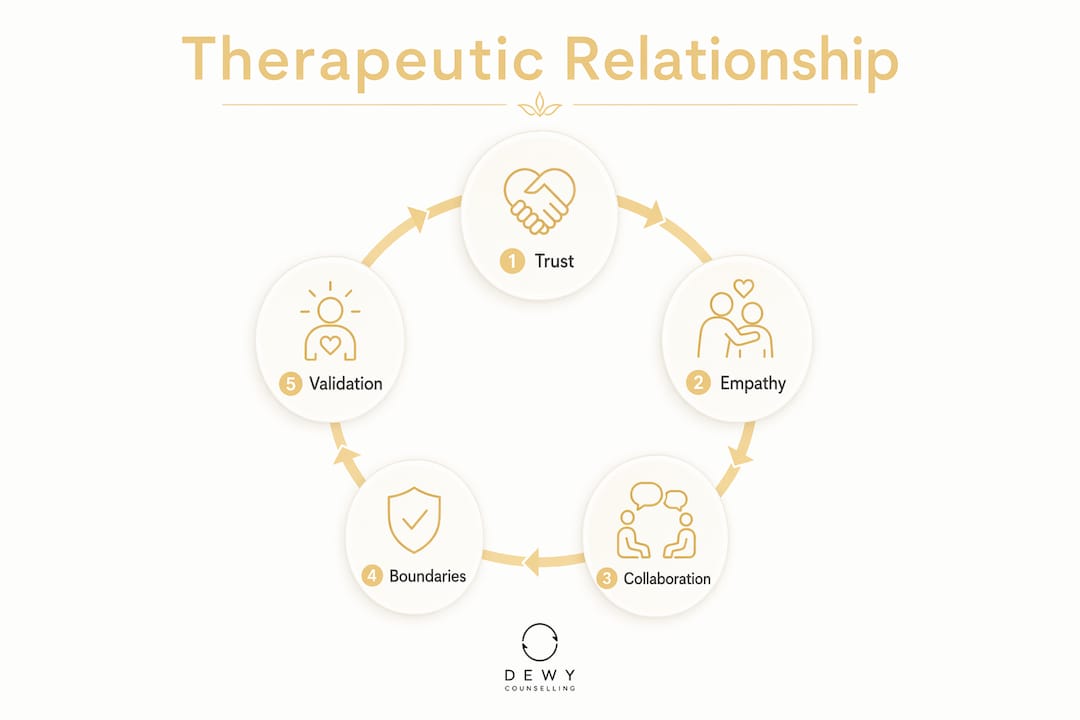
Beyond Bordin's triad, clinical literature and Gelso and Carter's operationalization consistently identify several additional elements:
- Trust: The client's confidence that the therapist is competent, honest, and genuinely invested in their wellbeing.
- Empathy: The therapist's ability to understand and reflect the client's inner experience accurately, not just sympathize.
- Collaboration: Both parties actively shaping the work rather than the therapist simply prescribing and the client complying.
- Transparency: Clear communication about the process, including what to expect and why certain approaches are used.
- Confidentiality: A protected space where disclosures stay private, within legal and ethical limits.
- Professional boundaries: Defined role limits that keep the relationship focused on the client's needs and prevent harm.
Therapist skills that bring these elements to life include reflective listening (paraphrasing and naming what the client seems to feel), attunement (tracking shifts in mood or energy during a session), and creating clear feedback loops where clients can say when something isn't working. These aren't soft extras. They're the mechanics of how a safe, effective relationship gets built session by session.
Pro Tip: If you're unsure what your goals or tasks are, you can simply ask: "Can we talk about what we're specifically working toward and how our sessions are structured?" A good therapist will welcome that question.

Why does the therapeutic relationship matter for outcomes?
The evidence here is both clear and somewhat surprising. Meta-analytic research shows the therapeutic alliance is consistently associated with treatment outcomes across many modalities, with a modest but consistent effect size across multiple meta-analyses that explains a modest portion of outcome variance, which sounds modest until you consider that it holds across diagnoses, treatment types, and settings.
The APA interdivisional task force concluded that specific relationship elements, including the alliance, therapist empathy, and client feedback, are demonstrably effective. Goal consensus and collaboration were rated "probably effective." These aren't soft findings. They represent decades of accumulated clinical research reviewed by independent experts.
John C. Norcross, one of the most cited researchers in this area, describes the relationship as the "heart and soul" of psychotherapy. His summary of evidence-based therapy relationships notes that the relationship accounts for as much client improvement as the specific treatment method in many studies. Therapist empathy alone, in a meta-analysis of 57 studies across 3,599 clients, showed an effect size of r = .30, linking empathic therapist behavior directly to better client outcomes.
For you as a client, this translates into something practical: if the relationship feels wrong, progress is likely to stall regardless of how evidence-based the technique is. Dropout rates are higher when the alliance is weak. Satisfaction is lower. And conversely, a strong alliance tends to carry clients through the difficult stretches of treatment that every meaningful therapy involves.
How do therapists build the alliance in practice?
Building the alliance is not a one-time event at the start of therapy. It's an ongoing process that skilled therapists attend to in every session. The PMC research overview identifies routine feedback collection and regular dialogue about the relationship as professional best practices, not optional add-ons.
Concrete session practices that support alliance-building include:
- Agenda-setting: Starting sessions by checking what the client most needs to address that day.
- Goal review: Periodically revisiting whether the stated goals still fit the client's situation.
- Collaborative task planning: Explaining why a particular approach is being used and asking whether it feels right.
- Asking for feedback: Directly inviting the client to say what's working and what isn't.
- Checking in on the relationship: Naming and exploring any tension or discomfort that arises between therapist and client.
On the interpersonal side, therapists draw on empathy, validation, and genuineness. Validation means acknowledging that a client's feelings make sense given their experience, even when those feelings are painful or inconvenient. Genuineness means the therapist shows up as a real person rather than a blank screen, which research links to stronger alliance ratings. Timely self-disclosure, used sparingly and purposefully, can also deepen trust when it normalizes the client's experience without shifting focus away from them.
Culturally responsive practice matters here too. A therapist who adapts their communication style, acknowledges cultural context, and avoids assumptions about a client's background builds trust faster and maintains it more reliably. Understanding how therapy sessions work can help you recognize these practices when you encounter them.

Pro Tip: You can actively strengthen the alliance by saying something like: "I want to make sure we're working on the right things. Can we take a few minutes to check in on how therapy is going for me?" Most therapists will respond positively and use it as a productive opening.
How is the therapeutic alliance measured?
Clinicians and researchers use structured tools to track alliance quality over time, and the most widely used is the Working Alliance Inventory (WAI). The WAI assesses all three of Bordin's components (goals, tasks, bond) through client and therapist ratings, typically on a short form of 12 items. Scores are compared across sessions to identify shifts, and discrepancies between client and therapist ratings often signal a rupture worth addressing.
Other tools used in practice include session rating scales, which clients complete in the final minutes of a session to give immediate feedback on connection, goals, approach, and overall fit. These brief instruments, often just four items, give therapists real-time data rather than waiting for problems to surface through dropout or stalled progress.
Observable indicators that clinicians watch for alongside formal measures:
- Attendance and punctuality: Consistent attendance signals engagement; frequent cancellations or lateness can indicate alliance strain.
- Openness: Whether the client volunteers information or waits to be asked.
- Task completion: Follow-through on between-session work (journaling, practicing skills) reflects investment in the process.
- Nonverbal cues: Body language, eye contact, and tone of voice often reveal comfort or discomfort before words do.
- Direct feedback: Clients who feel safe enough to say "that didn't feel helpful" are demonstrating a strong alliance.
Reviewing therapy best practices for adults can give you a fuller picture of how evidence-based feedback practices work in real sessions.
Pro Tip: If your therapist hands you a short questionnaire at the end of a session, that's a good sign. It means they're actively monitoring the relationship and using your feedback to adjust. You can answer honestly, including when something felt off.
Understanding transference, countertransference, and alliance shifts
Even in a well-functioning therapeutic relationship, relational dynamics from outside the therapy room tend to show up inside it. This is expected, and working with these dynamics is part of what makes therapy effective.
Transference refers to the way a client unconsciously brings feelings, expectations, or patterns from past relationships into their relationship with the therapist. A client who grew up with a critical parent might feel anxious about the therapist's approval, even when the therapist has given no reason for concern. Recognizing this pattern, rather than simply reacting to it, is one of the ways therapy creates change that generalizes beyond the session.
Countertransference is the therapist's emotional response to the client, shaped partly by the therapist's own history and partly by what the client brings. A well-trained therapist monitors their countertransference and uses it as clinical information rather than acting on it. Supervision and personal therapy are standard professional practices for managing this.
Alliance ratings can also differ significantly between client and therapist. Research shows that clients tend to view the alliance as more stable, while therapists and outside observers report more fluctuation. This asymmetry matters because early negative impressions are harder to change. A client who leaves the first session feeling unheard may not return, even if the therapist felt the session went reasonably well.
Common dynamics clients might notice include:
- Feeling reluctant to share something because you're worried about the therapist's reaction.
- Feeling unusually dependent on the therapist's approval between sessions.
- Noticing irritation or disappointment with the therapist that seems disproportionate.
- Feeling like the therapist reminds you of someone from your past.
None of these are problems to hide. They're material to bring into the room.
How ethics and boundaries protect the therapeutic relationship
Professional boundaries are not about emotional distance. They're the structural conditions that make trust possible. Without them, the therapeutic relationship loses its defining characteristic: that it exists entirely in service of the client's wellbeing.
Core boundary practices that StatPearls identifies as foundational to ethical psychotherapy include:
- Confidentiality: What you share in therapy stays private, with specific exceptions (imminent risk of harm, mandatory reporting requirements, and court orders).
- Limits on dual relationships: A therapist cannot also be your friend, employer, or romantic partner. These overlaps compromise the therapist's objectivity and the client's safety.
- Professional competence: Therapists are ethically required to practice only within their areas of training and to refer clients when a presenting issue falls outside their scope.
- Clear policies: Transparent fee structures, cancellation policies, and session length expectations reduce ambiguity and prevent misunderstandings that can damage trust.
Mandatory reporting is worth noting briefly: therapists in the United States are legally required to break confidentiality in specific circumstances, such as credible threats of harm to self or others, or suspected child abuse. A good therapist will explain these limits at the start of treatment so you're not caught off guard.
If you're beginning therapy and want to understand the boundaries upfront, it's entirely appropriate to ask: "Can you walk me through your confidentiality policy and what the limits are?" That question signals self-awareness, not distrust.
Signs of a strong vs. weak alliance and how to repair ruptures
Knowing what a healthy alliance looks and feels like helps you recognize when something has shifted. Here are the most reliable indicators on both sides.
Signs of a strong alliance:
- You feel safe bringing up topics you've never told anyone else.
- You and your therapist agree on what you're working toward.
- Progress feels real, even when sessions are hard.
- Your therapist invites feedback and responds to it without defensiveness.
- You leave sessions with a clearer sense of yourself or your situation.
Signs of a weak or strained alliance:
- You dread sessions or find reasons to cancel.
- You feel judged, dismissed, or misunderstood.
- You're going through the motions but nothing is shifting.
- You avoid bringing up certain topics because you anticipate a poor response.
- The therapist seems more invested in their approach than in your experience.
When the alliance feels strained, repair is almost always possible and is itself a therapeutic process. Effective repair, as described in evidence-based relationship research, typically follows these steps:
- Name the rupture. Either the client or therapist acknowledges that something feels off.
- Invite the client's perspective. The therapist asks what the client experienced, without defensiveness.
- Validate the client's reaction. Even if the therapist sees it differently, the client's experience is real and worth acknowledging.
- Collaboratively adjust. Goals, tasks, or communication style may need to shift based on what the repair conversation reveals.
- Follow through. The adjustment is implemented in subsequent sessions, not just discussed once.
Repairs tend to succeed when both parties are willing to engage honestly and when the therapist treats the rupture as clinically meaningful rather than inconvenient. When repairs are handled well, clients often report feeling more trust afterward than before the rupture occurred.
When it may be time to consider changing therapists
Attempting repair is almost always worth trying first. But there are circumstances where changing therapists is the right call, and recognizing them protects your wellbeing and your time.
Legitimate reasons to look for a new therapist include:
- Ethical breaches: Any boundary violation (inappropriate self-disclosure, dual relationship, breach of confidentiality without legal cause) warrants immediate action.
- Repeated unresolved ruptures: If you've raised concerns multiple times and nothing changes, the fit may be genuinely incompatible.
- Mismatch in treatment goals: If your therapist is focused on a goal you no longer share and won't adapt, the work loses its foundation.
- Persistent lack of progress: After a reasonable period of consistent effort, if nothing is shifting and the therapist can't explain why or adjust the approach, a second opinion is reasonable.
- Feeling consistently unsafe: Discomfort is normal in therapy; feeling unsafe is not.
If you decide to make a change, the most respectful approach is to raise it in session first when possible. Ask for a referral. Request that your records be transferred to your new provider. Continuity of care matters, and a good therapist will support your transition even if the ending is difficult.
For practical guidance on starting therapy for the first time, including how to find a new provider, that resource walks through the process step by step.
What the research actually shows about the therapeutic alliance
The evidence base for the therapeutic relationship is one of the most consistent bodies of research in clinical psychology. Here's a summary of the key sources and what they contribute.
- Bordin (1979, conceptualized in working-alliance literature): Introduced the goals-tasks-bond framework that became the dominant model for understanding and measuring the alliance across all therapy modalities.
- PMC meta-analytic review: Synthesizes multiple meta-analyses showing a consistent effect size of r ≈ .26 between alliance quality and treatment outcomes, holding across diagnoses and settings.
- APA interdivisional task force: Reviewed decades of research and concluded that the alliance, therapist empathy, and client feedback are demonstrably effective relationship elements.
- Norcross's evidence-based relationship summary: Argues that the relationship accounts for as much improvement as the specific treatment method and that therapist empathy (r = .30 across 57 studies) is a particularly strong predictor.
- StatPearls / NCBI clinical overview: Provides a clinician-facing summary identifying rapport, trust, empathy, collaboration, and ethical boundaries as foundational to psychotherapy.
| Source | Main finding | Practical implication |
|---|---|---|
| Bordin's working-alliance model | Goals, tasks, and bond are the three core components | Clients can use this framework to evaluate whether therapy feels collaborative |
| PMC meta-analytic review | Alliance effect size r ≈ .26 | The relationship predicts outcomes independent of technique |
| APA task force | Alliance and empathy are demonstrably effective | Relationship quality is not secondary to method |
| Norcross summary | Relationship accounts for as much improvement as treatment method | Therapist–client fit is a primary determinant of success |
| StatPearls / NCBI | Trust, empathy, collaboration, and boundaries are foundational | These are the elements clients should expect and therapists should actively build |
For readers who want to go deeper, PMC's clinical overview and the StatPearls entry are the most accessible starting points. Both are peer-reviewed, freely available, and written for a clinical audience that includes informed clients.
Key Takeaways
The therapeutic relationship is the single most consistent predictor of therapy outcomes across modalities, built on Bordin's goals-tasks-bond model and sustained through trust, empathy, and ongoing feedback.
| Point | Details |
|---|---|
| Core definition | The therapeutic relationship is a professional, collaborative bond built on trust, empathy, agreed goals, and shared tasks. |
| Bordin's three-part model | Goals, tasks, and bond are the foundational components; all three must be present for the alliance to function. |
| Alliance predicts outcomes | Meta-analytic research shows the relationship consistently predicts improvement across diagnoses and treatment types. |
| Repair is possible | Naming a rupture, inviting the client's perspective, and adjusting collaboratively can restore and even strengthen the alliance. |
| You can assess it now | Use the opening checklist (safety, shared goals, honest feedback, openness to concerns) to evaluate your current alliance in session. |
The alliance is the work, not just the container for it
Most people entering therapy assume the relationship is the backdrop and the technique is the treatment. The research tells a different story. After decades of meta-analyses and task force reviews, the evidence points consistently in one direction: the quality of the connection between therapist and client is not incidental to the outcome. It is a primary driver of it.
What I find most clinically meaningful about this is the implication for clients. You are not a passive recipient of a therapist's expertise. The alliance is co-created. When you raise a concern, ask for clarification, or tell your therapist that something isn't working, you're not being difficult. You're doing exactly what the research says produces better outcomes. The clients who improve most are often the ones willing to engage with the relationship itself, not just the content of their sessions.
There's also something worth naming about the difference between a therapeutic relationship and a friendship. The boundaries, the professional role limits, the explicit focus on your needs rather than the therapist's: these aren't coldness. They're the conditions that make the relationship safe enough to be useful. A friendship that tried to do what therapy does would collapse under the weight of it.
At Dewycounselling, the alliance is treated as central to every session, whether the work is individual, couples, or family therapy. If you're curious about what that looks like in practice, Dewycounselling's psychotherapy services offer both online and in-person options so you can find the format that makes the relationship easiest to build. Bring your questions. Bring your checklist. The conversation about how therapy is working is always worth having.
Useful sources and further reading
These resources are organized by purpose. Use the clinical overviews for a grounded understanding of the evidence; use the Dewycounselling links if you're ready to take a practical next step.
Research and clinical evidence
- The Therapeutic Alliance: The Fundamental Element of Psychotherapy (PMC) — A peer-reviewed meta-analytic overview of alliance research, including effect sizes and clinical implications. The most accessible academic starting point.
- Psychotherapy and Therapeutic Relationship (StatPearls / NCBI) — A clinician-facing summary covering foundational elements, rapport, and ethical boundaries. Freely available and regularly updated.
- Evidence-Based Therapy Relationships (Norcross summary) — Norcross's synthesis of what the relationship contributes to outcomes, including empathy effect sizes and the case for client feedback.
- APA task force on relationship elements — The interdivisional task force conclusions on which relationship elements are demonstrably or probably effective.
- Bordin's working-alliance conceptualization — The foundational model for goals, tasks, and bond, still the dominant framework in alliance research.
- Enhancing adult therapeutic interpersonal relationships (PMC) — A focused review on how therapists can actively strengthen the alliance in adult psychotherapy.
- Healing and dating: how a therapist can transform your love life — A practical perspective on how therapeutic alliance principles apply in relationship-focused work, including coaching and therapy crossover contexts.
Dewycounselling resources
- Why people seek therapy: honest reasons and real benefits — Useful if you're still deciding whether therapy is right for your situation.
- What is mental health treatment? Your clear guide — A broader primer on mental health care that provides context for where the therapeutic relationship fits.
- Dewycounselling services — Individual, couples, and family therapy, available online and in person.