
The earliest warning signs of addiction relapse are changes in self-care, growing secrecy or isolation, and a return to thoughts or plans about using again. None of these signs require a needle, a drink, or a pill to count. That is the part most people miss, and it is the part that matters most, because relapse is a process that usually starts weeks or months before anyone picks up a substance.
If you or someone you love is showing these signs right now, here is where the risk concentrates:
- Withdrawing from support meetings, sponsors, or therapy sessions
- Slipping on basic self-care: sleep, meals, hygiene, appointments
- Mood swings, irritability, or a flat, checked-out affect
- Talking about old using friends, old places, or "the good parts" of using
- Lying about time, money, or whereabouts
- Cravings that show up more often, or thoughts about planning an opportunity to use
Do this now, in order:
- Get to safety. If there are signs of intoxication, overdose, or suicidal thinking, call 911 or go to an emergency room.
- Remove easy access to substances, prescriptions, or paraphernalia from the immediate environment.
- Call one trusted support person: a sponsor, therapist, or family member who already knows the history.
- Contact a clinician, addiction counselor, or prescriber the same day, not next week.
- Increase check-ins for the next several days. Relapse risk does not resolve in a single conversation.
The clinical framework behind this comes from StatPearls on NCBI Bookshelf, which describes relapse as a three-stage process, and from health systems like Cleveland Clinic, which outline the everyday triggers behind it. Both agree on the same core point: the signs show up long before the substance does.
Key Takeaways
Relapse builds through three stages, emotional, mental, and physical, and the earliest, most treatable signs appear long before anyone uses again.
| Point | Details |
|---|---|
| Watch the early stages | Poor self-care, isolation, and mood swings signal emotional relapse before cravings even begin. |
| Any use is urgent | Treat a lapse the same way you'd treat a relapse: contact a clinician the same day. |
| PAWS extends the risk window | Mood and sleep symptoms can fluctuate for up to two years after acute withdrawal ends. |
| Act within hours, not days | Remove access, contact support, and increase monitoring the moment signs appear. |
| Support that adapts with you | Dewycounselling offers online and in-person therapy to build or revise a relapse prevention plan. |
The Three Stages of Relapse: Emotional, Mental, and Physical
Relapse rarely starts with a drink or a dose. It starts with a mood, then a thought, then a plan. Clinicians describe this progression as three distinct stages, and understanding them is the single biggest advantage you have for catching relapse before it happens.
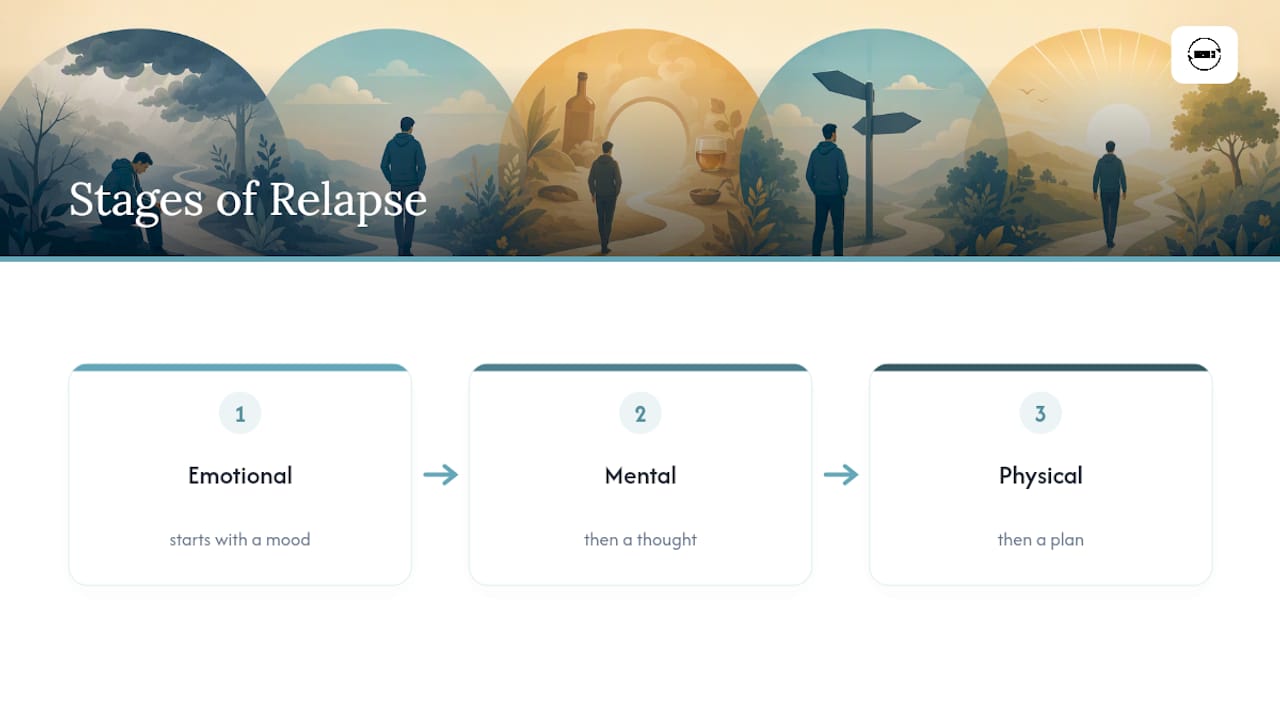
Emotional relapse
Emotional relapse is the quiet stage. There's no craving yet, and the person may swear they're "fine." But underneath, the coping muscles are weakening.
- Isolating from friends, family, or recovery meetings
- Skipping self-care routines like sleep, meals, or exercise
- Bottling up feelings instead of talking them through
- Irritability or unexplained mood swings
- Missing therapy sessions or check-ins
- Poor boundaries, saying yes to things that add stress
- A general sense of "going through the motions"
Left unaddressed, emotional relapse sets the stage for mental relapse because a depleted, isolated person has fewer defenses left when cravings arrive.
Mental relapse
This is the internal tug-of-war stage: part of the person wants to stay in recovery, and part is already negotiating a way out.
- Increasing cravings, sometimes intense and sudden
- Thinking about people, places, or routines tied to past use
- Glamorizing or romanticizing the "old days"
- Bargaining ("just one won't hurt," "I can control it this time")
- Lying about feelings, plans, or whereabouts
- Actively planning a relapse, even in small, deniable ways
- Seeking out opportunities to use, like reconnecting with an old contact
Every one of these signs is documented in the clinical literature as a stage that precedes physical use, not a stage that follows it.
Physical relapse
This is the stage most people think of as "the relapse," but by the time it arrives, the emotional and mental stages have usually been building for weeks.
- Actual substance use, even a single instance
- Rapid escalation back toward prior tolerance levels
- Concealing evidence of use
- Withdrawal or intoxication symptoms
- Sudden financial or scheduling gaps that don't add up
Pro Tip: If you notice signs from more than one stage at the same time, or cravings that are intensifying week over week, that's the moment to escalate care, not wait and see. Contact a clinician before physical relapse, not after.
Common Warning Signs You Can Spot in Everyday Life
Textbook stages are useful, but real life is messier. Warning signs show up in specific, ordinary moments, at the dinner table, in a text message, during a work call. Here's what they actually look like.
- Isolation: They stop answering calls from their sponsor and skip the family barbecue they'd normally attend.
- Decline in self-care: Laundry piles up, showers become sporadic, and they stop showing up to the gym they'd been proud of.
- Mood swings: A snapped response over something small, followed hours later by unusual, forced cheerfulness.
- Cravings: They mention "just thinking about" a drink or a drug more than once in a week, even in passing.
- Glamorizing past use: Stories about "the fun times" start creeping back into conversation, stripped of the consequences that used to follow.
- Lying or secretive behavior: Vague answers about where they were, unexplained cash withdrawals, a phone that's suddenly always face down.
- Minimizing consequences: "It wasn't that bad" replaces the honest accounting they used to give in therapy or meetings.
- Returning to old networks: A reappearing contact from their using days, or a sudden interest in a bar or neighborhood they used to avoid.
One sign on its own rarely means much. Everyone has an off week. What matters is a pattern that builds over several weeks, not a single bad day. If you notice two or three of these together, that's the signal worth acting on, not the first flicker alone.
What Triggers Relapse, and Who's Most at Risk
Triggers fall into two buckets: things happening around a person, and things happening inside them. Both matter, and both are worth naming out loud rather than leaving vague.
External triggers tend to be concrete and often predictable. Cleveland Clinic points to exposure to people or places connected to past use, stress from major life changes, medical situations involving pain medication, and celebrations or anniversaries that carry old associations. A wedding, a funeral, even a holiday that used to revolve around drinking, all of these can quietly raise risk.
Internal triggers are harder to see coming. Stress, loneliness, boredom, and untreated anxiety or depression create the emotional conditions where cravings take hold. Co-occurring mental health conditions raise the stakes further; someone managing both a substance use disorder and an anxiety disorder faces two overlapping risk pathways instead of one.
Life transitions deserve special attention:
- Starting or losing a job
- Divorce, breakup, or major relationship conflict, which is often where relationship-based triggers come into play
- Bereavement or the anniversary of a loss
- Moving, especially back to an old neighborhood
- Completing a treatment program (the drop in structure is itself a risk factor)
Statistic callout: Roughly half of people relapse within the first 12 weeks after intensive inpatient treatment in some clinical samples. That window, right after structured care ends, is when triggers hit hardest and support often thins out fastest.
The triggers most likely to push someone from mental relapse straight into physical relapse are the ones combining access and isolation at the same time: a using contact reappearing while a person is already isolated, or a medical prescription for pain medication arriving during an unmonitored stretch. Therapy, medication management, and regular monitoring all reduce this risk, and the next sections cover exactly how to put those pieces in place.

Post-Acute Withdrawal Syndrome: Why Risk Lingers for Months
Acute withdrawal ends. Post-acute withdrawal syndrome, known as PAWS, does not follow the same clean timeline. It can persist and fluctuate for up to two years, which is one of the most underappreciated facts in relapse prevention.
PAWS symptoms include:
- Mood swings that seem to come from nowhere
- Anxiety or a persistent sense of unease
- Sleep disturbances, including insomnia or restless nights
- Low enthusiasm or motivation, even for things the person usually enjoys
- Difficulty concentrating
- Irritability that ebbs and flows without an obvious cause
| Timeframe | Common symptom pattern |
|---|---|
| First weeks | Sharp mood swings, disrupted sleep, high irritability |
| First few months | Concentration problems, low motivation, anxiety spikes |
| Months to two years | Symptoms fluctuate in waves, often triggered by stress |
Statistic callout: Because PAWS symptoms can persist for up to two years, relapse risk does not disappear once acute detox is over. It simply changes shape, becoming slower and less predictable, but no less real.
Here's the tricky part: PAWS can look almost identical to depression. Low energy, poor concentration, flat mood, these overlap heavily with mood disorder symptoms, and clinicians will often watch progress month-to-month rather than reacting to any single bad day, since a rough Tuesday doesn't mean the whole trajectory has turned.
Pro Tip: Keep a simple weekly log, just a line or two on mood, sleep, and cravings. A pattern across four weeks tells you far more than how any single day felt, and it gives your therapist something concrete to work from.
Lapse vs. Relapse: Why the Difference Shouldn't Change Your Response
A lapse is a single, isolated return to use. A relapse is a loss of control that leads to continued or escalating use. The distinction exists in clinical literature, but here's the catch: leaning too hard on that label in the moment often does more harm than good.
| Feature | Lapse | Relapse |
|---|---|---|
| Pattern | Single instance, often followed by regret | Continued use, escalating frequency |
| Typical response | Reassess triggers, contact support quickly | Requires clinical re-engagement, possible increased care |
| Risk level | Elevated but often manageable with fast action | High, includes tolerance and overdose risk |
| Next step | Return to prevention plan immediately | Contact clinician same day, consider stepped-up treatment |
Clinicians caution that drawing a hard line between "just a lapse" and "a real relapse" can quietly encourage minimization. One use often escalates fast, especially because tolerance drops during periods of abstinence, which raises real overdose risk if someone returns to a previous dose. Treating any return to use as something that needs immediate attention, rather than debating which label it deserves, is the safer instinct every time.
If someone is intoxicated, showing signs of overdose (slowed or stopped breathing, unresponsiveness, blue lips or fingertips), or in dangerous withdrawal, call 911 immediately. Stay with them, keep them on their side if unconscious, and if naloxone is available and you're trained to use it, administer it while waiting for emergency responders. Do not wait to see if symptoms pass on their own.
What to Do the Moment You See Warning Signs
Speed matters here more than perfection. You don't need the ideal words, you need to act.
- Assess immediate safety. Check for signs of intoxication, overdose, or self-harm risk first, before anything else.
- Remove access. Clear out substances, unused prescriptions, or paraphernalia from the home if it's safe to do so.
- Contact one trusted person. A sponsor, therapist, or close family member who already understands the history.
- Reach the clinician or prescriber. Same-day contact, not a message left for later in the week.
- Increase monitoring. Daily check-ins for at least a week, since relapse risk peaks in the weeks right after a warning sign appears, not months later.
For loved ones, how you approach the conversation matters almost as much as the fact that you're having it. Calm, nonjudgmental observations work far better than accusations.
- "I've noticed you've missed a few meetings this week. I'm not upset, I just want to check in."
- "You seem more stressed lately. Is there something going on I can help with?"
- "I care about you, and I'm here if you want to talk about how things are going."
Avoid: "You're relapsing, aren't you?" or "I knew this would happen." Both push people toward defensiveness and away from honesty, which is the opposite of what you need in this moment.
Call 911 or a crisis line immediately if you see signs of overdose, severe intoxication, or suicidal ideation. For lower-urgency situations, SAMHSA's national helpline is a solid starting point for referrals to local treatment and support.
Once the immediate danger has passed, low-effort next steps make a real difference: restart meeting attendance this week, call a sponsor today, and schedule an urgent therapy check-in rather than waiting for the next regularly scheduled session.
Building a Relapse Prevention Plan That Actually Works
A relapse prevention plan is not a one-time document. It's a living tool, and the best ones get revised after every close call, not just written once and filed away.
A workable plan includes six parts:
- Known triggers: the specific people, places, situations, and emotional states that raise risk for this particular person.
- Early warning signs: the individual's personal version of emotional and mental relapse signs, written in their own words.
- Coping skills: specific techniques, not vague intentions, for the moment a craving hits.
- Support contacts: names and numbers, saved in a phone, not just remembered.
- Professional resources: therapist, prescriber, and treatment program contact information.
- Emergency steps: exactly what to do, and who to call, if things escalate quickly.
Coping skills work best when they're rehearsed before they're needed:
- Grounding: Name five things you can see, four you can hear, three you can touch. It interrupts the spiral of a craving in real time.
- Urge surfing: Picture the craving as a wave. It rises, peaks, and falls, usually within 20 minutes, whether or not you act on it.
- Breathing: Four counts in, hold for four, six counts out. Simple, and it works because it calms the nervous system directly.
- Distraction: A short walk, a call to a support contact, or a specific task lined up in advance.
- Medication reminders: A phone alarm or pillbox system, especially important if medication-assisted treatment is part of the plan.
Therapy, medication management, monitoring, and peer support all serve different roles. Therapy addresses the thought patterns driving cravings. Medication can reduce the physical intensity of cravings for certain substances. Monitoring catches drift early. Peer support offers the kind of accountability a clinician alone can't provide. When warning signs intensify, increasing the intensity of any one of these, more frequent sessions, closer monitoring, more meetings, is almost always the right move. Working through cognitive distortions tied to glamorizing past use is often a useful piece of that therapeutic work.
Pro Tip: Test the plan when things are calm, not just when a crisis hits. Walk through it with your therapist every few months, and always revise it after any lapse. A plan that hasn't been updated since it was written is a plan that's already out of date.
What Clinicians Actually Watch For
Therapists don't diagnose relapse from a single session. They track patterns across weeks, looking for the same signals family members often miss because they're too close to notice gradual change.
Clinicians pay attention to increasing secrecy, disengagement from treatment (canceled sessions, vague answers, resistance to specific questions), and shifts in how someone talks about their own recovery. Someone who used to speak in detail about their coping strategies and suddenly gives one-word answers is telling you something, even if they don't say it directly.
Common interventions include:
- Cognitive behavioral therapy focused specifically on craving management
- Medication review, adjusting dosage or type as needed
- Increased monitoring frequency, sometimes including check-ins between sessions
- Contingency management, using structured incentives to reinforce recovery behaviors
- Stepped-up care, moving from weekly to twice-weekly sessions, or adding a higher level of program support
A therapist checking in might sound less like an interrogation and more like this:
That kind of question opens a door instead of forcing a confession, and it's the same principle self-awareness work in therapy is built around: naming a pattern without attaching blame to it.
A therapist's note on why early action matters
Relapse feels frightening to talk about, but it's common, and it's preventable far more often than people expect. The earlier someone reaches out, whether it's a client noticing their own drift or a family member noticing it first, the more options are available and the less dramatic the intervention needs to be. Asking for help at the emotional or mental stage isn't a sign of weakness. It's the single most effective thing a person can do for their own safety, and it's a strength worth recognizing every time it happens.
How Dewy Counselling Supports Recovery and Relapse Prevention
Dewycounselling offers a faster path back to stability than waiting to see if things get worse on their own. Through in-person and online psychotherapy, you can get addiction-informed support without the delay of a long waitlist or the pressure of walking into an unfamiliar clinic. Sessions focus on building a real relapse prevention plan, working through the emotional and cognitive patterns behind cravings, and adjusting the intensity of support as your situation changes. Whether you're the person noticing your own warning signs or a loved one trying to figure out how to help, Dewycounselling's psychotherapy services can meet you where you are, in person or online. Reach out through the website to request an assessment or an urgent consult, confidentially and at your own pace.
Frequently Asked Questions
What are the earliest warning signs of addiction relapse? The earliest signs are emotional, not physical: poor self-care, isolation from support systems, mood swings, and skipping meetings or therapy sessions. These typically appear weeks before any actual substance use.
How can I tell the difference between a lapse and a relapse? A lapse is a single, isolated use; a relapse involves continued or escalating use. Clinicians caution against focusing too much on the label, since one use often progresses quickly, and any return to use deserves same-day attention.
How long does relapse risk last after treatment? Post-acute withdrawal symptoms can persist and fluctuate for up to two years, meaning relapse risk doesn't disappear once acute detox ends. It changes shape and often becomes harder to predict day to day.
What should I say to a loved one showing signs of relapse? Lead with calm, specific observations rather than accusations: "I've noticed you've missed a few meetings, I'm not upset, I just want to check in." This approach reduces defensiveness and increases the chance they'll accept help.
When should I call emergency services instead of a clinician? Call 911 immediately for signs of overdose, severe intoxication, or suicidal ideation. For lower-urgency warning signs, contact a clinician or use a resource like SAMHSA's helpline the same day.
This article is general information, not a substitute for advice from a qualified doctor. Consult a qualified healthcare professional about your own circumstances before acting on anything here.
Sources
- Addiction Relapse Prevention - StatPearls - NCBI Bookshelf
- Relapse prevention and the five rules of recovery - PMC
- Treatment and recovery - National Institute on Drug Abuse (NIDA)
- Substance Abuse and Mental Health Services Administration (SAMHSA)
Share this list with your clinician or treatment team. It gives them a shared starting point for talking through your specific triggers and warning signs.