
The first and most important step after leaving a toxic relationship is to create safety and clear contact boundaries, then stabilize your daily routine. Before anything else, confirm you are physically safe. If you are not, contact the National Domestic Violence Hotline at 1-800-799-7233 (available 24/7) or text "START" to 88788. Once safety is secured, tell one trusted person what you are going through, limit or cut contact with your former partner, and secure any shared documents, finances, or passwords that could be used against you.
Immediate actions to take in the first 24–72 hours:
- Confirm physical safety and, if needed, create a safety plan with a counselor or advocate
- Set a no-contact rule or, where children or shared obligations require communication, a structured contact agreement (text only, specific topics only)
- Tell one trusted friend, family member, or colleague what is happening
- Secure important documents (ID, financial records, lease agreements) and change shared passwords
- Contact a professional, even if you don't feel "in crisis" — early support shortens recovery time
Recovery from toxic love typically takes time, depending on the severity of the relationship, your support network, and whether you have access to professional help. Most clinical guidance and community accounts suggest healing spans several months to a few years; individual timelines vary considerably. Dewycounselling offers both in-person and online individual psychotherapy for people navigating exactly this kind of recovery, and a first session can happen sooner than most people expect.
How do you actually start healing from a toxic relationship?
Recovery is not linear, and it does not reward rushing. Think of it less like a sprint and more like physical rehabilitation after an injury: the early weeks are about reducing inflammation and restoring basic function, not about running again yet. The Cleveland Clinic recommends journaling objective facts and dates as one of the first concrete tools to rebuild trust in your own memory after gaslighting, and that practice can start today.

Week 1–2: Safety and stabilization
Your nervous system has likely been in a state of chronic stress. The priority now is basic regulation: consistent sleep times, regular meals, and at least one brief outdoor walk per day. These are not trivial suggestions. When your body is dysregulated, emotional processing is nearly impossible. Protect your sleep window above almost everything else.
Limit contact with your former partner as much as your situation allows. If you must communicate (co-parenting, shared lease), write out a short script and stick to it:
- "I'm only able to discuss [specific topic] right now. Please contact me by text for anything related to [child's name / lease]."
- "I'm not in a position to have that conversation. I'll respond to practical matters only."
These scripts feel awkward at first. Use them anyway. Consistency is what builds the boundary, not the perfect phrasing.
Weeks 3–8: Emotional processing and support-building
Once basic stability is in place, grief tends to surface. This is healthy. Overcoming emotional abuse means allowing yourself to mourn what the relationship was, what you hoped it would become, and the version of yourself you may have set aside to survive it. Lean on your support network during this phase. If you have not already told a trusted friend the full picture, this is the time.

Begin a simple reality journal. Each entry takes five minutes: write the date, a brief description of what happened, and how you felt. Separate objective facts from your interpretation of them. This practice, endorsed by trauma-informed clinicians, directly counteracts the self-doubt that gaslighting leaves behind. Over weeks, you will accumulate evidence that your perceptions are reliable.
Pro Tip: Keep your reality journal in a private, password-protected app or a locked notebook. The act of securing it reinforces that your experiences are real and worth protecting.
Start identifying self-care practices that genuinely restore you, not ones you think you should enjoy. A short list of three to five practices works better than an ambitious wellness plan you abandon by week two. Good starting options include a consistent morning routine, a weekly call with a supportive friend, and one physical activity you actually like.
Months 2–6: Rebuilding identity and patterns
This phase is where deeper work begins. You may notice recurring thoughts about the relationship, moments of longing even when you know the relationship was harmful, and confusion about who you are outside of it. All of this is normal. Recovery from emotional abuse unfolds across multiple stages, and identity repair is one of the most time-intensive.
Begin identifying relationship patterns: what drew you to this person, what you tolerated, and how you responded to conflict. This is not self-blame work. It is pattern recognition, and it is what prevents the same dynamic from repeating. A therapist can guide this process more efficiently than self-reflection alone.
Protect yourself from quick re-engagement. The pull toward a new relationship can feel like healing, but it often reflects a nervous system seeking familiar intensity rather than genuine readiness. Most clinicians suggest waiting until your daily functioning has stabilized and you can reflect on the previous relationship without overwhelming distress before dating again.
How long does recovery take, and what stages will you go through?
Healing is variable. Clinical guidance and survivor accounts consistently note that recovery typically spans several months to a few years for full healing from a serious toxic relationship. The factors that most influence your timeline include the severity and length of the relationship, whether physical or sexual abuse was involved, your prior trauma history, the quality of your support network, and whether you engage professional help.
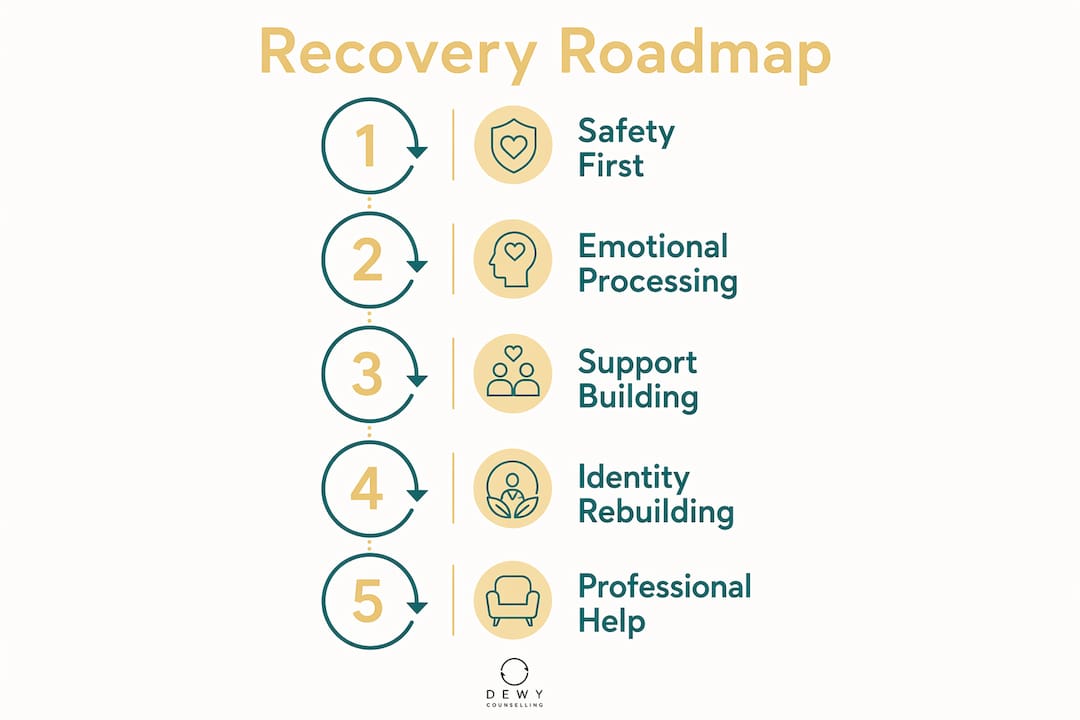
Common emotional stages
Shock and relief often arrive together in the first days and weeks. You may feel numb, disoriented, or strangely calm. This is your nervous system processing a major threat removal. It does not mean you are "fine."
Grief and longing follow, sometimes weeks later. You may miss your former partner even while knowing the relationship was harmful. This is one of the most confusing parts of recovering from toxic love, and it is entirely normal. Grief is not evidence that you made the wrong choice.
Anger and processing tend to surface once the grief softens. Anger is often a sign that your sense of self is returning. It means you are beginning to recognize what was done to you. Let it move through you rather than suppressing it or acting it out.
Identity rebuilding is the longer arc. You start to rediscover preferences, values, and ways of being that the relationship may have suppressed. This stage often benefits most from therapy.
Reengagement with life looks like restored routines, renewed interest in friendships and activities, and the ability to consider the future without dread.
Practical milestones to watch for:
- Fewer intrusive thoughts about your former partner during daily tasks
- Clearer sense of your own boundaries and comfort with enforcing them
- Restored sleep, appetite, and basic self-care routines
- Ability to reflect on the relationship without overwhelming panic
- Renewed interest in friendships, hobbies, or work
- Capacity to consider future relationships without fear dominating the thought
Recovery milestone: Verywell Mind notes that observable signs of progress include reduced intrusive thinking, more stable daily routines, and restored self-care — not a dramatic single moment of "being over it."
Week-by-week and month-by-month signs of progress:
- Weeks 1–4: Sleep and appetite begin to stabilize; you have told at least one trusted person; contact with your former partner is limited or structured
- Months 1–3: Grief is present but not constant; you are using at least one daily grounding or journaling practice; support network is active
- Months 3–6: Anger is processing; identity questions are surfacing; therapy, if started, is producing insight
- 12+ months: Most intrusive thoughts have reduced significantly; you can describe the relationship with clarity rather than chaos; you are building toward a life that feels like yours
Why did this happen, and how do you avoid repeating it?
Toxic relationships rarely form from a single cause. They usually develop from a combination of relational patterns and situational factors, and understanding those patterns is one of the most protective things you can do for your future.
Trauma bonding forms when cycles of tension, harm, and reconciliation create a powerful emotional attachment. The intermittent reinforcement of kindness after cruelty is neurologically similar to other compulsive patterns, which is why leaving can feel physically painful even when you know the relationship is harmful.
Insecure attachment styles (anxious, avoidant, or disorganized) shape how you respond to intimacy and conflict. Someone with an anxious attachment style may tolerate more harm to avoid abandonment; someone with a disorganized style may find chaos familiar in ways that feel like love.
Gaslighting is a pattern of manipulation in which a partner systematically undermines your confidence in your own perceptions, memories, and judgment. Over time, it erodes your ability to trust yourself, which is why rebuilding epistemic trust (confidence in your own reality) is a core part of recovery.
Intermittent reinforcement is the mechanism that makes trauma bonds so difficult to break. When positive experiences are unpredictable, the brain works harder to pursue them, creating an attachment that can feel stronger than one built on consistent care.
Self-audit: mapping your patterns
Work through these prompts in your journal, or with a therapist:
- What first attracted you to this person? Were any of those qualities ones you had been taught to prioritize?
- What did you tolerate in the first three months that you would not have accepted from a friend?
- How did you typically respond when your partner criticized you or denied something you remembered?
- What did you tell yourself to explain away behavior that felt wrong?
This is not an exercise in self-blame. Psychology Today frames this kind of reflection as a route to reclaiming agency: understanding your role in patterns is what gives you the power to choose differently, not evidence that you caused the harm done to you.
"Taking responsibility for your patterns is not the same as accepting blame for someone else's abuse. Recognizing where you were vulnerable, what you tolerated, and why — that is the work that actually changes your future relationships." — Psychology Today
| Pattern | Common signals | What helps |
|---|---|---|
| Trauma bonding | Intense pull to return despite harm; physical withdrawal symptoms after separation | Trauma-informed therapy; no-contact support; psychoeducation on bonding cycles |
| Anxious attachment | Fear of abandonment; difficulty tolerating partner distance; over-apologizing | Attachment-focused therapy; self-compassion practices; boundary work |
| Gaslighting impact | Self-doubt; difficulty trusting own memory; chronic second-guessing | Reality journaling; trauma-informed CBT; rebuilding epistemic trust |
| Intermittent reinforcement | Craving contact even after harm; minimizing bad episodes; hope cycles | Psychoeducation; structured no-contact; behavioral pattern mapping |
When should you seek professional help, and how do you choose a therapist?
Seek professional help when symptoms are interfering with daily life, when your safety is at risk, or when self-help efforts have stalled after several weeks. You do not need to be in acute crisis to deserve support. If you are sleeping poorly, struggling to concentrate at work, withdrawing from friends, or finding that intrusive thoughts dominate your day, those are sufficient reasons to reach out.
Healthline notes that individual therapy is often the recommended starting point, particularly when only one partner wants to change. Couples therapy can be appropriate when both people are genuinely committed to change and when the relationship did not involve abuse dynamics that make joint sessions unsafe.
Therapy approaches worth knowing
Trauma-informed individual therapy is the broadest and most flexible option. A trauma-informed therapist understands how chronic stress and relational harm affect the nervous system and will not push you to process faster than your system can handle.
Cognitive Behavioral Therapy (CBT) helps identify and restructure distorted thought patterns, including the self-blame and catastrophizing that often follow emotional abuse.
EMDR (Eye Movement Desensitization and Reprocessing) is particularly effective for processing specific traumatic memories that remain vivid and distressing. It does not require you to talk through every detail of what happened.
Narrative therapy helps you reauthor the story you tell about yourself and your relationship, separating your identity from the harmful narrative your former partner may have imposed on you.
Trauma-informed care is the common thread across effective approaches. Not every therapist has specific training in emotional abuse recovery, and that experience genuinely changes outcomes.
Questions to ask a potential therapist in a first session
- Do you have experience working with survivors of emotional abuse or gaslighting?
- What therapeutic approaches do you use for relationship trauma?
- How do you handle it if I feel overwhelmed or dissociated during a session?
- Do you offer remote sessions, and what is your crisis protocol between appointments?
- What does a typical course of treatment look like for someone in my situation?
Practical steps for finding a therapist quickly:
- Check Psychology Today's therapist finder and filter by "trauma" and "relationship issues"
- Ask about sliding-scale fees or reduced rates if cost is a barrier
- Community mental health centers often offer lower-cost sessions
- Teletherapy platforms expand access if local options are limited
- Confirm the therapist's licensure through your state's licensing board
U.S. crisis resources:
- National Domestic Violence Hotline: 1-800-799-7233 (24/7)
- Crisis Text Line: text HOME to 741741
- SAMHSA National Helpline: 1-800-662-4357 (mental health and substance use)
- NCADV safety planning resources
Signs your relationship may need professional attention include persistent anxiety, difficulty functioning at work, and an inability to set or maintain basic limits with your former partner.
What daily tools actually help you stabilize and rebuild?
Emotional recovery requires daily practice, not occasional effort. The tools below are short, repeatable, and grounded in trauma-informed guidance. Start with one or two, not all of them at once.
Grounding practices
Box breathing (4 counts in, 4 hold, 4 out, 4 hold) activates the parasympathetic nervous system within minutes. Use it when a trigger hits or before a difficult conversation. Three to five cycles is enough.
Sensory grounding (5-4-3-2-1): Name five things you can see, four you can touch, three you can hear, two you can smell, one you can taste. This interrupts a trauma response by anchoring you in the present moment.
A simple five-minute morning routine can anchor the whole day: one glass of water, three box breaths, and writing one sentence about how you feel right now. That is it. Consistency matters more than complexity.
Journaling templates
Fact log: Date, time, what happened (objective description only), and how you felt. Keep the facts and feelings in separate columns. This is the Cleveland Clinic-endorsed technique for rebuilding trust in your own perceptions after gaslighting.
Evidence vs. interpretation: Draw a line down the page. On the left, write what you observed. On the right, write what you concluded from it. Over time, you will see where your interpretations are accurate and where old relational wounds are coloring your reading of events.
Prompts to start with:
- "Today I noticed I felt [emotion] when [specific event]. The facts were..."
- "One thing I know to be true about myself that this relationship tried to take away is..."
- "A boundary I held today, or wish I had held, was..."
Boundary scripts for common situations
- Blocking: No message needed. Blocking is a complete sentence.
- Limited contact (co-parenting): "I'll respond to messages about [child's name] within 24 hours. Please keep communication to that topic."
- Responding to manipulation: "I'm not going to engage with that. If you have a practical matter to discuss, I'm available by text."
Building your support system
Tell one trusted person the full picture this week. Not a summary, the real version. People cannot support what they do not understand. If you are worried about burdening friends, guidance on how to support someone seeking therapy can help them understand how to show up for you.
Consider a support group, either in-person or online. Hearing others name experiences that mirror yours is one of the fastest ways to reduce the isolation that toxic relationships tend to create.
Pro Tip: Set up one accountability structure around no-contact: tell a trusted friend your plan and ask them to check in with you once a week. External accountability reduces the likelihood of breaking contact during a vulnerable moment by giving you a pause point before you act.
Self-care practices for mental health that are evidence-based and sustainable can help you build a routine that actually holds during difficult weeks.
Key Takeaways
Healing from a toxic relationship requires safety and clear boundaries first, then stabilization, then professional support and daily practice — in that order, not all at once.
| Point | Details |
|---|---|
| Safety and boundaries come first | Confirm physical safety, set no-contact or structured contact rules, and tell one trusted person within 24–72 hours. |
| Recovery takes time | Healing commonly spans several months to a few years; progress is measured in milestones, not a single moment of resolution. |
| Daily tools build the foundation | Box breathing, reality journaling, and consistent morning routines stabilize the nervous system and rebuild self-trust over time. |
| Professional help changes outcomes | Trauma-informed therapy, CBT, or EMDR can significantly shorten recovery and interrupt repeating patterns — seek help when daily functioning is affected. |
| Dewycounselling offers guided support | Individual and online psychotherapy through Dewycounselling provides structured, professional recovery support for survivors of toxic relationships. |
The part of recovery most people underestimate
Most articles about recovering from toxic love focus on what to do. Far fewer address the hardest part: tolerating the ambiguity of not knowing yet who you are on the other side of it.
Survivors often arrive at therapy expecting to process the relationship and then return to a prior version of themselves. That is not how it works. The relationship changed you, and the goal of recovery is not restoration to a pre-relationship state. It is the construction of something more grounded, more boundaried, and more honest than what existed before. That is a longer project, and it requires more patience than most people give themselves.
There is also a clinical distinction worth naming: recovery and rebuilding are not the same thing. Recovery addresses the damage, the dysregulation, the distorted self-perception, the grief. Rebuilding is what comes after, when you are constructing a life and an identity that reflects who you actually are. Conflating the two leads people to push toward rebuilding before recovery is solid, which tends to produce the rebound relationships and repeated patterns that make healing feel impossible.
The therapist's role in this process is not to tell you what to feel or how quickly to move. It is to help you restore safety, rebuild epistemic trust in your own perceptions, and then support the integration of what happened into a coherent life narrative. That work is possible. It takes longer than most people want it to, and it is worth every week.
If you are reading this and feeling overwhelmed, that is not a sign you are doing it wrong. It is a sign you are in the middle of something real. Guided support makes the middle part shorter.
Dewycounselling supports your recovery, step by step
Recovery from a toxic relationship is not something you have to figure out alone, and it moves faster with the right professional support. Dewycounselling offers individual psychotherapy, both in-person and online, specifically designed to help people work through relationship trauma, rebuild self-worth, and develop the boundaries and self-trust that protect against future harm. Sessions are structured, confidential, and paced to where you actually are, not where you think you should be.

Whether you are in the early days of leaving or months in and feeling stuck, a first session with Dewycounselling gives you a clear picture of what treatment would look like for your specific situation. Relevant services include individual trauma-informed therapy, support for anxiety and depression that often accompany relationship harm, and couples counselling for situations where both partners are committed to genuine change. When you book, bring your questions: ask about the therapist's experience with emotional abuse, how sessions are structured, and what the crisis protocol looks like between appointments. Book your first session at Dewycounselling and take the one step that makes every other step easier.
Useful resources and hotlines
Crisis and safety resources:
- National Domestic Violence Hotline: 1-800-799-7233 (24/7 call or chat at thehotline.org) — call when safety is at immediate risk or you need help creating a safety plan
- Crisis Text Line: Text HOME to 741741 — text-based support for acute emotional distress
- SAMHSA National Helpline: 1-800-662-4357 — free, confidential referrals for mental health and substance use support
- NCADV — the National Coalition Against Domestic Violence; provides safety planning tools and local resource referrals
Authoritative reading:
- Cleveland Clinic — How to heal from emotional abuse: Clinician-reviewed guidance on recovery steps, including the reality-journaling technique
- Healthline — Toxic relationship signs and coping: Practical overview of signs, coping strategies, and when to seek help
- Psychology Today — Healing from toxic relationship patterns: Therapist-authored perspective on responsibility, patterns, and recovery
- Verywell Mind — Identifying and coping with emotional abuse: Detailed breakdown of emotional abuse signs and recovery milestones
- Psychanatomy — Emotional abuse complete guide: In-depth resource covering trauma bonding, gaslighting, and multi-stage recovery
- self-compassion.org: Dr. Kristin Neff's research-based resources on self-compassion practices, directly relevant to building self-esteem after toxicity
Dewycounselling:
- Individual and online psychotherapy services — book a session or learn about treatment options
- Dewycounselling home — primary booking page for in-person and online therapy