
Cognitive distortion in addiction describes how habitual, biased thinking errors both drive and maintain addictive behavior. The core mechanism is straightforward: a distorted thought triggers a feeling (shame, hopelessness, craving), which then pushes behavior (using, avoiding, relapsing). What makes this pattern so persistent is that these thoughts feel completely true, like your own voice rather than a filter. The encouraging reality is that thinking errors are treatable, and cognitive behavioral therapy (CBT) is the primary evidence-based path for dismantling them.
Here is what you will find in this article:
- The ten most common distortions seen in addiction, with real examples
- How these thought patterns sustain use and raise relapse risk
- Practical exercises you can start today to identify your own patterns
- What CBT treatment looks like and when to seek professional help
What are cognitive distortions and how do they fuel addiction?
Cognitive distortions are habitual, biased thinking patterns, often called thinking errors, that distort reality in ways that feel entirely rational from the inside. Psychologist Aaron Beck first mapped these patterns in the 1960s as part of his cognitive model, showing that automatic thoughts shape emotional states, which then drive behavior. In addiction, that loop becomes a trap: a distorted thought ("I can handle just one drink") produces a feeling of permission or relief, which makes using feel justified.
"Cognitive distortions are internal mental filters or biases that increase our misery, fuel our anxiety, and make us feel bad about ourselves. Our brains are continually processing lots of information. To deal with this, our brains seek shortcuts." — Harvard Health
What makes distortions particularly stubborn in addiction is that they operate on two levels simultaneously. They are both a symptom of the disorder and a mechanism that sustains it. Research published on PubMed frames distortions as creating persistent denial of severity and a "partial control" illusion, where a person can exert short-term restraint in high-stakes situations but still fails at long-term abstinence. The distortion is not a character flaw. It is a learned cognitive pattern, and that distinction matters for how you approach treatment.
What are the most common cognitive distortions in addiction?
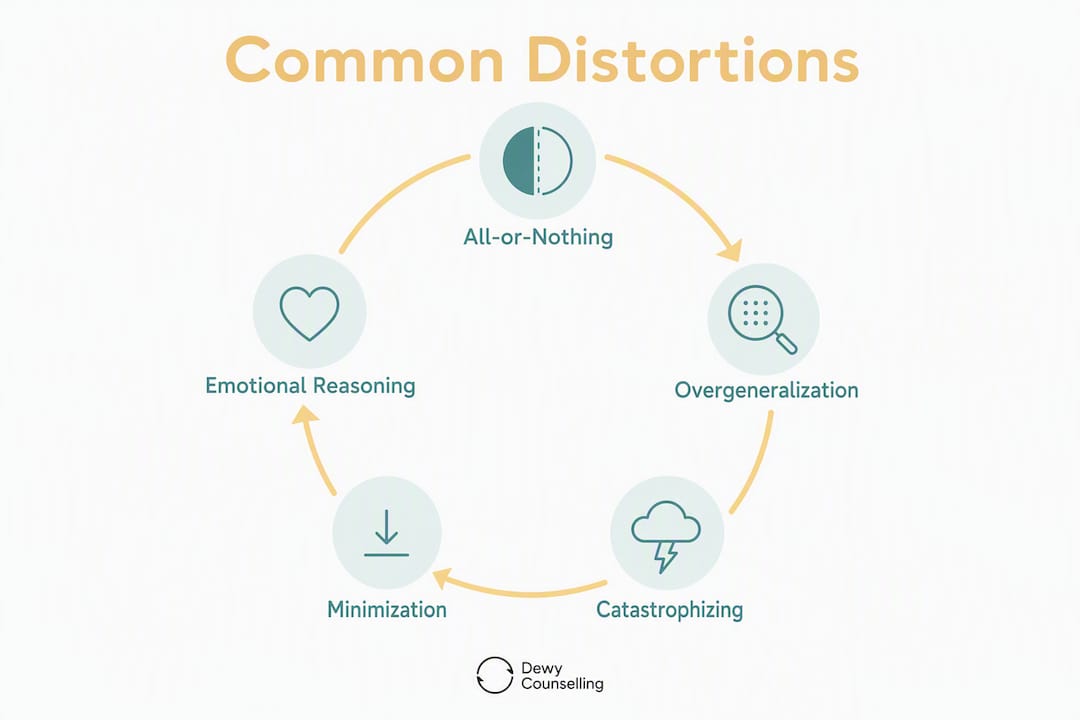
StatPearls on NCBI identifies ten core distortions linked to psychopathology and treatment. Each one has a recognizable form in addiction:
- All-or-nothing thinking: "I used once, so I've completely failed." One slip becomes total collapse, making it harder to course-correct after a minor setback.
- Overgeneralization: "I always end up relapsing. I'll never get better." A single event becomes a permanent pattern.
- Mental filtering: Focusing only on the craving or the bad day while ignoring three weeks of progress.
- Discounting the positive: "Anyone could have stayed sober that long. It doesn't count." Achievements get dismissed before they can build confidence.
- Mindreading/fortune-telling: "My family thinks I'm hopeless anyway" or "I know I'll use again at that party." Assumptions replace facts.
- Catastrophizing: "If I feel this anxious without using, something is seriously wrong with me." Normal discomfort gets magnified into a crisis.
- Emotional reasoning: "I feel like using, so I must need it." The feeling becomes the evidence.
- "Should" statements: "I should be over this by now." Rigid rules create shame when reality doesn't match expectations.
- Labeling: "I'm an addict. That's just who I am." A behavior becomes a fixed identity that forecloses change.
- Personalization/blame: "My stress is everyone else's fault, so using is their fault too." Responsibility gets deflected outward.
Recovery-focused research notes that distorted interpretations of setbacks, particularly the "one slip equals total failure" version of all-or-nothing thinking, are among the most common triggers preceding relapse.
Pro Tip: When a thought feels absolutely certain, that certainty itself is worth questioning. Distortions feel true precisely because they are familiar. Try labeling the thought by type ("that's all-or-nothing thinking") before you respond to it. Naming it creates a small but real gap between the thought and your reaction.
How do cognitive distortions sustain and worsen addiction?
Understanding the mechanism helps you interrupt it. There are five specific pathways through which distorted thinking keeps addiction going:
- Justification and minimization. Thoughts like "I've had a hard week, I deserve this" or "It's not that bad" lower the perceived cost of using. Automatic negative thoughts are implicated in both initiating and continuing addictive behaviors, with distorted beliefs about a substance actively driving misuse.
- Altered reward valuation. Distortions inflate the perceived benefit of using ("This is the only thing that helps me relax") while shrinking the perceived cost. Over time, this skews decision-making toward short-term relief.
- Distorted risk assessment. The partial-control illusion, described in PubMed research on impaired control, leads people to genuinely believe they can manage use when the evidence says otherwise.
- Stress-response amplification. Chronic substance exposure affects prefrontal cortex functioning, reducing the brain's capacity for balanced evaluation. Under stress, distorted shortcuts fill the gap, and the brain reaches for the familiar pattern of use.
- Denial and the partial-control illusion. "I can stop whenever I want" is not a lie told to others; it is a genuinely held belief shaped by distorted cognition. This makes external intervention feel unnecessary.
Consider a brief scenario: a person in early recovery has a difficult conversation with a family member (situation). The automatic thought arrives: "They'll never trust me again" (catastrophizing). That thought produces shame and hopelessness (feeling), which intensifies craving (urge), which leads to use (behavior), which then reinforces the belief that they cannot cope without the substance (reinforcement). The loop closes.
Co-occurring depression and anxiety amplify every step. Mental health conditions and addiction interact in ways that compound relapse risk, because the same distortions that fuel low mood also fuel the justification for use. Treating one without addressing the other leaves the cycle intact.

How can you identify and track your own cognitive distortions?
The most therapist-tested tool for catching distortions before they escalate is the thought record. Here is a basic version you can use today:
- Describe the situation. Where were you? What happened? Keep it factual, no interpretation yet.
- Write the automatic thought. What went through your mind immediately? Write it word for word.
- Name the emotion and rate its intensity. Shame (80%), anxiety (60%), hopelessness (90%). Numbers help you track change over time.
- Gather evidence for and against the thought. What facts support it? What facts contradict it? This is where building self-awareness in therapy pays off, because you start to see the thought as a hypothesis, not a verdict.
- Write an alternative, balanced thought. Not a forced positive, just a more complete picture: "This conversation was hard, and it doesn't mean trust is permanently gone."
- Re-rate the emotion. Even a 10-point drop in intensity is meaningful progress.
A few practical habits that support this work:
- Keep a small notebook or use a notes app to capture thoughts within minutes of a trigger, before the emotion fades and the thought becomes invisible again.
- Set a five-minute journaling cue tied to an existing habit (morning coffee, evening wind-down) so the practice builds without requiring willpower.
- Ask a trusted support person to gently flag when your language sounds absolute ("always," "never," "everyone").
- Track the context of each distortion: time of day, mood, social setting. Patterns emerge quickly.
Pro Tip: You do not need to challenge every distortion in the moment. Sometimes the most useful step is simply writing it down and labeling it. Therapists teach clients to pause, label a thought, and test evidence rather than aim for perfect rationality. That pause is the skill.
When self-monitoring reveals the same distortions recurring despite your efforts, or when distortions are accompanied by severe depression, unsafe use, or inability to function, that is the signal to move from self-help to professional care.

How do therapists treat cognitive distortions in addiction?
CBT is the gold standard for addressing thinking errors in addiction, and the evidence behind it is consistent. The Mayo Clinic describes CBT as time-limited, structured, and built around self-monitoring and homework, making it a practical fit for people who want measurable progress. Published clinical research on cognitive restructuring for alcohol-use samples shows reductions in distortion scores following structured interventions delivered over weeks to months.
What a typical course of CBT for addiction looks like:
- Duration: Usually 12–20 sessions, though complex presentations or co-occurring disorders may extend this.
- Frequency: Weekly sessions, with daily homework between appointments.
- Session content: Thought monitoring, cognitive restructuring, relapse-prevention planning, and behavioral experiments (testing whether the feared outcome actually occurs).
- Homework: Daily thought records, trigger logs, and brief behavioral experiments that build evidence against distorted beliefs.
| Therapy approach | Primary focus | Role in addiction treatment |
|---|---|---|
| CBT | Identifying and restructuring distorted thoughts | Gold standard; reduces relapse risk and builds coping skills |
| Motivational Interviewing (MI) | Resolving ambivalence about change | Useful in early stages when motivation is low |
| Dialectical Behavior Therapy (DBT) | Emotion regulation and distress tolerance | Helpful when emotional dysregulation drives use |
| Relapse Prevention (RP) | Anticipating and managing high-risk situations | Directly targets distortion-driven relapse triggers |
Effective therapy treats distorted thinking as a learned neurocognitive adaptation rather than a moral failing. That reframe reduces shame and improves engagement, which matters because shame itself is one of the most powerful relapse-driving emotions. Practical success depends on repeated, specific cognitive restructuring exercises combined with relapse-prevention planning tied to tracked triggers.
When should you seek professional help for cognitive distortions?
Self-help exercises are a genuine starting point, but some situations call for professional support from the beginning. Consider reaching out to a therapist if you notice:
- Repeated relapse despite sincere efforts to stay sober
- Unsafe or escalating substance use
- Co-occurring severe depression or anxiety that does not lift with rest or self-care
- Inability to function at work, in relationships, or with daily responsibilities
- Distortions so automatic and rapid that you cannot catch them before acting on them
An initial intake assessment with a therapist typically covers your substance use history, current mental health symptoms, any co-occurring diagnoses, and your goals for treatment. From there, a treatment plan is built that may include individual CBT, group therapy, medication evaluation, or a combination.
On the practical side: many therapists offer sliding-scale fees, and teletherapy options have made access significantly easier. When contacting a provider, it is reasonable to ask directly about session costs, insurance billing, and whether a reduced fee is available. SAMHSA's national helpline is a free, confidential resource for finding treatment options in your area.
Short-term CBT (12–16 sessions) is often appropriate when distortions are the primary concern and substance use is not at a medically dangerous level. Longer-term integrated care is typically recommended when there are co-occurring disorders, a history of multiple relapses, or complex trauma. Personal goals integrated into a treatment plan significantly improve outcomes, so coming to an intake with a clear sense of what you want from recovery is genuinely useful.
This article provides general information, not professional medical or clinical advice. Please consult a qualified therapist or healthcare provider to discuss your specific situation.
Key Takeaways
Cognitive distortions are both a symptom and a sustaining mechanism of addiction, and CBT is the primary evidence-based treatment for identifying and restructuring them.
| Point | Details |
|---|---|
| Distortions sustain addiction | Thinking errors like minimization and the partial-control illusion actively maintain use and raise relapse risk. |
| Ten core patterns to watch | All-or-nothing thinking and catastrophizing are among the most common relapse-driving distortions in addiction. |
| Thought records work | A six-step thought record (situation, thought, emotion, evidence, alternative, re-rate) is the foundational self-help tool. |
| CBT is the gold standard | Structured CBT over 12–20 sessions, with daily homework, produces measurable reductions in distortion scores. |
| Dewycounselling offers a path forward | Individual psychotherapy and CBT-informed sessions are available in-person and online through Dewycounselling. |
The part of recovery most people underestimate
Most people entering recovery focus on the substance. They count days, manage cravings, and restructure their environment. What they often underestimate is how much of the real work happens at the level of thought, specifically in the quiet, automatic narratives that run before any conscious decision is made.
The "partial control" finding from addiction research is worth sitting with. People in active addiction are not simply choosing pleasure over responsibility. Their cognitive architecture has been reshaped by chronic use and, often, by years of learned distortions that predate the addiction itself. Telling someone to "just think differently" without giving them a structured method is like telling someone with a broken leg to walk it off.
What actually moves the needle is consistent, specific practice: one thought record per day, a labeled distortion, a tested prediction. Progress is not linear, and backsliding is part of the skill-building process, not evidence that the approach has failed. Peer support and group settings add something individual therapy alone cannot fully replicate: the experience of hearing your own distortions reflected back by someone who has held the same thought and found a way through it. Self-care practices that stabilize mood during recovery create the conditions where cognitive work can actually take hold.
The most honest thing a clinician can say is this: the thinking errors that sustain addiction are not a sign of weakness or low intelligence. They are a sign that your brain learned to protect you in the only way it knew how. The goal of therapy is not to shame those patterns out of existence but to build new ones alongside them, until the new ones become the default.
Dewycounselling can help you work through these patterns
Recognizing your own cognitive distortions is a meaningful first step. Changing them consistently, especially under the pressure of cravings and stress, is where professional support makes a real difference.

Dewycounselling offers individual psychotherapy for addiction, anxiety, and depression, available both in-person and online, so you can access structured CBT-informed care in the format that fits your life. Sessions are designed to move beyond conversation into skill-building: thought monitoring, cognitive restructuring, and relapse-prevention planning grounded in your specific triggers and patterns. Self-help modules are also available for those who want to begin working between sessions or before booking a first appointment.
Book a session or explore psychotherapy options to take the next concrete step toward recovery.
Useful sources and further reading
These resources were selected for their clinical authority, evidence base, and practical relevance to cognitive distortions and addiction recovery. Consider bringing one or two to a therapy session as a starting point for discussion.
- Cognitive Behavior Therapy, StatPearls, NCBI Bookshelf — Peer-reviewed clinical overview of CBT, including the ten core cognitive distortions and their treatment implications.
- Impaired Control in Addiction Involves Cognitive Distortions, PubMed — Research on the partial-control illusion and how distortions sustain long-term relapse risk.
- Addiction and Cognition, PMC/NIH — Neuroscience review of how chronic substance use alters prefrontal functioning and promotes distorted reasoning.
- Cognitive Behavioral Therapy, Mayo Clinic — Accessible clinical summary of CBT structure, session content, and what to expect from treatment.
- How to Recognize and Tame Your Cognitive Distortions, Harvard Health — Practical, reader-friendly explanation of distortions as mental filters, with guidance on defusing them.
- SAMHSA Find Help — Free, confidential national resource for locating addiction treatment and mental health services in the United States.