
The treatments that reliably reduce symptoms of generalized anxiety disorder are cognitive behavioral therapy and, when needed, SSRIs or SNRIs. Many people see the biggest gains when they combine both. The realistic first step is a proper evaluation, followed by regular follow up and some adjustment along the way. Recovery is rarely instant, but it is genuinely achievable.
TL;DR:
- Combining cognitive behavioral therapy and medication yields the most significant symptom reduction for moderate to severe GAD.
- Medication such as SSRIs or SNRIs typically takes several weeks to show full benefits, with regular follow-ups crucial for adjustment.
- CBT is most effective when delivered in 12 to 20 weekly sessions, focusing on skills like cognitive restructuring and graded exposure.
- Lifestyle changes like maintaining consistent sleep, limiting caffeine and alcohol, and practicing relaxation techniques support formal treatment but are insufficient alone for serious cases.
- Treatment success depends on sustained, collaborative care, with progress often seen through small improvements over time rather than dramatic changes.
What Diagnostic Criteria Point to Generalized Anxiety Treatment?
Generalized anxiety disorder is diagnosed when worry shows up more days than not for at least six months and it interferes with daily life. That is the clinical threshold, not just "feeling anxious sometimes." The worry tends to jump between topics, work, health, relationships, finances, and rarely settles even when one concern resolves before another takes its place.
Clinicians look for a cluster of symptoms alongside the worry itself. You do not need every symptom on this list, but several together, persisting for months, is what separates ordinary stress from a treatable disorder:
- Restlessness or feeling constantly on edge
- Fatigue that does not improve with rest
- Difficulty concentrating or a sense the mind "goes blank"
- Irritability
- Muscle tension
- Sleep disturbance, especially trouble falling or staying asleep
GAD rarely travels alone. It commonly overlaps with depression, and clinicians routinely screen for substance use and sleep disorders during the same visit, since untreated alcohol use or chronic insomnia can both mimic and worsen anxiety symptoms.
A typical diagnostic process starts with a clinical history and often a screening questionnaire like the GAD-7. From there, a clinician usually rules out medical causes, including thyroid problems and stimulant use, since these can produce anxiety symptoms that look identical to GAD on the surface. Baseline safety checks, including screening for suicidal thoughts, are standard practice given how often anxiety and depression coexist.
Treatment is recommended once symptoms are causing meaningful impairment, missed work, strained relationships, avoided activities, rather than waiting for things to become severe. According to Mayo Clinic's guidance on diagnosis and treatment, active treatment is the standard recommendation once functioning is affected. Mild, transient worry without impairment might just be monitored. Once treatment starts, regular follow-up at least every three months is the standard of care, used to track symptom change and catch side effects early. If you are unsure whether what you are feeling counts as GAD or just a rough patch, a simple checklist for telling stress apart from anxiety can help you figure out whether it is time to book an assessment.
Why Is CBT the First-Line Psychotherapy for GAD?
Cognitive behavioral therapy is widely considered the gold standard psychotherapy for GAD, and for good reason. It is structured, time-limited, and built around skills you can actually practice between sessions rather than open-ended talk.
A typical CBT course for GAD includes four main components:
- Psychoeducation, understanding how anxiety works physiologically and why avoidance keeps it alive.
- Cognitive restructuring, learning to identify and challenge the catastrophic "what if" thoughts that drive worry loops.
- Behavioral experiments and graded exposure, testing feared predictions in small, manageable steps rather than avoiding them.
- Skills homework, worry logs, scheduled "worry time," and relaxation practice done outside the session.
CBT is not the only option. Applied relaxation trains you to release muscle tension on cue, useful for people whose anxiety shows up mostly in the body. Mindfulness and acceptance-based therapies, including mindfulness-based cognitive therapy, teach you to observe worry without getting pulled into it, which some people find more sustainable long term than direct cognitive challenge. A broader breakdown of these approaches and where each one fits is worth reading before you commit to a format.
Course length varies, but most CBT protocols for GAD run somewhere between 12 and 20 weekly sessions, delivered individually, in a group, or increasingly through guided digital programs. Group format tends to work well for people who find comfort in realizing their worry pattern is not unique to them. Guided digital CBT, where a therapist checks in periodically but most content is self-directed, can be a reasonable middle ground when in-person slots are scarce. A closer look at how CBT sessions are actually structured gives a realistic preview of what the first few weeks look like.
Pro Tip: If your wait time for a first CBT appointment stretches past a few weeks, do not just wait passively. A short daily grounding routine, even something as brief as a 60-second technique, keeps you practicing the "notice and redirect" skill that CBT eventually formalizes.
CBT's skill-based structure is also why it pairs so effectively with medication in moderate to severe cases: the medication lowers the baseline physiological noise, and CBT gives you tools to interrupt the worry cycle that remains.
What Medications Treat GAD, and How Long Do They Take to Work?
SSRIs and SNRIs are the first-line pharmacologic treatment for adults with GAD. These are the same drug classes used for depression, which is not a coincidence given how often the two conditions overlap. Class-level examples include SSRIs and SNRIs prescribed specifically for anxiety, but the exact choice depends on your history, side effect tolerance, and any other medications you take.
Beyond first-line antidepressants, a few alternatives come up in practice:
- Buspirone, a non-addictive option that can help with milder symptoms, though it takes two to three weeks to show an effect.
- Pregabalin, used off-label in some regions for GAD, though it is not universally approved for this indication and carries its own dependence considerations.
- Benzodiazepines, effective for rapid short-term relief but generally limited to brief use because of dependence risk. They are a bridge, not a long-term plan.
The timeline reality: SSRIs and SNRIs often need several weeks of gradual dose titration before you can fairly judge whether they are working. Buspirone acts a bit faster, in the two to three week range, but still is not instant. This delay is the single biggest reason people stop medication too early, mistaking normal onset time for treatment failure.
Side effects during the first two weeks, nausea, mild sleep disruption, restlessness, are common with SSRIs and SNRIs and usually settle. If they do not, that is a conversation for your prescriber, not a reason to quit unilaterally. Once you respond to a medication, continuing it for at least 12 months before considering a gradual taper is standard practice, since stopping too early is strongly linked to relapse.
Monitoring matters here just as much as the initial prescription. Follow-up visits at least every three months let your prescriber track whether the dose is working, adjust for side effects, and catch anything that needs escalation. Skipping these check-ins is one of the more common, and avoidable, reasons treatment stalls.
How Do Clinicians Decide Between Therapy, Medication, or Both?
Several factors shape this decision, and none of them work in isolation. Symptom severity and how much daily impairment you are experiencing usually top the list, followed by whether you have coexisting depression or substance use, how you responded to any prior treatment, personal preference, and, honestly, what is accessible to you given wait times and cost.
Combined treatment, therapy plus medication, commonly produces the largest symptom improvement for people with moderate to severe GAD, which is why many clinicians recommend starting both rather than sequencing them.
If you want to walk into an appointment prepared, bring these questions:
- What specific improvement should I expect, and by when?
- How long is the typical trial before we know if this medication or therapy approach is working?
- What side effects should prompt me to call you sooner rather than waiting for the next visit?
- If I am seeing both a therapist and a prescriber, how will you two coordinate my care?
- What happens if this first approach does not work well enough?
A few red flags deserve faster attention than a routine three-month check-in: thoughts of self-harm, a sudden spike in panic-level symptoms, or anxiety that has made it impossible to function at work or care for yourself. Those warrant contacting a clinician immediately rather than waiting for a scheduled visit.
For everyone else, follow-up at least every three months is the recommended rhythm, and it is genuinely when most plan adjustments happen. Treatment for GAD is rarely "set it and forget it." Expect your plan to shift as your symptoms, life circumstances, and response to treatment evolve.
Which Lifestyle Changes Actually Support Treatment?
Lifestyle measures will not replace therapy or medication for clinically significant GAD, but they meaningfully support both. Regular exercise, consistent sleep habits, and limiting caffeine and alcohol all show up consistently in clinical guidance as adjunctive tools worth taking seriously.
A few practical, low-effort habits worth building in:
- Keep a consistent sleep and wake time, even on weekends.
- Cap caffeine intake, especially after early afternoon.
- Move your body most days, even a 20-minute walk counts.
- Limit alcohol, which disrupts sleep architecture and often worsens next-day anxiety.
- Practice slow diaphragmatic breathing for two to three minutes when worry spikes.
- Try progressive muscle relaxation before bed if physical tension is a major symptom.
These strategies help most when anxiety is mild to moderate or when used alongside formal treatment. They are not sufficient on their own once symptoms are significantly interfering with your life, and treating them as a substitute for therapy or medication often just delays real progress.
Pro Tip: Pick one relaxation technique and practice it daily for two weeks before judging whether it helps. Doing breathing exercises only during a spike, when your nervous system is already flooded, is the hardest time to learn a new skill. A broader set of self-care habits with actual evidence behind them can round out this list.
How Do I Access Care, and What Should I Expect?
You have a few entry points into care, each with tradeoffs. Primary care physicians can start an initial evaluation and prescribe first-line medication, often the fastest route if wait times for specialists are long. Psychologists and psychotherapists provide CBT and other talk therapies but generally cannot prescribe. Psychiatrists handle more complex medication management, particularly when multiple conditions overlap. Virtual therapy platforms have expanded access considerably, trading some of the in-person rapport for shorter wait times and scheduling flexibility.
Before a first visit, jot down when your symptoms started, what makes them better or worse, and any family history of anxiety or depression. Clinicians typically assess symptom duration, severity, functional impairment, and screen for co-occurring depression or substance use during that first session.
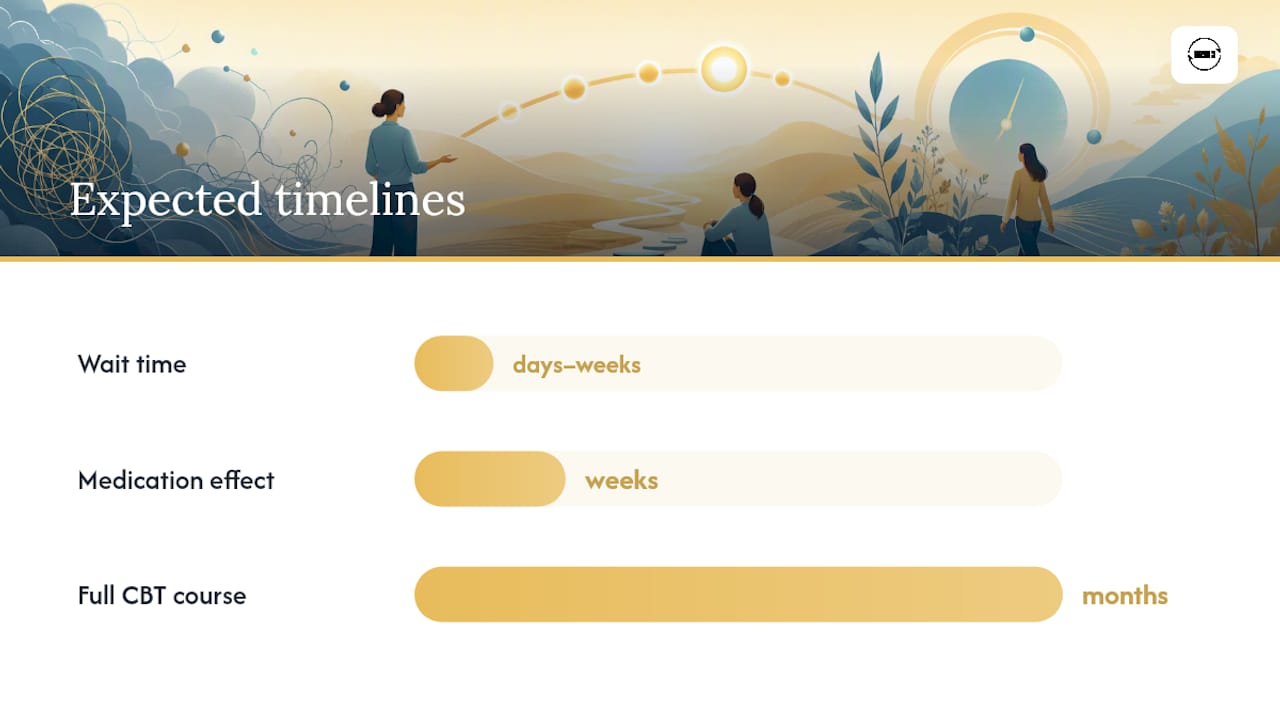
Set realistic timeline expectations going in:
- Wait times for a first therapy appointment can range from days to several weeks depending on your location and provider type.
- Medication takes weeks, not days, to show its full effect.
- A full CBT course typically runs several months.
- Plan adjustments along the way are normal, not a sign something has gone wrong.
Consistency between visits is one of the strongest predictors of good outcomes: showing up to sessions and taking medication as prescribed matters more than almost any other single factor. While you wait for a formal appointment, interim supports, guided self-help material or a basic lifestyle change plan, help preserve momentum rather than letting symptoms sit unaddressed. Reading about how therapy translates into daily functioning can also help set realistic expectations for what a completed course actually changes.
Therapist-Backed Resources Worth Knowing About
Practical CBT micro-routines designed to bridge the gap between "I need help" and "I have an appointment" include short grounding exercises and structured breakdowns of what CBT sessions actually involve, often written by clinicians rather than adapted from generic self-help content.
Online and in-person psychotherapy options are available, along with couples and family therapy for situations where relationship strain is compounding anxiety symptoms.
, and would round out this section with the kind of specific, checkable detail that helps readers evaluate fit before booking. would similarly add concrete evidence of outcomes for readers weighing their options.
Does Treatment Differ for Children, Older Adults, or Pregnant Women?
Treatment principles stay largely consistent across age groups, but the details shift meaningfully.
In children and adolescents, CBT is typically the first choice, often adapted with more parental involvement and age-appropriate language for cognitive restructuring. Medication is used more cautiously in younger patients, and any prescribing decision usually involves closer monitoring for mood changes early in treatment.
Older adults face a different set of considerations. Physical health conditions and other medications increase the risk of drug interactions, so prescribers tend to start at lower doses and titrate more slowly. Cognitive changes associated with aging can also make certain CBT techniques need adaptation, though the core approach remains effective.
Pregnant and lactating women require particularly careful risk-benefit discussion. Some SSRIs carry different safety profiles during pregnancy and breastfeeding than others, and this decision should always involve direct conversation with both a prescriber and an obstetric provider, not a general rule applied uniformly. Psychotherapy alone, without medication, is often prioritized during pregnancy when symptoms are mild to moderate, reserving medication for cases where impairment is significant enough that the risks of untreated anxiety outweigh medication risks.
Across every one of these groups, the same principle holds: personalization of the treatment plan matters more than following a generic protocol.
What Happens When Generalized Anxiety Treatment Doesn't Work?
Treatment-resistant GAD, where symptoms persist despite an adequate trial of therapy, medication, or both, is not uncommon, and it does not mean you have run out of options.
The first step is usually confirming the trial was actually adequate. Was the medication dose optimized, and was it given long enough, generally a minimum of several weeks, to make a fair judgment? Was CBT delivered with genuine homework compliance, or did life get in the way of the between-session practice that makes it work? A surprising number of "resistant" cases turn out to be under-dosed or under-practiced rather than truly unresponsive.
If the trial was genuinely adequate, next steps typically include switching to a different SSRI or SNRI, since response varies meaningfully between individual drugs within the same class, or augmenting with a second agent. Reassessing for undiagnosed comorbid conditions, particularly depression, substance use, or an underlying medical issue, is also standard practice at this stage, since an untreated comorbidity can quietly undermine an otherwise sound treatment plan.
Combining or switching therapeutic approaches also helps. Someone who has done traditional CBT without full relief might respond better to acceptance-based approaches, or vice versa. Referral to a specialist, a psychiatrist for complex medication management or a therapist with a different clinical orientation, is a reasonable and common next move rather than a sign of failure.
Why Shared Decision-Making Changes Treatment Outcomes
Anxiety treatment works better when you understand it, not just comply with it. Clinicians who take the time to explain why a medication takes weeks to work, or why CBT homework matters between sessions, tend to see better follow-through from patients than those who simply hand over a prescription or a workbook.
This is not just intuition. Consistency in attending sessions and taking medication as prescribed is one of the clearest predictors of good outcomes in GAD treatment, and consistency is hard to sustain when you do not understand or agree with the plan you are following.
Shared decision-making means your prescriber or therapist lays out the realistic options, benefits, timelines, and tradeoffs, and you weigh in based on your own priorities and constraints. Maybe you would rather try therapy alone first because you are wary of medication side effects. Maybe your schedule genuinely cannot accommodate weekly in-person sessions right now, making a digital CBT program the more honest choice. Both are legitimate starting points when they come from an informed conversation rather than a default protocol.
Interprofessional coordination, your primary care doctor, therapist, and psychiatrist actually talking to each other, also improves this process considerably, catching side effects and comorbid issues that any single provider might miss in isolation.
A Clinician's View on What Real Progress Looks Like
GAD is often a chronic condition, but chronic does not mean unmanageable. What actually moves the needle is sustained, collaborative care: showing up consistently, being honest about what is and is not working, and building skills gradually rather than expecting a single breakthrough session.
Progress in this work is rarely dramatic. It looks like slightly shorter worry spirals, one more night of decent sleep, a plan that gets adjusted instead of abandoned. Normalize that iteration. It is the process working, not the process failing.
— Wayne Dewhurst
Start Generalized Anxiety Treatment With Dewycounselling
If you have read this far, you already understand more about evidence-based anxiety treatment than most people walking into a first appointment, and that puts you ahead. Dewycounselling offers both online and in-person psychotherapy across individual, couples, and family formats, so you are not stuck choosing between convenience and quality of care.

An initial session typically covers your symptom history, current impairment, and goals for treatment, the same groundwork described earlier in this article, so nothing about that first visit should feel unfamiliar. From there, your therapist builds a plan suited to your specific situation rather than a one-size-fits-all worksheet. If anxiety is straining a relationship alongside your own symptoms, couples counselling is also available as a complementary option. To see the full range of psychotherapy services offered online and in person, or to book your first session directly, visit Dewycounselling and take the next concrete step toward a plan that actually fits your life.
This article is general information, not a substitute for advice from a qualified doctor. Consult a qualified healthcare professional about your own circumstances before acting on anything here.
Sources
- Generalized anxiety disorder in adults: Management
- Generalized anxiety disorder - Diagnosis and treatment (Mayo Clinic)
- Pharmacotherapy for Generalized Anxiety Disorder in Adults and Pediatric Patients: An Evidence-Based Treatment Review
- Generalized Anxiety Disorder (GAD): Symptoms & Treatment (Cleveland Clinic)
- StatPearls: Generalized anxiety disorder
FAQ
Is GAD Hard to Live With?
Yes, untreated GAD is genuinely exhausting since the worry rarely fully switches off, but it responds well to CBT, medication, or both, with most people seeing meaningful improvement over a course of treatment.
How Do I Deal With Constant Anxiety Day to Day?
Short-term tools like paced breathing and brief grounding routines help in the moment, but persistent, near-daily anxiety lasting six months or more usually needs formal evaluation and treatment rather than coping strategies alone.
Can I Treat Anxiety Myself Without Seeing Someone?
Lifestyle measures like exercise, sleep hygiene, and cutting back on caffeine and alcohol can ease mild symptoms, but clinically significant GAD generally needs professional therapy or medication for lasting improvement.
How Can I Reduce My Anxiety Starting Today?
Cutting caffeine, keeping a consistent sleep schedule, and practicing a short daily relaxation technique like progressive muscle relaxation can lower symptom intensity while you pursue formal treatment through a therapist or prescriber.
How Long Does It Take for Generalized Anxiety Treatment to Work?
CBT often shows initial benefit within several weeks, while SSRIs and SNRIs typically require weeks of gradual dose adjustment before effects become clear, which is why regular follow-up every three months matters for tracking progress.