
Yes, you can date well with social anxiety. The evidence points to one clear approach: choose low-stakes dates, notice and drop your safety behaviors, and treat each date as a small, CBT-informed exposure rather than a test you can fail. Progress is rarely linear, and that is fine. Therapy remains available if the anxiety runs deeper than dating tips alone can touch.
TL;DR:
- Limiting dates to under an hour, especially activities like walking or coffee, reduces the feeling of being trapped and eases social pressure.
- Dropping safety behaviors such as rehearsing lines or avoiding eye contact correlates with worse emotional outcomes, making exposure essential for progress.
- Practicing a simple ritual before, during, and after the date, like grounding breaths and reflection, turns dating into effective exposure therapy.
- Using text-based messaging on dating apps and setting firm response and meeting timelines prevents avoidance from becoming a permanent escape.
- Brief, early disclosure of social anxiety, if needed, normalizes the experience without overexplaining, fostering connection and understanding.
Quick Tips for Dating With Social Anxiety on Your Next Date
You don't need a personality transplant before your next date. You need a handful of small adjustments that lower the physical alarm bell long enough for a real conversation to happen.
Start with the setup. A 45- to 60-minute coffee or walk beats a three-hour dinner every time, because a built-in end point removes the fear of being trapped. Side-by-side activities, like walking or browsing a bookstore, also ease the pressure of constant eye contact.

Before you sit down, run a 60-second grounding routine: four-second inhale, six-second exhale, three rounds. It signals your nervous system that nothing dangerous is actually happening.
Once you're talking, shift attention outward instead of monitoring your own performance. Clinicians describe this as trading self-focus for non-judgmental curiosity, and it works because rumination and genuine curiosity can't run at the same time.
A few concrete moves:
- Ask one open-ended question about something specific they mentioned earlier, rather than a generic "so, tell me about yourself."
- Cap mental rehearsal of what to say next; plan a rough opener, then let the conversation move on its own.
- Set a soft exit ("I've got an early start tomorrow") so you always have a graceful way out.
- Name one small thing you noticed about the setting or the person out loud. It anchors you in the room.
Pro Tip: If you plan to mention your anxiety, keep it light and brief. Something like "I get a little quiet when I'm nervous" tells your date what's happening without turning the evening into a therapy session.
Why CBT and Exposure Actually Work Here
The anxiety itself isn't the problem that sabotages dates. The behaviors you used to manage it are.
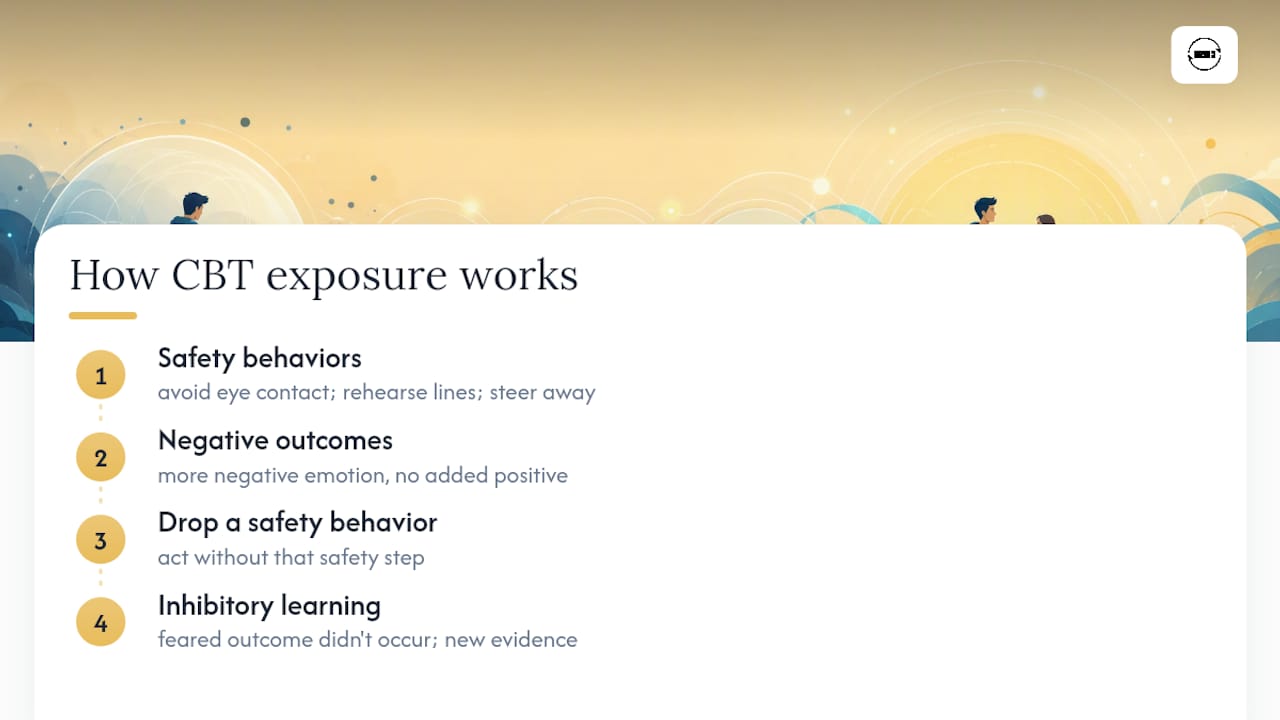
A 21-day daily-diary study of adults with and without social anxiety disorder found that people with SAD used significantly more safety behaviors on dates, things like avoiding eye contact, rehearsing lines mentally, or steering conversation away from themselves, than people without the diagnosis. The study also found these behaviors were tied to more negative emotion during dates, with no corresponding boost in positive feeling.
Safety behaviors feel protective in the moment, but the safety behaviors during dates study found they correlate with worse emotional outcomes, not better ones. They keep the anxiety fed instead of starving it.
This is where exposure and inhibitory learning come in; for a deeper clinical discussion of social anxiety and strategies like reducing safety behaviours, see Vous avez dit … Phobie sociale ?. Every date where you drop one safety behavior and survive the discomfort teaches your brain new evidence: the feared outcome didn't happen. That's the mechanism behind CBT-based approaches for social anxiety, and it's why repeated low-stakes dates work better than waiting to feel ready.
A Simple Routine for Before, During, and After the Date
Turning a date into useful practice means treating it as three separate phases, each with its own small job.
- Prepare. Limit rehearsal to one rough opener, not a script. Pick a single, specific learning goal, "I'll make eye contact for a few extra seconds" beats "I'll be confident." Run your grounding breath before you leave the house.
- Perform. Stay curious about your date instead of monitoring yourself. Anchor to a sensory detail (the warmth of your cup, background music) when anxiety spikes. Treat one small behavior, holding eye contact a beat longer, speaking without pre-editing, as a deliberate experiment, not a performance metric.
- Process. Give yourself five minutes, no more, to mentally replay the date. Then log it: prediction, outcome, and one honest note. "I predicted silence would be awkward. Outcome: we sat quietly for a minute and it was fine. Note: silence isn't proof of failure."
For exits and follow-ups, keep the language simple: "This was great, I'd like to see you again" or "I had fun, let's grab coffee again soon." Clear beats clever.
Using Dating Apps Without Feeding Avoidance
Apps can help people with social anxiety, since text-based first contact reduces the anxiety cues that come with face-to-face interaction. The risk is using that safety indefinitely instead of as a bridge.
- Set a response window (same day or next morning) so texting doesn't become a full-time anxiety-management job.
- Give yourself a firm timeline, often within one to two weeks, to move from chatting to a short video call or a brief in-person meet.
- Resist rereading and rewriting every message five times; send something genuine and move on.
- Use app conversations to gather one or two real topics you can bring up naturally in person.
Structured rules like these reduce uncertainty and function as short-term scaffolding, not a permanent hiding place, according to clinical strategies for social anxiety and dating.
Talking About Your Anxiety Without Overexplaining It
Disclosure works best when it's brief, early, and low on clinical language.
- Try: "I tend to overthink sometimes, so I might be quiet at first." It normalizes without requiring a diagnosis conversation.
- Mention it lightly and early if it's already affecting your behavior; save deeper conversations about your history for once trust has built.
- A kind, curious reaction is a good compatibility signal. Dismissiveness is useful information too.
- You never owe anyone a full explanation. Share only what makes the moment easier for you.
When Tips Aren't Enough: Therapy, Couples Work, and Medication
Self-help strategies help most people make real progress. Some signs point toward professional support instead:
- Anxiety that stops you from scheduling dates at all, not just makes them harder.
- Panic symptoms that don't ease with grounding or time.
- Dating anxiety that's straining an existing relationship.
Individual CBT for social anxiety disorder, often including structured exposure work, remains the best-supported clinical approach. Couples therapy (approaches like CBCT or IBCT) can help when anxiety is affecting a current partnership, and medication sometimes supports therapy rather than replacing it.
A first session usually involves discussing your history and goals, nothing more dramatic. When searching for a therapist, ask about their experience with social anxiety specifically, their treatment approach, and whether they offer online or in-person psychotherapy.
Therapist Insight: How Exposure Gets Staged in Practice
Wayne Dewhurst structures dating exposure the same way most anxiety work gets built: small, sequenced steps rather than one big leap. A first date might target one dropped safety behavior, longer eye contact, less rehearsed speech, while later sessions raise the difficulty gradually. [Credentials and years in practice], [client outcome notes]. The goal isn't fearlessness. It's a nervous system that's collected enough real evidence to stop assuming the worst.
A Small Step Worth Taking This Week
Setbacks are part of the process, not proof it isn't working. A quiet date or an awkward pause doesn't erase the fact that you showed up.
This week, schedule one 30-minute, low-pressure meet, coffee, a walk, nothing elaborate. Afterward, write down one thing you learned, not one thing you did wrong. That single habit, repeated, is what actually moves the needle.
— Wayne Dewhurst
How Dewycounselling Can Help You Build on This
Dewycounselling gives you a structured, therapist-guided version of everything above, individual CBT for social anxiety, couples counselling when dating anxiety is affecting a relationship, and both online and in-person psychotherapy so you can choose whatever format actually lowers your barrier to showing up. A first appointment typically focuses on individual patterns and goals, rather than a generic intake script, and sessions build toward graded exposure work with professional guidance tracking progress. If dating anxiety has started limiting more than your love life, or if it's straining a current relationship, book a session with Dewycounselling and take the next concrete step instead of waiting to feel ready first.
This article is general information, not a substitute for advice from a qualified doctor. Consult a qualified healthcare professional about your own circumstances before acting on anything here.
Sources
- Safety behaviors during dates among individuals with social anxiety disorder
- ADAA — dating anxiety (expert blog)
- TIPS FOR DATING WITH SOCIAL ANXIETY — National Social Anxiety Center