
Run through this tonight: sleep on a regular schedule, 20 to 30 minutes of movement, one real social contact, a screen-off window before bed, two minutes of slow breathing, one gratitude note, hydration, and a one-sentence mood log. That's your core checklist, eight items, five minutes, yes-or-no answers.
- Consistent sleep and wake time
- 20 to 30 minute walk or movement (general guideline)
- One genuine social contact
- A screen-off window before bed
- One gratitude note
- Two minutes of slow breathing
- Water intake tracked (amount not specified)
- One-sentence mood log (1 to 10)
Pick your weakest item and turn it into a SMART goal: "10-minute breathing practice, five days a week, for four weeks." Then open a notes app or a paper notebook tonight and write today's date next to your first mood rating. That single line is the whole tracker. You'll build from there.
Key Takeaways
A short daily checklist built around sleep, movement, and social contact, converted into one SMART goal and reviewed weekly, produces more sustained change than any broad overhaul attempt.
| Point | Details |
|---|---|
| Start with one goal | Pick a single anchor habit, like sleep or breathing, before adding others. |
| Use the daily checklist tonight | Run through the 8-item list and log one mood rating before bed. |
| Review weekly, not daily | Ask what helped and what drained you once a week to spot real patterns. |
| Shrink the list on hard weeks | Drop to the 5-item minimal version instead of skipping tracking entirely. |
| Watch for two-week patterns | Persistent sleep, mood, or functioning changes are the cue to seek professional support. |
How to Turn a Checklist Item Into a Mental Health Goal
A checklist tells you what to check. A goal tells you how to actually change something. The S.M.A.R.T. framework, borrowed from project management but well suited to mental health work, forces vague intentions into testable commitments.
- Specific — name the exact action, not the feeling you want. "Anxiety management" isn't specific; "10-minute breathing exercise after breakfast" is.
- Measurable — attach a number: minutes, days per week, or a 1 to 10 rating you log daily.
- Achievable — pick something you can do on a bad day, not just a good one.
- Relevant — tie it to what actually drains you, not what sounds impressive.
- Time-bound — set a review date, typically two to four weeks out.
Three quick conversions: "Feel less anxious" becomes "10-minute breathing practice, five times a week, for four weeks." "Sleep better" becomes "Lights off by 10:30 PM on weeknights for three weeks." "Be more social" becomes "One 15-minute phone call with a friend each week for a month."
Pro Tip: Choose one anchor habit first, ideally sleep or breathing, since both settle your nervous system and make every other goal easier to sustain.
Your Daily, Weekly, and Monthly Check-In Worksheet
A mental health improvement plan works best when it operates on three timers: daily, weekly, and monthly. Each one asks a different question, and none of them should take more than five minutes.
Daily covers the fast checklist above. Keep the bar low. Sleep regularity, movement, one social contact, a screen-off window, gratitude, hydration, a two-minute breath, and a one-sentence mood log. Mental Health America's goal-setting worksheet recommends this kind of stepwise structure specifically because small, repeatable actions convert into lasting behavior more reliably than big, occasional efforts.
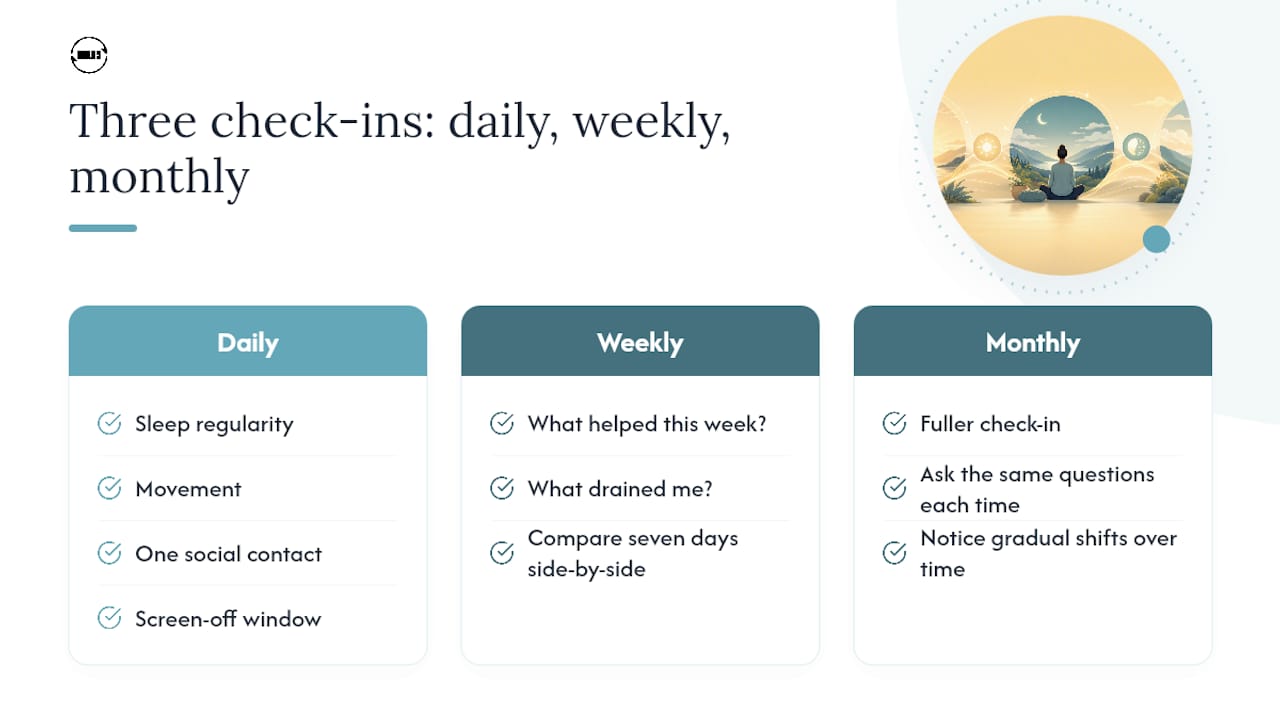
Weekly, ask two questions: what helped this week, and what drained me. That's the entire review. Patterns show up faster than you'd expect once you're comparing seven days side by side.
Monthly, do a fuller check-in. A structured monthly or weekly check-in that asks the same questions every time helps you notice gradual shifts that a single "how am I doing" moment would miss entirely.
Copy this template into a notebook or phone app:
On hard weeks, drop to a 5-item version: sleep and wake tracking, a few minutes of outdoor light, one social contact, brief movement, and the mood log. That minimal version, built for people managing caregiving or newborn schedules, still catches the biggest warning signs without demanding energy you don't have. On steadier weeks, run the full 8 to 10 item list.
Turning Checklist Habits Into Something That Actually Sticks
Checklists fail when they depend on willpower instead of structure. Attach each new habit to something you already do: breathing exercises right after you brush your teeth, gratitude notes while your coffee brews, a walk during a call you'd normally take sitting down. That's habit-stacking, and it removes the decision-making that kills most plans by day four.
Common barriers have specific fixes:
- No time? Shrink the action to under two minutes before adding more.
- Guilt over missed days? Track the week, not the day. One miss doesn't break a streak that's measured in sevens.
- Perfectionism? Aim for five out of eight items, not eight out of eight.
- Caregiving demands? Use the 5-item minimal version above instead of the full list.
A workable micro-schedule: mood log and hydration first thing in the morning, a walk mid-day, gratitude note and screen-off wind-down at night. Our daily mental wellness habits guide breaks this down further if you want a longer-term tracker.
Pro Tip: Measure progress by how your patterns shift over three weeks, not by whether yesterday was perfect. Feelings trending upward matter more than a flawless checkbox row.

What the Evidence Actually Supports
Not every checklist item carries equal weight. Sleep, daily movement, and social contact show the strongest evidence for mood improvement among the common daily items, which is why they anchor the checklist above rather than sitting as optional extras. Gratitude practices carry a smaller but still measurable effect. Harvard Health reports that regular gratitude tracking is linked to modest, reliable gains in subjective well-being, making it a low-cost addition worth keeping even on hard weeks.
Clinicians use these same domains during check-ins. The American Psychiatric Association's 8-step checkup covers concentration, sleep, energy, mood, and anxiety, and flags a referral when multiple areas show trouble at once, not just one.
A single off day rarely means much. A pattern across two or three of these domains, repeated over weeks, is what tells a clinician it's time to move from self-tracking into structured care.
When Checklist Tracking Isn't Enough Anymore
Some signs call for more than a checklist. Reach out to a professional if you notice:
- Sleep or appetite changes lasting two weeks or more
- Trouble functioning at work, school, or home
- Persistent hopelessness or thoughts of self-harm
- Withdrawal from people you'd normally reach out to
Therapy adds what self-tracking can't: a full assessment, skills training for anxiety or depression specifically, coordination with a prescriber when medication is part of the picture, and a goal plan built around your actual life rather than a generic list.
If your own checklist shows repeated red flags, that pattern is information, not failure. It's the signal to bring in outside support rather than adjust the list again.
If you're in immediate crisis, contact your local emergency line or a crisis service right away. Self-screening tools are useful for spotting patterns, but they were never built to replace professional assessment when distress is severe or persistent.
A Clinician's Note on Small Daily Anchors
I've seen simple daily anchors, sleep, a short walk, one honest conversation, do more for people than ambitious overhauls that collapse by week two. Pick one or two goals, not five. Setbacks aren't failure; adjust the goal at your next monthly review, not the moment things slip. If you want guided support building a plan that fits your actual week, Dewycounselling's therapy team can help you build it.
Printable Worksheets and Tools Worth Bookmarking
Start with Mental Health America's goal-setting worksheet and the APA's 8-step checkup for structured self-assessment. Our emotional wellness checklist and self-care practices guide expand on daily items above. Ready for guided support? Book a session with Dewycounselling.
Frequently Asked Questions
How many items should a mental health goals checklist have? Eight to ten items covers the main domains, sleep, movement, social contact, and mood, without taking more than five minutes a day. Drop to five items during high-stress weeks.
How often should I review my mental health goals? Weekly for quick pattern checks, monthly for a fuller review. During high-stress periods, weekly check-ins catch shifts faster than monthly ones alone.
What's the difference between a checklist and a SMART goal? A checklist tracks daily actions. A SMART goal turns one weak checklist item into a measurable commitment, like "10-minute breathing practice, five days a week, for four weeks."
When should I stop self-tracking and see a therapist? If sleep, appetite, or functioning changes persist for two weeks or more, or you notice persistent hopelessness, bring in a professional rather than extending self-monitoring further.
This article is general information, not a substitute for advice from a qualified doctor. Consult a qualified healthcare professional about your own circumstances before acting on anything here.
Sources
- Mental Health Checklist: 10 Daily Habits (2026) | HabitBox Blog
- 8-step mental health checkup — American Psychiatric Association (APA)
- Setting and reaching goals – Mental Health America
- Test your own mental health — Global News
- Giving thanks can make you happier — Harvard Health