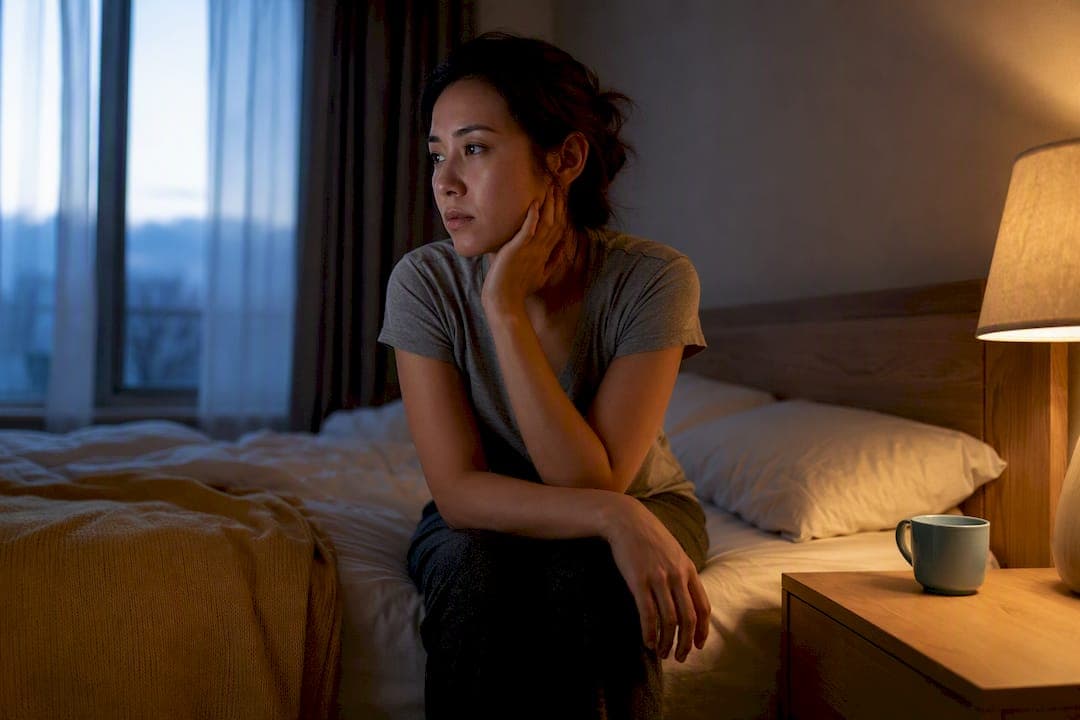
Stress is your body's short-term response to an external demand; anxiety is persistent, excessive worry that often outlasts or appears without a clear trigger. The clearest clinical signal is duration and function: if symptoms fade once the deadline passes or the conflict resolves, that's stress. If worry lingers for weeks or months and starts eating into your work, sleep, or relationships, that pattern points toward an anxiety disorder and toward the "when to seek help" guidance below.
TL;DR:
- Symptoms lasting more than a few weeks that interfere with daily life suggest persistent anxiety rather than temporary stress.
- Chronic activation of the nervous system, rumination, or a trauma history can cause stress to evolve into a long-term anxiety disorder.
- When symptoms persist without an identifiable trigger and involve avoidance or panic attacks, professional help is usually needed.
- Treatment differs: stress benefits from problem-solving and boundary-setting, while anxiety responds better to acceptance, exposure, and cognitive techniques.
- Recognizing the duration and pattern of symptoms is essential for determining whether to monitor or seek immediate therapy.
Anxiety vs. Stress at a Glance
Stress and anxiety look alike on the surface. Both raise your heart rate, tighten your shoulders, and keep you up at 2 a.m. But they behave differently over time, and that difference is what a therapist actually listens for during an intake session.
| Feature | Stress | Anxiety |
|---|---|---|
| Trigger | Identifiable external demand (deadline, bill, conflict) | Often internal or unclear; can appear without a trigger |
| Timeline | Resolves when the stressor ends | Persists for weeks or months, sometimes indefinitely |
| Focus | Present tense, tied to the specific problem | Future tense, anticipatory "what if" thinking |
| Typical behavior | Problem-solving, direct action | Avoidance, reassurance-seeking, checking |
| Resolution | Fades once the situation changes | Requires active coping or treatment to interrupt |
Stress is a response to a specific external demand that typically resolves when the stressor is removed, while anxiety can persist without a clear trigger at all. A rough patch at work that vanishes the moment the project ships is stress doing its job. Worry that keeps circling back weeks after the project shipped, with no new deadline to explain it, is a different animal. The symptom checklist below and the help-seeking thresholds further down both build on this same distinction.
What Symptoms Overlap, and What Points to Anxiety?
Stress and anxiety share a symptom list that can make the two feel indistinguishable in the moment:
- Trouble falling or staying asleep
- Muscle tension, jaw clenching, or headaches
- Irritability and a shorter fuse with people you love
- Digestive issues, from a knotted stomach to appetite changes
Where they split is in intensity and pattern. Anxiety tends to bring uncontrollable worry that jumps from topic to topic even when there's no active problem to solve. It often shows up with avoidance (skipping the meeting, dodging the phone call), occasional panic attacks, and a baseline of physiological arousal that doesn't fully switch off, even during downtime.
Both stress and anxiety share overlapping symptoms like insomnia and irritability, but anxiety disorders are specifically defined by symptoms that persist for months and interfere with daily functioning. That's the pivot point. A tense week before a big presentation is expected. Tension that hasn't lifted three months after the presentation, and now stops you from accepting new projects, has moved into different territory.
What Causes Stress to Turn Into Anxiety?
Stress usually starts outside you: a job loss, a custody dispute, a stack of unpaid bills. Anxiety draws on the same nervous system but adds internal ingredients that keep the alarm ringing after the external cause is gone.
- Genetics and family history of anxiety disorders
- Prior trauma or a childhood marked by unpredictable stress
- Chronic activation of the HPA axis and sympathetic nervous system
- Rumination, which recycles worry and prevents the body from resetting
The mechanism matters here. Repeated stress keeps cortisol and adrenaline cycling through your system, and over time that repeated activation can lower the threshold at which your brain sounds an alarm. Add a habit of rumination, and you have a maintenance loop: repetitive negative thinking that keeps anxiety active long after the original stressor is gone. People with a genetic predisposition or a trauma history are more likely to have that loop stick.
When Should You See a Therapist for Stress or Anxiety?
Some warning signs mean it's time to stop monitoring and get an evaluation:
- Symptoms interfere with work, relationships, or basic daily tasks for an extended period.
- You're avoiding situations, people, or responsibilities to manage worry.
- You've had a panic attack, or physiological arousal (racing heart, shortness of breath) shows up without a clear cause.
- You're using alcohol, cannabis, or other substances to quiet the anxiety.
- You're having thoughts of self-harm or suicide, which warrants immediate crisis support, not a wait-and-see approach.
If symptoms resolve once the stressor passes, self-monitoring is reasonable. If they persist with no relief or your functioning is visibly declining, book an evaluation with a primary care provider or a licensed therapist. Intake typically starts with a conversation about symptom duration, common triggers, and what you've already tried.
Pro Tip: Before your first appointment, jot down when symptoms started, what makes them better or worse, and one realistic goal for therapy. Therapists work faster when they're not starting from zero.
Which Treatments Work for Stress, and Which for Anxiety?
Effective treatment for stress and effective treatment for anxiety overlap, but the emphasis shifts. For stress, the priority is closing the loop that's causing it: setting workload boundaries, tackling the actual problem, and rebuilding recovery habits like sleep and movement. For anxiety, the priority is retraining how your brain interprets ambiguous signals, which usually takes structured therapeutic work rather than a to-do list.
- Cognitive behavioral therapy (CBT) helps identify and challenge catastrophic predictions, a technique Harvard Health highlights alongside self-compassion practices.
- Exposure therapy gradually reduces avoidance, one of anxiety's most stubborn maintenance behaviors.
- Acceptance-based approaches teach you to tolerate uncertainty instead of fighting it, which reduces the secondary distress anxiety creates.
- Medication, typically SSRIs or SNRIs, is often combined with therapy when anxiety is persistent and significantly impairing.
CBT and exposure therapy are established, evidence-based treatments for anxiety, while exercise and sleep hygiene do more of the heavy lifting for stress reduction. For readers weighing whether talk therapy, medication, or both make sense, our guide to types of psychotherapy breaks down how CBT, exposure, and acceptance-based methods actually differ in practice.
A 3-Step Checklist to Tell Stress From Anxiety Right Now
Run through this the next time you're not sure what you're dealing with:
- Name the trigger. Identify what's causing the tension. If symptoms ease once that specific situation resolves, you're likely looking at ordinary stress.
- Check duration and impact. Has this lasted more than a few weeks? Is it affecting your work, sleep, or relationships? Weeks with no functional impact is manageable stress; months with real impact is a signal to get evaluated.
- Test the loop. For an acute spike, try the 3-3-3 rule: name three things you see, three things you hear, and move three parts of your body. It interrupts the panic response fast. For ongoing worry, track how often the same thought loops back uninvited across a single day. More than a handful of intrusions with no new information each time suggests rumination, not problem-solving, and that's a strong candidate for therapy.
A Therapist's View: Anxiety as a False Alarm
Anxiety often behaves like your body's fight-or-flight system misfiring, sounding the alarm even when there's no actual threat in the room. At Dewy Counselling, the first goal in treatment isn't to eliminate that alarm. It's to teach you to observe it without obeying it, which clinicians describe as building tolerance rather than fighting the sensation directly.
- Bring specifics to your first session: symptom duration, typical triggers, and what coping methods you've already tried.
- Name one realistic short-term goal, like sleeping through the night or attending a meeting without a panic attack.
- Expect noticeable shifts in a matter of weeks, not months, once you're working an active plan.
Pro Tip: Start therapy at the first noticeable dip in functioning, not after you hit a breaking point. Earlier starts consistently mean shorter treatment. Our psychotherapy services page outlines what in-person and online sessions look like if you're ready to book.
How Chronic Stress and Anxiety Wear Down Your Body
Chronic stress and anxiety don't stay confined to your mood. They show up in blood pressure readings, in stomach lining, in how quickly you catch a cold. Prolonged activation of the HPA axis keeps cortisol elevated, and sustained high cortisol is linked to hypertension, weight gain concentrated around the abdomen, and suppressed immune response.
The cardiovascular system takes a direct hit. A nervous system stuck in sympathetic overdrive means an elevated resting heart rate and blood pressure that never fully settles, both of which raise long-term cardiovascular risk. The digestive system reacts too. Chronic stress and anxiety are common contributors to irritable bowel symptoms, acid reflux, and appetite disruption that swings between overeating and skipping meals entirely.
Sleep takes the biggest early hit, and it's a two-way street. Poor sleep increases physiological arousal, and physiological arousal makes sleep harder to get, which compounds fast. Muscle tension held for months rather than hours contributes to chronic pain conditions, particularly in the neck, jaw, and lower back.
None of this is abstract. It's the reason a clinician evaluating chronic stress or anxiety asks about physical symptoms alongside mood, and it's the reason treating the psychological piece often resolves physical complaints that medication alone hasn't touched.
Do Sleep, Diet, and Exercise Actually Help?
Yes, and they help both conditions through overlapping but distinct pathways. Exercise burns off the same adrenaline and cortisol that stress and anxiety both produce, which is why a walk after a hard day works even when it feels too simple to matter. Regular aerobic activity of moderate duration and frequency measurably lowers baseline anxious arousal over time.
Sleep is the recovery window your nervous system needs to reset. Chronic short sleep keeps your amygdala more reactive to negative stimuli, meaning ordinary irritations get processed as bigger threats than they are. Fixing sleep timing and consistency is often the fastest lever available, faster than most people expect.
Diet plays a smaller but real role. Stable blood sugar reduces the physical jitteriness that can be mistaken for anxiety, and cutting back on excess caffeine matters more than people assume since caffeine directly mimics the physiological signature of a panic response.
For stress specifically, these lifestyle levers work as direct recovery tools. For anxiety, they lower the baseline arousal that makes therapeutic work harder, without replacing that work. Our self-care practices guide walks through specific routines, and meditation's role in recovery is worth exploring if grounding practices appeal to you.
Can You Prevent Stress and Anxiety From Escalating?
Prevention looks different depending on which condition you're managing, but both benefit from catching escalation early rather than waiting for a crisis. For stress, that means building in recovery time before you're depleted: protected time off, clear boundaries around after-hours work communication, and problem-solving triggers before they pile up.
For anxiety, prevention is more about interrupting the maintenance loop before it hardens into a pattern. Regular check-ins with yourself about rumination frequency, maintaining social connection instead of withdrawing during rough patches, and addressing sleep disruption immediately rather than letting it drag on for weeks all reduce the odds that a stressful season tips into a diagnosable disorder.
Financial cushioning, even a modest emergency fund, reduces the frequency of acute stress spikes tied to money, one of the most common external triggers. Building a support network before you need it, rather than scrambling for one during a crisis, does the same for emotional resilience.
Waiting until you hit a wall almost always means a longer road back.
Do Stress and Anxiety Need Different Coping Strategies?
Yes, and using the wrong strategy for the wrong problem is a common reason people feel stuck. Stress responds well to problem-focused coping: making a decision, delegating a task, having the hard conversation you've been avoiding. Action resolves stress because stress is tied to an actual, solvable demand.
Anxiety often gets worse with that same problem-focused approach, because there's frequently no concrete problem to solve. Trying to "fix" free-floating worry by researching every worst-case scenario just feeds the rumination loop. Anxiety responds better to acceptance-based and exposure-based coping: tolerating uncertainty, gradually facing avoided situations, and practicing observation of anxious thoughts rather than argument with them.
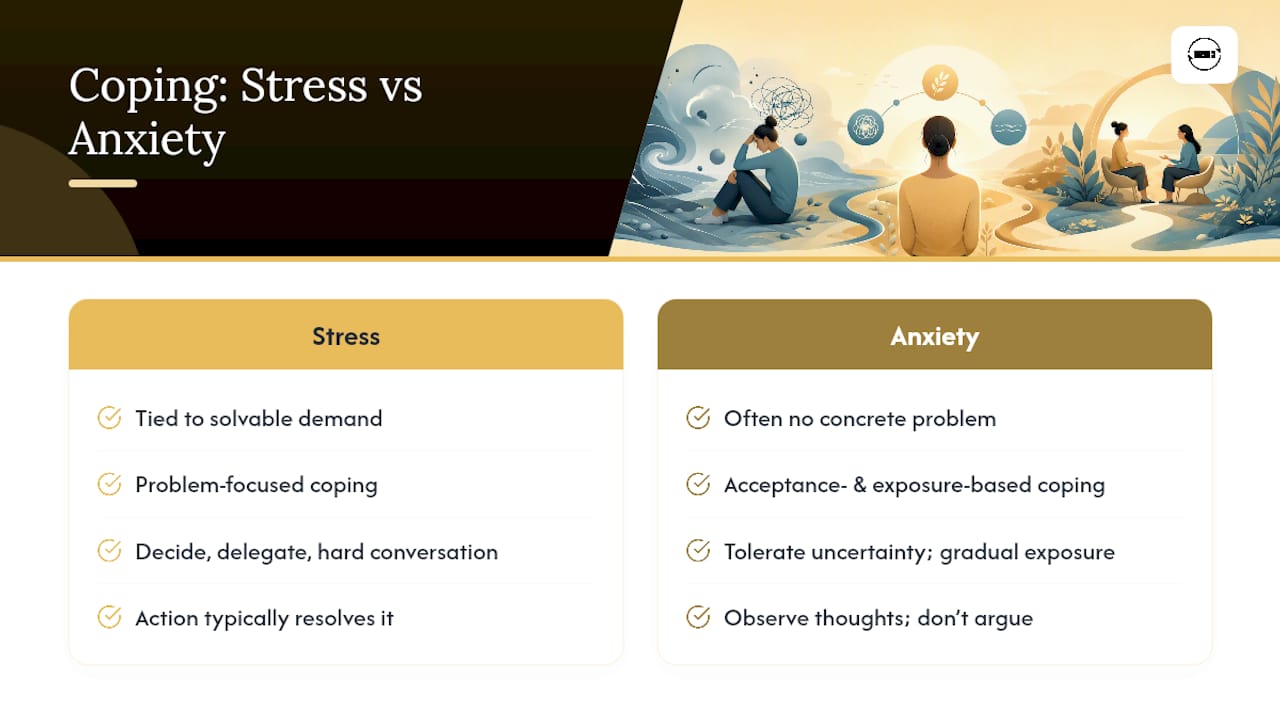
Grounding techniques illustrate the split well. The 3-3-3 rule works fast for acute stress or panic because it redirects attention to the present. For chronic anxiety, grounding helps in the moment but doesn't address the underlying rumination pattern, which needs a different tool: tracking how often a worry recurs and consciously redirecting rather than following it down. Interrupting rumination is one of the most consistent therapeutic targets precisely because it's the mechanism that keeps anxiety alive after the original stressor is long gone.
Knowing which strategy fits which condition saves you from spinning your wheels on the wrong fix.
What Do Specific Anxiety Disorders Look Like Compared to Acute Stress?
Acute stress responses are situational and typically resolve on their own: a racing heart before a job interview, a knot in your stomach during a custody hearing, sleeplessness the week before a move. They map cleanly to a specific event and fade once it passes.
Anxiety disorders are a different category entirely, defined by persistence and breadth. Generalized anxiety disorder involves excessive worry across multiple areas of life for a prolonged period, often without a single identifiable trigger. Panic disorder involves recurrent, unexpected panic attacks along with ongoing fear of the next one, which itself becomes a source of anxiety. Social anxiety disorder centers on intense fear of judgment in social situations, persistent enough to shape which invitations someone accepts. Specific phobias attach the same persistent, disproportionate fear to a single object or situation, like flying or needles.
The dividing line isn't intensity of the initial reaction. It's whether the fear response detaches from the original context and keeps running on its own. Acute stress ends when the stressor ends. An anxiety disorder keeps the alarm going regardless.
The Real Gap in How People Handle This
Most of what gets written about stress and anxiety treats them as points on the same scale, just different volumes of the same feeling. That framing is convenient, and it's wrong often enough to cause real damage. Treating persistent anxiety like it's just stress you haven't managed well enough leads people to double down on productivity hacks and breathing apps for months while the actual problem, a maintenance loop that needs structural intervention, keeps running underneath.
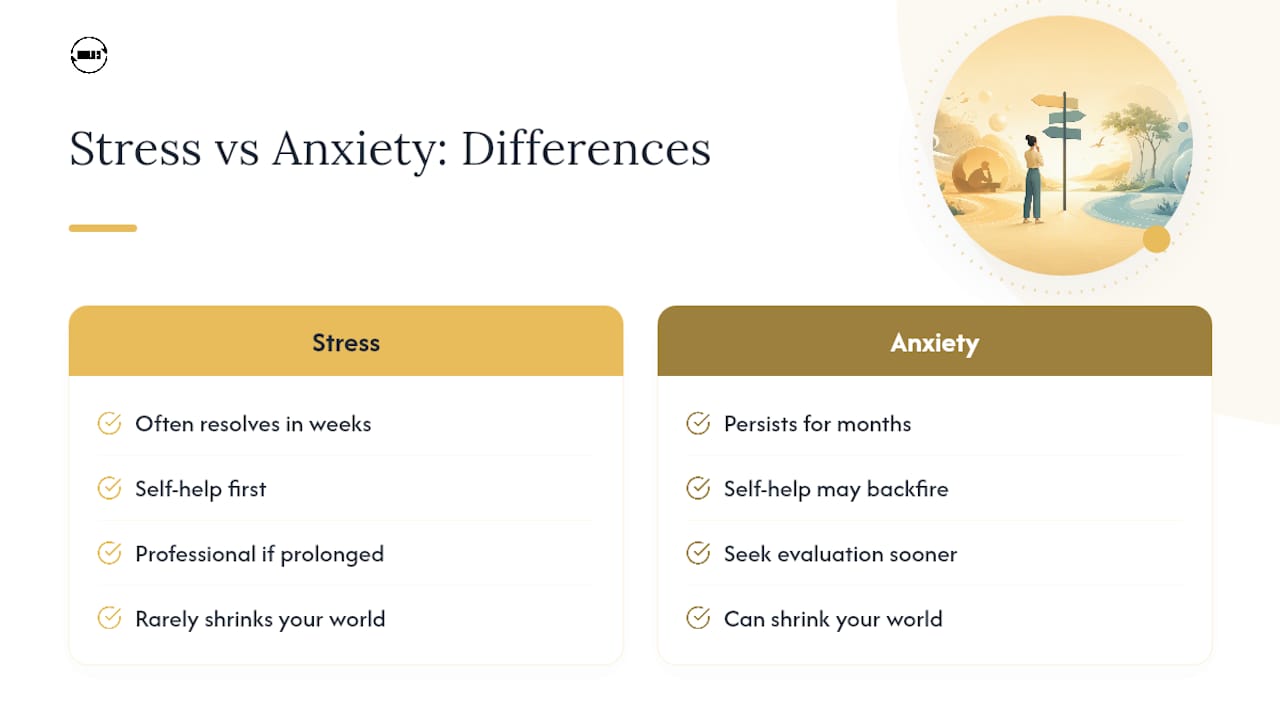
The bigger failure I see in conventional advice is the assumption that self-help should always come first and professional help is the last resort. That ordering makes sense for garden-variety stress. It backfires for anxiety, where waiting extends suffering and often deepens avoidance patterns that are harder to unwind the longer they run.
If you take one thing from this, take the duration test seriously. Weeks that resolve on their own are stress. Months that don't, especially months that are shrinking your world, are worth a real evaluation, not another article promising a fix.
— Wayne Dewhurst
Ready to figure out which one you're dealing with? Dewy Counselling offers in-person and online psychotherapy across individual, couples, and family formats, and a first session usually clarifies more than weeks of guessing on your own.
This article is general information, not a substitute for advice from a qualified doctor. Consult a qualified healthcare professional about your own circumstances before acting on anything here.
Sources
- American Psychological Association — What's the difference between stress and anxiety?
- Cleveland Clinic — Rumination and the cycle of negative thinking
- University of Utah Health — How to tell the difference between stress and anxiety