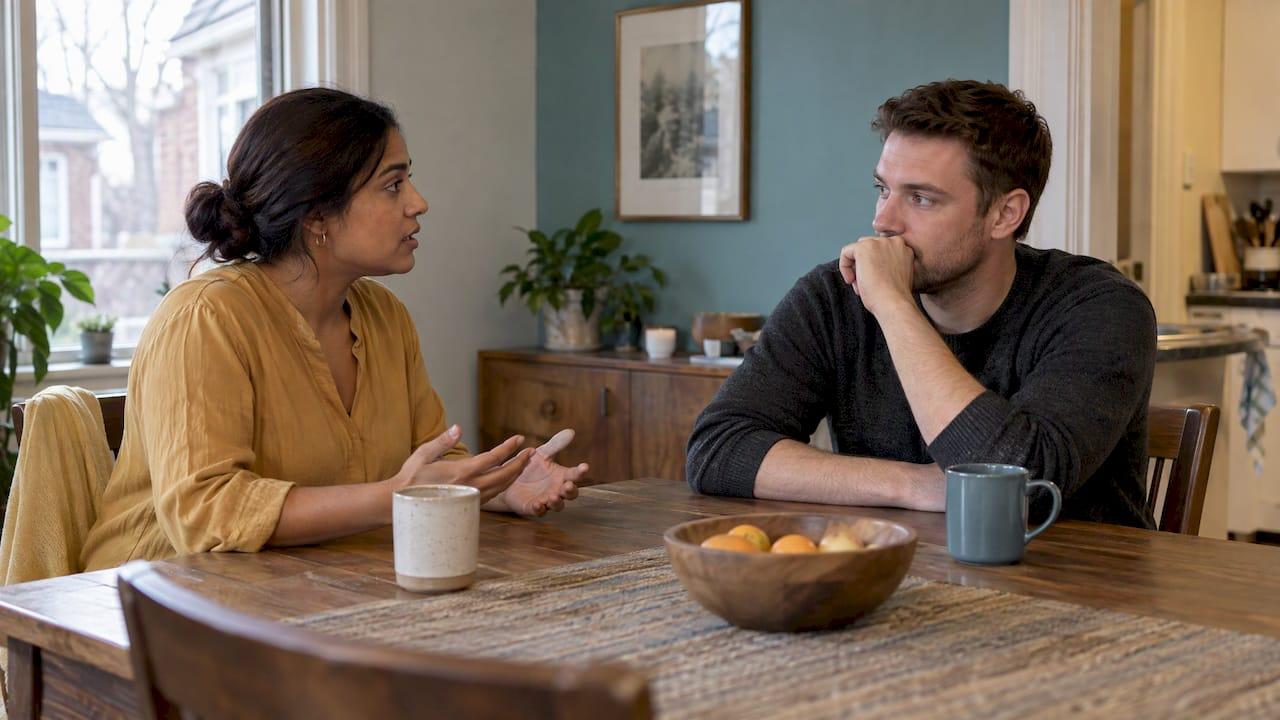
Defensiveness in a relationship is a protective reflex. It switches on when you feel criticized, blamed or rejected, and it turns a simple concern into an argument about who is at fault. The good news is that a reflex can be retrained. You do it by noticing the moment it starts, slowing the conversation down, owning even a small part of the problem and learning to hear your partner's feelings before you answer the facts. When the pattern has set deep, working with a therapist gives you someone to slow the conversation down with. Our psychotherapists at Dewycounselling work with individuals and couples across Ontario, in person and online.
This guide explains what defensiveness is, how to recognize it, why it develops and what to do about it, whether you are the one who gets defensive, the one living with it, or both.
TL;DR
- Defensiveness is self-protection against a perceived attack. It usually shows up as excuses, counter-complaints or playing the innocent victim.
- It is rarely about the topic. It is about feeling hurt, ashamed, sad or angry, and wanting that feeling to stop.
- The most reliable antidote is taking responsibility for your part, even a small one, and using "I" statements instead of "you" statements.
- If a conversation is escalating, take a break of at least 20 minutes and come back to it.
- If the cycle keeps repeating, therapy for you or for the two of you can break it, even if your partner is not ready to attend.
What defensiveness in a relationship actually is
Most of us picture defensiveness as raised voices and slammed doors. More often it is quieter. Researchers who study couples describe it as self-protection that takes the form of righteous indignation or innocent victimhood, an attempt to ward off a perceived attack. It often arrives as a counterattack to a complaint, and its hidden message is: the problem isn't me, it's you. The Greater Good Science Center at UC Berkeley notes that defensiveness tends to arise when people feel criticized or attacked. It involves making excuses to avoid responsibility or deflecting blame onto your partner, and it tells your partner you are not really listening.
That last point matters. When you are defensive, you are reacting to your partner's words rather than hearing them. You are already composing your rebuttal while they are still talking. Your partner experiences this as being dismissed, even if you never raised your voice.
Psychology writers also describe it as a maladaptive defense mechanism: an overwhelming urge to protect yourself when you feel hurt, shame, sadness or anger, set off by feedback you perceive as critical, according to Verywell Mind. The word "perceive" is doing real work there. The comment may have been fair, gentle or even loving. What counts is how it landed in your nervous system.

Common signs of a defensive pattern
Defensiveness is easier to change once you can spot it. These are the most common forms:
- Denial. "That never happened." "I didn't say that."
- Excuses. "I would have, but you know how my week was."
- Counter-complaints. "Well, what about the time you...?" The conversation switches from your partner's concern to your partner's faults.
- Playing the victim. "Nothing I do is ever good enough." The focus moves from your partner's feelings to yours.
- Minimizing. "You're overreacting." "It's not a big deal."
- Over-explaining. Long, detailed justifications that are really a request to be found innocent.
Notice that the first five all end the same way: your partner stops getting heard. Most people do not choose any of these on purpose. As you may have noticed in your own life, sometimes you perceive a perfectly reasonable request as an attack and counterattack before you have even decided how you feel.
How it feels from the other side
If you are the partner who raises concerns, defensiveness can be exhausting. You may find yourself rehearsing how to bring something up, softening it until it means nothing, or giving up on raising it at all. Psychology writers note that pointing out the other person's flaws can make them defensive too, creating a vicious cycle. This is why defensiveness often travels with other patterns, such as one partner pursuing and the other withdrawing. If that sounds familiar, our guide to the pursuer-distancer cycle explains how the two fit together.
Why people get defensive
No one wakes up and decides to be defensive. It is a learned response, and it usually has a history.
Verywell Mind explains that defensiveness may have developed from earlier experiences, including harsh parenting, abuse, neglect, peer rejection, bullying, or narcissistic abuse in a previous romantic relationship. If you grew up in a home where mistakes brought punishment or ridicule, your body may have learned that admitting fault is dangerous. As an adult, a partner's mild comment about the dishes can trigger the same alarm that a parent's anger once did.
There is also a present-day explanation. Canada.ca, in a communication guide from the Department of National Defence, explains that when we feel accused and criticized unfairly, our instinct is to search for justifications and cast ourselves as innocent victims, hoping our partners will change their tune. That strategy tends to signal that we are not taking our partners' concerns seriously.
Underneath most defensiveness, there is something tender: fear of being a bad partner, shame about a mistake, or a sense that nothing you do is ever enough. Seeing the feeling beneath the behavior is the first step toward changing it, and it is also the most compassionate way to understand a defensive partner.
What defensiveness does to a relationship
Defensive reactions can feel better in the moment, because they relieve the sting of criticism. Over time, though, the relationship suffers and so does the person being defensive. According to Verywell Mind, defensive behaviors might help you feel better in the short term but generally result in relationships suffering and you feeling worse over time.
Think of a relationship wound like a physical one. A cut that is repeatedly bumped never closes. Each time a concern is met with a counterattack, the underlying issue stays open and a new injury is added on top: your partner now also feels unheard. After enough rounds, couples stop discussing the original problem and only fight about how they fight.
The Berkeley researchers point to one further effect. Because defensiveness tells your partner that their feelings are not valid, it erodes trust and closeness faster than the original disagreement ever would. Wounded pride is a poor reason to pay that price.
How to stop being defensive: six steps you can practice
Changing a reflex takes repetition. Start with low-stakes moments, such as a comment about who forgot to buy milk, rather than your biggest conflict.
1. Catch the physical signal
Defensiveness is more passive than criticism or contempt, so you may not realize you have entered a defensive state. Learn your body's early warning: a tight chest, heat in your face, a clenched jaw, a sudden urge to explain. When you feel it, that is your cue to slow down, not to speak.
2. Pause and breathe before you answer
MyHealth Alberta notes that couples are more likely to argue during times of stress, and recommends listening to your partner, pausing before you speak and taking a few deep breaths before reacting (Managing Relationship Stress for Couples). A five-second pause will not fix a relationship, but it interrupts the autopilot.
3. Look for the part that is true
This is the core skill. Defensiveness has an antidote, and it is accepting responsibility for your role in the situation, even if it is only a small part of the conflict. Canada.ca recommends this directly, noting that owning part of a conflict can prevent it from escalating. In practice it sounds like: "You're right, I could have been more aware of how exhausted you were." You do not have to agree with everything your partner says. You only have to find the piece that is accurate.
If you want to see how this plays out beyond couples, this overview of personality-based conflict resolution shows how people with different styles can own their part in a disagreement.
4. Swap "you" statements for "I" statements
Canada.ca advises expressing concerns without finding fault, by avoiding the word "you" and using "I" statements that constructively articulate your needs. CAMH gives the same advice in its guidance on difficult family conversations. It explains that "I" statements focus on your own feelings or beliefs rather than criticizing the other person, and may help you make your point without prompting defensiveness.
Compare these two:
| Triggers defensiveness | Invites a conversation |
|---|---|
| "You never help around the house." | "I feel overwhelmed when the housework piles up, and I'd like us to share it differently." |
| "You always get defensive." | "I feel shut out when we can't talk about this, and I want to understand your side." |
| "You don't care how I feel." | "I'm feeling hurt and I need to know you've heard me." |
5. Take a proper break when you are flooded
Sometimes you are too activated to think. In that case, say so and step away. Canada.ca advises that time-outs should last at least 20 minutes, because that is the time the body and mind need to relax. During the break you can listen to music, read or exercise. Avoid replaying the argument in your head, which keeps your body on alert. Then come back. A break without a return becomes avoidance, so say when you will return to the conversation: "I need 30 minutes, and then I want to finish this."
6. Get curious about what is underneath
Ask yourself what you were afraid of in that moment. Maybe it was being seen as a failure, or being rejected. Naming it, even privately, loosens its grip. Over time, you can say it out loud to your partner: "I got defensive because I felt like I'd let you down." That sentence tends to end arguments rather than start them.
If you want structured practice, our guides to communication exercises for couples and practical exercises to improve communication with your partner walk through exercises you can try at home. For handling the larger disagreements, there is also our five-step playbook for conflict resolution in marriage.

How to respond when your partner is the defensive one
Living with a defensive partner takes patience, and you are allowed to have needs too. These approaches tend to help.
Assume they feel threatened. Rather than reading defensiveness as a refusal to care, treat it as a sign that your partner feels unsafe. That does not excuse hurtful behavior. It simply gives you a more useful starting point than anger.
Lead with softness. Begin with your own feeling and a specific, small request. CAMH's suggestion to use "I" rather than "you" statements applies here too, because a gentle opening gives your partner less to defend against.
Ask before you explain. A question such as "What is happening for you right now?" signals that you want to understand, not win. People tend to soften when they feel emotionally understood.
Do not force the conversation. If your partner is flooded, pushing harder will not help. You might say: "Earlier didn't go the way I hoped. Can we try again after dinner?" Then actually return to it.
Own your side too. Taking responsibility for part of a conflict works in both directions. If you raised an issue in a harsh way, acknowledging it can lower the temperature for both of you.

When someone seems to take everything personally
Some people experience almost every comment as an attack. CAMH suggests preparing for difficult interactions by drawing on your past experience with that person, developing coping strategies such as deep breaths or a short walk, and finding a buddy to help keep things from getting out of hand (CAMH on dealing with toxic interactions). The same CAMH page suggests that understanding what lies behind someone's negativity, such as loneliness, envy or uncertainty, can build empathy and patience without excusing the behavior. The University of Alberta's counselling resource adds that rehearsing your part of a hard conversation ahead of time can lessen miscommunication (University of Alberta).
If you are the one who takes things personally, the six steps above are written for you. If you love that person, remember that you are not responsible for managing their reactions, only for communicating with care.
When defensiveness needs more than a technique
Self-help skills go a long way, but some patterns are hard to see from the inside. You may find that you understand everything in this article and still get pulled into the same argument every Thursday night. That is common, and it is not a sign of failure. A therapist can observe the cycle as it happens, help each of you name the fear underneath it and give you a safe place to practice a different response.
Signs that it is time to reach out include:
- The same argument keeps returning, whatever you try.
- One or both of you has stopped raising concerns to avoid conflict.
- Defensiveness is tangled up with old wounds, such as infidelity, trauma or money stress.
- You notice you feel anxious, low or on edge much of the time at home.
MyHealth Alberta also points out that it is okay to see a counsellor on your own if your partner does not want therapy. Your own change can shift the whole pattern. If you are unsure what to expect, our overviews of what relationship counselling is and how it helps and why couples seek therapy are good places to start. Attachment patterns often sit underneath defensiveness, and we explain them in our guide to attachment styles in couples.
Working on defensiveness with Dewycounselling
We offer individual, couples and family therapy, in person at two locations or online, for people across Ontario. Our team brings over 20 years of experience working with diverse clients, multiple therapy modalities and evidence-based approaches, and we offer sliding scale pricing. For couples, our couples counselling covers communication, conflict, and specific issues such as trauma, infidelity, and sexual or financial concerns.
Sessions in person or online are $175 per hour, mobile sessions are $225 per hour, and a prepaid annual membership is $1,750 per year. You can see all options on our services page, or read about individual psychotherapy if you would like to start on your own.

If you are not sure where to begin, you can start with one session and see how it feels.
Our perspective
In our work, defensiveness is almost never the real problem. It is the guard standing at the door of something more vulnerable: the fear of being a disappointment, of being unlovable, of being blamed again for something you could not control. When we help couples, we do not ask anyone to drop their guard in the first session. We help each partner understand what the guard is protecting, so that it can step aside when it is safe.
We believe change happens fastest when both people feel safe enough to be honest. That is why we offer in-person sessions at two locations, online sessions for busy households, and sliding scale pricing, so that cost and distance are not what stand between you and the support you need.
Whether you come as a couple or on your own, you will not be told who is right. You will be helped to hear each other, take responsibility where it is yours, and find the words for what you need.
Wayne Dewhurst
FAQ
What does it mean to be defensive in a relationship?
It means responding to a perceived criticism by protecting yourself rather than listening. That can look like denying, making excuses, counterattacking or playing the victim. It usually grows out of feeling hurt, ashamed or afraid, not out of not caring.
How do I respond to a defensive partner?
Start from the idea that your partner feels threatened. Lead with an "I" statement, ask what is happening for them and avoid pushing if they are overwhelmed. Offer to pause and come back to the topic later, and then follow through.
Is defensiveness a sign of a toxic relationship?
Not on its own. Defensiveness is a very common reaction to stress and criticism, and many healthy couples fall into it. It becomes a problem when it is constant and no one takes responsibility. If you feel unsafe, afraid of your partner or controlled, speak to a doctor, a counsellor or a local support line in confidence.
How long should a break last during an argument?
Canada.ca advises at least 20 minutes, the time the body and mind need to relax. Use the break for something calming, such as music, reading or exercise, and agree on when you will resume the conversation.
Can therapy help if my partner will not come?
Yes. It is okay to see a counsellor on your own, as MyHealth Alberta notes, and changing how you respond often shifts the dynamic. You can book an individual session with us in person or online.
Sources
- Avoiding the "Four Horsemen" in Relationships, Greater Good in Action, UC Berkeley
- What Is Defensiveness?, Verywell Mind
- How to solve communication breakdowns in a relationship, Canada.ca
- Managing Relationship Stress for Couples, MyHealth Alberta
- When a family member chooses not to seek help, CAMH
- Strategies for dealing with toxic interactions, CAMH
- Dear Maddi: tactfully pruning toxic friendships, University of Alberta