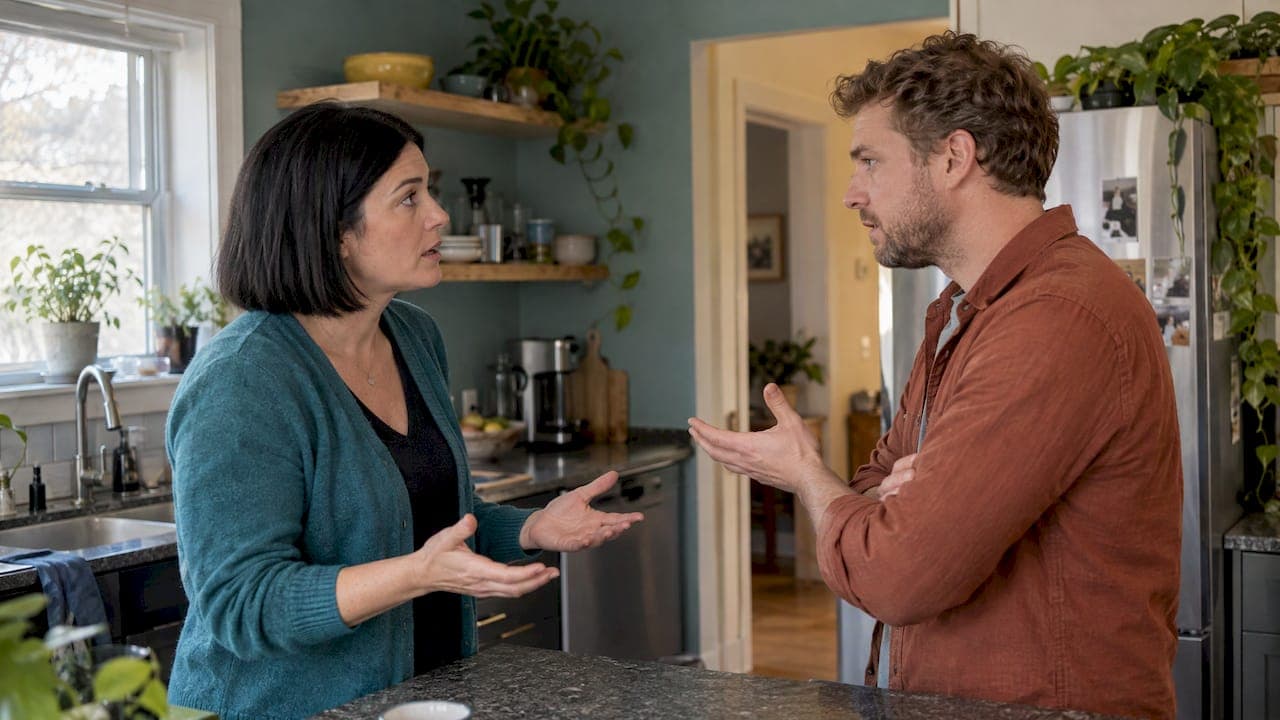
If you and your partner seem to fight all the time, it rarely means you picked the wrong person. More often it means a pattern has taken over: the same hurt, the same defence, the same ending. Conflict is a normal part of being a couple. The Canadian Psychological Association (CPA) says it becomes destructive when needs go unspoken or are voiced through criticism, blame or belittling. That is good news, because patterns can be changed. This guide explains why the arguments keep coming back, how to tell ordinary friction from something harmful, what you can do tonight, and when counselling helps.
TL;DR
- Arguing is normal. Arguing that repeats, turns personal, or leaves you both feeling trapped is a sign that a cycle, not the topic, is the problem.
- Most repeat fights are about something under the surface: an unmet need, an old hurt, or an expectation nobody has said out loud.
- Soften the start, use 'I' language, take breaks, and repair after a fight. Small habits interrupt the cycle.
- Name-calling, isolation, threats or fear are not a communication problem. They call for safety planning and specialist support.
- Couples who seek help earlier tend to have more to work with. Therapy gives you tools and a neutral space.
Why do couples fight all the time?
Most couples who argue constantly are not arguing about the dishes, the in-laws or the budget. They are arguing about what those things seem to mean: 'You don't care,' 'I'm not a priority,' 'I'm never good enough.' The topic is the doorway, and the same feeling is waiting on the other side.
A few well-documented reasons keep the cycle going.
The issue was never really resolved
A Toronto psychologist, Dr. Saunia Ahmad, explains to CBC Life that arguments become more likely in longer relationships because unresolved conflict builds resentment and arguments can snowball. Think of it like a physical wound. If it is only covered over, it stays tender, and every small bump hurts more than it should. If you notice growing bitterness toward your partner, our piece on resentment and what to do about it goes deeper.
The argument points to something deeper
Psychology Today describes four reasons couples repeat arguments: the issue was never fully resolved, it reflects a deeper issue, expectations need adjusting, or a person is drawn to partners who activate their insecurities. Licensed clinical social worker Katherine Cullen adds that repeated fights can wear down the shared satisfaction, trust and safety in a relationship, and that the repetition often signals a tension that runs deeper than the surface issue.
One partner pursues, the other withdraws
The CPA describes a common pattern in distressed relationships: one partner does not say how they feel while the other blames and criticizes. This pattern tends to get worse over time, and couples feel trapped in fights that are never resolved. One person pushes for a conversation, the other goes quiet to avoid a blow-up, and the silence makes the first person push harder. If this sounds familiar, read about attachment styles and the pursue and withdraw cycle and about stonewalling in relationships.
The story each of you tells
The Australian Psychological Society notes that when couples have problems, they can start to blame each other and see their partner's behaviour as selfish and intentional. That view leads to more conflict or withdrawal. Once you read every forgotten errand as proof of indifference, ordinary moments become evidence in a case you are building.
Your conflict style
John and Julie Schwartz Gottman describe three couple types: conflict-avoidant couples who agree to disagree, validators who fight politely and compromise, and volatile couples who erupt more often and burn hotter. If your styles differ, the mismatch alone can feel like a fight. One of you wants to talk it out loudly and now, the other wants quiet and time.

How often is too often to argue?
There is no magic number. Frequency matters less than what the fights are like and how you recover. Still, it helps to know that disagreement is common.
A YouGov poll of 1,000 U.S. adults in serious relationships (April 29 to May 5, 2022) found that 30% argue once a week or more, 28% once a month or several times a month, and 32% once or several times a year. Only 3% said they never argue. Nearly half said they feel they have the same arguments over and over. A national study by BYU researchers, cited by Utah State University Extension, found newly married couples report minor disagreements averaging around once or twice a month, with a range from many times a week to a few times a year.
These figures come from U.S. samples, so treat them as a rough picture, not a Canadian benchmark. The takeaway is that a weekly argument does not mean your relationship is broken. What matters more are the signs below.

Signs the conflict has become a cycle
The Gottman Institute's blog lists signs that a couple is stuck: small issues become disproportionately large fights, arguments repeat, conversations become personal attacks, one or both partners regularly shut down, nobody remembers what started it, resolution never comes, and both feel defensive most of the time.
The Australian Psychological Society adds that disrespect, defensiveness, criticism or stonewalling are signs a relationship is in crisis. It also mentions a suggested ratio of five positive interactions for every negative one as a good indicator of a healthy relationship. That ratio is a useful question to ask yourself: in an ordinary week, how much warmth sits between the fights?
If you recognize several of these, our list of signs your relationship needs therapy can help you decide your next step.
Can a relationship survive constant arguing?
Yes, many do, and some come out closer. The CPA states that couples who resolve conflicts constructively can strengthen the relationship over time by improving intimacy and trust. The conflict itself is not the verdict. The way you fight and repair is.
Avoiding conflict is not the safe alternative. The same CPA fact sheet notes that avoiding conflict still damages relationships because partners become increasingly disengaged from each other. A quiet house is not automatically a peaceful one.
Chronic conflict also has costs beyond the couple. The Australian Psychological Society links it to poorer mental and physical health, strain on family, friends and work relationships, and a greater risk of anxiety, depression and behavioural problems in children who are exposed to high conflict at home. If you have children, that is a strong reason to change the pattern sooner rather than later. If the fights centre on parenting a teenager, see our parent and teen conflict scripts.
When arguing is not just arguing: safety
Everything above assumes two people who both feel safe. Some situations are different, and it matters to name them.
The StrongHearts Native Helpline lists signs of emotional abuse that include constantly calling a partner hurtful names, isolating them from family and friends, threatening to hurt them or themselves, and denying the abuse when confronted. The CPA also notes that ongoing conflict can escalate to physical aggression such as pushing, slapping or hitting, and to emotional and verbal harms including cyber aggression.
If you are afraid of your partner, if you change what you say to avoid being hurt, or if there has been any physical violence, communication exercises are not the first step. Your safety is. In an emergency, call 911. Otherwise, a family doctor, a local crisis line or a registered mental health professional can help you plan next steps privately. Please do not attempt to work through these issues in joint exercises without that support.
What you can do tonight to stop the cycle
These steps are small on purpose. Change in a conflict cycle rarely comes from one big talk. It comes from repeating a better move until it becomes familiar.
- Notice the trigger before you react. Montreal couples and family therapist Sherel Griffiths advises that when triggered, you sit with the feeling and get curious about why you are reacting that way. That gap is the difference between an automatic reaction and a considered response.
- Swap criticism for 'I' language. Dr. Ahmad suggests saying 'I feel as though you don't care about me when the dishes are left' instead of 'You didn't do the dishes,' because criticism makes people shut down and less likely to hear you.
- Say the need, not only the complaint. Behind most complaints is a request: more time together, more help, more reassurance. Say that part out loud.
- Pause when you are flooded. Agree on a signal and a return time. A break of twenty to thirty minutes is common advice, and our guide to stonewalling explains how to pause without it feeling like abandonment. The one who asks for the break is responsible for coming back.
- Repair, every time. PSPNET Families, a Canadian resource, lists repair strategies that include vulnerability, agreeing where you can, taking responsibility, reassurance, shared humour, affection, apologizing and interrupting an escalation. It also reminds us that even happy couples say things they do not mean, yell or shut down. What counts is the friendship and respect underneath, and the repair that follows.
- Name the cycle, not the person. Try 'We're doing it again' instead of 'You're doing it again.' You become a team facing the pattern, not opponents.
For more structure, our five-step approach to conflict resolution and practical communication exercises walk through each skill with examples. If you want to build closeness between fights, see our guide to relationship satisfaction.
A short example
Imagine a couple who fight every Sunday about chores. On the surface, it is about who does what. Underneath, one partner feels invisible and the other feels constantly inspected. Using the steps above, the first says, 'I feel alone with the house when I carry it by myself, and I need us to plan it together.' The second, instead of defending, says, 'I hear that you feel alone. I get defensive when it sounds like a report card.' Neither problem is fixed in a minute, but both are now on the table, and the fight has turned into a conversation.
Perspective
Our perspective: fighting is a signal, and help works best early
After more than 20 years of working with individuals, couples and families, we have seen the same thing again and again: couples who argue constantly are rarely short on love. They are short on a way to be heard. The fight becomes the only language they have left for 'I need you.'
We think of a relational wound like a physical one. It needs prompt, gentle care, not a dramatic fix. Waiting for a crisis means the hurt has more time to harden into resentment and distance. Reaching out while you are still arguing, when there is still energy between you, is often the most hopeful time to begin.
In our work we draw on several evidence-based approaches, because no two couples fight for the same reason. For some, the work is practical: learning to communicate and solve problems. For others, it is emotional: understanding the unmet needs under the anger. And for couples at a crossroads, it can be about gaining clarity on whether to commit to the work ahead. We offer sessions in person at two locations and online, with sliding scale pricing, so that distance and budget are not the reasons a couple waits.
Wayne Dewhurst
When counselling can help
The CPA notes that few couples seek psychological treatment early enough. It identifies three therapies shown to help distressed couples: Behavioural Marital Therapy and Cognitive Behavioural Couple Therapy, which help couples communicate and solve problems, and Emotion-Focused Couple Therapy, which addresses unmet emotional needs. It also says you can consult a registered psychologist to find out whether psychological interventions might help.
Consider reaching out when:
- The same argument has repeated for months and nothing you try changes it.
- Fights turn into personal attacks, or one of you regularly shuts down.
- Resentment is growing, or you feel more like roommates than partners.
- A specific injury sits under the fighting, such as infidelity, a financial breach or a sexual issue. Our article on rebuilding trust after infidelity is one place to start.
- One or both of you is questioning the relationship. The CPA describes Discernment Counselling as a brief intervention that helps couples decide whether to take steps toward divorce or commit to working on the relationship.
It is also worth knowing that the CPA says relationship enrichment programs are effective in the short term, but couples often struggle to keep new skills once a program ends. That is why ongoing practice and follow-up matter as much as the first insight.
How we can help
We provide individual, couples and family therapy for Ontario residents, including support for conflict, addiction, anxiety, depression and sexual and financial issues. Our couples counselling covers couples therapy, separation and mediation support, and focused work on trauma, infidelity, and sexual and financial concerns.

In-person and online sessions are $175 per hour, and a mobile session is $225 per hour. If you expect to work together over time, a prepaid annual membership is $1,750 per year. You can see everything on our services page, and you are welcome to ask about sliding scale options. If you are not sure whether to come as a couple or on your own first, individual psychotherapy is a good starting point, and you can bring the conversation to couples work when you are ready.
FAQ
Why do we fight all the time even though we love each other?
Love and conflict are not opposites. Repeated fights usually mean an underlying need, hurt or expectation has not been voiced or heard. When criticism meets defensiveness, both partners feel unloved even while caring deeply. Naming the need beneath the complaint is often the first change.
Is too much conflict in a relationship a sign of a toxic relationship?
Not by itself. Frequent arguing can be a stuck pattern that couples learn to change. It becomes a serious concern when there is name-calling, isolation, threats, fear or any violence. In those cases, contact a professional or a crisis service about your safety first, and call 911 in an emergency.
How do couples stop arguing about the same thing?
They stop trying to win the topic and look for what it stands for. Using 'I' language, pausing when overwhelmed, and repairing after each fight all help. If the loop persists, a therapist can help you see the pattern from the outside and practise new responses.
When should we see a couples therapist?
Earlier than most people expect. If the same fights repeat, conversations turn personal, or one of you keeps shutting down, support can help before resentment sets in. You can also go alone if your partner is not ready. A registered psychologist can explain which approach might suit you.
Sources
- CPA Psychology Works Fact Sheet: Relationship Distress
- How to break an argument cycle with a loved one, CBC Life
- 4 Reasons Couples Keep Repeating the Same Arguments, Psychology Today
- Why Couples Fight the Way They Do, Psychology Today
- Relationship problems, Australian Psychological Society
- How and why do American couples argue? YouGov
- During the Fight: Perspectives and Skills for De-escalating Conflicts, Utah State University Extension
- Everything Turns Into an Argument, Gottman Institute
- 16 Signs of Emotional Abuse, StrongHearts Native Helpline
- Managing Conflict, PSPNET Families