
Resentment toward your husband usually signals repeatedly unmet needs, chronic emotional overload, or a pattern of small hurts that never got addressed — not a sudden collapse of love. The feeling is painful, but it is also informative. It tells you something important about what is missing and what needs to change.
If you are in the middle of an intense moment right now, here is what to do first:
- Pause and breathe. Take slow, deep breaths before saying anything.
- Self-soothe. Step into another room, hold something cold, or put on headphones for a short time.
- Set a time-limited boundary. Tell yourself (not necessarily him) that you will address this in a calm, planned conversation within 24–48 hours.
- Use this script when you are ready: "I've been feeling overwhelmed and I'd like to talk about something that's been bothering me. Can we find a quiet time this week?"
If there is any emotional or physical harm happening in your relationship, your safety comes first. Contact the 988 Suicide and Crisis Lifeline or text HOME to 741741 via the Crisis Text Line for immediate support. Do not attempt relationship repair alone when safety is at risk.
This article contains a 6-week action plan, vulnerability-based conversation scripts, a self-assessment checklist, and clear guidance on when couples therapy — including Emotionally Focused Therapy (EFT) as offered at Dewycounselling — is the right next step.
What causes resentment in a marriage and why does it build?
Resentment is persistent anger mixed with hurt, disappointment, and a sense that your needs or expectations have been repeatedly dismissed. It rarely arrives all at once. More often, it accumulates the way water erodes stone: slowly, through repetition, until the damage is visible.
Common causes include chronic imbalance in household or mental labor, repeated broken promises, emotional neglect, misaligned expectations about parenting or finances, and exhaustion that never gets acknowledged. Grief and major life transitions — a new baby, a job loss, a move — can also crack the foundation if one partner feels unsupported during the stress.
Consider how it often plays out in everyday life. One partner handles the mental load of scheduling, remembering, and anticipating every household need. The other partner does tasks when asked but rarely initiates. Over months, the first partner stops asking and starts silently cataloguing. The gap between what she expected and what she received quietly becomes resentment.
What makes this particularly tricky is that resentment often grows from meaning-making rather than malicious intent. When your husband loads the dishwasher differently than you would, your brain may interpret that as he doesn't care rather than he does it differently. That interpretive leap, repeated dozens of times, is often where the real injury lives. Identifying whether your resentment stems from a genuine pattern of neglect, a mismatch in standards, or both will shape which steps come next: personal regulation, direct communication, or professional support.
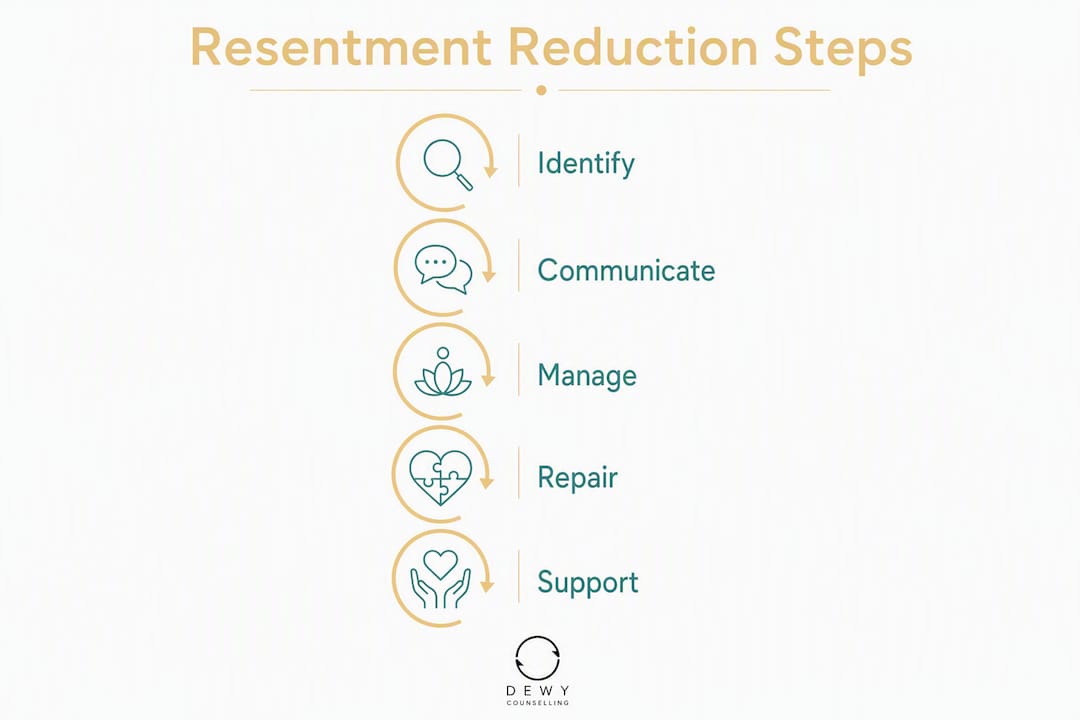
How do you know if what you feel is resentment?
Resentment can be hard to name because it often disguises itself as irritability, exhaustion, or vague dissatisfaction. A self-assessment can help you identify what you are actually dealing with.
Behavioral signs:
- Frequent criticism or sarcasm directed at your husband
- Withholding affection, conversation, or physical closeness
- Eye-rolling, sighing, or dismissive body language
- Persistent irritability that spikes specifically around him
Cognitive signs:
- Replaying past grievances in your mind, sometimes for hours
- Mentally cataloguing his wrongs as evidence
- Thinking "I hate him" or "I can't stand him" as a recurring thought
Emotional signs:
- Numbness or emotional flatness where warmth used to be
- Contempt — a sense that he is beneath your respect
- Sudden, disproportionate anger triggered by small things
Relationship signs:
- Arguments that cycle through the same issues without resolution
- Declining intimacy, both emotional and physical
- Increasingly separate lives, separate routines, separate social circles
"When the thought 'I hate my husband' shows up repeatedly, it usually functions as a protective shell masking deeper resentment, exhaustion, or grief — not a final verdict on the relationship." (Freudly)
Red flags that require urgent attention: If your husband uses emotional coercion, controls your access to money or relationships, or if there is any physical intimidation or harm, these are safety concerns that go beyond resentment. Please reach out to a licensed professional or a crisis resource before attempting any repair conversation.
Immediate strategies to manage intense feelings without escalating
The goal in the short term is not to resolve the resentment — it is to stop it from driving your behavior while you are still activated. Think of it the way you would treat a physical wound: you stabilize first, then treat.
Grounding and self-regulation work by interrupting the physiological stress response. The 5–4–3–2–1 technique (name five things you see, four you can touch, three you hear, two you smell, one you taste) pulls your attention into the present and out of the grievance loop. Progressive muscle relaxation, where you tense and release muscle groups from feet to shoulders, reduces physical tension that feeds emotional reactivity.
Journaling with purpose moves beyond venting. Instead of writing about what he did, write toward what you need. Three prompts that help:
- What specific need of mine is going unmet right now?
- When did I first notice this pattern?
- What am I assuming about his intentions — and is that assumption certain?
Timing matters enormously. Attempting repair when you are hungry, exhausted, or emotionally flooded almost always makes things worse. Schedule a calm, focused conversation for a time when both of you have energy and privacy. This is not avoidance — it is strategy.
One caution worth naming: venting to friends can feel relieving in the moment, but when it becomes the primary outlet, it tends to entrench resentment rather than ease it. Friends naturally validate your perspective, which can solidify an "us vs. them" frame that makes repair harder. Use your support network for emotional steadiness, not as a substitute for direct conversation or therapy.
For practical habit-change strategies that complement these coping tools, breaking impulsive habits in relationships offers a useful framework for interrupting reactive patterns before they escalate.
How to talk to your husband without triggering defensiveness
The structure that works best for opening a resentment conversation is deceptively simple: state your experience, name the specific pattern, and make a clear request. Psychology Today describes this as inviting your partner into your experience rather than indicting him for his behavior.

The core template: "I feel [emotion] when [specific pattern], and what I need is [concrete request]."
Scripts for common resentments:
On household labor: "I feel exhausted and invisible when I'm the only one tracking what needs to happen at home. I'd like us to sit down this weekend and divide the mental load more explicitly."
On emotional availability: "I feel disconnected from you when our conversations stay surface-level. I'd love to have one evening a week where we actually talk about how we're both doing."
On broken promises: "I feel hurt when plans we make together don't happen. I need us to either commit to what we agree on or renegotiate before the deadline, not after."
Dos and don'ts:
- Do ask permission first: "Is now a good time to talk about something important?"
- Do stay on one issue per conversation.
- Don't use "you always" or "you never" — these trigger defensiveness immediately.
- Don't start the conversation during an argument or immediately after one.
- Do offer a repair option: "Here's what would help me feel better about this."
Pro Tip: Schedule the conversation explicitly. Text him earlier in the day: "I'd like to talk tonight about something that's been on my mind. Can we find 20 minutes after dinner?" This gives him time to prepare emotionally, which dramatically reduces defensive reactions.
When he becomes defensive despite your best effort, validate briefly ("I can see this is hard to hear"), stay on the single issue, and if the conversation escalates, request a pause: "Let's take 20 minutes and come back to this." If defensiveness is a consistent wall, that is a strong signal that a couples counselor can help mediate the dynamic.
Concrete steps to repair connection and prevent resentment from returning
Repair is not a single conversation. It is a series of small, consistent actions that rebuild trust and rebalance the relationship over time.
A repair checklist for couples:
- Acknowledge the pattern that caused harm (both partners, separately)
- Accept responsibility for your own contribution to the cycle
- Express your needs clearly and specifically
- Make a concrete, written agreement with timelines
- Schedule a weekly 10-minute check-in to review how the agreement is holding
A simple agreement template: "I will [specific task/behavior] by [day/time]. If I miss it, I will [accountability step]. We will check in every [day] to see how this is working and adjust if needed."
Small rituals do more for connection than grand gestures. A weekly "us" hour with phones away, a daily appreciation practice (one specific thing you noticed about your partner that day), or a shared micro-goal like a weekend walk builds the relational bank account that resentment drains. Building intimacy through consistent small acts tends to outlast any single repair conversation.
One of the most underestimated repair moves is adjusting expectations. Much resentment comes from misreading "different" as "wrong." If your husband folds laundry differently, cleans to a different standard, or parents with a different style, the question worth asking is: Is this actually harmful, or is it just not my way? Distinguishing between the two narrows the real list of things that genuinely need to change.
After a blow-up, a short apology structure helps re-establish safety: acknowledge what happened, take responsibility for your part, state what you will do differently, and ask what the other person needs to feel okay again. Keep it brief. A long, elaborate apology often centers the apologizer rather than the person who was hurt.
When resentment doesn't lift: what therapy can do
Some resentment does not respond to self-help strategies, no matter how sincerely applied. When the same arguments cycle endlessly, when contempt has replaced warmth, or when one partner has emotionally withdrawn, professional support is not a last resort — it is the appropriate next step.
Clear indicators that therapy is needed:
- Repeated repair attempts that fail or escalate
- Contempt (eye-rolling, mockery, dismissiveness) as a regular feature of interaction
- Emotional withdrawal or stonewalling from either partner
- Any power imbalance, coercion, or safety concern
- Resentment that has persisted for more than six months without improvement
What therapy actually does: A skilled couples therapist interrupts the negative interaction cycle, helps both partners identify the attachment needs driving their behavior, and creates new patterns of emotional attunement. It is not about assigning blame or relitigating the past. It is about changing what happens between you in real time.
Questions to ask a prospective therapist:
- Are you licensed in this state, and what is your specific training in couples work?
- Do you use EFT, CBT, or another evidence-based modality?
- Do you offer telehealth sessions?
- What is your cancellation policy and session length?
- Do you offer sliding-scale fees?
Timeline and expectations: Early symptom relief — feeling heard, having a framework for the conflict — often comes within the first four to six sessions. Durable change in interaction patterns typically requires a longer course of work. Couples therapy is not a quick fix, but it is one of the most effective interventions available for entrenched resentment and negative cycles.
On cost and access: Couples therapy fees vary widely. Many therapists offer sliding-scale rates based on income. If cost is a barrier, community mental health centers, university training clinics, and employee assistance programs (EAPs) often provide low-cost options. Short-term individual therapy or structured self-help modules can also be a meaningful bridge while you arrange couples support.
Why Emotionally Focused Therapy (EFT) works for resentment
Emotionally Focused Therapy is one of the most rigorously studied approaches for couples with persistent negative cycles. Developed by Dr. Sue Johnson, EFT is grounded in attachment theory: the idea that most relationship conflict is driven by underlying fears of abandonment, rejection, or emotional unavailability rather than the surface issue being argued about.
For resentment specifically, EFT works because it targets the cycle, not the content. Instead of debating who does more chores, EFT helps both partners see that the argument is really about feeling unseen or feeling controlled — and then creates new, emotionally honest interactions that address those deeper needs directly.
What to expect in EFT:
| Phase | Session goals | Signs of progress |
|---|---|---|
| Assessment | Map the negative cycle; identify each partner's triggers and attachment needs | Both partners can name the cycle without blaming |
| Cycle identification | Slow down the cycle in session; access softer, vulnerable emotions underneath anger | Anger decreases; sadness or fear becomes accessible |
| Change enactments | Practice new emotional disclosures; build secure, responsive interactions | Partner responds with empathy; repair happens in session |
| Consolidation | Integrate new patterns; plan for setbacks | Couple manages conflict without therapist present |
EFT is effective, but it requires genuine commitment from both partners. Progress is rarely linear. Sessions can feel emotionally demanding, particularly when old injuries surface. What makes the difference is consistency: showing up, staying curious about your partner's experience, and trusting the process even when it feels slow.
Dewycounselling offers EFT-informed couples counselling with licensed therapists, both in-person and online. If you are unsure whether couples therapy or individual therapy is the right starting point, an initial consultation can help clarify the best path.
A 6-week action plan to start reducing resentment
Structured, week-by-week plans with measurable prompts help small changes stick. This plan is designed to move you from acute distress to active repair, with a built-in check-in template each week.
| Week | Focus | Key action |
|---|---|---|
| 1 | Self-regulation | Practice one grounding technique daily; journal three times using the prompts above |
| 2 | Clarity work | Identify your top two unmet needs; write them as "I feel… when… I need…" statements |
| 3 | First conversation | Use the vulnerability-based script to open one planned, calm conversation |
| 4 | Micro-repairs | Introduce one small daily ritual (appreciation, brief check-in, shared activity) |
| 5 | Shared agreement | Draft a concrete agreement on one recurring issue; review together |
| 6 | Therapy check-in | Assess progress honestly; book a couples or individual session if patterns persist |
Weekly check-in template:
- What went well this week in the relationship?
- What felt hard or triggered resentment?
- One thing I will do differently next week.
- My accountability item (specific, observable, time-bound).
Measuring progress: Track three things weekly: how often heated or resentful thoughts arise (frequency), how many repair attempts you made (count), and how close you feel to your husband on a simple 1–10 scale. What you are looking for is a gradual positive shift over time.
If the plan stalls, that is useful information, not failure. Stalling usually means the issue is deeper than self-help strategies can reach alone. At that point, moving to couples counselling or individual therapy is the appropriate adaptation, not a retreat.
Before starting the joint elements in weeks 3–5, consider sharing the plan with your husband. Transparency about what you are trying to do often reduces defensiveness and invites him into the process as a participant rather than a subject.
Key Takeaways
Resentment toward your husband is a signal of unmet needs and repeated unaddressed patterns — and it responds to structured, consistent action combined with professional support when needed.
| Point | Details |
|---|---|
| Resentment signals unmet needs | Persistent anger mixed with hurt usually points to a specific unmet need, not a verdict on the marriage. |
| Regulate before you communicate | Grounding, journaling, and timing-first strategies reduce defensiveness and improve repair success. |
| Vulnerability-based scripts work | "I feel… when… I need…" statements invite empathy rather than triggering defensiveness. |
| EFT targets the cycle, not the content | Emotionally Focused Therapy addresses attachment injuries and interaction patterns, making it effective for entrenched resentment. |
| Dewycounselling offers a clear next step | Licensed couples counselling, EFT-informed sessions, and individual therapy are available in-person and online at Dewycounselling. |
Resentment is information, not a life sentence
There is a version of this story that ends with the resentment winning — with two people living parallel lives in the same house, politely distant and quietly exhausted. But that is not the only version available to you.
What strikes me most, reading the research and listening to how people describe this experience, is how often resentment gets treated as a character flaw rather than a relational wound. Wives especially tend to carry the weight of it silently, convinced that feeling this way means something is wrong with them. It does not. It means something has gone unaddressed for too long, and your nervous system is doing exactly what it is designed to do: signal that something needs attention.
The shift that tends to matter most is not the grand conversation or the dramatic breakthrough. It is the small, deliberate choice to treat the resentment as information and take one concrete step — scheduling a calm talk, writing down what you actually need, or picking up the phone to book a first therapy session. That single different action is often where lasting change begins.
Dewycounselling offers real support for couples navigating resentment
Feeling stuck in a cycle of resentment and emotional distance is one of the most common reasons couples seek professional help — and one of the most treatable. Dewycounselling provides individual psychotherapy, couples counselling, and EFT-informed sessions both in-person and online, with licensed therapists who specialize in relationship conflict, communication breakdown, and emotional repair.

What you can expect when you reach out: an initial assessment where your therapist maps the patterns driving the conflict, collaborative goal-setting based on what matters most to you, and a session cadence that fits your schedule. All sessions are confidential. Sliding-scale options may be available depending on your situation.
The first step is straightforward. Visit Dewycounselling to explore services and book an initial session. If you are ready to focus specifically on your relationship, the couples counselling page outlines what to expect and how to get started. You do not need to have everything figured out before you call — that is what the first session is for.
This article provides general information and is not a substitute for professional mental health advice. Please consult a licensed therapist or qualified professional for guidance specific to your situation.
Useful sources and further reading
These resources offer deeper evidence, clinical context, and practical tools for anyone working through resentment in a relationship.
- How to Let Go of Resentment and Open Up to Your Partner — Psychology Today: — A clinician-authored piece on using self-compassion and vulnerability-based communication to reduce resentment; particularly useful for the communication scripts in this article.
- Emotionally Focused Therapy for Couples: A Clear Guide — Dewycounselling Blog: A detailed explanation of EFT methodology, what to expect in sessions, and how the approach addresses attachment injuries. Read this before your first couples therapy session.
- Signs Your Relationship Needs Therapy — Dewycounselling Blog: Twelve clear signals that professional support is the right next step; useful for readers unsure whether self-help is enough.
- How to Overcome Built-Up Resentment in Marriage — First Things First: — A practical overview of common causes and repair strategies, written for couples at various stages of resentment.
- Crisis Text Line: — Text HOME to 741741 for free, confidential crisis support by text, available 24/7.
Suggested next steps: Read the EFT guide linked above, work through the 6-week plan in this article, and contact Dewycounselling if patterns persist or if safety is a concern. You do not have to navigate this alone.