
Yes, many couples can rebuild trust after infidelity, but it requires immediate, verifiable action and sustained behavioral change from the unfaithful partner. The single most important first step is ending the affair completely and beginning voluntary, non-defensive transparency before it's demanded. From there, structured couples therapy and daily, observable behaviors do the actual repair work.
TL;DR:
- Ending all contact with the affair partner immediately is essential, and half-measures or lingering connections hinder trust rebuilding efforts.
- Verifiable behaviors such as honest disclosure, daily transparency, empathy, consistency, and repeated commitment form the core of restoring trust.
- Structured therapy models like Gottman’s or EFT focus on specific phases and attachment repair, with progress measured through behavioral markers rather than time.
- Managing triggers requires trauma-sensitive tools, scheduled check-ins, and individual therapy when panic or dissociation symptoms persist.
- Ongoing effort, consistency, and clear boundaries are necessary for trust recovery, but if patterns of repeated lies or abuse emerge, separation may be the safest option.
What Should You Do in the First 72 Hours After Discovery?
The moment discovery happens, the relationship enters a kind of emergency room state. What you do in the next three days sets the tone for everything after. This is not the time for long conversations about "why." It's the time to stop the bleeding.
Contact with the affair partner has to end completely, not taper off. Half-measures like "we're just finishing a work project together" or staying friends on social media keep the wound open and make every future promise sound hollow. The betrayed partner needs physical and emotional safety first: a place to sleep if needed, permission to feel whatever they feel, and no pressure to decide the relationship's future yet.
Here's a short stabilization sequence that works for most couples in crisis:
- End all contact with the affair partner (block, unfollow, change work arrangements if possible).
- Tell the truth about the basic facts: who, how long, and whether it's truly over.
- Give the betrayed partner space to react without being managed or rushed.
- Agree on one shared next step, even something as small as "we'll talk again tomorrow evening."
- Avoid major decisions about moving out, telling extended family, or ending things for at least a few days.
Pro Tip: If either partner is experiencing panic attacks, suicidal thoughts, or can't function at work or with kids, that's a signal to call a clinician immediately rather than lean on friends or family. Community support helps with the emotional load, but acute trauma symptoms need a trained professional.
The Five Behaviors That Rebuild Trust After Infidelity
A therapist-developed framework breaks affair recovery into five observable behaviors instead of vague promises. This matters because "I'll never do it again" means nothing to a nervous system that's been burned. Verifiable action does.
- Truth and disclosure: Answering hard questions honestly, even when the answer is uncomfortable. This looks like sharing phone passwords voluntarily or naming the affair partner without hedging.
- Transparency: Offering information before being asked. A partner who says "I'm grabbing coffee with a coworker after the meeting, here's who's coming" is practicing this daily.
- Empathy: Sitting with the betrayed partner's pain without getting defensive. This sounds like "That makes sense you'd feel that way" instead of "You're bringing this up again?"
- Consistency: Doing the same trustworthy thing day after day, not just during a crisis week. Coming home when you said you would, for months, not days.
- Commitment: Choosing the relationship repeatedly, out loud, especially when it's inconvenient. Canceling a trip that overlaps with the affair partner's schedule, unprompted.
These five behaviors don't operate in isolation. They stack, forming what's sometimes called a Safe Enough Pyramid: truth and transparency form the base, empathy and consistency build the middle layers, and commitment sits at the top as the behavior that only becomes believable once everything underneath it is solid. Skip a layer and the whole structure wobbles.
Structured therapy that puts these behaviors into practice between sessions produces real change. One review of structured affair recovery programs found that a significant share of couples resolved the betrayal injury after therapy, with resolved cases averaging several sessions. That's not a quick fix, but it's a realistic one.
Which Therapy Approach Actually Helps Couples Heal?
Not every therapy model treats infidelity the same way, and picking the wrong one can stall progress for months. Three approaches show up most often in serious affair recovery work.
The Gottman Trust Revival Method structures healing in three phases: Atone, Attune, and Attach. Atone is where the unfaithful partner takes full responsibility without minimizing or explaining it away. Attune involves guided exercises where both partners learn to read each other's emotional cues again, often through structured conversations about the affair's impact. Attach is the final stage, where couples rebuild physical and emotional intimacy at a pace the betrayed partner can tolerate.
Emotionally Focused Therapy (EFT) treats infidelity as an attachment injury, essentially a wound to the bond itself rather than just a broken rule. EFT-based approaches show strong effectiveness for repairing that kind of injury, and many therapists pair it with the Gottman framework rather than choosing one exclusively. If your therapist mentions attachment styles or "softening" the unfaithful partner's defensiveness, that's EFT language.
Trauma-informed and individual therapy matter when the betrayed partner shows symptoms beyond ordinary hurt, things like intrusive images, sleep disruption, or panic when their partner is late. Combined care often works best on a staggered schedule:
- A handful of individual sessions to stabilize acute trauma symptoms for the betrayed partner.
- Concurrent coaching sessions for the unfaithful partner focused on accountability, not self-pity.
- Joint sessions once both partners can engage without one flooding the room emotionally.
How Do You Know If Trust Is Actually Coming Back?
Couples often ask "how long will this take?" as if there's a universal countdown. There isn't. Fixed timelines like "18 to 24 months" get repeated so often they sound scientific, but researchers actually track behavioral resolution rather than calendar months, because two couples working equally hard can land in very different places at the one-year mark.
Early markers look like the betrayed partner asking a hard question and getting a straight answer instead of deflection. Mid-stage markers include the checking behavior (location apps, phone glances) naturally decreasing because the transparency has become believable. Later markers show up as the betrayed partner being able to ask for comfort during a hard moment and actually receive it, rather than needing to manage their own pain alone.
| Study focus | What was measured | Reported outcome |
|---|---|---|
| Structured affair recovery therapy | Resolution of betrayal injury after therapy | About two-thirds of couples resolved the injury |
| Resolved cases average course length | Number of therapy sessions to resolution | Several sessions on average |
| Six-month follow-up | Sustained improvement post-therapy | Improvements largely held at follow-up |
These numbers come from couples who did structured, therapist-guided work, not passive waiting. That distinction is the whole point of tracking behavior instead of the calendar.
How Do You Manage Triggers Without Turning Every One Into a Fight?
Hypervigilance and intrusive thoughts after betrayal aren't a character flaw or a sign the betrayed partner is "not over it." They're a normal trauma response, the same nervous system reaction you'd expect after any event that shattered a sense of safety. A late text, a hotel commercial, a familiar restaurant. Any of it can trigger a spike of fear that feels as real as the original discovery.
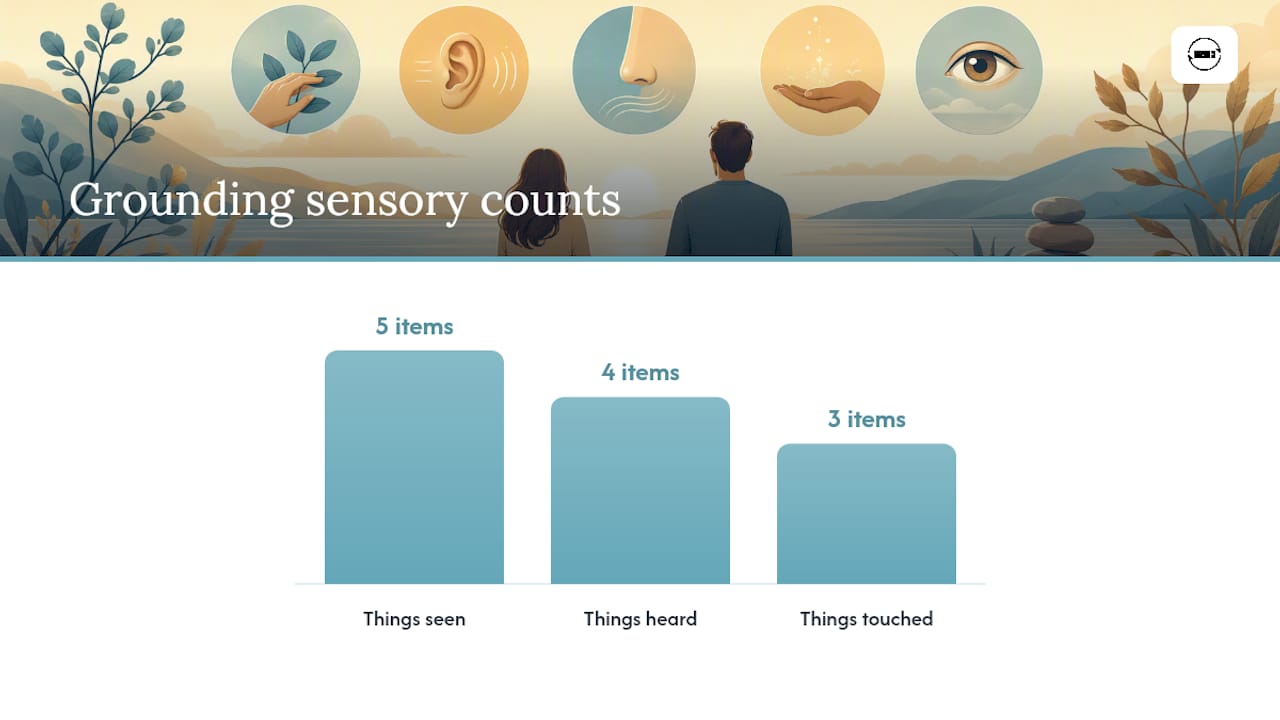
Practical grounding tools help in the moment: naming five things you can see, slow exhale breathing, or stepping outside for two minutes before responding to a trigger. Scheduling matters too. Some couples set a daily fifteen-minute window to process hard feelings so triggers don't hijack every evening. When triggers involve panic attacks, dissociation, or ongoing sleep loss, individual therapy focused on trauma stabilization becomes necessary rather than optional.
- Ground yourself with a sensory check before reacting (five things seen, four heard, three touched).
- Set a fixed daily check-in window instead of processing triggers at random hours.
- Use individual therapy when triggers include panic, dissociation, or persistent insomnia.
- Track patterns: certain times, places, or phrases that consistently set off a trigger.
Pro Tip: When your partner gets triggered, resist the urge to defend yourself or relitigate the facts. A steady, calm presence, "I'm here, I'm not going anywhere," does more to rebuild safety than any argument about fairness ever will.
What Exercises and Boundaries Help Rebuild Intimacy?
Emotional and physical intimacy usually return in that order, not the reverse. Rushing physical closeness before emotional safety exists tends to backfire, leaving the betrayed partner feeling more exposed rather than more secure.
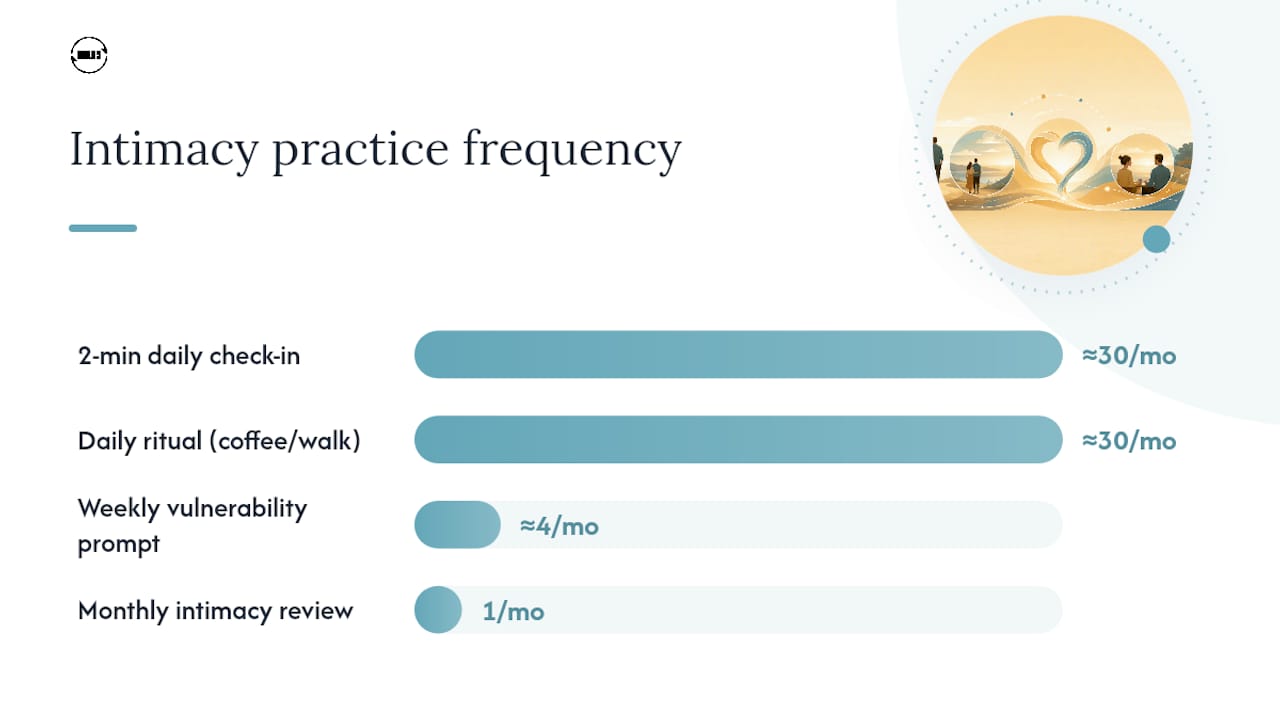
- Start with a two-minute daily check-in where each partner names one feeling from the day, no problem-solving allowed.
- Add a weekly vulnerability prompt, a question like "what did you need from me this week that you didn't ask for?"
- Build a small daily ritual, coffee together before phones come out, or a walk after dinner.
- Introduce physical touch gradually, starting with non-sexual contact and letting the betrayed partner set the pace.
- Revisit intimacy goals monthly rather than assuming progress is automatic.
Boundaries need to be specific, not vague gestures of goodwill. A workable boundary checklist usually covers phone and social media access, contact with mutual friends connected to the affair, and any workplace overlap with the affair partner. Co-creating these, rather than one partner dictating them, keeps the process from feeling like probation.
Many couples benefit from writing an actual Restructuring Plan: a document naming specific behaviors, a review timeline (say, checking in every 30 days), and what happens if a boundary gets crossed. It sounds clinical, but having it in writing removes the guesswork that fuels arguments later. Pairing this with structured communication exercises gives couples a concrete script instead of hoping the right words show up in the moment.
When Is Repair Not Safe or Realistic?
Not every affair is recoverable, and pretending otherwise does real damage. Certain patterns signal that continued effort may be wasted or even harmful.
- Ongoing contact with the affair partner, even "just as friends," despite repeated requests to stop.
- Repeated new lies discovered after the initial disclosure, especially about the affair's scope or timeline.
- Refusal to attend therapy or engage in any accountability structure.
- Blaming the betrayed partner for the affair itself.
- Any pattern of emotional, verbal, or physical abuse, which changes this from a trust problem to a safety problem entirely.
A useful approach here is setting a finite season-of-effort: agreeing to a defined period, often a few months, of structured work with clear review criteria, rather than an open-ended wait. This gives both partners a dignified point to honestly assess whether the effort is real.
If separation becomes the healthier path, individual therapy remains essential for processing the loss and rebuilding self-trust. A safety-first exit plan with practical scripts can make that transition less chaotic, particularly when finances, children, or shared housing are involved.
How Dewy Counselling Supports Couples Through Affair Recovery
Dewycounselling works with couples at every stage of this process, from the raw first weeks after discovery through the longer behavioral work of rebuilding safety. Sessions are available both in person and online, which matters for couples who need flexibility around work schedules or simply feel safer starting the conversation from home.
A typical plan often begins with stabilization sessions, sometimes individual, sometimes joint, focused on reducing acute distress before deeper work starts. From there, couples move into combined individual and couples therapy, using Emotionally Focused Therapy alongside practical accountability coaching for the unfaithful partner. Many couples work with their therapist to draft a Restructuring Plan, the same kind of written agreement described earlier, tailored to their specific triggers and boundaries.
- Couples counselling focused specifically on infidelity recovery and attachment repair.
- Emotionally Focused Therapy for couples working to rebuild emotional safety.
- Individual therapy for trauma stabilization alongside joint sessions.
- Both online and in-person formats to fit different comfort levels and schedules.
Readers curious about the broader signs it's time to seek couples therapy can find more context on when professional support tends to make the biggest difference.
An Honest Note From Clinical Experience
The biggest pitfall isn't lack of love, it's inconsistency. Couples do the hard emotional work for two weeks, then quietly slide back into old defensive habits once the crisis feeling fades. Measured, boring consistency beats dramatic gestures every time.
It's also worth saying plainly: leaving after honest, sustained effort is not a failure. Sometimes the most self-respecting outcome is walking away with clarity instead of staying in confusion. When repair does work, though, couples often describe the relationship afterward as more honest than it ever was before the affair, which is a strange but real gift.
— Wayne Dewhurst
Ready to Start Rebuilding? Here's What Working With Dewy Counselling Looks Like
Dewycounselling gives couples something a self-help article can't: a trained therapist who can read what's actually happening in the room and adjust the plan when progress stalls. If you've read this far and recognize your relationship in the stabilization steps or the Five Behaviors framework, the next move is booking an initial session rather than trying to run the whole process solo.

Sessions are available in both online and in-person formats, so scheduling around work or childcare doesn't have to be a barrier to starting. An initial consultation typically focuses on understanding where the relationship stands right now, whether the affair has fully ended, what triggers are most active, and what each partner hopes repair looks like. From there, your therapist builds a plan specific to your situation rather than a generic checklist.
Explore couples counselling options or visit the main Dewycounselling site to see current formats and get started with a first appointment.
Sources
For readers who want to go deeper, a few sources stand out. The Psychotherapy Networker's Five Behaviors framework breaks down daily trust-building actions in more detail. The Gottman Institute's Trust Revival Method walks through Atone, Attune, and Attach with specific exercises. Positivepsychology offers a practical overview of marriage therapy structure, and Psychology Today covers the trauma-informed side of recovery in depth.
This article is general information, not a substitute for advice from a qualified doctor. Consult a qualified healthcare professional about your own circumstances before acting on anything here.
- 5 Behaviors that Rebuild Trust After Infidelity - Psychotherapy Networker
- Reviving Trust After an Affair (part 2) - Gottman Institute
- The Path to Affair Recovery - Psychology Today