
Stonewalling in relationships happens when one partner shuts down emotionally during conflict, going silent, withdrawing, or refusing to engage. Most episodes are involuntary, a nervous system response called flooding, not a calculated punishment. The most effective immediate remedy is an agreed, short time-out with a specific, committed return, not pushing through the silence or walking away for good.
TL;DR:
- Stonewalling often coincides with physiological flooding, where increased stress hormones impair the ability to think or communicate clearly.
- Building daily habits like brief check-ins and paced breathing can reduce overall stress and lower the likelihood of emotional shutdown during conflict.
- Recognizing early signs of internal shutdown, such as racing heart or tense muscles, allows for timely use of self-soothing techniques before complete withdrawal occurs.
- Therapy approaches like Emotionally Focused Therapy or Gottman-informed couples work can address underlying patterns that sustain repetitive pursue-withdraw cycles.
- Misinterpretation of silence as either deliberate punishment or respectful restraint highlights the importance of understanding cultural and gender differences in conflict behavior.
What Does Stonewalling Look Like in Real Conflict?
Stonewalling rarely announces itself. One partner is mid-sentence, and the other partner's face goes flat, their answers shrink to a word or two, and their eyes drift somewhere else in the room. That flatness is the tell. It is not boredom. It is a person whose system has quietly gone into lockdown.
The behavior has a recognizable signature. Watch for:
- Monosyllabic answers ("fine," "sure," "whatever") delivered with no follow-up
- Avoiding eye contact or turning the body away mid-conversation
- Suddenly checking a phone, tidying, or finding a task to escape into
- Physically leaving the room without saying when, or if, they'll come back
- A blank or frozen expression, even when the other person is visibly upset
Compare two moments. In the first, a partner says, "I need a minute, my head's spinning, can we come back to this in twenty minutes?" That's a pause, and it protects the conversation. In the second, a partner says nothing, stares at the wall, and starts scrolling their phone while their partner is mid-sentence. That's stonewalling. The difference isn't the silence itself. It's whether there's a plan to return.
Underneath the visible behavior, something physical is happening. According to Gottman research, stonewalling often coincides with physiological flooding, where the body's stress response overrides the ability to think or speak clearly — one of what the Gottman Institute calls the Four Horsemen of relationship breakdown. A racing heart, tight chest or jaw, and a mind that suddenly can't form sentences are the internal side of the external shutdown.
One useful distinction separates two things that look identical from the outside: involuntary shutdown and deliberate silent treatment. Stonewalling can be both a protective reflex and, in some cases, a chosen tactic used to punish or control a partner. The visible silence looks the same either way, which is exactly why the intent behind it matters so much for how you respond.
Why Does Stonewalling Happen? Physiology, Attachment, and Old Habits
The body drives most stonewalling before the mind ever weighs in. Gottman's research describes flooding as a state where rising heart rate and stress hormones overwhelm the nervous system's capacity for verbal processing — the Gottman Institute's explainer on stonewalling frames it less as a communication choice and more as a temporary biological shutdown, similar to a circuit breaker tripping.
Attachment history shapes how that shutdown shows up. Someone with a dismissive-avoidant style often learned early that withdrawing was safer than confronting. Someone with an anxious attachment style might escalate first, then go quiet once they feel hopeless about being heard. Neither pattern is a character flaw. Both are strategies a nervous system picked up somewhere, usually in a family where conflict was either explosive or completely off limits.
Several forces tend to feed into a stonewalling episode:
- A childhood home where conflict meant yelling, so silence felt like the only safe option
- A previous relationship where speaking up led to punishment or dismissal
- Undiagnosed anxiety or a trauma history that makes conflict feel physically dangerous
- Sheer exhaustion, where the nervous system has nothing left to regulate with
Left unaddressed, these individual patterns often calcify into a couple-level dynamic: one partner pursues, raising their voice or repeating themselves to get a reaction, while the other withdraws further, which makes the pursuer push harder. Clinical explainers link this cycle directly to trauma history, anxiety, and conflict-avoidant patterns learned over years, according to the Cleveland Clinic's breakdown of stonewalling, and the loop feeds itself until something interrupts it.
There's a version of stonewalling that changes the entire calculus: when silence becomes a weapon. If a partner withholds engagement specifically to punish, control, or destabilize the other person, that's no longer flooding. It's coercion, and it calls for a different response than a compassionate time-out, often including outside support to address the power imbalance directly.
What to Do the Moment Stonewalling Starts
The first ninety seconds after someone starts shutting down determine whether the conversation can be salvaged that night or needs to wait. Both partners have a job in that window, and neither job is "push through it."
If you're the one starting to shut down, try this sequence:
- Name it out loud: "I'm flooding, I need a break." Naming the state, rather than hiding it, keeps your partner from reading the silence as rejection.
- Ask for a specific amount of time, not a vague exit. "I need twenty minutes" lands very differently than walking out.
- Use a calming routine during the break, slow breathing, a short walk, splashing cold water on your face, or naming five things you can see in the room.
- Return when you said you would, even if the urge is to avoid the whole topic entirely.
If you're the partner on the receiving end, resist the instinct to follow, repeat yourself louder, or demand an answer before they leave. Clinical guidance consistently recommends an agreed pause with a specific self-soothing plan and a committed return, rather than continuing to press for a response, according to SimplyPsychology's overview of stonewalling in relationships. Say something like, "Okay, I hear you need space. Let's pick it back up at 8:30." Then let them go without a parting jab.
A twenty to thirty minute window tends to work well for most couples, long enough for a racing heart to settle, short enough that the issue doesn't quietly disappear. Agree in advance on a neutral signal, a specific word or hand gesture, that either partner can use to call a break without it feeling like an accusation.
Pro Tip: Agree on your time-out signal and window during a calm moment, not mid-argument. Trying to negotiate the rules of a break while you're already flooded almost never works.
Daily Habits That Lower the Odds of Shutdown
Couples who stonewall less often aren't couples who never get overwhelmed. They're couples who've built small, repeatable habits that keep their baseline stress lower, so a hard conversation doesn't tip either partner into flooding as easily.
A few habits do most of the work:
- Short daily check-ins, even five minutes, where each partner shares one high and one low from the day
- Practicing paced breathing together outside of conflict, so the technique is familiar under pressure
- Using a soft start when raising a complaint ("I felt hurt when..." instead of "You always...")
- Reflective listening drills, where one partner summarizes what they heard before responding
- Building toward a rough five-to-one ratio of positive to negative interactions, a buffer that gives the relationship room to absorb friction without cracking
None of this requires a dramatic overhaul. It requires repetition, the same way a person builds physical stamina by showing up to practice, not by trying to run a marathon cold.
This is also where structured therapy earns its reputation. Emotionally Focused Therapy and Gottman-informed couples work both build these regulation and communication skills deliberately, with a therapist coaching the timing and tone in real time. A first EFT session typically maps each partner's cycle, identifying who pursues, who withdraws, and what triggers the pattern, before any new skills get introduced. Couples looking for structured drills can also work through practical communication exercises or daily emotional regulation practices between sessions.
Pro Tip: Practice the soft-start script on a low-stakes topic first, like who's cooking dinner, before trying it on something that actually hurts. Skills learned under pressure the first time rarely stick.
When Self-Help Isn't Enough: Getting Professional Support
Some patterns don't respond to time-outs and breathing exercises alone. It's time to bring in a professional when stonewalling is used deliberately to punish or control, when the same shutdown repeats week after week with no change, or when either partner feels unsafe, physically or emotionally, during conflict.
Emotionally Focused Therapy and Gottman-informed couples work are commonly cited as effective approaches for shifting entrenched pursue-withdraw dynamics, per SimplyPsychology's review of intervention options. When trauma or chronic anxiety is driving the shutdown, individual trauma-informed therapy alongside couples work often moves faster than couples work alone.
A first intake session usually covers:
- Each partner's version of the cycle, and where it tends to start
- Individual history that shapes each person's stress response
- A realistic goal for the first few months, rarely "never fight again," more often "recover faster"
Booking a first session with a therapist familiar with couples counselling approaches is a reasonable next step once the pattern feels stuck.
Stonewalling vs. the Silent Treatment and Plain Old Avoidance
The three often get lumped together, but they aren't the same behavior, and treating them identically leads to the wrong response.
Stonewalling is typically involuntary, a flooded nervous system that has stopped being able to process language in real time. The person isn't choosing silence as a message. Their system has simply hit a limit. The silent treatment, by contrast, is usually intentional. It's silence deployed specifically to punish, withhold affection, or force the other person to chase an apology. Sources note that silence in relationships can function as either a protective shutdown or a deliberate control tactic, per Wikipedia's overview of stonewalling, and the two require very different responses.
Avoidance is broader still. It's a general pattern of sidestepping difficult topics altogether, sometimes before a conversation even starts. A partner who changes the subject every time finances come up is avoiding. A partner who goes quiet mid-argument because their heart rate just spiked past their limit is stonewalling. A partner who refuses to speak for two days specifically to make the other person suffer is delivering the silent treatment.
The practical difference matters because the fix is different for each. Flooding calls for a time-out and self-soothing. Avoidance calls for gradually building tolerance for hard topics, often in smaller, scheduled doses. The silent treatment, when it's a repeated pattern, calls for a direct conversation about what silence is being used to accomplish, and often a therapist in the room to keep that conversation from becoming another cycle of blame.
Are You the One Stonewalling? How to Tell
It's easier to spot shutdown in a partner than in yourself, mostly because the internal experience feels like relief rather than withdrawal. Recognizing your own pattern starts with noticing a few specific moments.
Ask yourself honestly: do you tend to go quiet the instant a conversation gets uncomfortable, even before your partner has finished a sentence? Do you find yourself agreeing just to end a conversation, rather than because you actually agree? Does your body tense, your jaw clench, or your thoughts go blank right before you stop responding? Have you ever left a room mid-conflict without saying when you'd be back, or if you would at all?
A useful habit is tracking your physical state during disagreements for a week or two. Clinical sources point to specific somatic markers, racing heart, tight muscles, difficulty finding words, that reliably show up just before a full shutdown, according to the Cleveland Clinic. Noticing those cues earlier gives you a chance to name what's happening before you've already gone silent.
Self-awareness here isn't about assigning blame to yourself either. It's diagnostic information. Once you can catch the early signs, you can use the same time-out and self-soothing tools described earlier, on your own terms, before the shutdown takes over the conversation entirely.
Does Stonewalling Look Different Across Cultures and Genders?
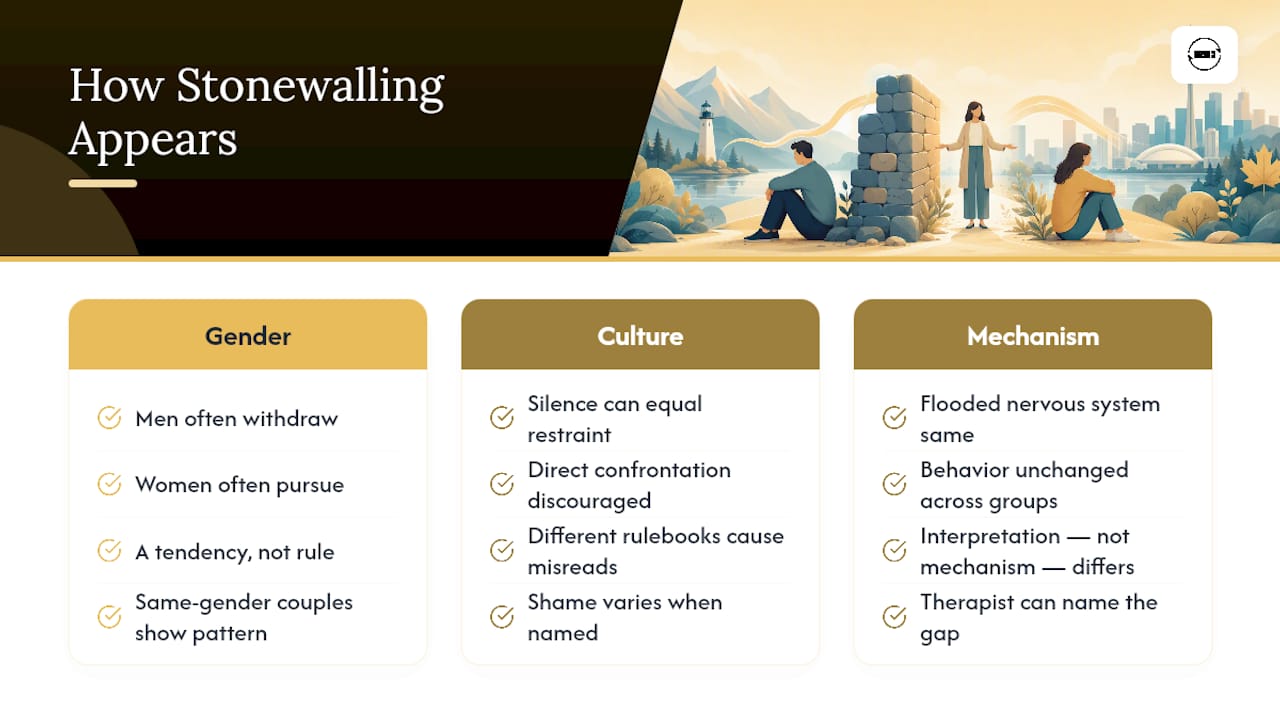
Research on gender patterns in stonewalling shows a tendency, not a rule: men are somewhat more likely to be identified as the withdrawing partner in heterosexual couples, while women are more often cast as the pursuer. That pattern shows up often enough in clinical literature to be worth naming, but plenty of couples run the opposite dynamic, and same-gender couples show the same pursue-withdraw pattern without needing a gendered explanation at all.
Cultural background shapes the picture further. In families and communities where direct confrontation is discouraged, whether for religious, generational, or regional reasons, silence during conflict can carry a completely different social meaning. What one partner reads as stonewalling, a hurtful withdrawal, another partner may have grown up understanding as respectful restraint, a way of avoiding saying something damaging in anger.
That gap in interpretation is exactly why couples from different backgrounds sometimes misread each other's silence for years before naming the pattern out loud. Neither interpretation is wrong on its own terms. The problem shows up when neither partner realizes the other is operating from a different rulebook entirely.
None of this changes the underlying mechanism. A flooded nervous system behaves the same way regardless of the culture or gender of the person experiencing it. What changes is how the silence gets interpreted, and how much shame gets attached to naming it out loud. Couples navigating a real cultural or gendered gap in expectations around conflict often benefit from a therapist who can name that gap explicitly, rather than letting each partner assume the other is simply being difficult.
Therapist's Perspective: How Real Couples Make Progress
Change with stonewalling tends to follow a specific sequence: a couple first learns to recognize the shutdown as it starts, then practices regulation tools until they're second nature, then builds a track record of safe returns after breaks, and only then does the underlying pursue-withdraw pattern actually shift. Skipping steps rarely works. A couple that jumps straight to "communicate better" without first learning to recognize flooding usually ends up right back in the same shutdown within weeks.
Setbacks are part of the process, not evidence that it isn't working. A couple who successfully manages three tense conversations and then has one that ends in silence hasn't lost their progress. They've hit the normal, uneven texture of learning a new skill under real pressure. What separates couples who improve from couples who stay stuck usually isn't willpower. It's whether they keep practicing after a bad night instead of deciding the whole approach failed. Therapy tends to compress that learning curve considerably, mostly by giving both partners language and structure they'd otherwise have to invent themselves through trial and error.
— Wayne Dewhurst
How Dewy Counselling Can Help You Break the Cycle
If you've recognized your own relationship in this pattern, working with a therapist trained in these exact dynamics moves you past guesswork a lot faster than trying to self-diagnose every argument. Couples counselling built around conflict cycles like pursue-withdraw, alongside individual psychotherapy for anxiety, trauma history, or conflict-avoidant habits that often sit underneath one partner's shutdown, is available.

A first session typically starts with mapping your specific cycle, who tends to pursue, who tends to withdraw, and what usually sets it off, so the work that follows targets your actual pattern instead of a generic script. Sessions are available online and in person, which matters if flexibility is what's kept you from booking something sooner. If you're ready to stop managing the same argument on your own, book a first session through Dewy Counselling's couples counselling page and bring your specific pattern to the table.
Sources
- The Four Horsemen: Stonewalling — Gottman Institute
- Stonewalling in a relationship — Cleveland Clinic
- Stonewalling in relationships — SimplyPsychology
This article is general information, not a substitute for advice from a qualified doctor. Consult a qualified healthcare professional about your own circumstances before acting on anything here.