
Relationship avoidance, more precisely called avoidant attachment, is a learned emotional pattern where a person consistently pulls back from closeness, vulnerability, and emotional dependence in romantic relationships — not because they don't care, but because intimacy feels genuinely threatening to them. If you've been wondering why you (or someone you love) keeps creating distance right when things get close, this pattern may explain a great deal.
Ask yourself whether any of these sound familiar:
- You feel smothered when a partner wants more emotional closeness
- You go quiet or pull away after a particularly connected moment
- Conversations stay surface-level, even with someone you care about
- You prize your independence so strongly that needing someone feels uncomfortable
- You return after periods of silence, but rarely explain why you withdrew
If two or more of those resonate, avoidant attachment is worth understanding. The encouraging news: avoidant patterns are common and, with the right support, genuinely changeable.
What does relationship avoidance actually look like day to day?

Attachment theory, developed by John Bowlby and later expanded by Mary Ainsworth, describes how early bonds with caregivers shape the way we seek (or avoid) closeness throughout life. The Attachment Project is one of the most widely referenced lay resources for understanding these patterns. Avoidant attachment is one of four styles the theory identifies, alongside secure, anxious, and disorganized.
In practical terms, avoidant attachment differs from simply being uninterested in someone. A person who isn't interested typically fades out and doesn't return. An avoidant person often does return — but keeps the relationship at a carefully managed emotional distance. Therapists note that consistency and emotional availability are the key differentiators: avoidant individuals give brief, surface-level replies and may still come back after silence, whereas someone who has simply lost interest usually doesn't.

Picture this scenario: a couple has a genuinely warm weekend together. On Monday, one partner sends an affectionate message. The other reads it, feels a flicker of anxiety they can't quite name, and responds with something short and neutral. By Wednesday they've gone quiet. Their partner feels confused and hurt. The avoidant person isn't being cruel — they're managing an internal alarm system that treats closeness as risk.
Key behavioral markers include:
- Preferring to handle problems alone rather than leaning on a partner
- Deflecting emotional conversations with humor or topic changes
- Feeling relief, not loss, when a partner gives them space
- Describing past relationships as "too clingy" or "too intense"
How does relationship avoidance develop in the first place?
Avoidant attachment typically forms when a child's caregivers were emotionally unavailable, dismissive of feelings, or inconsistent in their responsiveness. The child learns, through repetition, that expressing emotional needs doesn't bring comfort — it brings nothing, or worse, criticism. Self-reliance becomes the rational solution. Emotional suppression becomes a skill.
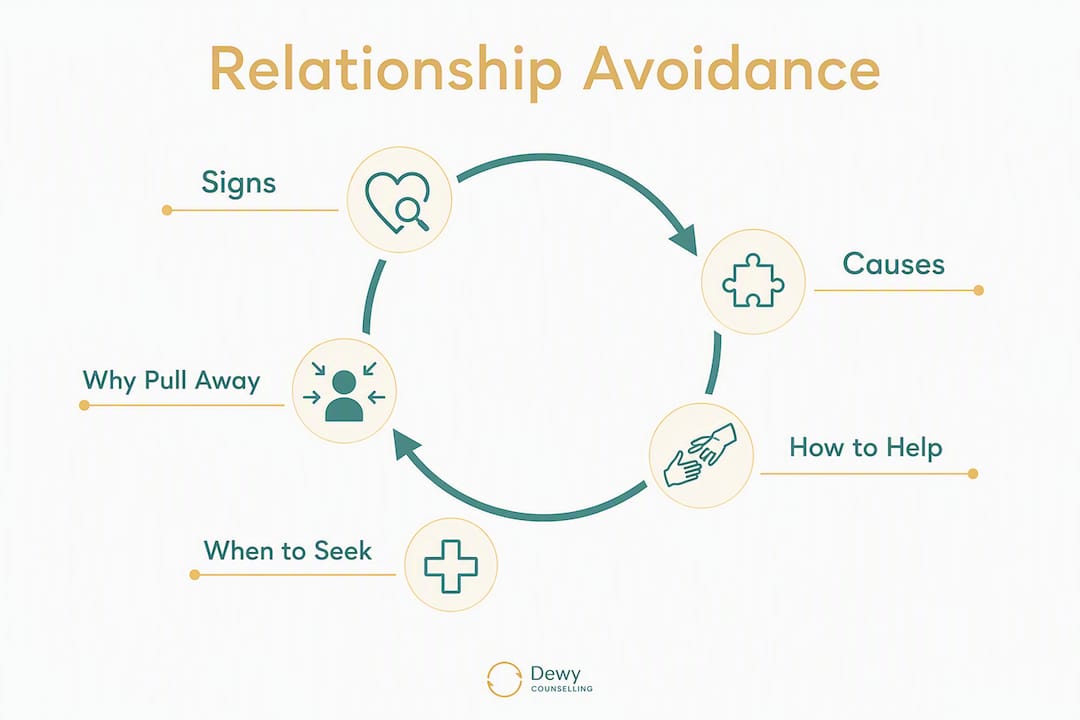
Other contributors compound this foundation. Repeated rejection in early friendships or adolescent relationships reinforces the belief that closeness leads to pain. Cultural messages — particularly those aimed at boys and men — that frame emotional independence as strength can deepen the pattern. Significant attachment injuries in adulthood (a painful betrayal, a sudden loss, an emotionally volatile relationship) can also push someone toward avoidant strategies even if their early caregiving was relatively healthy.
The critical reframe here is that avoidance is adaptive, not malicious. It was a smart solution to an environment where vulnerability wasn't safe. The problem is that the strategy persists long after the original environment is gone.
Pro Tip: If you're the partner of someone avoidant, try replacing "they don't care about me" with "they learned that closeness isn't safe." That single reframe tends to reduce the reactive anger that makes avoidant partners withdraw further.
What are the signs of avoidant attachment you can watch for?
About 20% of the population may show avoidant attachment tendencies, and many of them don't recognize the pattern in themselves because it feels like a preference for independence rather than a fear of closeness.
Common signs in yourself or a partner include:
- Strong, almost non-negotiable need for personal space and autonomy
- Discomfort when a partner expresses deep feelings or asks for emotional support
- Withdrawal after moments of genuine connection or vulnerability
- Keeping conversations at a practical, surface level even in long-term relationships
- Inconsistent engagement: warm and present one day, distant and monosyllabic the next
- Difficulty saying "I love you" or expressing affection unprompted
- Feeling suffocated by commitment milestones (moving in, meeting family, exclusivity talks)
- Minimizing or dismissing a partner's emotional needs as "too much"
In texts and digital communication, avoidant patterns often appear as delayed replies, short answers that don't engage with the emotional content of a message, or a habit of going quiet for days without explanation. In arguments, the avoidant person may shut down, leave the room, or pivot to logic when their partner is clearly asking for empathy.
Physical intimacy can be present while emotional intimacy stays absent. An avoidant partner may be comfortable with sex but pull away from cuddling afterward, rush through foreplay, or retreat quickly once the physical moment passes. Closeness without emotional exposure feels manageable; closeness with emotional exposure does not.
Busy vs. avoidant: a quick distinction. A busy person usually re-engages when their schedule clears and responds to the emotional heart of your messages. An avoidant pattern keeps replies shallow and the relationship vague over time, regardless of how busy life actually is.
Quick self-check: Track whether the distance in your relationship is situational (tied to a stressful period) or consistent (present even during calm stretches). Consistent, low-level emotional unavailability that doesn't shift with circumstances is the clearest signal of an attachment pattern rather than a scheduling issue.
Why do avoidant people pull away when they feel close?
The answer lies in what attachment researchers call the internal working model — a set of unconscious beliefs about whether other people can be trusted, whether depending on someone is safe, and whether the self is worthy of care. For avoidant individuals, that model says: closeness leads to rejection or engulfment, so distance is protection.
When intimacy increases, an internal alarm activates. The avoidant person doesn't consciously decide to withdraw — the nervous system does it first. Researchers describe this as a deactivation strategy: emotional signals get suppressed, self-reliance ramps up, and the person creates physical or emotional distance to reduce the perceived threat. From the outside it looks like coldness. From the inside it feels like relief.
Avoidant attachment operates as a deactivation system: when attachment needs are triggered, the person suppresses emotional signals and increases self-reliance to avoid the perceived threat of rejection. The withdrawal isn't indifference — it's the nervous system doing exactly what it learned to do.
The push-pull dynamic that so many couples describe follows a predictable arc: a moment of closeness triggers the avoidant partner's alarm, they pull back, the anxious or secure partner pursues to restore connection, the avoidant partner feels more pressured and pulls back further. Therapists emphasize that the goal isn't to eliminate the avoidant person's need for autonomy — it's to build enough safety that the alarm doesn't fire as loudly or as often.
Common deactivation strategies include humor to deflect emotional conversations, sudden interest in work or hobbies when a relationship deepens, reframing the relationship as "not that serious," and finding fault with a partner to justify emotional distance.
How should you respond when an avoidant partner goes silent?
The instinct to pursue harder when a partner withdraws is understandable, but it usually makes things worse. Here's a more effective sequence:
- Pause your own reaction first. Give yourself 20–30 minutes before sending a follow-up message. Sending multiple messages in quick succession signals urgency that tends to accelerate the avoidant partner's retreat.
- Send one low-pressure message. Something like: "I noticed things feel a bit quiet between us. No pressure — I'm here when you're ready." This keeps the door open without demanding entry.
- Name your experience, not their behavior. "I feel disconnected" lands very differently than "You always shut me out." The first invites; the second accuses.
- Give genuine space, not punishing silence. There's a difference between stepping back to let your partner regulate and going cold to signal your hurt. The first is respectful; the second recreates the same dynamic from the other direction.
- Return to your own life. Invest in friendships, hobbies, and your own emotional regulation. Partners who have a full life outside the relationship are less threatening to an avoidant person, and less depleted when the partner does return.
| Partner response | Effect on avoidant partner | Better alternative |
|---|---|---|
| Sending multiple messages when they go quiet | Increases pressure; accelerates withdrawal | One calm, low-pressure message, then wait |
| Demanding to know what's wrong | Triggers defensiveness and shutdown | "I'm here when you're ready" |
| Withdrawing coldly in return | Creates a standoff; no one moves | Genuine space with a warm re-entry |
| Criticizing their need for independence | Confirms their belief that closeness is unsafe | Acknowledge autonomy as valid, name your need separately |
| Escalating emotionally during conflict | Overwhelms their nervous system | Lower your voice, slow the pace, take breaks |
Distinguishing avoidant withdrawal from disinterest matters here: if your partner returns after silence with some warmth or explanation, avoidance is the more likely explanation. If they return only to repeat the cycle with no movement toward you, a direct conversation about the relationship's direction is appropriate.
Can avoidant attachment actually change?
Yes, though not quickly and not without some discomfort. Healing avoidant attachment typically requires consistent, supportive therapy and what researchers call corrective emotional experiences — repeated moments of being genuinely seen and having emotional needs met without the feared rejection occurring. Over time, those experiences erode the internal working model's certainty that closeness is dangerous.
Effective therapy approaches include:
- Emotion-Focused Therapy (EFT): Particularly well-suited to attachment work; helps clients identify and express the emotions underneath avoidant behavior, and restructures the negative interaction cycles in couples.
- Attachment-based individual therapy: Works directly with the internal working model, helping clients trace current patterns back to their origins and build new relational templates.
- CBT-informed approaches: Useful for identifying and challenging the specific thoughts that drive avoidant behavior ("If I need them, I'll be rejected," "Depending on someone is weakness").
- Couples therapy with an attachment focus: Gives both partners a structured space to practice new patterns together, with a therapist present to interrupt the push-pull cycle before it escalates. Understanding what couples therapy involves can help you decide whether individual or joint work is the right starting point.
Self-help exercises that support the process between sessions:
- Journaling prompts: "What am I afraid will happen if I let this person in?" or "What did I need as a child that I didn't get?"
- Small vulnerability experiments: Share one slightly uncomfortable feeling per week with a trusted person, and notice what actually happens.
- Paced exposure to intimacy: Agree with a partner on one new form of closeness to practice (a daily check-in, a weekly honest conversation) rather than trying to overhaul everything at once.
Progress is incremental and rarely linear. Relapses into old patterns, especially during stress, are normal. The measure of change isn't the absence of avoidant impulses — it's how quickly you notice them and how much more choice you have in how you respond.
When is it time to seek professional help?
Some patterns respond well to self-reflection and the practical steps above. Others are too entrenched, or too painful for the people involved, to shift without professional support. Consider reaching out when:
- The same cycle of closeness and withdrawal has repeated for months or years without movement
- One or both partners feel chronically lonely inside the relationship
- Attempts at honest conversation consistently end in shutdown, stonewalling, or escalation
- The avoidant person recognizes the pattern but feels unable to change it alone
- A partner's emotional needs are going unmet to the point of affecting their mental health
Therapy doesn't ask avoidant clients to abandon their need for independence. It asks them to expand their range — to have access to closeness and autonomy, rather than only one.
Dewycounselling offers individual therapy, couples counselling, and online sessions for clients working through attachment-related concerns. An intake assessment helps clarify whether individual work, couples work, or a combination makes the most sense for your situation. Signs your relationship needs therapy can help you gauge whether now is the right time to reach out.
Sessions are confidential, and both in-person and online formats are available, so access isn't limited by location or schedule. If you're the partner of someone avoidant and they're not yet ready for therapy, individual sessions focused on your own responses and needs are a genuinely useful starting point.
Key Takeaways
Avoidant attachment is a learned protective pattern, not a character flaw, and it responds to consistent, well-structured support.
| Point | Details |
|---|---|
| What it is | Avoidant attachment is a learned pattern of pulling back from emotional closeness to avoid perceived rejection. |
| How common it is | About 20% of people may show avoidant tendencies, so this pattern is far from rare. |
| Core signs to watch | Withdrawal after closeness, surface-level conversations, strong preference for independence, and inconsistent engagement. |
| What actually helps | EFT, attachment-based therapy, and corrective emotional experiences in a consistent therapeutic relationship. |
| Dewycounselling's role | Dewycounselling offers individual and couples therapy for attachment concerns, in-person and online, with an intake assessment to find the right fit. |
The part most people miss about avoidant attachment
Most articles about avoidant attachment focus on what the avoidant person does wrong, or on how to "fix" them. That framing misses something important. Avoidance is, at its core, a success story of adaptation. The child who learned to need less, feel less, and depend on no one was solving a real problem with the tools available to them. The tragedy isn't that they became avoidant — it's that the strategy outlived its usefulness.
What I find most striking in attachment work is how often avoidant clients genuinely want closeness. They're not indifferent to love. They're frightened of it in a way that feels indistinguishable from not wanting it. That distinction matters enormously for how partners respond and how therapy is framed. Approaching an avoidant person as someone who is protecting themselves, rather than someone who is withholding from you, changes the entire relational dynamic.
Change is possible. It tends to be slow, and it requires a therapeutic relationship that itself becomes a corrective emotional experience. But the clients who commit to that process consistently report something they didn't expect: that learning to let someone in doesn't feel like losing themselves. It feels like gaining a dimension of life they'd quietly given up on.
Dewycounselling's approach to attachment work
Chronic loneliness inside a relationship, the same withdrawal cycle repeating without resolution, a partner who wants to connect but doesn't know how: these are exactly the concerns Dewycounselling is built to address. Rather than waiting until a relationship reaches a breaking point, individual and couples therapy at Dewycounselling gives you a structured, confidential space to understand what's driving the distance and to practice something different.

Sessions are available in-person and online, so you can access support in whatever format fits your life. Whether you're the avoidant person ready to understand your own patterns, or the partner trying to stay connected without losing yourself, Dewycounselling's therapists work with attachment concerns regularly and without judgment. The intake process is straightforward: you share what's bringing you in, and together you determine whether individual therapy, couples counselling, or a combination is the right path. Confidentiality is absolute. Booking is the only step between where you are now and having real support.
Useful sources and further reading
- Attachment Theory — Wikipedia: A solid overview of Bowlby and Ainsworth's foundational research, useful for readers who want the academic context behind the clinical concepts in this article.
- Healing Avoidant Attachment — Simply Psychology: A thorough clinical explainer on why avoidant attachment develops and what genuinely helps people open up, written for a general audience.
- Avoidant Attachment Style Explained — Cleveland Clinic: Clear, medically reviewed overview of avoidant attachment with practical guidance on the push-pull dynamic.
- How to Heal an Avoidant Attachment Style — Verywell Mind: Evidence-based breakdown of therapy options and self-help tools for healing avoidant patterns.
- Avoidant Attachment in Relationships — Simply Psychology: Detailed look at how avoidant attachment shows up in adult romantic relationships and how it develops from early caregiving.
- Dewycounselling Services: Overview of individual, couples, and family therapy options available at Dewycounselling, including online and in-person formats.
- Types of Couples Therapy — Dewycounselling Blog: Practical guide to therapy modalities for couples, helpful for readers deciding which approach suits their situation.