
Track three fields every day: your mood label, its intensity from 0 to 10, and one line of context about what triggered it. Review those entries once a week, and you'll usually spot at least one pattern worth acting on within a month. Organizations like NIMH and the American Psychiatric Association frame this kind of self-monitoring as a foundation for better mental health, and at Dewycounselling we see the same thing play out in session: clients who bring data, not just impressions, make faster progress.
Here's your five-minute starting checklist:
- Pick one method (a free app or a notebook) and commit to it for two weeks minimum.
- Log mood label, intensity, and context daily, ideally at the same time.
- Add one behavior field: sleep hours, exercise, or alcohol/caffeine intake.
- Set a recurring weekly reminder to review entries for 10 to 15 minutes.
- Write down one small experiment to test based on what you notice.
Quick benchmark: A peer-reviewed review of mobile mood-tracking apps found that self-tracking can build meaningful awareness of personal mood patterns and support emotional wellbeing over time, but only when entries are consistent enough to reveal a trend rather than a single data point.
Key Takeaways
Tracking mood label, intensity, and context daily, then reviewing weekly, is the single most reliable method for turning vague emotional discomfort into a targeted, testable plan.
| Point | Details |
|---|---|
| Start with three fields | Log mood label, intensity (0 to 10), and one line of context every day. |
| Review weekly, not daily | Set a 10 to 15 minute weekly check-in to spot trends instead of overanalyzing single entries. |
| Test one change at a time | Use a S.M.A.R.T. experiment (like fixed bedtime) for two to four weeks before drawing conclusions. |
| Match the tool to your needs | Daylio and Moodfit suit speed and structure; eMoods suits symptom tracking; paper charts suit privacy. |
| Bring data, not just impressions | Dewycounselling sessions use weekly trend summaries from your mood log to design a targeted plan faster. |
Why Tracking Mood Patterns Improves Wellbeing
Mood tracking works because it turns a vague feeling ("I've been off lately") into a data trail you can actually interrogate. Instead of guessing whether Sundays are rough or whether your temper flares after a bad night's sleep, you get a record that either confirms or kills the theory. That shift, from impression to evidence, is the entire value proposition.
The peer-reviewed analysis of mobile mood-tracking apps found that consistent self-tracking helps people build real awareness of their own mood patterns, which in turn supports emotional wellbeing. That's not a minor side effect. Awareness is the raw material therapists work with, and clients who arrive with even two weeks of logged data tend to identify their own triggers faster than those who rely on memory alone, which is famously unreliable for emotional states.
Tracking mood patterns delivers a few concrete benefits that show up quickly:
- Spotting triggers you'd otherwise miss — a rough Tuesday might trace back to a recurring meeting, not "just a bad day."
- Sharper conversations with a therapist or doctor — instead of "I've felt anxious," you can say "anxiety spiked six of the last ten weekdays, always after 2 p.m."
- A testing ground for small changes — you can trial one adjustment (earlier bedtime, less caffeine) and watch whether the data actually moves.
- Early warning signs — a slow downward trend over three weeks is easier to catch in a log than in memory.
NIMH's guidance on caring for your mental health recommends pairing self-monitoring with concrete self-care behaviors like regular sleep and movement rather than treating tracking as an end in itself. That distinction matters for how you should think about your data: it's a diagnostic tool, not a finish line. If you want a deeper primer on which self-care behaviors tend to move the needle, our guide on self-care practices for mental health breaks those down further.
Which Mood-Tracking Method Fits Your Life?
There's no single best way to monitor mood changes. The right method depends on how much time you have, how much detail you want, and whether privacy is a dealbreaker.
Quick-entry apps (think emoji pickers or a one-tap 1 to 5 scale) take seconds and are the easiest habit to sustain, but they trade away nuance. A "3 out of 5" doesn't tell you whether you were bored, anxious, or just tired.
Narrative journaling goes the opposite direction: full sentences about what happened and how you felt. It captures rich context but takes longer, and consistency often slips after the first excited week.
Printable mood charts, like the kind found in PositivePsychology's templates, sit in the middle. They force structure (fixed fields, a grid you fill in) without requiring an app or a subscription.
Voice and photo logs are underused but effective for people who find typing tedious. A 15-second voice memo capturing tone and word choice can reveal irritability or flatness that a numeric scale entirely misses.

Wearables add a physiological layer, tracking sleep and heart rate variability alongside self-reported mood, though most require pairing with an app to make sense of the data.
A quick way to think about trade-offs:
- Fastest entry, lowest depth: emoji-scale apps like Daylio.
- Moderate entry time, moderate depth: structured templates with a feelings wheel for vocabulary.
- Slowest entry, highest depth: full journaling or voice logs with follow-up reflection.
Apps like Daylio and Moodfit dominate the fast end of this spectrum, while eMoods specializes in symptom tracking for mood disorders. Headspace and Calm aren't trackers per se, but many people log mood as a companion habit alongside their meditation sessions. The Feelings Wheel, a tool popularized in therapeutic settings, solves a specific problem: most people default to "fine," "bad," or "stressed" when a wider emotional vocabulary would surface much more useful detail.
Pro Tip: If you've tried journaling and abandoned it twice, don't try again the same way. Switch to a 10-second app entry for two weeks to rebuild the habit, then layer in weekly narrative reflection once daily logging feels automatic.
What to Log and Three Templates You Can Copy Today
Consistency matters more than complexity. A tracker with five fields that you actually fill out daily beats a beautiful 20-field system you abandon after four days.
The core fields worth logging
- Mood label — a word or two, ideally pulled from a feelings wheel instead of just "good" or "bad."
- Intensity — a 0 to 10 scale, so "anxious" at a 3 reads differently than "anxious" at an 8.
- Context or trigger — one line: what happened right before this mood, or what you were doing.
- Sleep — hours slept and rough quality (poor, okay, good).
- Movement — any exercise, even a 15-minute walk.
- Substances — alcohol or caffeine intake, since both interact heavily with mood regulation.
- Social contact — did you connect with anyone meaningfully, or spend the day isolated?
- Medication — if applicable, whether doses were taken as prescribed.
- Notes — a short reflection, optional but useful during weekly review.
Daily template (under 30 seconds)
Weekly review template
Set aside 10 to 15 minutes once a week and answer four questions in writing: Which days scored lowest, and what did they have in common? Which days scored highest, and what was different? Did sleep or substance patterns line up with mood swings? What's one small change worth testing next week?
Printable mood chart layout
A classic printable chart, similar in spirit to the DBSA Wellness Tracker, runs days of the month down the rows and tracked variables across the columns: mood rating, sleep hours, medication taken (yes/no), exercise (yes/no), and a notes column. At month's end, the grid becomes a visual map, colors or numbers clustering in ways a text log never quite shows.
If you'd rather keep digital records, a simple CSV schema works across almost any spreadsheet tool: date, mood_label, intensity, trigger, sleep_hours, exercise_minutes, substances, social_contact, notes. That structure exports cleanly if you ever want to share data with a therapist or run your own basic analysis.
Pro Tip: Keep the daily entry under 30 seconds by pre-filling repetitive fields (like your usual sleep window) and only editing what changed. Save the thinking for your weekly review, not your daily log.
For a broader printable checklist that pairs well with this system, our emotional wellness checklist offers additional structure for readers who want more than five fields.
Comparing the Top Mood-Tracking Apps and Templates
Daylio is built for speed. No writing required, just icon taps, which makes it the easiest habit to sustain long term. Moodfit goes further, bundling in CBT-style exercises and goal tracking for people who want structure beyond a simple log. eMoods is purpose-built for tracking mood disorders like bipolar disorder, with symptom and medication fields clinicians specifically request. Headspace and Calm aren't trackers first, but both include mood check-ins as part of their meditation flows, useful if you already use one for mindfulness. PositivePsychology's printable mood chart templates suit anyone who prefers paper or wants a zero-cost, offline-only system. The Feelings Wheel isn't an app at all, but pairing it with any of the above sharpens the vocabulary you use to describe what you're feeling.
Availability and exact features shift over time, so confirm current pricing and regional availability directly through each app's store listing before committing. If you're in Canada, most of these apps are fully available, though some premium tiers or promotional pricing may vary by region.
- If speed is your priority, start with a tap-based app like Daylio.
- If you want built-in therapeutic tools, Moodfit adds more structure.
- If you manage a diagnosed mood disorder, eMoods captures the clinical detail a doctor will actually want to see.
- If you'd rather stay offline entirely, a printed chart still works, and arguably works better for privacy.
How to Read Your Mood Data and Turn It Into Change
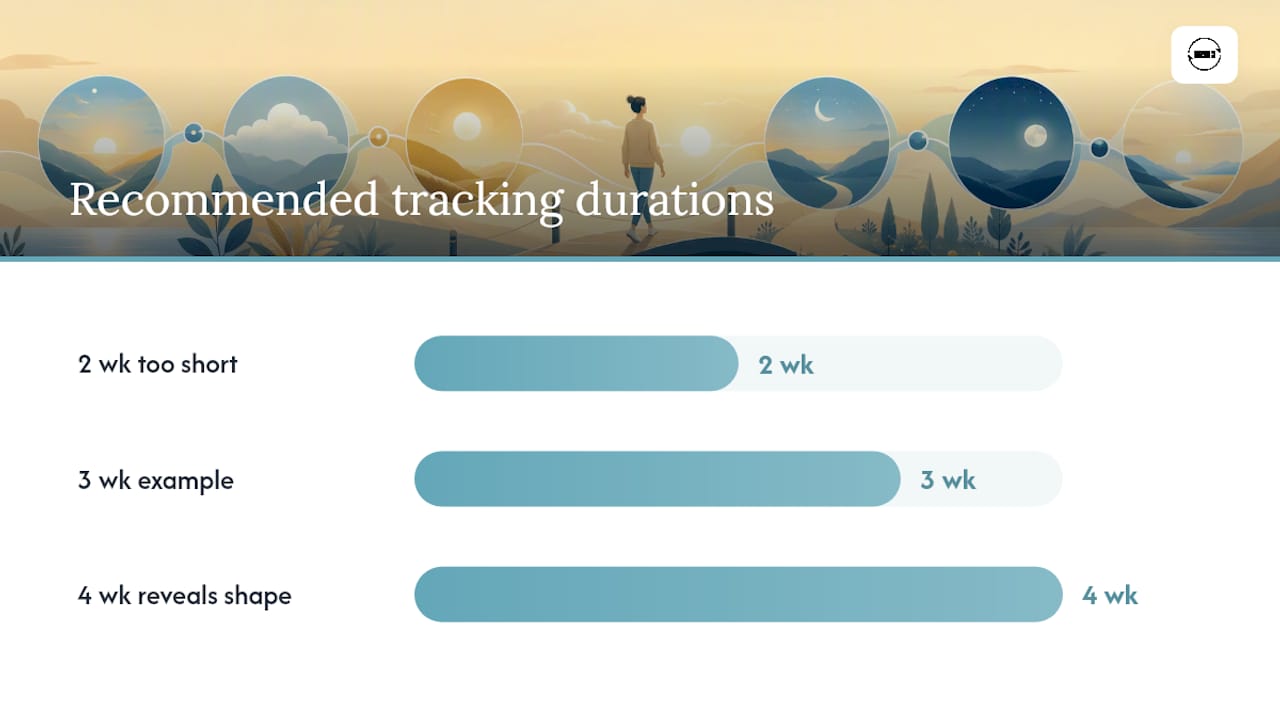
Two weeks of entries won't tell you much. Four weeks starts revealing shape. Here's how to actually read what you've collected:
- Scan for repeated context, not just repeated moods. If "irritable" shows up five times, check whether it's always paired with the same trigger, like poor sleep or a specific person.
- Look for timing patterns. Mood dips that cluster on Sunday nights or mid-afternoon usually point to a schedule issue, not a mystery.
- Cross-reference behaviors. Line up your mood intensity against sleep hours and substance intake. A pattern of anxiety spikes on high-caffeine days is common and fixable.
- Rank your findings. Pick the one pattern with the clearest, most repeated link. Ignore the noise for now.
- Design a single-change experiment. Choose one variable, set a specific goal (a S.M.A.R.T. framework works well here), and track it for two to four weeks without changing anything else.
A S.M.A.R.T. experiment might look like this: "I will go to bed by 11 p.m. on weeknights for three weeks and track whether my average morning mood intensity improves." That's specific, measurable, and time-bound, which makes the result easy to read afterward.
Here's a realistic before-and-after: a client tracking sleep and mood noticed irritability spiking on days following less than six hours of sleep. Over three weeks of intentionally extending sleep to seven hours, average irritability ratings dropped by roughly two points on their own 0 to 10 scale. That's not a clinical trial, it's an N-of-1 experiment, but it's exactly the kind of targeted, low-risk change that mood data makes possible. The American Psychiatric Association's lifestyle guidance groups sleep, movement, nutrition, and social connection as the four pillars most worth testing this way.
Pro Tip: Change one variable at a time. If you overhaul sleep, diet, and exercise simultaneously, you'll never know which change actually moved your mood.
For more on managing the emotional side of this process, see our piece on improving emotional regulation daily.
Your 4-Week Starter Plan for Tracking Mood
You don't need a perfect system on day one. You need a system you'll still be using in week four.
- Week 1: Setup and baseline. Choose your method (app, chart, or notebook), log daily without judging the results, and resist the urge to change anything yet.
- Week 2: Spot a pattern. Review entries at the end of the week and identify one recurring trigger or timing pattern. Pick a single small change to test.
- Week 3: Run your experiment. Apply the one change consistently (better sleep, less caffeine, more social contact) and keep logging exactly as before.
- Week 4: Review and plan ahead. Compare week 3 against your baseline. Did intensity scores shift? Decide whether to keep the change, adjust it, or test something new.
| Week | Focus | Time commitment |
|---|---|---|
| 1 | Setup and daily logging | 5 minutes/day |
| 2 | Weekly review and pattern spotting | 5 minutes/day + 15-minute review |
| 3 | Run one targeted experiment | 5 minutes/day |
| 4 | Compare results, plan next month | 5 minutes/day + 20-minute review |
To keep the habit alive past week four, pair your logging with something you already do daily, brushing your teeth, making coffee, or setting a phone alarm at a fixed time. Our guide to building daily mental wellness habits that stick covers habit-pairing strategies in more depth if week one feels shaky.
Is Your Mood Data Private and Secure?
Before you commit to any app, ask a few pointed questions: Can you export your data? Where is it stored, and is it encrypted? Does the app use your entries to train AI models, and can you opt out? Can you fully delete your account and any backups?
Some practical safeguards:
- Choose apps with local-only storage or a clear opt-out from cloud sync if privacy matters more than convenience.
- Export and archive your data periodically instead of relying solely on an app's server.
- Read the privacy policy for any language about third-party data sharing, especially with advertising partners.
- If in doubt, a paper chart or a password-protected note offers the simplest privacy guarantee available.
Pro Tip: For maximum control, a plain encrypted notes app or a locked physical notebook beats any cloud-based tracker. It's less convenient, but nothing leaves your device.
When Mood Tracking Isn't Enough on Its Own
Tracking helps you see patterns, but it isn't a treatment. Certain signs mean it's time to bring in professional support rather than keep monitoring alone.
Watch for these red flags:
- Severe symptoms (persistent sadness, hopelessness, or anxiety) lasting two weeks or longer, a threshold NIMH specifically flags as worth professional attention.
- Any thoughts of self-harm or suicide, which require immediate contact with a crisis line or emergency services.
- A noticeable decline in daily functioning, missing work, withdrawing from relationships, or neglecting basic self-care.
- Mood swings severe enough to disrupt sleep, appetite, or relationships consistently.
If your logged data shows a clear downward trend over several weeks, or if intensity scores repeatedly hit the extreme end of your scale, that pattern itself is a signal worth bringing to a clinician, not something to keep tracking in isolation.
When you do bring logs into therapy, clinicians tend to find trend data (weekly averages, recurring triggers, sleep correlations) more useful than a day-by-day play-by-play. Bring your weekly review notes, not just raw entries.
What the Research Actually Shows, and What It Doesn't
The strongest evidence behind mood tracking comes from a peer-reviewed analysis of mobile mood-tracking apps, which found that self-tracking can meaningfully build awareness of personal mood patterns and support emotional wellbeing. That's a real, useful finding, but it comes with honest limits.
Mood tracking has real constraints worth knowing upfront:
- Sampling bias. People often log more consistently during rough patches and skip entries when things feel fine, skewing the overall picture.
- Incomplete context. A mood label and number can't capture everything happening in someone's life that week.
- Feature variation across apps. Research on app features found that tools capturing richer context tend to produce more useful long-term patterns than those limited to a simple numeric scale.
- Over-reliance on scores. A tracker is a diagnostic aid, not a diagnosis. Pattern data works best paired with evidence-based interventions like CBT or structured lifestyle change, not used alone to self-diagnose a condition.
Why Tracking and Small Changes Actually Move the Needle
The mechanism behind mood tracking isn't magic, it's feedback loops. Once you can see a pattern, you can test a change and measure whether it worked, the same logic behind any well-designed experiment.
Part of the effect comes from emotional granularity, the practice of naming specific emotions instead of defaulting to a single vague score. People who label emotions precisely tend to regulate stress more effectively and recover faster from setbacks, which is exactly why a feelings wheel outperforms a simple 1 to 5 scale for many users.
The rest ties directly to lifestyle domains the American Psychiatric Association highlights: sleep, movement, nutrition, and social connection. A simple mechanism chain looks like this: poor sleep leads to increased irritability, which shows up repeatedly in your log, which prompts a sleep-focused experiment, which (for many people) measurably reduces irritability within a few weeks. That loop, notice, test, adjust, is the entire engine behind why tracking works better than willpower alone.
A Therapist's View on Reading Mood Logs
When clients bring mood logs into session, the data I look for isn't the mood itself, it's the pattern around it. A single bad Tuesday tells me nothing. A month showing anxiety spiking every Sunday night tells me a great deal, usually about anticipatory dread tied to the week ahead rather than anything acutely wrong.
The most useful logs include context, not just a number. Sleep, substance use, and social contact fields turn a mood chart from a diary into a diagnostic tool. If you're preparing to bring your own tracking into therapy, summarize trends rather than reading every entry aloud, weekly averages and repeated triggers save session time for the harder conversation: what to actually change.
Understanding the emotional side of this work matters as much as the mechanics. Our piece on the role of emotions in mental health goes deeper into why naming emotions precisely changes how you respond to them.
Ready to Turn Your Mood Data Into a Plan?
A mood log tells you what's happening. A therapist helps you figure out what to do about it, especially when patterns are murky or a single-change experiment isn't moving the numbers. Dewycounselling works with individuals, couples, and families across a wide range of concerns, and mood data you've already collected gives sessions a running start instead of a blank slate.

A first session typically starts with reviewing whatever you've tracked, even a few weeks of rough notes count, and using it to identify which lifestyle domain (sleep, connection, work stress) deserves focus first. If tracking has surfaced a pattern tied to a relationship rather than an individual struggle, our couples counselling service addresses that directly. For individual support, explore psychotherapy services offered both online and in person, or visit the main Dewycounselling site to book an initial consultation and bring your first month of data with you.
Frequently Asked Questions
How long does it take to see useful patterns in mood tracking? Most people start noticing repeatable patterns after two to four weeks of consistent daily entries. Shorter periods usually reflect noise rather than a real trend.
Do I need an app to track mood patterns effectively? No. A printable mood chart or a plain notebook works just as well for spotting patterns, and it sidesteps any privacy concerns tied to cloud-based apps.
What's the difference between a mood tracker and a feelings wheel? A mood tracker logs your emotional state over time; a feelings wheel is a vocabulary tool that helps you name that state more precisely, which improves the quality of what you're tracking.
Can mood tracking replace therapy? No. Tracking builds awareness and helps identify patterns, but interpreting complex or persistent symptoms, especially anything involving safety, calls for professional support.
What should I do if my mood log shows a worsening trend? Bring it to a clinician rather than continuing to monitor alone, particularly if symptoms have lasted two weeks or longer or functioning has noticeably declined.
This article is general information, not a substitute for advice from a qualified doctor. Consult a qualified healthcare professional about your own circumstances before acting on anything here.
Sources
For readers who want to go deeper, these sources back the guidance in this article and offer additional templates:
- Mobile apps for mood tracking: an analysis of features and user reviews
- Caring for Your Mental Health - National Institute of Mental Health (NIMH)
- Lifestyle to Support Mental Health
- Wellness Tracker - Depression and Bipolar Support Alliance