
If you're looking for the best mental health apps in Ontario right now, start with apps that combine CBT modules with clinician access, and book psychotherapy whenever symptoms persist beyond two to three weeks. Here is a quick shortlist to orient you:
- BetterHelp — licensed therapist matching via text, audio, or video
- Talkspace — asynchronous therapy with credentialed clinicians
- Headspace — structured mindfulness and sleep programs
- Calm — guided meditation, breathing, and stress relief
- Woebot — AI-driven CBT check-ins between sessions
- Sanvello — mood tracking with CBT and peer community
- Ginger (Headspace Health) — employer-focused coaching and therapy
- 7 Cups — free peer support with optional licensed therapy
- MindShift CBT — anxiety-focused CBT tools from Anxiety Canada
- Sentio — clinician-designed CBT goals for depression and anxiety
For Ontario residents, ConnexOntario offers free 24/7 navigation across a wide range of mental health and addiction programs, and the Ontario Structured Psychotherapy (OSP) program provides free, evidence-based CBT for adults 18 and older. When apps feel insufficient, Dewycounselling offers in-person and online psychotherapy for individuals, couples, families, and businesses across Ontario.
How do these apps compare on features, clinicians, and cost?
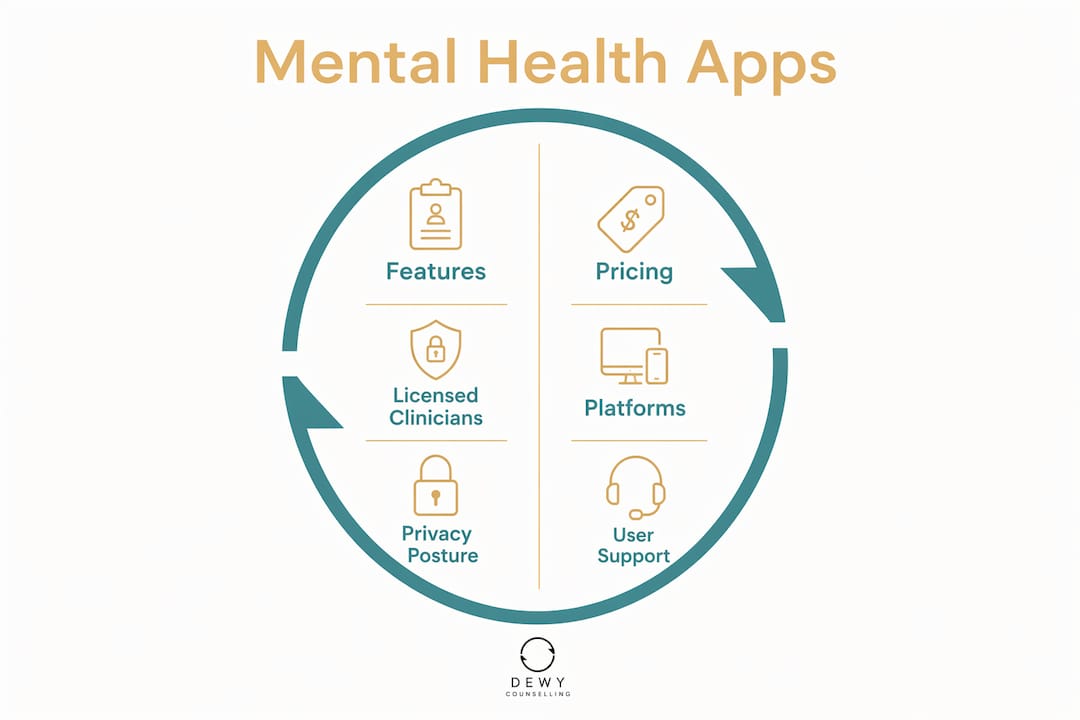
| App category | Licensed clinicians | Privacy posture | Key features | Pricing model | Platforms |
|---|---|---|---|---|---|
| Therapy-matching apps | Yes | HIPAA-aligned | Therapist video/text, messaging | Subscription + per-session | iOS / Android / Web |
| CBT module apps | No (self-guided) | Privacy policy varies | Structured CBT lessons, mood tracking | Free or low monthly fee | iOS / Android |
| AI-chatbot companions | No | Privacy policy varies | Conversational CBT, journaling prompts | Free tier / subscription | iOS / Android |
| Peer-support platforms | Optional add-on | Privacy policy varies | Listener matching, community forums | Free + paid upgrade | iOS / Android / Web |
| Employer / EAP apps | Yes (coaching + therapy) | HIPAA-aligned | Coaching, therapy, analytics dashboard | Employer-funded | iOS / Android / Web |
| Mindfulness-first apps | No | Privacy policy varies | Guided meditation, sleep, breathing | Free trial + subscription | iOS / Android / Web |

Typical pricing shapes: Therapy-matching apps run on monthly subscriptions, often with financial aid options. CBT and mindfulness apps usually offer a free tier with a paid premium. Employer and EAP platforms are typically funded by the organization, so cost to the individual is zero. Per-session rates on therapy platforms vary and are not publicly listed for all providers.
Best-for callouts:
- Individual coping with anxiety or low mood: CBT module apps or AI-chatbot companions
- Relationship or family support: Therapy-matching apps with couples modules, or couples therapy with a licensed clinician
- Employer wellness programs: Employer/EAP apps with opt-in consent and privacy-compliant dashboards
How we chose these apps
Every app on this list was evaluated against six criteria: published clinical evidence (CBT-based content or peer-reviewed trials), access to licensed clinicians or clear referral pathways, transparent privacy policies, user accessibility across platforms and languages, availability in Canada, and employer or EAP integration potential.
Public-sector benchmarks informed the vetting. OSP's tiered-care model, which moves from self-led modules through coach-assisted bibliotherapy to individual CBT, set the standard for what "evidence-based" means in this context. ConnexOntario's navigation principles shaped the privacy and referral-pathway criteria.
Apps are tools, not treatments. No consumer app replaces licensed psychotherapy for moderate-to-severe depression, complex trauma, relationship breakdown, or substance dependence. Feature sets change frequently, and regional availability can shift without notice.
Limitations to keep in mind:
- App features and pricing change; verify current details before subscribing
- Not all apps listed have published randomized controlled trials; some rely on CBT principles without independent validation
- Apps do not provide crisis intervention — call 911 or contact ConnexOntario for urgent situations
How to choose the right app for your situation
The right app depends on your goal, not the app's marketing copy. Work through these questions before you download anything.
Core criteria checklist:
- Clinical approach: Do you need structured CBT skill-building, or is mindfulness and relaxation your priority?
- Goal clarity: Are you managing daily stress, or do you need support for a diagnosable condition?
- Clinician access: Does the app connect you to a licensed therapist, or is it fully self-guided?
- Privacy: Does the app share identifiable health data with advertisers or third parties?
- Cost: Is there a genuine free tier, or does the free version lock core features behind a paywall?
- Language and cultural fit: Does the app offer content in your preferred language?
- Accessibility: Does it work on your device and support any accessibility needs you have?
For couples and families: Look for platforms with dedicated relationship modules or the option to invite a partner. If the conflict is significant, a self-help app is rarely enough. Couples therapy with a Registered Psychotherapist addresses relational wounds that an app cannot reach.
For employers: Choose platforms with explicit opt-in consent, anonymized aggregate reporting, and HIPAA-equivalent privacy terms. A workplace mental health guide can help you frame the pilot for your team.
Questions to ask before subscribing:
- Are the clinicians on this platform licensed in Ontario (Registered Psychotherapist or Registered Social Worker)?
- Does the app publish a clear data-use policy that excludes advertising?
- Can I export or delete my data?
- Does the app integrate with or complement my existing therapy plan?
When should you use an app, and when do you need a therapist?
Apps work well for mild-to-moderate symptoms, skill practice between sessions, and building daily habits like mindfulness or mood tracking. Ontario's tiered-care model, reflected in the OSP program, starts many people at lower-intensity self-help before stepping up to clinician-led care. That step-up matters.
Escalation signs that mean it's time to book a clinician:
- Symptoms have persisted for several weeks despite consistent app use
- Functional impairment at work, school, or in relationships
- Relationship conflict that feels cyclical or unresolvable
- Suicidal thoughts or self-harm urges
- Complex trauma or grief that feels overwhelming
- Substance use that is increasing or hard to control
ConnexOntario recommends starting with centralized navigation so you understand the full spectrum of options, from self-directed apps to hospital-based psychotherapy, before assuming an app alone is enough. That guidance is sound: navigating alone when you're already struggling adds unnecessary burden.
Pro Tip: When choosing a therapist in Ontario, verify that they hold Registered Psychotherapist (RP) or Registered Social Worker (RSW) credentials. Use a free introductory call to assess fit, communication style, and whether their approach matches your goals before committing to paid sessions.
For anyone needing CBT-based anxiety treatment, understanding the clinical framework behind the tools you're using helps you get more from both the app and any follow-up therapy.
Privacy and safety checks before you install
Mental health data is among the most sensitive information you can share. Before installing any app, run through this checklist.
Privacy checklist:
- Does the app publish a clear privacy policy that specifies what data is collected and how it is used?
- Is identifiable health data excluded from advertising or third-party data sales?
- Can you export or permanently delete your data on request?
- Does the app state whether it shares data with researchers, and if so, is that opt-in?
- Is there a HIPAA-equivalent statement or Canadian privacy compliance note?
Crisis protocol checks:
- Does the app display local crisis numbers (e.g., 988 Suicide Crisis Helpline, ConnexOntario) within the interface?
- Is there in-app guidance for what to do in a mental health emergency?
- Does the app clearly state it is not a substitute for emergency services?
When clinician access or privacy terms are unclear, Health811 offers free, confidential 24/7 access to a registered nurse who can provide mental health guidance and next-step direction. That is a safer starting point than downloading an app with opaque data practices.
A safe 5-step plan to start an app and integrate it with therapy
- Define a 2–4 week goal. Be specific: "I want to practice one 10-minute CBT exercise daily" is more useful than "I want to feel better."
- Check privacy and clinician access. Use the checklist above before entering any personal health information.
- Start with a free tier or trial. Most apps offer enough functionality in the free version to know whether the approach suits you.
- Track your mood and progress. Use the app's built-in tracking or a simple journal. Concrete data helps you and any future therapist see patterns.
- Share results with a therapist, or book one if escalation signs appear. If symptoms worsen or plateau, starting therapy with a licensed clinician is the logical next step.
If you're already in therapy: Ask your therapist which app modules align with your current treatment plan. Exporting mood data or homework logs gives your clinician concrete material to work with between sessions.
For employers piloting an app: Require explicit opt-in consent from staff, anonymize any aggregate reporting, and confirm the platform's privacy terms in writing before rollout.
Pro Tip: Apps work best as a bridge between therapy sessions, not as a replacement. Think of them the way you'd think of a daily exercise habit: consistent, low-intensity practice that supports the deeper work happening with your clinician.
Key Takeaways
The most effective approach to mental health apps in Ontario is to use evidence-based CBT tools for daily skill practice while reserving clinician-led psychotherapy for persistent, complex, or relational concerns.
| Point | Details |
|---|---|
| Start with CBT-based apps | Apps like MindShift CBT, Woebot, and Sanvello offer structured skill-building grounded in clinical evidence. |
| Verify clinician credentials | Look for Registered Psychotherapist (RP) or Registered Social Worker (RSW) on any therapy platform. |
| Use ConnexOntario to navigate | ConnexOntario offers free 24/7 navigation across a wide range of mental health and addiction programs. |
| Escalate when symptoms persist | Book a licensed clinician if symptoms last more than two to three weeks or affect daily functioning. |
| OSP offers free CBT for adults | Ontario Structured Psychotherapy provides free, evidence-based CBT to adults 18 and older across Ontario. |
A clinician's perspective on apps and real therapy
Apps have earned a genuine place in mental health care, but their role is specific. At Dewycounselling, the approach is to treat apps as skill-reinforcement tools, not as the primary therapeutic relationship. A CBT app can prompt a breathing exercise at 2 AM when no clinician is available. What it cannot do is hold the complexity of a couple's attachment history, or help a family navigate grief that has fractured communication across generations.
The clients who get the most from apps are those who use them intentionally: a daily mood log, a structured CBT module between sessions, a mindfulness practice that grounds them before a difficult conversation. When those tools plateau, or when the presenting concern involves trauma, relationship rupture, or persistent functional impairment, the step to clinician-led work is not a failure. It is the appropriate next move in a tiered system designed exactly for that purpose.
Dewycounselling offers individual, couples, and family psychotherapy in person and online across Ontario. If you're ready to move beyond self-help, booking a session is straightforward.
Authoritative sources and where to get help in Ontario
- ConnexOntario — Free, confidential 24/7 navigation by phone, text, chat, or email; connects you to mental health, addiction, and gambling programs across Ontario. No referral needed.
- Ontario Structured Psychotherapy — Free, evidence-based CBT for adults 18 and older, available in self-led, coach-assisted, and clinician-led formats.
- Ontario.ca mental health services — Provincial directory of local mental health and addiction services, including Health811 for 24/7 nursing support.
- BounceBack — A free, coach-assisted CBT program for adults and youth 15 and older, delivered via workbooks and phone coaching; part of the OSP service family.
- Dewycounselling — In-person and online psychotherapy for individuals, couples, families, and businesses in Ontario; no wait-list navigation required.
This article is general information, not professional advice. Confirm current program eligibility and app features directly with each provider, and consult a qualified mental health professional for guidance specific to your situation.