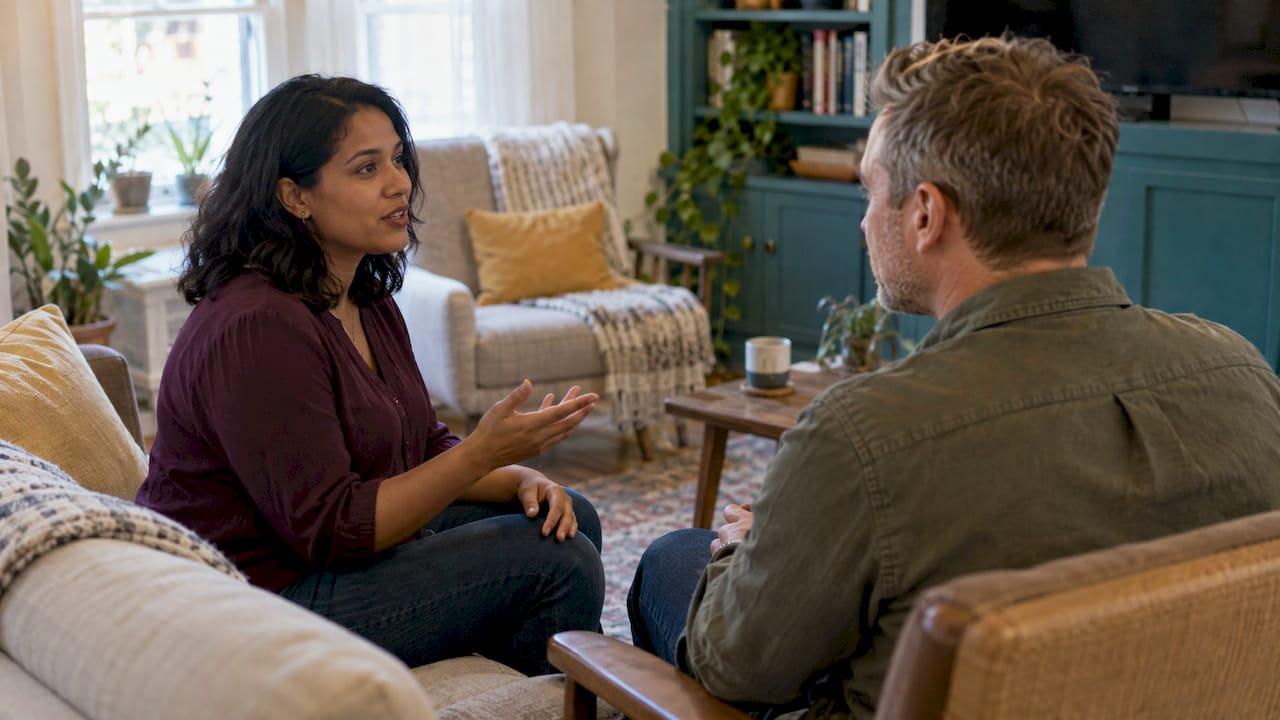
Self-guided couples therapy means working on your relationship together at home, using structured exercises, agreed ground rules and regular check-ins rather than sessions with a therapist. It can help you slow down arguments, understand each other better and build habits that protect your connection. It works best when you treat it as a first step with a clear plan, and when you know in advance which signs mean it is time to bring in a registered professional, who can guide the work when the two of you cannot do it alone.
This guide is for couples in Ontario who want to start now, whether you are waiting for a first appointment, wondering if therapy is necessary, or simply want to put more care into your relationship. It covers how to set up, which exercises to try, how to adapt them when depression, anxiety, addiction or sexual concerns are part of the picture, and how to tell when you need more support.
TL;DR
- Self-guided work is a good starting point for communication habits, conflict patterns and reconnecting, especially when both of you are willing.
- Set ground rules first: a time, a pause signal, no blame, and no serious topics when either of you is exhausted or upset.
- Research on digital and self-directed programs is encouraging, and couples tend to stick with them better when they have a deadline and some contact with a real person.
- If you feel unsafe, if there is an affair, addiction or a decision about separating, a professional guide matters more than any exercise.
- We offer couples therapy in person and online, with sliding scale pricing, if you want a therapist beside you.
What self-guided couples therapy actually is
In clinical settings, couple therapy is described by the Centre for Addiction and Mental Health (CAMH) as a way to resolve problems couples could not handle on their own, with a trained and objective third party. Self-guided therapy removes that third party. You and your partner become the structure: you choose the exercise, keep time, and hold each other to the rules.
That is a real strength and a real limit. The strength is that you build skills in your own living room, in the moments when conflict really happens. The limit is the one CAMH names: a therapist can act as a mediator who clears up misunderstandings, which is often difficult for partners who are emotionally caught up to do themselves. So the most useful way to think about home work is as practice and preparation, not as a complete replacement for a trained guide.
What the research says about doing it yourselves
The evidence is more encouraging than many couples expect. A 2025 systematic review and meta-analysis of digital relationship programs, which are mostly self-guided and structured, found that they improved relationship satisfaction overall, with the strongest results for programs that had some coach support and a focus on prevention.
A 2014 review of internet-based couple interventions adds a practical lesson: most of these programs are adaptations of evidence-based in-person therapies, and couples were more likely to finish them when they had contact with a staff member beforehand and clear deadlines to complete the work.
The takeaway for your kitchen table is simple. Structure helps, a schedule helps, and a human voice helps.
The Canadian Psychological Association (CPA) points out something similar about enrichment programs: they are effective in the short term, but couples often have difficulty maintaining the skills after the program ends. That is why the plan below builds in a weekly rhythm rather than a one-time effort.
Before you start: ground rules that keep it constructive
Most at-home attempts fail not because the exercises are poor but because the setting is. Two people with a history of hurt, tired after work, trying to be therapists for each other, will slip into the old fight. A few agreements made when you are both calm prevent that.
- Agree that you are both in. Ask each other, without pressure, whether you are willing to try this for a set period, such as six weeks. Hold the plan lightly but honestly.
- Choose a regular time. Pick 30 to 45 minutes once a week, away from screens, children and the end of a long day. A fixed slot is the home version of a deadline, which the research above links to better follow-through.
- Set a pause signal. Either of you can call a break at any point. The break lasts at least 20 minutes, and the person who called it is responsible for returning to the conversation, ideally the same day.
- Speak about yourself. "I felt dismissed when the plans changed" opens a conversation. "You always dismiss me" closes it.
- One topic at a time. Do not use the session to bring up every grievance of the last five years.
- Keep the hard topics for the right moment. Infidelity, money secrets, and big decisions about the future are better held for support than for a Tuesday evening at the kitchen table.
- Keep your notes together. CAMH's brief couples therapy manual notes that one session's homework often flows into the next, so keep a shared notebook of what you tried and what you noticed.
If you want more detail on why these rules matter, our guide to communication exercises for couples goes deeper on listening and turn-taking.
Couples therapy exercises you can try at home
These exercises are drawn from the kinds of skills most couples therapy builds: calming down, being understood, repairing after conflict and reconnecting. Try one or two a week rather than all at once.
1. The speaker-listener exchange
One partner speaks for two or three minutes about a single topic, using "I" statements. The other partner listens, then says back what they heard: "What I'm hearing is that you felt left out when I made plans without checking with you. Is that right?" The speaker corrects or confirms. Then you switch.
The point is not agreement. It is to be understood before you problem-solve. Where this goes wrong: the listener starts defending or correcting. If that happens, use your pause signal.
Our article on practical exercises to improve communication with your partner lists a dozen variations.

2. The pause-and-reflect habit (sometimes called the 5-5-5 rule)
A question many couples search is what the "5-5-5 rule" means. It is a popular, informal name rather than a formal clinical protocol, and versions differ, but the idea is consistent: when a conversation heats up, pause for a few seconds before responding, take a few slow breaths, and use a moment to think about what your partner may be feeling before you speak. You can adopt it as a private habit with no ceremony. It will not resolve a conflict on its own, but it interrupts the automatic reaction that turns a disagreement into a fight.
3. The soft start
How a hard conversation begins tends to shape how it ends. Practice opening with a feeling, a situation and a request: "I feel anxious when the bills pile up, and I'd like us to look at them together on Sunday." Compare that with "You never deal with money." Practice rewriting complaints in this form during your weekly check-in.
4. Repair after a fight
Every couple argues. What matters is whether you can come back. After a conflict has cooled, each person answers three questions in turn: What was I feeling? What did I need? What part of this can I take responsibility for? Then each of you names one small thing the other can do next time. Our five-step playbook for conflict resolution in marriage walks through this in more detail.
5. A weekly appreciation and check-in
Once a week, each of you shares three things you appreciated about the other, one thing that went well in the relationship, and one thing you would like more of. It sounds modest. It is also the habit that keeps the other exercises from feeling like only problem-solving. Alberta Health Services suggests being open about feelings, listening before reacting, giving each other space and trying new things together, such as starting a shared book club.
6. Mapping your support system
Not every need can or should be met by your partner. The 2025 Canadian student toolkit on healthy relationships from the Canadian Institute for Conflict Management for Higher Education includes a pod-mapping exercise, in which you map the people you can turn to for different kinds of support. Doing this together can lower the pressure on the relationship and help each of you see who else is in your corner.
A simple six-week plan
| Week | Focus | Exercise |
|---|---|---|
| 1 | Set up | Agree on ground rules, time and pause signal |
| 2 | Being heard | Speaker-listener exchange |
| 3 | Calming down | Pause-and-reflect habit, soft start |
| 4 | Repair | Post-conflict repair questions |
| 5 | Connection | Appreciation check-in, one new shared activity |
| 6 | Review | What changed? What do we still need help with? |
The review in week six matters most. If you both feel the tone has softened, keep the weekly check-in going. If the same fight keeps returning, that is useful information: it usually points to a pattern that benefits from a trained eye.

When depression, anxiety, addiction or sexual concerns are involved
Many couples come to this search because something larger is in the room. These adaptations keep the work kind and realistic.
- Depression or anxiety in one or both of you. Shorten sessions to 20 or 30 minutes, choose the time of day when energy is best, and agree that a missed week is not a failure. A partner's withdrawal or irritability is often a symptom, not a verdict on the relationship. If low mood, panic or worry is persistent, individual support runs alongside the couple work, and our psychotherapy service is available for that.
- Addiction. Exercises about communication cannot substitute for treatment of a substance or behavioural addiction. Keep your home practice to the basics, such as speaking about yourself and calling pauses, and get specialized help for the addiction itself. We provide therapy for addiction and for the relationship strain that comes with it.
- Sexual concerns. Start with talking, not performing. Take turns describing what feels connecting and what feels pressured, using the speaker-listener exchange, and agree that either of you can say "not tonight" without it being read as rejection. Concerns involving pain, trauma or a mismatch in desire that has lasted a long time are well suited to a therapist.
- After infidelity or broken trust. An affair is a relational wound, and like a physical wound it needs prompt, careful care before it can heal. The conversations are loaded, and the person who was betrayed and the person who betrayed need different things. We offer specific therapy for infidelity, trauma, and sexual or financial issues, and this is one area where we would encourage you not to go it alone.
Our overview of why couples seek therapy describes the situations in which support makes the biggest difference.
When to move from home to professional help
Self-guided work is not the right tool in every situation. Move to a professional, and do so promptly, if any of the following apply.
You do not feel safe. Alberta Health Services states that anger leading to threats, name-calling, pushing or slapping is a form of abuse, and advises talking with a trusted friend or counsellor or contacting a local advocacy group. Couples exercises are not designed for abusive dynamics, and they can put a person at risk. If you are in immediate danger, call 911. In Ontario, the Assaulted Women's Helpline and local victim services can also help.
You are stuck in the same fight. If six weeks of honest effort have not shifted the pattern, you are not failing. This is exactly what a third party is for.
One of you is unsure about staying. The CPA describes discernment counselling, a short-term approach that helps couples decide whether to work on the relationship for a set period or move toward divorce. It suits couples where the two of you are not yet on the same page about the future.
Resentment or contempt has taken over. When the default tone is sarcasm, eye-rolling or silence, exercises tend to feel like one more arena for the same battle.
An affair, addiction, or a major mental health concern is in the picture. See above.
The CPA identifies three treatments with good evidence for distressed couples: behavioural couple therapy, cognitive behavioural couple therapy and emotion-focused couple therapy. Its fact sheet reports that clinical trials found most couples were more satisfied by the end of treatment, and some gains lasted two years. If you are curious how these differ, read our practical Ontario guide to types of couples therapy and our clear guide to emotionally focused therapy. Not sure whether you are at that point? Our list of signs your relationship needs therapy can help you decide.

What to do while you wait for a first appointment
If you have already decided on therapy and are waiting, the weeks in between are not wasted. Use them to:
- Keep to the ground rules and one or two exercises a week.
- Write down, separately, what you each hope therapy will change.
- Notice patterns: when do arguments begin, and what is usually going on beforehand?
- Keep the notebook. A therapist can use it, and CAMH describes the first sessions as an assessment of the problems, relationship history and individual histories, so clear notes make that stage smoother.
- Be gentle about nerves. Feeling anxious before your first session is common, and it usually means you care about the outcome.
Our perspective
We have spent more than 20 years working with individuals, couples and families, and the pattern we see in the couples who reach out is rarely a lack of love. It is a lack of a safe, structured way to say what hurts and to be heard.
That is why we respect couples who start at home. A weekly check-in, a pause signal and a willingness to listen are valuable, and they make therapy more effective when it comes. Think of it like first aid for a relationship: it steadies things and prevents further harm. But a wound that runs deep, such as an affair, an addiction, or years of unresolved resentment, deserves the equivalent of a clinician.
Our approach draws on multiple therapy modalities and evidence-based methods, and we meet you in whatever way works: in person at either of our two locations, or online. We use sliding scale pricing because we do not want cost to be the reason a couple waits until the damage is hard to repair.
If you try the exercises in this guide and they bring you closer, wonderful. If they show you where you need a guide, we would be glad to be that guide.
Wayne Dewhurst
Support when you are ready for it
We offer couples therapy, couples separation and mediation support, and specific therapy for trauma, infidelity, and sexual or financial issues. Sessions, in person or online, are $175 per hour, and a mobile session is $225 per hour. A prepaid annual membership is $1,750 per year. We also offer sliding scale pricing. Learn more on our couples counselling page or see all session and membership options.

If you prefer to keep working at your own pace between sessions, we also offer self-help modules at $499 per module.
FAQ
Can couples therapy really work at home?
It can help with communication habits and connection, and research on structured self-guided programs shows improvements in relationship satisfaction. Results are strongest with a schedule and some support from a real person. For entrenched conflict, betrayal, or safety concerns, a therapist is the better guide.
Is it normal to be nervous before couples therapy?
Yes. Many people worry about being blamed, exposing private things, or discovering the relationship cannot be saved. A good therapist begins with an assessment and a conversation about what you each want, not with judgment. Writing down your hopes beforehand can settle the nerves.
What should we avoid saying during these exercises?
Avoid "always" and "never", name-calling, bringing up old grievances, threatening to leave, and mind-reading ("you only did that because..."). Replace them with "I" statements about what you feel and what you would like. If a sentence like that slips out, call a pause and try again.
How often should we do the exercises?
Once a week for 30 to 45 minutes is a sustainable rhythm for most couples, with small daily habits such as a pause before reacting or a brief appreciation. Consistency matters more than length. A missed week is fine; an abandoned plan is what to avoid.
Do we need a referral for couples therapy in Ontario?
No referral is needed to book private counselling or psychotherapy with us. You can book an in-person or online session through our couples counselling page, and we will talk through what you are hoping to change.
Sources
- Couple Therapy: An Information Guide, CAMH
- Brief Couples Therapy, CAMH
- "Psychology Works" Fact Sheet: Relationship Distress, Canadian Psychological Association
- Effectiveness of digital interventions on relationship satisfaction, systematic review and meta-analysis (2025)
- Incorporating Internet-based Interventions into Couple Therapy (2014)
- Managing Relationship Stress for Couples, Alberta Health Services
- A Student Guide to Healthy Relationships (2025)