
Manager mental health training teaches supervisors to recognize distress, hold supportive conversations, and connect employees to professional care without practicing therapy themselves. Formats range from 60 minute workshops to multi-session programs, and organizations that invest in them typically see steadier attendance and more confident leadership. Programs like those from Dewy Counselling, alongside frameworks like the 5 C's (Compassion, Communication, Consistency, Connection, Courage) and the 5 R's (Recognition, Response, Resources, Recovery, Resilience), give managers at every level a shared vocabulary and a clear role.
TL;DR:
- Short workshops can raise awareness and identify early warning signs, but deeper training across multiple sessions builds lasting confidence and skills.
- Programs should include recognition, conversation techniques, boundaries, and workplace adjustments, but never aim to enable managers to diagnose or treat mental health conditions.
- Virtual sessions work for dispersed teams, but in-person facilitation and practice offer faster confidence gains, especially when followed up within 6 to 12 months.
- Selecting qualified facilitators, emphasizing scenario practice, and linking training to existing policies increase effectiveness and sustainability.
- Post-training, managers must schedule regular check-ins, maintain clear referral pathways, and model boundaries to sustain support and prevent skills from fading.
How Long Does Manager Mental Health Training Take?
Training length depends on what an organization needs to accomplish, not what looks impressive on a certificate. A single interactive workshop can shift how a manager approaches a hard conversation. A multi-session program builds the muscle memory that makes those skills stick under pressure.
Most programs fall into one of three formats:
- Short interactive workshops (About an hour to an hour and a half): Best for building initial awareness and introducing signs of distress; commonly the entry point for teams new to this kind of training, and typical of the durations described in the Government of Canada's manager guidance.
- Half-day or multi-session programs: Add role-play, scenario practice, and small-group coaching, often spread across two to five sessions.
- Multi-day intensive programs: Reserved for HR leads or senior managers who will train others, sometimes running one to two full days.
Delivery mode matters as much as duration. Virtual instructor-led sessions work well for distributed teams but lose some of the nuance of in-person body language cues. In-person facilitation supports deeper role-play and immediate feedback, which tends to build confidence faster. Self-paced e-learning is the cheapest option to scale but performs worst on its own unless paired with a live follow-up session. Cohorts of 8 to 15 managers tend to produce the best mix of participation and personal attention, and most providers recommend a refresher session within 6 to 12 months.
What Should a Manager Mental Health Training Course Teach?
A course that only raises awareness without teaching action leaves managers informed but unequipped. Strong curricula follow a sequence that mirrors how a real conversation actually unfolds, from noticing a change to closing the loop with proper support.
- Recognition indicators. Managers learn to spot behavioral, performance, and attendance changes, such as withdrawal, increased errors, or sudden absenteeism, often before an employee says anything at all.
- Structured conversation skills. This covers how to open a conversation, use active listening, and avoid stigmatizing language that shuts a person down instead of opening them up.
- Boundaries and safe signposting. Managers practice recognizing when a situation is beyond their role and referring the employee to an Employee Assistance Program (EAP) or a licensed therapist.
- Practical workplace adjustments. This includes flexible scheduling, workload redistribution, and stigma-reduction habits that make it normal to talk about mental health on a team.
Curricula built around psychological and social risk factors, stigma reduction, and communication skills tend to hold up better over time, particularly when they include follow-up resources managers can return to. One detail gets lost in a lot of program marketing: managers are not being trained to diagnose or treat anyone.
Pro Tip: Give managers a simple script for opening a hard conversation, something as plain as "I've noticed you seem off lately, and I wanted to check in." Scripted language removes the fear of saying the wrong thing, which is the number one reason managers avoid these conversations altogether.
Does Manager Mental Health Training Actually Work?
Yes, and the evidence has a specific shape worth understanding before you approve a budget. Even short interventions move the needle on manager confidence, while comprehensive programs affect harder business metrics like absenteeism and turnover.
The APA notes that as little as three hours of mental health awareness training improves manager attitudes and motivation to support their teams. That is a low bar to clear for a meaningful shift in behavior.
Poor mental health support costs UK employers an estimated A very large annual cost in lost productivity, according to Deloitte's analysis, with better support potentially saving employers significant amounts annually.
Track these outcomes after rollout, not just attendance:
- Manager self-reported confidence in having a supportive conversation
- Number of employee referrals to EAP or counseling services
- Absenteeism and short-term disability trends over two to four quarters
- Engagement survey scores tied to psychological safety questions
None of this works in isolation. Training paired with clear policy and accessible resources produces change; training alone tends to fade within a few months.
How Do You Choose and Roll Out Manager Training?
Choosing a program comes down to a handful of concrete questions, not a glossy brochure. Ask any vendor about facilitator credentials, how much of the session is scenario practice versus lecture, and what confidentiality safeguards protect employees who come up in discussion. Red flags include vague answers about facilitator background, no scenario practice at all, and no plan for what happens after the training ends.
| Selection factor | What to look for |
|---|---|
| Facilitator background | Licensed clinicians or credentialed mental health professionals leading sessions |
| Practice format | Role-play and scenario-based exercises, not lecture-only delivery |
| Confidentiality safeguards | Clear rules on what stays private and what must be escalated |
| Follow-up access | Toolkits, refresher sessions, or ongoing membership resources |
Rollout works best in stages:
- Pilot with one department or a volunteer cohort before a company-wide launch
- Secure visible leadership endorsement so managers see this as a priority, not a checkbox
- Link training directly to your EAP and any accommodation policies already in place
- Set a refresher cadence, generally every 6 to 12 months
- Review the KPIs above at the 90 day mark to gauge early ROI
Operational checklists like the ones in this team management guide for wellness leaders can help translate training content into daily supervisory habits, particularly for industries where shift-based scheduling makes follow-up conversations harder to fit in.
How Dewy Counselling Approaches Manager Training
Clinician-led training changes the texture of a session because the person leading it has actually sat across from someone in crisis. Dewy Counselling's corporate seminars are built and delivered by licensed therapists, not generalist trainers reading from a slide deck.
A typical Dewy Counselling manager session includes:
- Therapist-led workshops covering recognition, conversation practice, and boundaries
- Corporate team-building seminars that extend the training into broader culture work
- Self-help modules managers can revisit between live sessions
- Access to licensed therapists for follow-up questions or staff referrals
Sample agenda items usually start with a grounding exercise, move into scenario-based role-play, and close with a signposting walkthrough so managers leave with an actual referral pathway, not just theory. Follow-up support often includes a checklist for handling a depressive episode at work and continued access to therapy resources.
How Do You Assess a Manager's Starting Point Before Training?
Skipping the baseline assessment is one of the more common mistakes organizations make when rolling out training. Without knowing where managers currently stand, it is nearly impossible to measure whether the training actually changed anything.
A short pre-training survey works well here. Ask managers to rate their own confidence in recognizing distress, their comfort level starting a hard conversation, and their familiarity with your EAP or referral process. You will almost always find a wide spread. Some managers have handled sensitive situations before and just need structure. Others have never had this conversation once in their career and are quietly dreading the idea of it.
This baseline does two things. First, it lets facilitators calibrate the session, spending more time on fundamentals for a newer group or moving faster into advanced scenario practice for a more experienced one. Second, it gives you a real comparison point after training, rather than relying on gut feeling about whether the investment paid off.
Behavioral warning signs like withdrawal, performance dips, and rising absenteeism are often the first reliable indicators a manager can spot, which is exactly why the Government of Canada's toolkit recommends training managers specifically on observation and documentation before moving into conversation skills. A manager who cannot yet name what they are looking for will struggle with everything that follows.
Should Training Differ by Management Level or Industry?
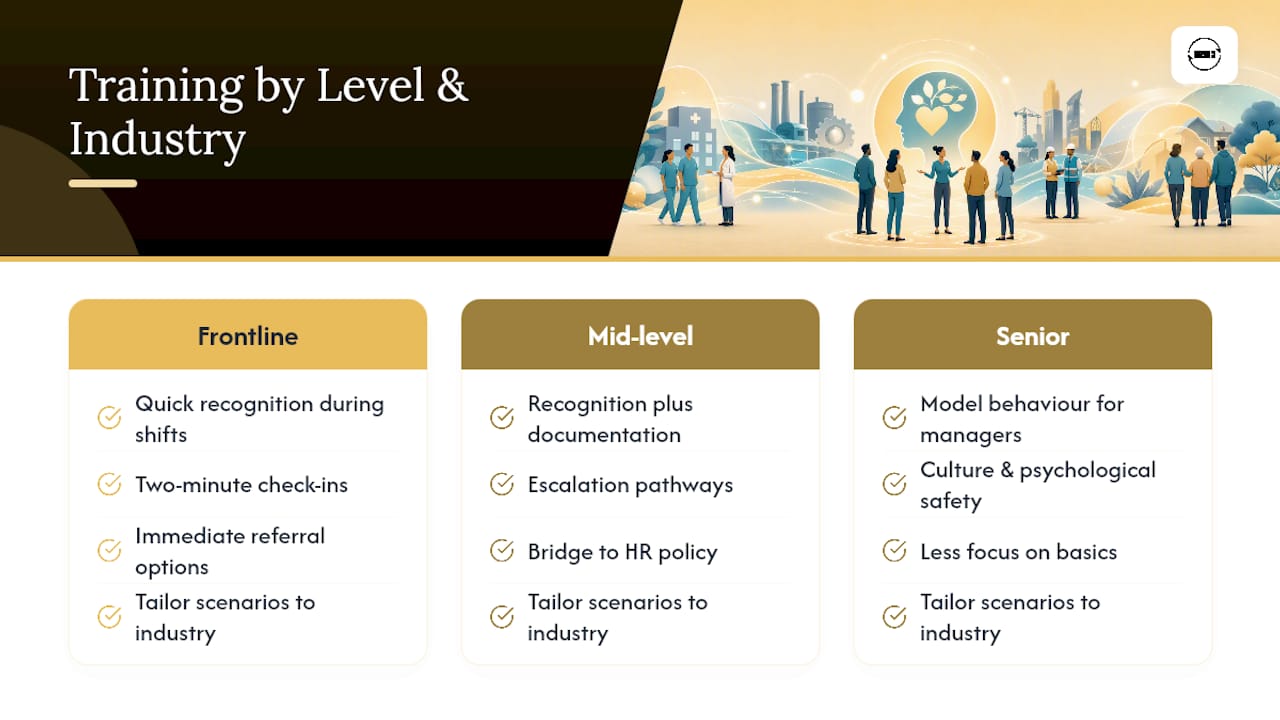
A frontline supervisor managing a retail floor faces a different set of pressures than a director overseeing five team leads, and training that ignores that distinction wastes everyone's time. Frontline managers usually need concrete, fast tools: how to spot a change during a busy shift, how to have a two-minute check-in between tasks, and where to send someone immediately.
Mid-level managers benefit from training that adds a layer of documentation and escalation, since they often sit between frontline reports and HR policy. Senior leaders need less on basic recognition and more on modeling behavior for the managers below them, since a culture of psychological safety tends to flow downward from how executives themselves talk about stress and support.
Industry context matters just as much. A construction supervisor manages physical risk alongside mental health, and stigma often runs deeper in physically demanding trades. A healthcare team lead is managing staff who are regularly exposed to trauma secondhand. A remote-first tech company faces isolation issues that an in-person retail environment rarely sees in the same way. Generic training that ignores these differences tends to feel disconnected from what managers actually face day to day, and disconnected training gets forgotten fast.
The best programs ask about your industry and team structure before building the curriculum, then adjust scenario examples accordingly rather than running the same generic script for a warehouse manager and a law firm partner.
What Legal and Ethical Lines Should Managers Know?
Managers occupy a strange middle ground: close enough to notice a problem, but without the clinical training or legal standing to treat one. Training has to draw that line clearly, because a manager who oversteps it can create real harm, both to the employee and to the organization's liability exposure.
The clearest ethical rule is this: managers are not therapists. Their job is to notice, hold a supportive conversation, and signpost to professional services, not to diagnose, counsel, or make clinical judgments about an employee's condition. Blurring that line, however well-intentioned, can damage trust and expose the organization to risk if a manager gives advice they are not qualified to give.

Confidentiality is the other pillar. Anything disclosed during a supportive conversation needs a clear, documented policy on what stays private and what must be escalated, particularly if there is any indication of risk to the employee or others. Managers should never discuss an employee's mental health with coworkers, even with good intentions, and should document only what is operationally necessary, not personal details shared in confidence.
Accommodation obligations also apply here. Depending on jurisdiction, organizations may have a duty to accommodate employees dealing with mental health conditions, similar to physical disability accommodations. Training should walk managers through what a reasonable accommodation conversation looks like, and when to loop in HR rather than handling it solo.
What Should Managers Actually Do After Training Ends?
Three habits separate managers who use their training from those who let it fade. First, schedule regular check-ins before a crisis hits, not after performance has already dropped. Second, keep the referral pathway visible and simple, a card or bookmark works fine. Third, model your own boundaries openly. A manager who never takes a lunch break rarely gets believed when they tell a struggling employee that rest matters.
— Wayne Dewhurst
Bring Clinician-Led Training to Your Leadership Team
Most manager mental health training comes from generalist consultants who have never actually sat with someone in crisis. Dewy Counselling is different: our workshops and corporate seminars are built and delivered by licensed therapists, which means your managers get conversation practice grounded in real clinical experience, not a slide deck written by someone with a marketing background.

We tailor sessions for cohorts of 8 to 15 managers, matching the scenario examples to your industry and management structure rather than running a one-size script. If your organization is ready to move past awareness alone and into practical, therapist-led training, request a sample agenda and pricing through our professional counselling services page, and we will help you plan a pilot session for your leadership team.
Where to Learn More
- Government of Canada: free workplace mental health toolkit
- APA: guidance on training managers for workplace well-being
- MHFA England: MHFA for Managers program
- Dewy Counselling: emotional wellness checklist for follow-up
This article is general information, not a substitute for advice from a qualified doctor. Consult a qualified healthcare professional about your own circumstances before acting on anything here.
Sources
- Government of Canada: free toolkit to support mental health in the workplace
- Government of Canada: Lead with empathy — manager guidance
- APA: Train your managers to promote health and well-being
- MHFA England — MHFA for Managers