
If you're trying to handle a depressive episode at work today, start with three moves: check your safety, run a two-minute regulation technique, and cut your task list down to one small thing. These aren't cures. They're a bridge to get through the next hour, which is often all a depressive episode actually asks of you.
While you're at your desk or ducking into a stairwell, try one of these:
- Breathe in for four counts, hold for four, out for six, three times.
- Splash cold water on your face or hold an ice pack to your wrists for thirty seconds.
- Step outside for a five-minute walk, even around the parking lot.
If you're having thoughts of suicide or self-harm, or you can't manage basic self-care, this isn't a workday problem. Call 911 or a local crisis line immediately.
Pro Tip: Keep a note in your phone with one grounding technique and one "smallest viable task" for your job. When your brain fogs over, you won't have to think. You'll just do the next thing on the list.
Key Takeaways
Handling a depressive episode at work comes down to shrinking your tasks, protecting your privacy, and asking for support before you hit a crisis point.
| Point | Details |
|---|---|
| Start with safety first | Check for suicidal thoughts or inability to self-care before anything else; call 911 or a crisis line if either applies. |
| Use micro-tactics fast | Box breathing, 5-4-3 grounding, and 10-minute time blocks reduce symptom impact with minimal effort. |
| Triage your workload | Sort tasks into must-do, defer, and delegate, and protect one MIT (most important task) per day. |
| Ask for accommodations early | Requesting flexible hours or remote work based on functional needs, not diagnosis, tends to get faster approval. |
| Get professional support | Dewy Counselling offers online and in-person therapy and can help with accommodation documentation. |
This article is general information, not a substitute for advice from a qualified doctor. Consult a qualified healthcare professional about your own circumstances before acting on anything here.
Why Depressive Episodes Make Work Harder
Depression doesn't just lower your mood. It changes how your brain processes information, and that shows up fast in an office. Work can both help and hinder major depressive disorder, which is exactly why the same job can feel manageable one week and impossible the next.
The disruptions tend to follow a pattern:
- Low energy turns a normal task list into an uphill climb.
- Slowed thinking or brain fog makes concentration during meetings genuinely hard.
- Decision fatigue means even choosing what to answer first in your inbox feels heavy.
- Sleep disturbance compounds the fog the next day.
- Increased self-criticism turns a missed deadline into a spiral instead of a minor setback.
Each of these translates directly into workplace friction: dropped follow-ups, quiet withdrawal from meetings, small tasks slipping through the cracks. None of that means you're failing. It means your brain is temporarily running on less fuel.
Quick, Practical Tactics You Can Use at Work Right Now

When energy and focus are scarce, the goal isn't to push through a full day the way you would on a good week. It's to protect function with the smallest possible effort. Practical workplace tactics such as task prioritization, smallest viable action, and time blocking are backed by practice-based research specifically because they demand so little from a depleted brain.
Try these, in order of how fast they work:
- Do a box breathing round. Four seconds in, four seconds hold, four seconds out, four seconds hold. Repeat four times before opening your inbox.
- Run a 5-4-3 grounding check. Name five things you see, four things you can touch, three things you can hear. It pulls your nervous system out of spiral mode in under a minute.
- Pick the smallest viable action. Instead of "finish the report," write one sentence. Instead of "clear my inbox," answer one email.
- Time-box in 10-minute blocks. Set a timer. Work until it rings. Stop, even if you're not done. Momentum matters more than completion today.
- Batch your communication. Check email or chat at two set times instead of constantly, so you're not reacting all day.
If you need a little leeway without over-explaining, a short message works better than silence:
"Running behind today, can I get this to you by end of day tomorrow instead?"
"Not feeling great, stepping away for 20 minutes. Back shortly."
Pro Tip: You never owe anyone a diagnosis to ask for room. "I'm dealing with a health issue and need a short extension" is complete, professional, and true. Save the details for your therapist, not your Slack channel.
How to Organize Your Workload on Low-Energy Days
On the days when everything feels like too much, sort your task list into three buckets instead of trying to do all of it.
- Must-do: Client deadlines, anything with legal or financial consequences, urgent replies.
- Defer or ask for help: Internal reports, non-urgent meetings, anything that can wait 48 hours.
- Delegate: Tasks a teammate can realistically cover with a two-line handoff.
Two rules make this workable:
- Pick one MIT (most important task) per day. Everything else is bonus.
- Break that task into 10-minute chunks rather than treating it as one large block.
A short autoresponse buys you breathing room without oversharing:
"Thanks for your message. I'm responding to urgent items with a slight delay today and will follow up by [time]."
How to Ask for Accommodations at Work
You don't need a diagnosis to request support. You can request accommodations by describing functional limitations rather than clinical details, which protects your privacy and tends to get faster results than a formal medical disclosure.
Accommodations worth requesting during an episode:
- Flexible start or end times
- A quieter workspace or permission to work with headphones
- Temporary reduction in workload or deadline flexibility
- Remote or hybrid work for a set period
- Protected time for therapy or medical appointments
A short script for your manager: "I'm managing a health issue and could use some flexibility with my schedule for the next few weeks. Can we talk about adjusting deadlines or my hours?" For HR, you can add: "I may need documentation from my provider if that's required for a formal accommodation."
Focusing on what you need to function, not what's wrong with you, usually gets a faster and more respectful response.
Pro Tip: Start with your direct manager if you trust them. Involve HR only if you need a formal, documented accommodation, since HR conversations create a paper trail that some people prefer to avoid until it's necessary.
When to Get Professional or Urgent Help
Some signs mean this is bigger than a bad week and calling your workplace flexible isn't going to be enough.
Watch for:
- Persistent thoughts of suicide or self-harm
- Inability to manage basic self-care (eating, hygiene, getting out of bed)
- Severe withdrawal from everyone around you
- Symptoms that are rapidly getting worse, not just staying flat
If any of these apply to you right now, call 911 or a local crisis line. This is not something to manage alone at your desk.
For everything short of a crisis, treatment pathways include psychotherapy, medication, and combined approaches, and an Employee Assistance Program or your family doctor can often get you a referral faster than searching alone. Because specialist wait times can be long, joining a waitlist the moment symptoms appear, and using interim supports like an EAP in the meantime, is worth doing even before you feel "bad enough."
The Real Cost of Waiting to Get Support
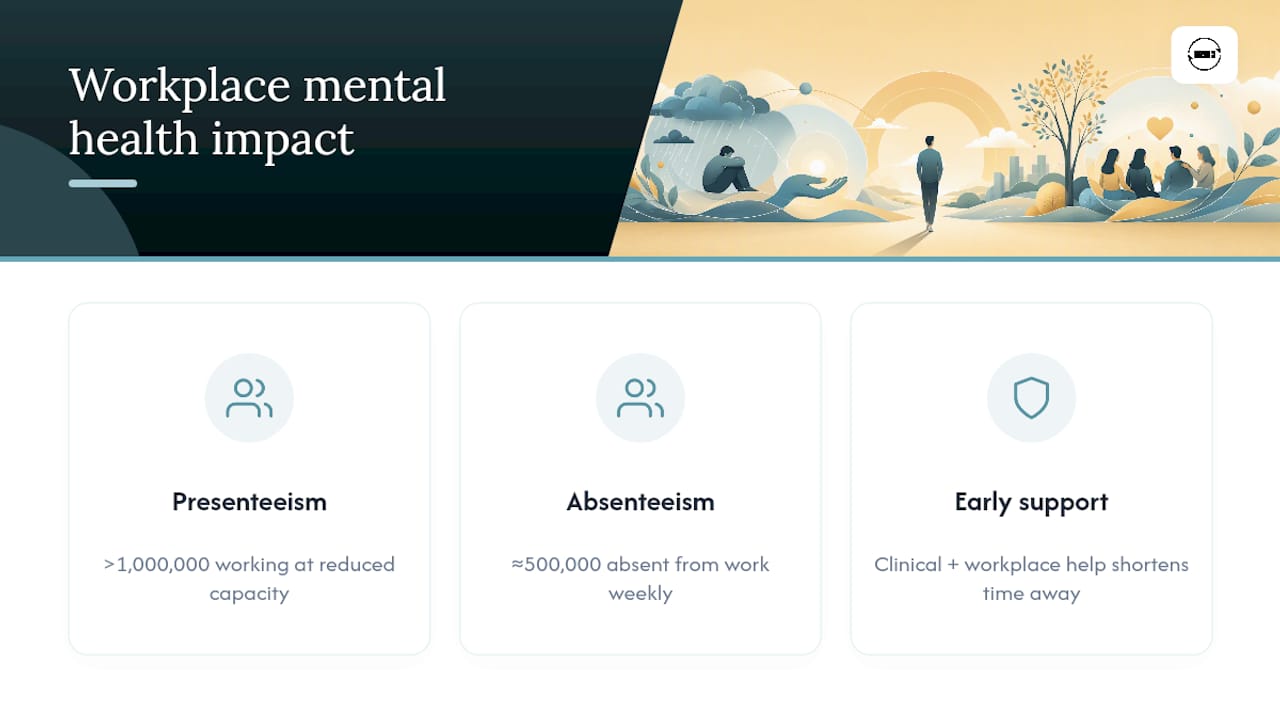
A 2023 review estimated that roughly 500,000 Canadians may be absent from work in any given week due to a mental health disorder, with more than 1,000,000 working at reduced capacity through presenteeism. That second number matters more than it sounds. Most people don't take leave. They show up depleted and try to push through.
The same research found that combining clinical treatment with workplace-focused interventions, like accommodations or a gradual return-to-work plan, shortens time away from work compared to clinical treatment alone. That's the case for requesting support early rather than waiting until you're at a breaking point.
A Note From Wayne Dewhurst
This guide reflects what I see working in practice: small, safety-first steps beat willpower every time during a depressive episode. If you're reading this at your desk right now, that's a good sign. It means you're already looking for a way through. Please don't stop at self-help. Reach out for professional support, too.
Getting Support From Dewy Counselling
You don't have to figure this out alone or wait until things get worse to ask for help. Dewy Counselling offers individual psychotherapy both online and in person, so you can start sessions around your work schedule instead of rearranging your life around a clinic's hours.

If workplace stress is spilling into your relationship at home, couples counselling can help you and your partner navigate that together rather than separately. And if your employer requires documentation for an accommodation request, our therapists can help you put together the paperwork your HR department needs, without disclosing more than necessary. Every session is confidential. If you're ready to talk to someone this week, book an appointment and get a session on the calendar before the day gets away from you.
Sources
- Practical pathway for the management of depression in the workplace: a Canadian perspective
- An evidence-informed guide to supporting people with depression in the workplace
- Depression
- Managing MDD and Your Job - Major Depressive Disorder
- Working while depressed: strategies for maintaining function during a depressive episode