
Psychotherapy for depression is a structured clinical process in which a trained therapist uses evidence-based talk therapy techniques to help you identify and change the negative thoughts, emotions, and behaviors that fuel depression. The National Institute of Mental Health describes the core goals as symptom relief, maintaining or improving daily functioning, and enhancing quality of life. Sessions typically run 45–50 minutes and occur weekly, with treatment spanning anywhere from 8 to 28 sessions depending on the severity of your depression and the approach used.
A few things worth knowing from the start:
- It is not one-size-fits-all. Therapists tailor the approach to your specific symptoms, history, and goals.
- Multiple evidence-based modalities exist. Cognitive Behavioral Therapy (CBT), Behavioral Activation, and Interpersonal Psychotherapy (IPT) are the most widely used and researched.
- It can stand alone or work alongside medication. For mild to moderate depression, therapy alone is often effective. For moderate to severe cases, combining therapy with medication tends to produce the best outcomes.
- Progress takes time. Most people begin noticing meaningful change after several weeks of consistent sessions, not after one or two visits.
- The relationship with your therapist matters enormously. Research consistently shows that the quality of the therapeutic alliance predicts outcomes more reliably than the specific technique used.
Understanding these fundamentals helps you walk into therapy with realistic expectations and a clearer sense of what you are working toward.
What types of therapy are used to treat depression?
Several well-researched psychotherapy approaches address depression, and each one works through a different mechanism. Knowing how they differ helps you have a more informed conversation with a potential therapist about what might suit you best.

Cognitive Behavioral Therapy (CBT)
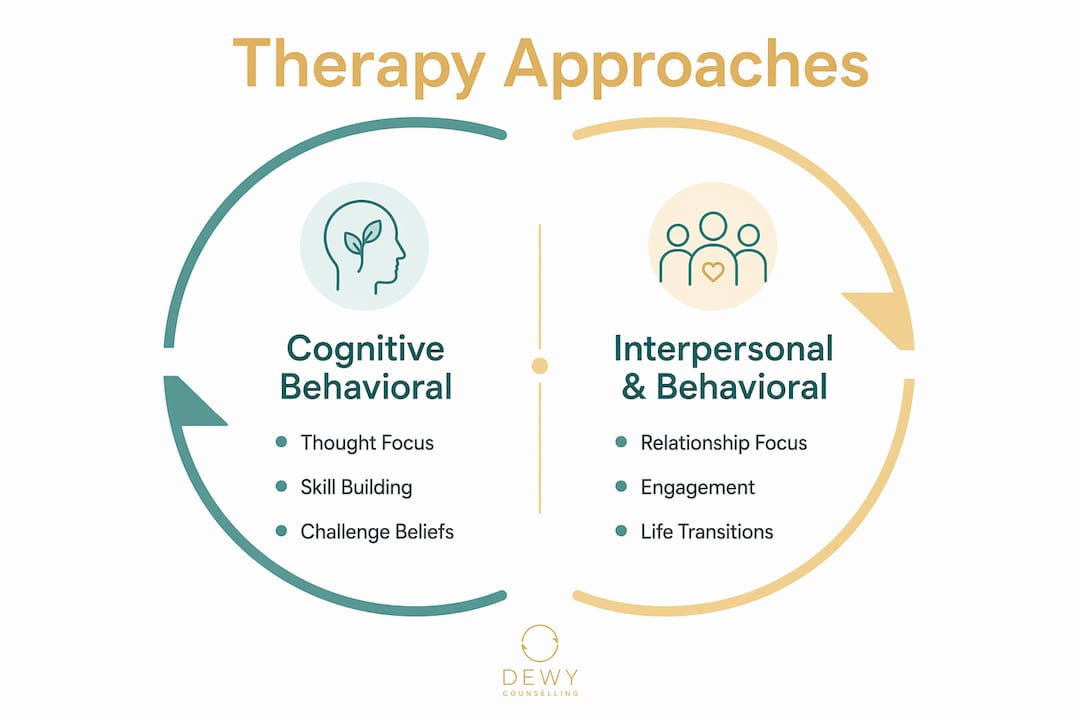
CBT is the most widely studied psychological treatment for depression. It works by helping you recognize and challenge the pessimistic underlying schemas and distorted thought patterns that sustain low mood, then practice real-world skills to shift those patterns. According to clinical guidelines, CBT for adults typically runs 8–28 weekly sessions, making it one of the more time-defined options available. You might explore a CBT overview to understand what the session structure actually looks like before committing.
Behavioral Activation
Behavioral Activation takes a different angle. Rather than focusing primarily on thoughts, it targets the withdrawal and avoidance patterns that deepen depression. When you stop doing things that once brought pleasure or meaning, your mood drops further, which makes you withdraw even more. Behavioral Activation breaks that cycle by systematically re-engaging you with activities that restore a sense of accomplishment and connection, typically over about 20–24 sessions.
Interpersonal Psychotherapy (IPT)
IPT focuses on the relationship and life-transition problems that often trigger or maintain depression, things like grief, role disputes, or major life changes. By improving communication skills and resolving interpersonal conflicts, IPT addresses the social context of your depression rather than just its internal experience. Treatment runs 16–20 weekly sessions on average, with a structured focus on one or two key interpersonal problem areas.
Other evidence-based approaches
Beyond these three, a few other modalities appear in clinical guidelines:
- Psychodynamic therapy explores unconscious patterns and early experiences that shape current depressive responses, promoting self-awareness and adaptive functioning. Session ranges vary widely, from short-term formats of roughly 3 sessions to longer-term work of up to 80 weekly sessions, depending on treatment design.
- Supportive therapy provides a consistent, empathic relationship that helps you manage symptoms and build coping skills without a structured technique-driven framework.
- Mindfulness-based approaches such as Mindfulness-Based Cognitive Therapy (MBCT) are particularly useful for people with recurrent depression, helping interrupt the ruminative thought cycles that trigger relapse.
For a deeper look at how these approaches compare, Dewycounselling's guide on types of psychotherapy walks through each modality with practical clarity.
How effective is psychotherapy for treating depression?
The evidence supporting psychotherapy for depression is substantial and spans decades of clinical research. The American Psychological Association recommends seven psychotherapy interventions for adult depression, and meta-analyses consistently show that combined treatment, meaning therapy alongside medication, produces better outcomes than either approach alone for moderate to severe depression.
For mild to moderate depression, psychotherapy alone often achieves clinically meaningful symptom reduction. The typical window for evaluating whether a given approach is working falls somewhere between 8 and 28 sessions, though IPT guidelines suggest monitoring progress across a 16–20 week timeline. If you are not noticing any shift in your ability to manage daily stress, engage socially, or tolerate difficult emotions by that point, that is useful clinical information, not a reason to give up on therapy altogether.
The research is clear: psychotherapy does not just reduce depressive symptoms in the short term. Studies show it also improves daily functioning and quality of life, and certain approaches, particularly CBT and IPT, reduce the risk of relapse when treatment ends.
What makes therapy effective is not a mystery. Skill practice between sessions, honest engagement with difficult material, and consistency all contribute. The modality matters less than most people assume. What matters more is the fit between you and your therapist, a point covered in depth later in this article.
When is psychotherapy the right choice for depression?
Psychotherapy is appropriate across a wide range of depression presentations, though the specific recommendation depends on severity and individual circumstances.
- Mild to moderate depression: Psychotherapy is typically the first-line treatment, often before medication is introduced. The NIMH notes that therapy can be used as an alternative to or alongside medication, with the choice guided by individual needs and medical context.
- Recurring depressive episodes: If you have experienced multiple episodes of depression, therapy, particularly CBT or MBCT, offers skills that reduce the likelihood of future relapse.
- Functional impairment: When depression is affecting your work, relationships, or ability to manage daily responsibilities, structured therapy provides a framework for rebuilding those capacities.
- Medication contraindications or preferences: Some people cannot tolerate antidepressants due to side effects, medical conditions, or pregnancy. Others simply prefer not to use medication. Psychotherapy offers a viable, evidence-backed path in those cases.
- Trauma or interpersonal contributors: When depression is rooted in grief, relationship conflict, or unresolved trauma, therapy addresses the underlying cause rather than just the symptoms.
- Personal readiness: Therapy requires active participation. You need to be willing to engage honestly, complete between-session work, and tolerate some emotional discomfort. If you are not ready for that, a therapist can help you build toward it gradually.
The decision to pursue therapy, medication, or both is best made with a qualified mental health professional who knows your full picture. Dewycounselling's psychotherapy services are available both in-person and online, making it easier to take that first step regardless of where you are.
What are the possible side effects and limitations of psychotherapy?
Psychotherapy is generally safe, but it is not without challenges. Setting realistic expectations protects you from misreading a difficult phase as evidence that therapy is not working.
- Initial symptom worsening ("therapy hangover"): Early sessions sometimes bring suppressed emotions to the surface, which can temporarily intensify distress. This is a recognized and normal part of the process. Skilled therapists anticipate it and equip you with coping strategies and, when needed, a safety plan before you go home.
- Emotional discomfort: Confronting painful memories, relationship patterns, or core beliefs about yourself is hard work. That discomfort is often a sign that meaningful change is underway, but it can feel destabilizing in the short term.
- Time commitment: Weekly sessions over months require consistent scheduling and follow-through. Life disruptions, work demands, or financial pressures can make that consistency difficult to maintain.
- Variable individual response: Not every approach works equally well for every person. Some people respond quickly; others need to try more than one modality before finding traction.
- Therapist fit: The quality of the therapeutic relationship is the strongest predictor of outcomes. A technically skilled therapist who is not the right fit for you will produce weaker results than one with whom you feel genuinely understood.
- Insufficient alone for severe depression: For severe or treatment-resistant depression, psychotherapy alone is rarely enough. Clinical guidelines are clear that combined treatment is the standard of care in these cases.
None of these limitations mean therapy is not worth pursuing. They mean you go in with open eyes, prepared to communicate honestly with your therapist when something is not working.
How do you find a therapist and set up regular sessions?
Finding the right therapist takes some deliberate effort, but the process is more manageable than it might seem. Here is what to focus on:
- Verify credentials. Look for a licensed mental health professional: a licensed clinical social worker (LCSW), licensed professional counselor (LPC), licensed marriage and family therapist (LMFT), psychologist (PhD or PsyD), or psychiatrist (MD). Each credential carries specific training requirements.
- Match the therapist's specialization to your needs. Not every therapist has deep training in depression-specific modalities like CBT or IPT. Ask directly whether they use evidence-based approaches for depression.
- Consider practical logistics. Location, session availability, telehealth options, and cost all affect whether you can maintain consistency. Dewycounselling offers both online and in-person therapy, which removes some of the logistical barriers that often delay people from starting.
- Assess the fit in early sessions. The first one or two appointments are as much about evaluating the therapist as they are about beginning treatment. Do you feel heard? Do you feel safe enough to be honest? Those early impressions carry real weight.
- Ask questions. You are entitled to ask about their approach, their experience with depression, and what progress might look like for you. A good therapist welcomes those questions.
- Communicate openly about progress. If something in the sessions is not landing, say so. Therapists adjust their approach based on your feedback, and that kind of honest dialogue often accelerates progress.
Pro Tip: Before your first appointment, write down two or three specific ways depression is affecting your daily life. Concrete examples help your therapist understand your experience quickly and shape the treatment plan more accurately from the start.
What should you do if therapy is not reducing your symptoms?
Therapy does not always produce the results you hoped for on the first try, and that is more common than people realize. The absence of progress is information, not failure.
- Talk to your therapist directly. If you have completed several sessions without noticing any shift in symptoms or functioning, raise it explicitly. A good therapist will not be defensive. They will reassess the approach and adjust.
- Consider adding medication. For moderate to severe depression that is not responding to therapy alone, combined treatment with antidepressant medication often produces better outcomes. Your therapist can refer you to a psychiatrist or your primary care physician for an evaluation.
- Switch therapy modalities. If CBT has not moved the needle after a full course of treatment, IPT or Behavioral Activation might. Different approaches work through different mechanisms, and your depression may respond better to one than another.
- Evaluate the therapeutic relationship. If you do not feel genuinely understood or respected in sessions, that alone can stall progress. Changing therapists is not a failure; it is a clinical decision.
- Request a referral for specialized care. Treatment-resistant depression sometimes requires more intensive intervention, such as a partial hospitalization program, intensive outpatient therapy, or evaluation for newer treatments like transcranial magnetic stimulation (TMS).
- Review lifestyle factors. Psychotherapy works as part of a broader picture. Sleep disruption, poor nutrition, social isolation, and substance use all undermine the gains made in sessions.
The path through depression rarely runs in a straight line. Staying engaged with the process, even when progress stalls, is itself a meaningful act of self-care.
Why the therapeutic alliance matters more than you might think
The single strongest predictor of positive therapy outcomes is not the modality used. It is the quality of the therapeutic alliance, the working relationship built on trust, respect, and honest communication between you and your therapist.
This finding holds across decades of psychotherapy research and across different treatment approaches. A therapist who uses a less-studied technique but with whom you feel genuinely understood will often outperform a technically precise therapist with whom you feel guarded or misread. That is not an argument against evidence-based methods. It is an argument for taking the fit seriously.
Psychotherapy also works best as part of a biopsychosocial approach, meaning it addresses the psychological and social dimensions of depression while biological supports, including medication when appropriate, sleep quality, nutrition, and physical activity, work in parallel. Therapy is rarely a standalone solution for severe depression, and framing it as one sets up unrealistic expectations.
Early therapy can feel disorienting. You may leave sessions feeling more stirred up than when you arrived, especially in the first few weeks. That is not a sign something is wrong. Skilled therapists prepare you for this phase and help you build the coping tools to move through it without being overwhelmed.
Pro Tip: If you feel a mismatch with your therapist after two or three sessions, say something. You can raise it directly in session: "I want to make sure we are working in a way that fits me." A therapist who responds defensively to that kind of honest feedback is itself useful information about the fit.
How much does psychotherapy for depression cost, and does insurance cover it?
Cost is one of the most practical barriers to accessing therapy, and it deserves a straightforward answer. In the United States, the price of a single therapy session varies depending on the therapist's credentials, location, and practice setting.
Private-pay rates at licensed therapists in private practice typically run higher than community mental health centers or training clinics, where fees are often sliding-scale. University-affiliated training clinics offer supervised therapy at reduced cost, which can be a genuinely good option for people without insurance coverage.
Insurance coverage has expanded meaningfully since the Mental Health Parity and Addiction Equity Act, which requires most insurance plans to cover mental health treatment at the same level as physical health care. In practical terms, this means:
- Most employer-sponsored health plans, Medicaid, and Medicare cover psychotherapy for depression when provided by a licensed mental health professional.
- Your out-of-pocket cost depends on your deductible, copay, and whether the therapist is in-network.
- Telehealth therapy, which expanded dramatically in recent years, is now covered by most major insurers, often at the same rate as in-person sessions.
Before starting therapy, call your insurance provider and ask specifically about mental health benefits, your deductible status, and which providers are in-network. That one call can save you from a billing surprise later.
If cost remains a barrier, community mental health centers, federally qualified health centers (FQHCs), and employee assistance programs (EAPs) often provide free or low-cost sessions. The Substance Abuse and Mental Health Services Administration (SAMHSA) maintains a treatment locator at findtreatment.gov that lists low-cost options by zip code.
Ready to take the next step?

Depression responds to treatment. The research is consistent on that point, and the range of evidence-based options means there is a path forward regardless of where you are starting from. Dewycounselling offers individual, couples, and family therapy with a warm, client-focused approach designed to help you move from surviving to genuinely thriving.
Whether you are exploring therapy for the first time or returning after a difficult stretch, Dewycounselling's therapy services are available online and in-person, making it straightforward to find a time and format that works for your life.
Key Takeaways
Psychotherapy for depression works by combining evidence-based techniques with a strong therapeutic relationship to reduce symptoms, restore daily functioning, and build lasting resilience against future episodes.
| Point | Details |
|---|---|
| Core purpose of therapy | Psychotherapy targets negative thoughts, emotions, and behaviors to relieve symptoms and improve daily functioning. |
| Treatment duration | Most approaches run 8–28 sessions; Interpersonal Psychotherapy generally involves 16–20 weekly sessions, and Behavioral Activation about 20–24 sessions. |
| Combined treatment advantage | The American Psychological Association recommends combining therapy with medication for moderate to severe depression. |
| Therapeutic alliance | The quality of the therapist-client relationship predicts outcomes more reliably than the specific technique used. |
| Cost and access | Most U.S. insurance plans cover psychotherapy; SAMHSA's findtreatment.gov lists low-cost options by zip code. |