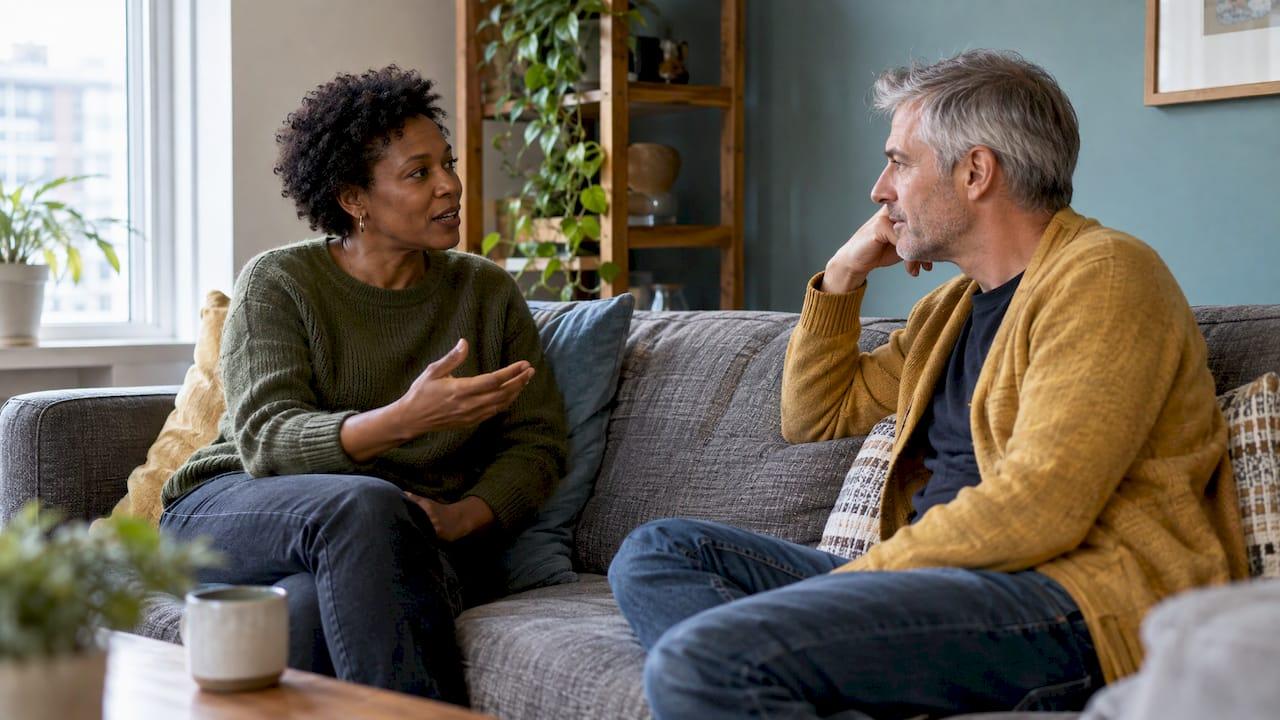
Affair recovery moves through recognizable stages: the shock of discovery, a period of emotional upheaval, a search for meaning, and then the slow rebuilding of trust and connection. The stages are not a straight staircase, and most couples revisit earlier ones. What changes the outcome is having a map, a pace you can both sustain, and a skilled person in the room when the pain is at its sharpest. Our couples therapists in Ontario offer exactly that, in person at two locations or online.
TL;DR
- Researchers describe recovery in three to seven stages, but they agree on the arc: crisis, understanding, then rebuilding.
- Stages overlap, and flashbacks can pull you back to an earlier one. That is part of the process, not failure.
- Couples in one 2023 study had stayed together an average of 50 months after the infidelity (median 24 months), so healing is measured in years more often than weeks.
- Understanding why the affair happened is not excusing it, and the partner who had the affair remains responsible.
- Forgiveness unfolds gradually. Support in the first weeks makes the hardest stage safer.
Why a map of the stages helps
After discovery, many people say they feel as if they have been in a car crash. Your thoughts race, you cannot sleep, and you may swing between rage and a wish to hold on. A relational wound behaves like a physical one: it needs immediate care and steady attention before anything more ambitious, such as deciding the future, can be done.
A map of the stages does not tell you how you should feel. It tells you that what you are feeling has a place in a recognized process, and that others have come through it. If you are the hurt partner, it gives language for the chaos. If you are the partner who had the affair, it shows what is being asked of you, and why it is asked for so long.
The stages researchers describe
There is no single official model. Different researchers have mapped the same terrain in different ways, and they overlap more than they differ.
A four-stage view from couples who stayed together
A 2023 study of 16 couples who stayed together after sexual infidelity organized healing into four stages: revelation of the infidelity, initial reactions, stabilizing the relationship, and revitalizing the relationship. Inside those stages, couples assessed the damage, affirmed commitment, established accountability, sought reconnection, communicated more deeply, re-established trust, and moved from early forgiveness to a deeper kind.
A seven-step process
An earlier qualitative study of couple healing found seven steps: exploring your own emotions and thoughts, expressing them to your partner, developing empathy, softening of emotions, accepting personal responsibility and reducing blame, establishing accountability, and restoring trust. The steps began as sequential and gradually became non-linear, which matches what many couples report: you do not finish one and never return.
Three treatment phases used by clinicians
A clinical paper on treating affair couples describes three phases. The first deals with the impact: emotional dysregulation, depression, anger and damage control. The second explores the factors that contributed to the affair. The third addresses forgiveness, consolidates what was learned, and reexamines the relationship, including the decision to continue or not. The authors note that people may show mixed symptoms and return to earlier stages after flashbacks.

What the hurt partner goes through inside
One clinician describes the hurt partner's path as five cognitive states: ignorance or unspoken suspicion, shattered assumptions about the partner and the relationship, forming a new picture of each person's life during the affair, gradually rebuilding trust and emotional safety, and forgiveness or at least acceptance with a heightened awareness of vulnerability.
The stages in plain language
Combining these models, most couples move through the following, with plenty of looping back.
Stage 1: Discovery and crisis
This is the shock. Both partners are in survival mode. The goal is not to solve anything. It is to stabilize: sleep, food, safety, and honest answers to the questions the hurt partner needs answered. The partner who had the affair is asked to be transparent and to end the outside relationship. Big decisions about separating or staying can usually wait until the intensity eases.
Stage 2: Emotional upheaval
Anger, grief, panic, numbness and bargaining can arrive within the same hour. Hurt partners often need to ask the same questions many times. That repetition does not mean they are refusing to forgive. It means the mind is trying to build a new, believable account of what happened. The involved partner's steady, patient responsiveness matters more here than any grand gesture.
Stage 3: Making meaning
When the storm settles, couples ask why. In clinical work, this meaning stage is often treated as the heart of treatment. A coherent story about what was going on in the relationship, and in the person who strayed, helps replace cruel, simple explanations with a fuller picture. Understanding is not excusing: the partner who had the affair remains responsible for the choice.
Stage 4: Rebuilding trust
Trust returns through consistent, small, observable behavior: doing what you say, being reachable, answering questions without defensiveness. A 2025 study of couples who stayed together found that hurt partners also described learning to trust themselves again, for example resisting the urge to check on a partner's every move. For specific behaviors, see our guide to therapist-backed behaviors that rebuild trust after infidelity.
Stage 5: Forgiveness and a renewed relationship
Forgiveness here means giving up the right to punish and committing to move beyond the thoughts and feelings that have dominated, as described in Baucom's work on forgiveness. It is a gradual unfolding, not a single moment. Many couples find the relationship that emerges is more honest than the one before, with better communication habits. Others, after real reflection, decide to part. Both can be a healthy resolution when reached with care.

How long does affair recovery take?
No official timeline exists, and any promise of one should be treated cautiously. The couples in the 2023 study who had stayed together had a mean of 50 months since the infidelity, with a median of 24 months, which tells us that many were still reflecting on healing well past the two-year mark. Reasonable expectations, drawn from that kind of evidence rather than a rule:
- The acute crisis often takes weeks to months to settle.
- Rebuilding trust commonly takes the better part of a year or more.
- Deeper forgiveness and renewal can continue for years.
What shapes the pace? The same study found that a couple's shared history, sociocultural background, and the formal and informal support they received all influenced how they experienced the infidelity and how they healed. Ongoing contact with the affair partner, repeated deception, untreated depression or addiction, and isolation tend to slow things, while accountability and good support help.
Healing after an affair: what each partner can do
If you were hurt
- Ask for what you need to know, and allow yourself to ask again when the question returns.
- Protect the basics: sleep, meals, movement, and one or two people you trust.
- Notice if the pain is turning into constant panic, hopelessness or thoughts of harming yourself. Contact your family doctor, or call or text 9-8-8, Canada's Suicide Crisis Helpline, any time.
- Do not feel pressured by a deadline for forgiveness. Ask whether you are judging progress by the calendar or by whether anything is moving.
If you had the affair
- Take responsibility without defending or minimizing.
- Offer transparency before being asked, and answer questions patiently, even the repeated ones.
- Stay with the hurt partner's pain rather than rushing them toward "getting over it."
- Explore your own part of the story with a therapist: what you were avoiding, wanting or numbing.
If you are both exhausted
Communication tends to break down under this much strain. Our communication exercises for couples offer a gentle structure for conversations that otherwise escalate. A structured approach such as emotionally focused therapy can also help partners reconnect after the story has been told.
Why guided support changes the odds

The 2023 study identified therapy's role in open communication, processing emotions, deepening forgiveness, and the two-way process of restoring trust as key clinical implications. Left alone, couples often get stuck in one of two places: replaying the facts, or declaring the matter closed too early. A therapist keeps the conversation safe enough to continue, slows it when it is going off the rails, and moves it forward when it stalls.
If you are unsure whether your situation calls for it, our article on signs your relationship needs therapy walks through what to look for. Affairs often sit alongside depression, anxiety, alcohol or drug use, or sexual difficulties, and individual psychotherapy can run alongside couples work when one partner needs extra room. For families dealing with the aftermath of a crisis at home, mental health and marriage is a useful angle on how strain between partners reaches everyone in the household.
Our perspective
After more than 20 years of working with couples, individuals and families, we have come to believe that the first few weeks after discovery matter enormously. A relational wound needs prompt, careful attention, much as a physical wound needs cleaning and dressing before anyone talks about surgery.
We do not ask couples to decide on day one whether to stay or leave. We ask them to stabilize, to tell the truth, and to understand what happened. From there, the decision is made with a clearer head and a steadier heart.
We also hold two things at once: the partner who had the affair is accountable, and both people deserve compassion. Our work draws on multiple therapy modalities and evidence-based approaches, and we offer sessions in person at two locations and online, with sliding scale pricing.
Wayne Dewhurst
Support from Dewy Counselling
Our couples counselling includes specific therapy for trauma, infidelity, and sexual or financial issues, as well as couples separation and mediation when staying together is no longer the goal. Individual and couples sessions in person or online are $175 per hour, and a mobile session is $225 per hour. A prepaid annual membership is $1,750 per year. See our services page for details.

If you would like to begin on your own while you decide about couples sessions, our self-guided couples therapy guide offers a starting point.
FAQ
Is it normal to go back and forth between stages?
Yes. Research describes the process as starting out sequential and becoming non-linear over time, and clinicians note that flashbacks can return a person to earlier stages. A setback does not erase progress. It usually signals that something still needs attention.
How do I forgive without rushing?
Forgiveness is a gradual unfolding rather than a one-time event. Hurt partners should be free to raise the subject as many times as they need, and needing to repeat it does not mean unwillingness to forgive. Judge progress by whether things are moving, not by a deadline.
Can a relationship be stronger after an affair?
Some couples describe a more honest and connected relationship, particularly where there is accountability, deep communication and shared work on trust. It is not guaranteed, and some couples decide to separate. Therapy can support either path.
Should we see a therapist right away?
The first stage is often the most volatile, and early support helps keep conversations safe and honest. You can also start with individual sessions if your partner is not ready. If you feel unsafe at home, contact local emergency services or a crisis line.
Sources
- Couple healing from infidelity: A grounded theory study (Journal of Family Therapy, 2023)
- The Process of Couple Healing Following Infidelity (Journal of Couple & Relationship Therapy)
- Treating affair couples: clinical considerations and initial findings (Baucom, 2006)
- Helping Couples Recover from Affairs (Shelton, 2013)
- Baucom, The Guilford Press excerpt (2009)
- Staying Together After Infidelity (PMC, 2025)