
Workplace conflict training gives managers and HR leaders the practical skills to diagnose disputes, de-escalate tense interactions, and guide employees toward interest-based resolutions. It works best for people leaders and team leads, not just HR specialists. Programs typically run from a two-hour workshop to a multi-day certificate, and the strongest ones teach de-escalation, mediated conversations, and root-cause diagnosis through role-play rather than slides.
TL;DR:
- The most effective conflict training combines role-play, real-case scenarios, and clinician-led emotional regulation techniques, rather than reliance on lectures or generic modules.
- Programs should focus on building five core skills: self-awareness, active listening, emotional intelligence, conflict style awareness, and interest-based negotiation for lasting impact.
- Follow-up coaching and peer accountability groups are essential to reinforce skills and prevent de-escalation abilities from fading over time.
- Training that includes clinician-led sessions can produce measurable improvements in conflict handling within just a few hours, especially in managing escalation patterns.
- Organizations should ensure programs incorporate customization, real practice time, and post-training measurement to guarantee practical skill transfer and behavior change.
What Does Workplace Conflict Training Actually Cover?
Course syllabi vary, but the strongest programs share a similar backbone; for practical conflict-navigation insights, listen to Navigating Conflict at Work and Home: How to Avoid It, Resolve It, and Use It Well. If a course skips more than one or two of these modules, it's likely a compliance checkbox rather than a skill-building program.
- Foundations of conflict: how disagreement escalates, common triggers, and why avoidance usually makes things worse.
- Emotional intelligence: recognizing your own reactions and reading the emotional state of the other party before responding.
- Diagnosing conflict: separating the stated complaint from the underlying interest or need driving it.
- Mediation and interest-based negotiation: structured techniques for guiding two parties toward a resolution neither dictates alone.
- Group conflict and culture: handling disputes that involve teams, not just two individuals, where norms and history complicate things.
- Managing high-conflict behaviors: scripts and boundary-setting for chronic escalators or people who weaponize conflict.
By the end of a well-built program, a participant should be able to run a mediated conversation between two direct reports, identify when a dispute has moved from disagreement to something requiring HR involvement, and document an interaction defensibly. Programs come in two broad shapes: single workshops (a few hours, skills-focused, no formal credential) and certificate programs that stack multiple modules over several weeks with continuing-education credit attached. The Algonquin College conflict resolution program is a useful example of how a course page should disclose modules, audience, and fees upfront. If a provider hides pricing until after a sales call, that's worth noting.
The Five Skills Every Effective Program Teaches
Skip past the modules, and every credible course boils down to five components. The Industrial Relations Centre at Queen's University categorizes conflict competence this way, and it holds up against most curricula on the market.
- Self-awareness of triggers. Trainees learn to notice their own physical and emotional cues before reacting. A common exercise: rate your stress response to a scripted conflict scenario, then compare it to a colleague's rating of the same scenario.
- Active listening and empathetic communication. This means reflecting back what was said before responding, not just staying quiet. Practiced through paired role-play with a scripted grievance.
- Emotional intelligence. Reading tone, body language, and unspoken frustration in real time, then adjusting your approach mid-conversation.
- Conflict-style awareness. Most programs use the Thomas-Kilmann Instrument, or TKI, to help participants see whether they default to competing, accommodating, avoiding, compromising, or collaborating under pressure.
- Interest-based negotiation. Moving from "who's right" to "what does each side actually need," then building a solution around that.
Statistic Callout: Teams that operate with high psychological safety handle conflict productively rather than suppressing it, which supports innovation and reduces costly errors. Training that ignores psychological safety and only teaches negotiation tactics misses half the equation.
Which Training Delivery Actually Works?
Format matters almost as much as content. A one-hour e-learning module can teach vocabulary, but it can't teach de-escalation under pressure. That takes practice with feedback.
- E-learning modules (1 to 2 hours): useful for baseline awareness and compliance documentation, weak for behavior change on their own.
- Half-day workshops: enough time for one or two role-play cycles and a working model of conflict styles.
- Multi-day certificate programs: allow for layered practice, group conflict scenarios, and often carry continuing-education credit.
- Coaching cohorts: ongoing small-group sessions over weeks, best for leaders actively managing a live conflict situation.
The Center for Creative Leadership's guidance on conflict training is clear that facilitated role-play based on an organization's actual cases beats generic scenarios every time. The best programs also build in train-the-trainer components so a skill doesn't die with the one manager who attended, plus follow-up coaching to check whether behavior actually changed.
Pro Tip: Ask whether the program includes even a short clinician-led session on emotion regulation. A single hour with a therapist covering how to recognize your own escalation pattern often does more for real-world de-escalation than an extra module of negotiation theory.
How to Choose the Right Workplace Conflict Training
Selecting a program comes down to five checks: does it align with your team's actual conflict patterns, are the facilitators qualified beyond a generic HR certificate, does it include real practice time, can it be customized to your organization's cases, and does it build in measurement after the fact.
Ask vendors direct questions and listen for specificity in the answers:
- "What percentage of session time is role-play versus lecture?" A strong answer names a ratio, not "a good mix."
- "Can facilitators adapt scenarios to our industry or past incidents?" Vendors who say yes but need weeks of lead time to customize usually can't actually do it well.
- "What happens 30 days after the session?" Programs with built-in coaching follow-up show better skill transfer than one-off sessions.
- "What's included in the fee, and what costs extra?" SHRM's own training resources list this as a standard employer expectation.
Red flags worth walking away from:
- No mention of role-play or simulation anywhere in the proposal.
- Facilitators with no clinical or mediation background, just a generic "leadership trainer" title.
- A single flat fee with zero explanation of what happens after day one.
E-learning-only vendors tend to run cheaper per seat but leave skill gaps that surface the next time a real dispute happens. Blended programs cost more upfront but usually pay for themselves in fewer escalations to HR.
Why Therapist-Led Training Changes the Outcome
Most conflict training teaches frameworks. Clinician-led training teaches your nervous system what to do when a framework isn't enough, which is exactly the moment most managers actually fail. Therapists bring tools for emotional regulation that generic facilitators don't, and that speeds up behavioral change instead of just adding vocabulary.
Dewy Counselling's own manager training data shows this in practice: clinician-led sessions produce measurable impact in as little as three hours, paired with a three-tier plan for preventing burnout at the team level. Organizations don't need to overhaul their entire learning and development calendar to use this. A single clinician-led half-day slotted into an existing manager training track, refreshed annually, is enough to shift how leaders handle the moment conflict actually escalates.
Making Training Stick After the Workshop Ends
A single workshop, no matter how well designed, has a short shelf life without reinforcement. Skills taught on a Tuesday tend to fade by the following month unless something forces them back into use.
The most reliable reinforcement tactic is scheduled coaching check-ins, typically 30 and 90 days after the initial session, where a facilitator or manager's own supervisor reviews a real conflict the manager handled since training. This is where the emotional regulation exercises taught in session actually get tested against a live situation rather than a script.
Peer accountability groups work almost as well and cost less. A small cohort of managers who attended the same training meets briefly every two weeks to talk through one conflict each handled, using the same vocabulary and framework from the course. This keeps the language alive across the organization instead of living only in one person's notes.
Refresher content matters too, but it doesn't need to be another full session. A short recap document, a two-question self-assessment using the TKI framework, or a five-minute video reminder before performance review season does more than people expect. The mistake most organizations make is treating training as a one-time event on a compliance calendar rather than a skill that needs a maintenance schedule, the same way a certification needs renewal.
The Conflict Patterns Training Actually Has to Solve
Most workplace conflict falls into a handful of repeatable patterns, and good training is built to address each one directly rather than teaching conflict theory in the abstract.
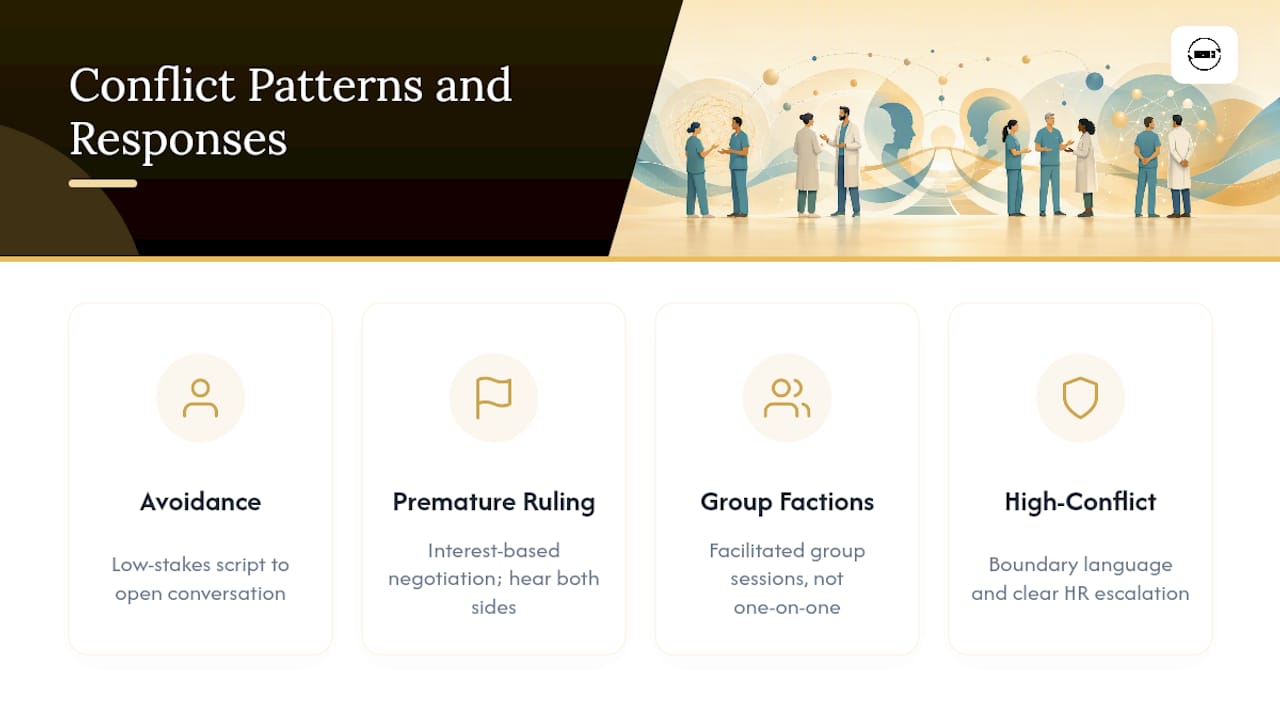
Avoidance is the most common failure mode. A manager senses tension between two employees, says nothing, and hopes it resolves itself. It rarely does. Training addresses this by giving managers a low-stakes script for opening a conversation early, before resentment hardens into something harder to mediate.
The second pattern is premature top-down intervention: a manager hears one side of a story and issues a ruling without hearing the other side, which resolves the immediate friction but breeds quiet resentment and erodes trust in leadership. Interest-based negotiation training exists specifically to interrupt this reflex.
Group-level conflict, where an entire team splits into factions over a decision or a personality clash, is harder still. It requires the group-conflict module most individual coaching skips entirely, since it depends on facilitated group sessions rather than one-on-one mediation.
Finally, chronic high-conflict individuals, people who escalate every disagreement regardless of the issue, require a different toolkit: boundary-setting language and a clear point at which a manager should involve HR rather than keep trying to mediate personally. Training that treats this as a special case rather than folding it into general conflict skills tends to serve managers better when it actually happens.
A Practitioner's Take on What Leaders Get Wrong
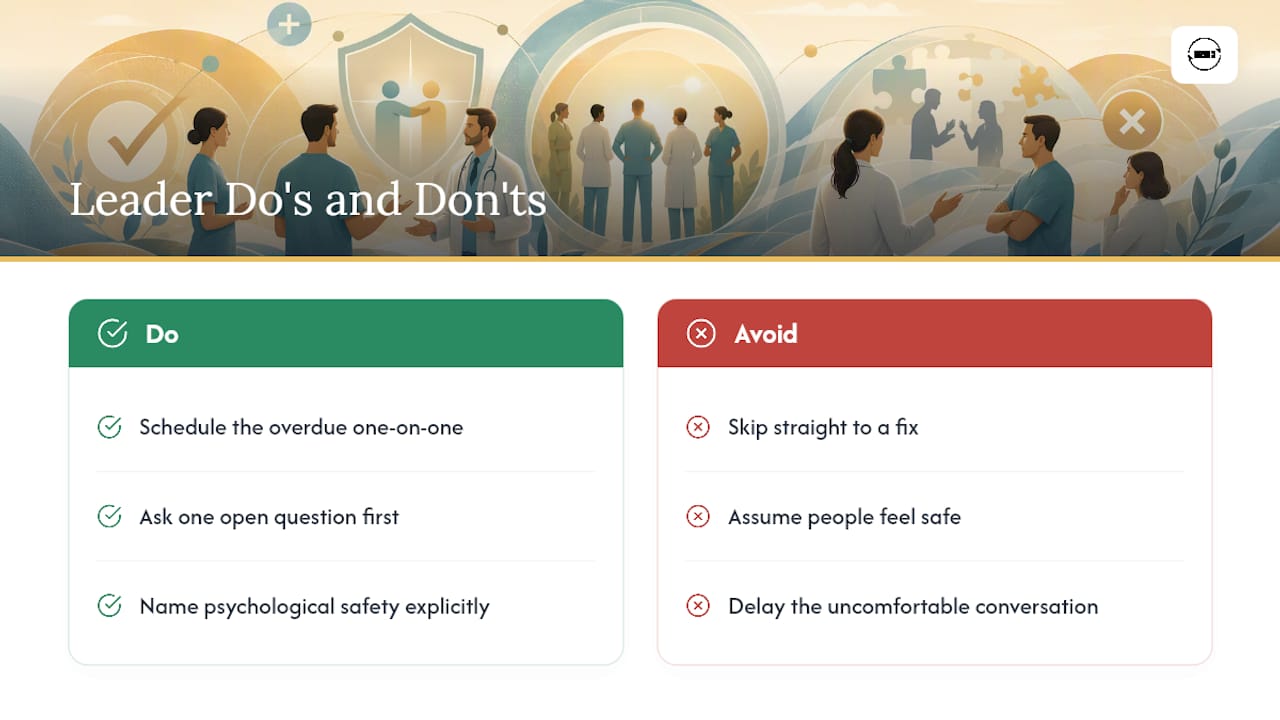
The most common mistake I see isn't lack of training. It's leaders skipping straight to a fix before anyone has actually been heard, which trades a fast resolution for a slower, quieter breakdown in trust. Listening and inquiry before intervening resolves conflict faster than a quick top-down ruling, even though it feels slower in the moment.
Three things a leader can do the same week they finish training: schedule the overdue one-on-one they've been avoiding, ask one open question before offering any opinion in the next disagreement they witness, and name psychological safety explicitly to their team rather than assuming people feel it. None of these require a follow-up course. They require doing the uncomfortable thing sooner.
— Wayne Dewhurst
How Dewy Counselling Helps: Therapist-Led Workplace Training
If the programs above sound solid in theory but you want someone who actually understands emotion regulation running the room, that's the gap Dewy Counselling fills. We're not a generic corporate trainer reciting a negotiation framework. We're therapists who bring clinical tools for de-escalation into a manager's actual workday, delivered online or in person, from a focused half-day session to a multi-day program built around your team's real conflicts.

A typical booking includes a diagnostic conversation about your team's specific friction points, a session built around role-play rather than lecture, and the option to add follow-up coaching so the skills don't fade after week one. Corporate team-building seminars and therapy room rentals are options for organizations that want to run their own internal sessions. If you're ready to see what a clinician-led conflict workshop looks like for your team, book a consultation through Dewy Counselling and we'll scope a session around what your managers are actually dealing with.
Sources
For readers who want to go deeper: Queen's University's Industrial Relations Centre offers a detailed breakdown of core conflict competencies. Psychological Safety resources explain why culture matters as much as individual skill. SHRM's training tools show what HR departments expect from vendors. For broader context on institutional conflict handling, see this Justice Canada resource.
- Managing Workplace Conflicts - Industrial Relations Centre - Queens University
- Conflict resolution training for leaders — Center for Creative Leadership