
Journaling supports mental health because it turns unstructured, looping thoughts into language your brain can actually process, reappraise, and act on. That shift, from raw emotion to organized narrative, is what researchers behind Pennebaker-style expressive writing trials and a recent Cornell identity-journaling study keep finding: putting feelings into words changes how the body and mind respond to stress.
You do not need a plan to test this. Right now, set a timer for five minutes and write about one feeling you had today, no editing, no audience, just the honest sentence. That single act is the mechanism this entire article explains.
Key Takeaways
Journaling supports mental health by converting raw emotion into language the brain can reappraise, organize into narrative, and act on.
| Point | Details |
|---|---|
| Mechanism drives the benefit | Naming feelings, reappraising events, and building narrative identity are what make writing effective, not the act of writing alone. |
| Evidence is real but bounded | Reviews and trials support journaling as a low-cost adjunct, not a standalone treatment for serious conditions. |
| Method should match goal | Expressive writing suits processing; gratitude suits mood; narrative journaling suits identity and depression symptoms. |
| Short, consistent sessions win | Five to twenty minutes done regularly outperforms occasional long sessions for building the habit. |
| Know when to add support | Persistent distress or trauma-related writing is safest paired with a clinician, such as through Dewycounselling's psychotherapy services. |
Why Journaling Helps: The Science Behind the Page
Journaling works through a handful of overlapping mechanisms, and understanding them changes how you use a notebook.

Emotional processing happens when you translate a vague, physical sense of distress into specific words. Naming an emotion recruits the brain's language centers and appears to dampen the intensity of the raw feeling. Cognitive reappraisal follows close behind: writing forces you to slow down and reconsider a situation from a different angle, which is why a frustrating event often looks smaller on the page than it felt in your chest. Narrative identity is the process of stitching daily events into a coherent life story, and it is the specific mechanism behind the Cornell trial, where more than 100 young adults who wrote about their identity for two weeks saw reduced depressive symptoms and less feeling of being derailed, with benefits still visible two months later for many participants. Rounding things out, attentional shifting and behavior planning let journaling double as a rehearsal space: you notice patterns, then write down what to try differently tomorrow.
The evidence base is not thin. A systematic review and meta-analysis concluded journaling functions as an effective, low-cost adjunct for managing common mental-health symptoms in primary care and community settings. The classic Pennebaker protocol, several minutes of expressive writing across multiple sessions, has been replicated widely enough to show improvements in psychological well-being and even fewer physician visits among participants.
- Emotional processing: naming feelings reduces their physiological grip.
- Cognitive reappraisal: writing creates distance from automatic reactions.
- Narrative identity: organizing events into a story restores a sense of coherence.
- Behavior planning: writing surfaces next steps you might otherwise avoid.
Statistic Callout: Systematic review data show journaling functions as a legitimate low-cost adjunct treatment, not a replacement for care, particularly for managing symptoms in primary care settings.
One caveat matters here: expressive writing can raise distress in the short term before benefits appear weeks later, so timing and framing matter as much as the writing itself.
Pro Tip: If a writing session leaves you more agitated than when you started, that is common in the first few days of expressive writing. Give it a week before deciding whether the method fits you.
What Mental Health Benefits Does Journaling Actually Support?
Not every benefit attributed to journaling carries equal evidence weight. Here is how the research stacks up, strongest signal first.
- Stress reduction: Consistently the best-supported outcome, backed by decades of expressive-writing research and the PMC systematic review on journaling as an adjunct intervention.
- Reduced anxiety and worry: Clinical and experimental studies link structured journaling to lower anxiety and improved well-being, though effects vary by person and method.
- Reduced depressive symptoms: The identity-focused protocol from Cornell showed measurable symptom reduction in young adults, with effects holding at a two-month follow-up for many participants.
- Improved mood and emotional awareness: Naming and examining feelings on paper builds the same skill therapists call emotional granularity, which tends to improve mood regulation over time.
- Better sleep in some cases: Worry-dump journaling before bed appears to reduce the rumination that delays sleep onset, though this evidence is less robust than the stress and mood findings.
- Increased self-awareness and clarity: A near-universal reported benefit across clinician guidance, though harder to quantify than symptom-based outcomes.
- Better problem-solving and planning: Writing through a decision or conflict engages structured thinking that pure rumination does not.
The caveat that applies across nearly every item on this list: benefits concentrate among people who write specifically and reflectively, not those who vent without direction.
Which Journaling Method Fits Your Goal?
Different journaling styles serve different psychological jobs, and picking the wrong one for your situation is a common reason people give up on the habit.
Expressive writing means writing freely about a difficult experience and your emotional response to it, following the Pennebaker structure of 15 to 20 minutes across several sessions. It suits processing a specific stressor or loss, not daily maintenance. Gratitude journaling asks you to name specific things you are thankful for and why they matter, and short trials show it reliably increases well-being within two weeks when entries stay specific rather than generic. Analytical or third-person writing, describing your situation as if narrating someone else's story, creates the emotional distance needed for cognitive reappraisal. Narrative or identity journaling works like the Cornell protocol, weaving daily events into your broader life story, and fits people wrestling with a sense of drift or disconnection. Bullet or problem-solving journaling favors short, structured entries for tracking patterns and planning action, useful for busy schedules or anxious overthinking.
- Medium matters less than you think: notebook, app, or typed document all work.
- Consistency beats format, so choose whatever you will actually return to tomorrow.
As clinicians note, there is no single right way to journal; the method should match the goal.
How Do You Start a Journaling Practice That Sticks?
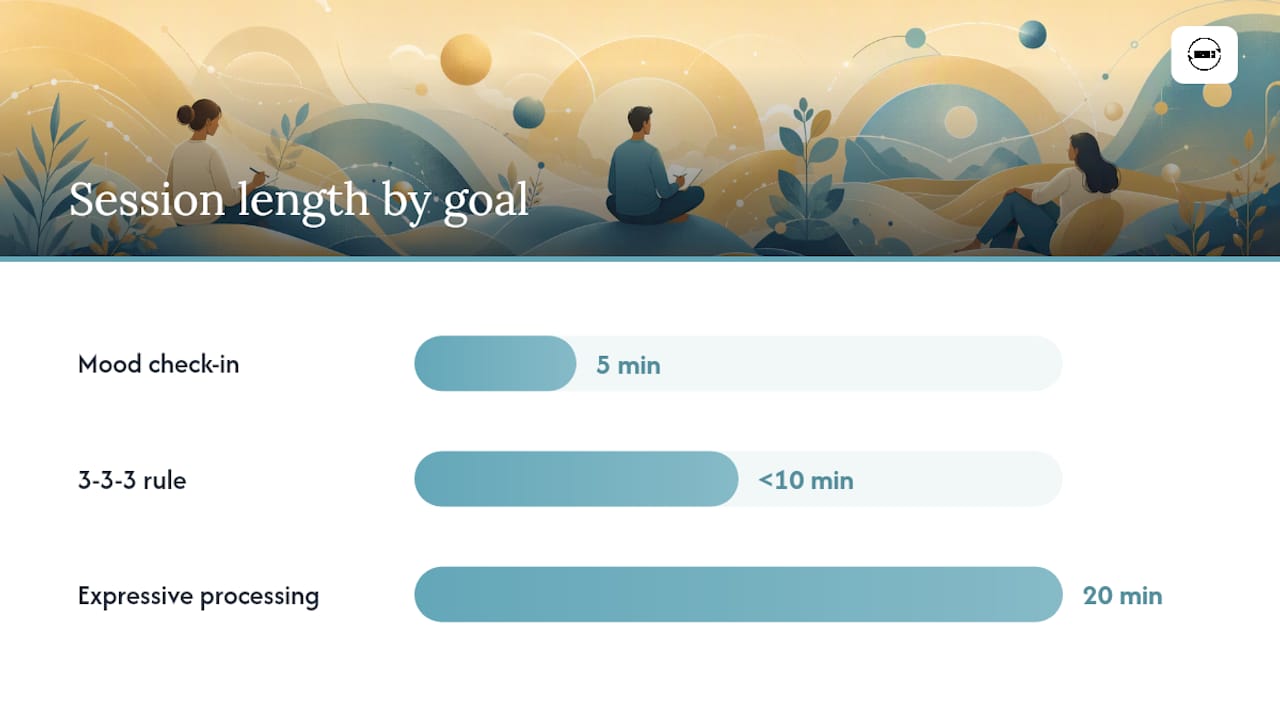
A journaling session works best with light structure: pick a goal, set a time limit, choose a prompt, and close with one line of reflection. Sessions can run as short as 5 minutes for a mood check-in or as long as 20 minutes for expressive processing, depending on what you are working through.
The 3-3-3 rule is a simple entry point: write 3 things you are grateful for, 3 things bothering you, and 3 things you want to accomplish tomorrow. It takes under ten minutes and touches gratitude, processing, and planning in one sitting.
- Choose your goal for the session (process, reflect, plan, or appreciate).
- Set a timer for 5 to 20 minutes based on that goal.
- Pick a prompt that matches it.
- Write without editing until the timer ends.
- Close with one sentence naming what you noticed.
Prompts by goal:
- Processing: "What happened today that I haven't fully sat with yet?"
- Gratitude: "What is one specific moment today I was glad for, and why?"
- Problem-solving: "What is one small step I can take on this tomorrow?"
- Identity narrative: "How does today's event fit into the story I'm telling about who I am becoming?"
Consistency outperforms intensity. Guidance from habit-formation research points to short, frequent sessions tied to a stable cue, like writing right after brushing your teeth, as more sustainable than occasional long sessions. Pair the habit with a small reward, even just closing the notebook with satisfaction, and it sticks faster.
When Can Journaling Make Things Worse?
Journaling is not risk-free. Unstructured venting, writing the same painful loop over and over without new insight, can reinforce rumination rather than relieve it. Writing about severe trauma too soon after it happens, without support, can spike distress rather than settle it. Some people find that expressive writing temporarily worsens mood before any benefit shows up.
A few safeguards reduce that risk:
- Cap emotionally intense sessions at 20 minutes.
- Use a grounding technique, like slow breathing or naming five things you see, after heavy writing.
- Never force disclosure of trauma you are not ready to name, even to yourself on paper.
- Decide in advance whether your journal stays private or gets shared with a therapist.
If writing consistently leaves you more distressed, stuck in the same painful memory, or if you are processing significant trauma, that is the signal to bring a therapist into the process rather than working through it alone. Timing and framing matter enough that trauma-focused writing is often safest inside a clinical relationship.
Pro Tip: If you notice your journal entries repeating the same complaint without any new angle after a week, that is rumination, not processing. Switch to a structured prompt or bring it to a session.
Your 7-Day Journaling Starter Plan
This plan needs 5 to 15 minutes a day and works whether you prefer short check-ins or deeper reflection.
- Day 1: Write for 5 minutes on how you feel right now, no filter.
- Day 2: List 3 things you're grateful for and why each matters.
- Day 3: Use the 3-3-3 rule (grateful, bothering you, tomorrow's goals).
- Day 4: Write a short letter to your future self, 10 minutes.
- Day 5: Describe a recent challenge in the third person, as if it happened to a friend.
- Day 6: Free-write for 15 minutes on a moment that shaped who you are.
- Day 7: Review the week's entries and write one sentence on what you noticed.
Two tracks work here: a mood-focused track using Days 1, 2, 3, and 7 for quick daily check-ins, or a deeper-reflection track adding Days 4, 5, and 6 for longer identity and narrative work.
- Pick one consistent time (morning coffee, before bed).
- Choose one place you associate with quiet focus.
- Set a phone reminder for the first two weeks until it becomes automatic.
How Therapists Actually Use Journaling With Clients
In practice, journaling shows up as homework between sessions, a mood-tracking tool, or a way to draft the narrative a client is struggling to say out loud in the room. It gives a therapist something concrete to build on rather than relying on memory of how a difficult week felt. Journaling works best as a complement to therapy, not a substitute for it, especially when trauma or persistent depression is involved.
Building a Journaling Practice With Professional Support
A journal gives you a private space to process; a therapist gives you a trained eye on what that processing reveals; together they cover ground neither manages alone. Dewycounselling offers both online and in-person psychotherapy built around exactly this kind of integration, where writing exercises get structured, timed, and debriefed by a clinician rather than left to guesswork.

If your journal entries keep circling the same difficult memory, or you sense that what you are writing about needs more support than a blank page can offer, that is worth a conversation. Dewycounselling's therapy services can help you decide whether expressive writing, narrative work, or a different approach fits your specific situation, and how to pair it safely with regular sessions. Book an initial consultation to talk through where journaling fits into your care plan.
Frequently Asked Questions
Why does journaling support mental health more than just thinking things through? Writing forces language and structure onto thoughts that otherwise loop unresolved in your head, which is why it engages cognitive reappraisal in a way passive thinking often does not.
How long should a journaling session be for mental health benefits? Anywhere from 5 minutes for a quick mood check-in to 20 minutes for expressive processing, depending on your goal and how much emotional weight the topic carries.
Can journaling replace therapy? No. Journaling works well as a complement to therapy and a low-cost adjunct for common symptoms, but persistent depression, anxiety, or trauma benefit from professional guidance alongside it.
What is the 3-3-3 journaling rule? Write 3 things you're grateful for, 3 things bothering you, and 3 goals for tomorrow, a quick structure that touches gratitude, processing, and planning in one entry.
Is it normal to feel worse after journaling at first? Yes, especially with expressive writing about difficult topics. Short-term distress followed by longer-term improvement is a documented pattern in the research.
Sources
- Efficacy of journaling in the management of mental illness - PMC
- This simple, low-cost activity reduces depression in young adults | Cornell Chronicle
- How Journaling Can Help Ease Anxiety and Encourage Healing
- Journaling for Mental Health: What the Science Actually Says (2026) | Simply Psychology
- How to Journal for Mental Health | Psychology Today