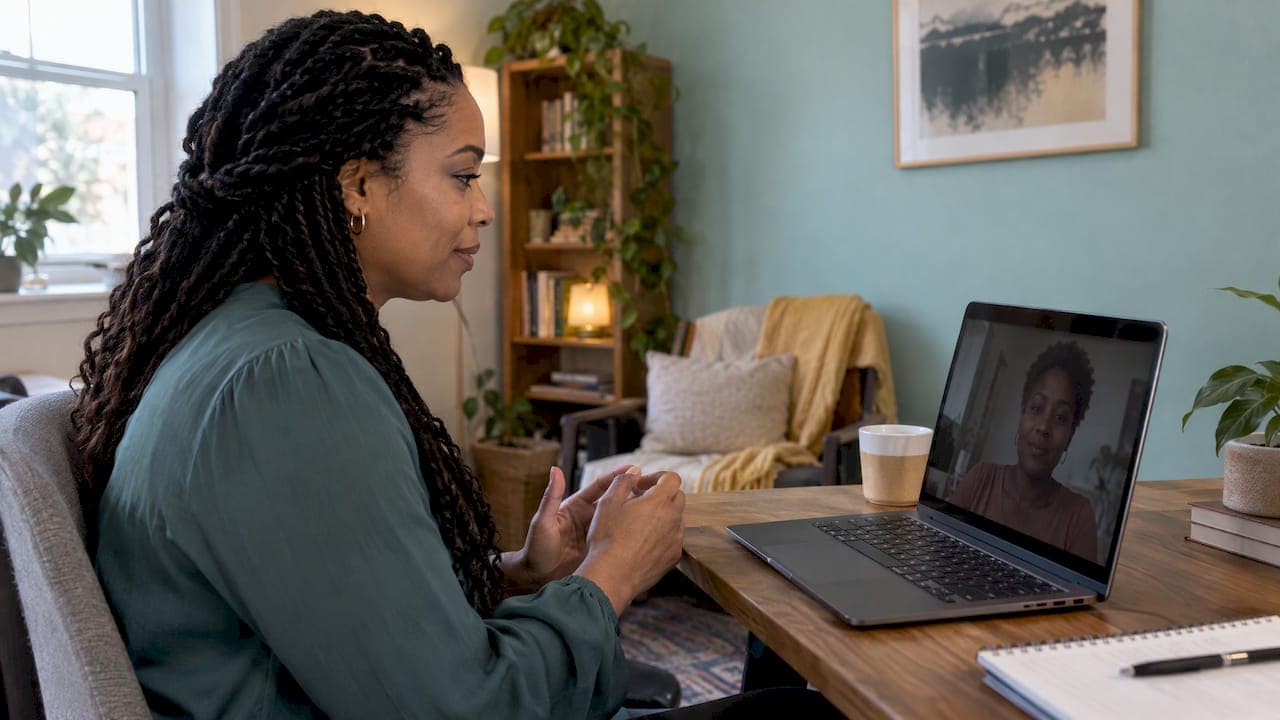
Teletherapy is allowed in Ontario, and it is regulated the same way in-person therapy is. The professional's college sets the standards, Ontario privacy law applies, and the province you are sitting in when the session happens decides which regulator has authority. If you are choosing an online therapist, or simply wondering whether the video sessions you already attend are on solid ground, this guide explains the rules in plain language and tells you what to ask.
Many people find it a relief to learn that online care is not a loophole or a lesser option. It comes with real duties for the therapist: informed consent, secure technology, insurance, and a plan for what happens if something goes wrong. Knowing those duties helps you recognize a careful practice when you meet one.
TL;DR
- Teletherapy is permitted for Ontario registered psychotherapists, subject to the same professional standards as in-person work, plus added duties on consent, privacy, and insurance.
- Your physical location during the session is what matters most: a therapist generally needs to meet the licensing requirements of wherever you are.
- Ontario's health privacy law (PHIPA) applies to virtual care just as it does to an office visit, and you must give voluntary consent to how your information is handled.
- A good therapist will assess whether online work suits you, agree on a plan for technology failures and crises, and document all of it.
- Ask about registration, consent, platform security, and crisis procedures before your first session.
What teletherapy means, and whether it is allowed in Ontario
Teletherapy is therapy delivered through communications technology, such as video, telephone, text, or email, when the therapist and client are not in the same room. The College of Registered Psychotherapists of Ontario (CRPO) describes this in its Electronic Practice Guideline, and it permits registered psychotherapists to practise this way, provided they respect professional standards, informed consent, privacy and security, insurance, clinical appropriateness, and jurisdictional requirements.
The guideline's underlying message is worth remembering. Electronic practice is not treated as a lesser form of practice. The same professional standards apply, but technology adds specific duties around consent, confidentiality, clinical safety, contracting, and insurance. In other words, your online therapist is held to the same bar as one whose office you can walk into, and then to a few extra requirements on top.
That matters because "teletherapy" is not a single thing. A weekly video session with a registered psychotherapist, a text-based check-in, and a phone call during a hard week all count. Each carries slightly different risks, which is why the rules ask your therapist to think about the format, not only the technology.
Who regulates teletherapy in Ontario
There is no separate "teletherapy law" in Ontario. Instead, the rules come from the regulator of the profession your therapist belongs to, together with privacy legislation.
For psychotherapists, the key piece is CRPO Standard 3.4 on electronic practice, read alongside the CRPO's other standards, its code of ethics, PHIPA, and other applicable law. Under that standard, registered psychotherapists are required to:
- obtain informed consent for the use of electronic media,
- use technology that is secure, confidential, and appropriate,
- carry sufficient liability insurance for electronic practice,
- comply with licensing requirements where the client is located, and
- include treatment-related secure-text or email correspondence in the clinical record.
Other professions have their own versions. Psychologists and psychological associates answer to the College of Psychologists and Behaviour Analysts of Ontario (CPBAO), which publishes guidance on delivering services through technology. Physicians follow the College of Physicians and Surgeons of Ontario's Virtual Care policy. The College of Physiotherapists of Ontario has its own virtual care guidelines, which show how consistent the expectations are across Ontario's regulated health professions: document that care was virtual, follow PHIPA, obtain and record consent, manage technology risks, and keep an emergency plan.
If you are unsure which kind of professional you need, or what it means that psychotherapy is a regulated act in Ontario, our explainer on the controlled act of psychotherapy in Ontario is a good companion to this page. And if you are still looking for someone, how to find a therapist in Ontario walks through checking registration step by step.
Why your location matters more than your therapist's
The single most misunderstood part of teletherapy is geography. People assume that if their therapist is licensed in Ontario, everything is fine wherever they log in from. It is not that simple.
CPBAO's position is that the client's physical location is central to regulatory jurisdiction. An Ontario licence does not automatically authorize practice into another province, and an out-of-province licence does not automatically authorize service to a client in Ontario, according to its guidance on cross-jurisdictional practice.
If you are in Ontario
CRPO Standard 3.4.5 requires registrants to comply with the professional licensing requirements of the jurisdiction where the client is. CRPO's Cross Border Therapy Tool adds that CRPO registrants can provide services to clients in Ontario through their registration and do not need to live or work in Ontario. CRPO is also clear that it does not give legal advice or speak for other jurisdictions.
For psychologists, CPBAO says practitioners licensed elsewhere who serve a client physically in Ontario generally need CPBAO registration. Canadian practitioners may qualify under Ontario's "as of right" legislation, and temporary registration exists for limited telepsychology practice.
For physicians, the CPSO's policy requires an active CPSO certificate to provide virtual care to patients located in Ontario. It allows exceptions only where out-of-province care is in the patient's best interest, for example unavailable specialty care, bridging an existing relationship, or urgent or emergency care.
The practical takeaway: if you live in Ontario and are hiring a therapist, the safest question is simply, "Are you registered to practise with clients who are physically in Ontario?"
If you travel, move, or study elsewhere
This is where clients are most often caught off guard. CRPO's guidance on clients outside Ontario says an Ontario registrant may serve a client in another jurisdiction only if they are competent to do so, comply with CRPO standards, are not prohibited by that jurisdiction's laws or regulations, and are appropriately insured for cross-jurisdictional risks. CPBAO adds that an Ontario registrant serving a client outside Ontario should obtain permission from the regulator where the client is located, subject to exceptions such as interjurisdictional agreements.
The Canadian Psychological Association's telepsychology guideline points out that provincial and territorial requirements take precedence over the guideline and that the rules are still evolving. Practitioners are expected to track the law in every jurisdiction where they or the client are located.
What this means for you:
- If you plan a month abroad or at a cottage in another province, tell your therapist before you go. They may need to pause, adjust, or check what is permitted.
- Students who study out of province and return home for summers should raise this early, since the answer can change with your address.
- A therapist who asks where you are at the start of a session is not being nosy. They are doing what their regulator expects.
Consent and privacy: what you should expect
Ontario's Information and Privacy Commissioner states that PHIPA applies to virtual care just as it does to in-person care, alongside other laws and regulator guidance. Its page on privacy and virtual health care sets out what this looks like in practice: providers should explain the limitations and risks of virtual care, obtain voluntary consent to collect, use, and disclose your personal health information through virtual technologies, and tell you that you can withdraw consent. You should never be pressured into agreeing.
The CPSO adds detail on safeguards for physicians that clients of any provider can use as a yardstick: confirming who you are, working from a private setting, disclosing everyone present in the session, checking that you have privacy on your side, and using secure technology where appropriate. If a less secure tool is used, the physician must get and document your express verbal or written consent.
The electronic practice agreement
CRPO's guideline says a registrant must enter into an agreement with you before providing electronic services. A written agreement is encouraged, and where none exists, the terms must be documented in your clinical record. CRPO recommends that the agreement cover:
- the platform being used,
- the risks and benefits of the technology,
- what happens if the technology fails, and how crises will be handled,
- the limits of confidentiality,
- how you can protect your own privacy,
- practice policies and expected response times, and
- the fact that CRPO regulates the therapist.
Read this document rather than clicking past it. It tells you what to do if the call drops mid-session, how quickly emails are answered, and whether texting is part of the relationship at all. If the therapist cannot tell you these things, that is useful information.
Your own part of the privacy picture
Secure software is only half of it. The other half is your environment. A shared apartment, a car in a parking lot, or a workplace meeting room can undo careful safeguards. Our short guide to video therapy etiquette in Canada covers the practical checks: private space, headphones, a stable connection, and what to do about interruptions.

Is teletherapy right for you? How a good therapist decides
Regulators do not treat teletherapy as automatically suitable for everyone. CPBAO says virtual care should be used only when it is clinically appropriate and in the client's best interests. Its guidance on technology asks professionals to weigh engagement, lost visual or sensory cues, privacy risks, accessibility, boundaries, and which populations or conditions can be addressed without in-person contact.
CRPO says that before therapy begins, a registrant should assess your concerns, whether you have safe and private access to technology, how comfortable and capable you are with it, and risks such as unsafe surroundings or an adverse reaction during a session. CRPO's article on implementing electronic practice, updated in September 2024, adds that a therapist should find out whether you are in another jurisdiction and whether that jurisdiction restricts the service, and should confirm that liability insurance covers electronic practice.
In plain terms, a careful therapist will ask you questions at the start, and some of them will feel administrative. Others will feel personal. Both kinds protect you.
When in-person work may be the better fit
Some situations deserve a conversation about format: very intense couple conflict where one partner does not feel safe speaking freely, a home with no private room, or a period of acute distress when the therapist needs to see more than a screen can show. Many people start online and move to in-person sessions, or the reverse, as life changes. A flexible practice that offers both makes that transition simple.
What to do in a crisis
Your agreement should say what happens if you are in distress during or between sessions. Ask for the plan in advance, and share the address where you will normally be during sessions so help can be sent if needed. If you are ever in immediate danger, call 911 or go to the nearest emergency department rather than waiting for an email reply.
A short checklist before your first online session
You do not need to be a regulatory expert. Five questions cover most of what matters:
- Who regulates you? Ask for the college and registration number, and look the person up on the public register.
- Can you work with me where I will be? Mention any plans to travel or relocate.
- What platform do you use, and how is my information protected? You are entitled to a plain answer.
- What is in your electronic practice agreement? Ask to see it before the first session.
- What is the plan if the connection fails or I am in crisis?
If cost and coverage are on your mind too, our guides on what OHIP does and does not cover for psychotherapy and avoiding rejected therapy claims explain how receipts and registration affect reimbursement.
Our perspective
Over more than twenty years of working with individuals, couples, and families, we have seen that people rarely struggle with the idea of therapy itself. They struggle with the practical question of how to fit it into a life that is already stretched. Online sessions solve a real problem for the parent who cannot leave the house, the partner whose schedule never lines up, and the person who lives far from the nearest office.
But convenience should never come at the cost of safety. When we talk with clients about online work, we treat the regulatory points above as part of good care, not paperwork: knowing where you are, agreeing on how your information is handled, and deciding together what happens if the connection drops or a conversation becomes overwhelming.
This is especially true for couples. A difficult conversation about trust, money, or intimacy needs privacy and steadiness on both sides of the screen. That is why we offer both online and in-person sessions at two locations, so the format can follow what helps you most, and why we use sliding scale pricing to keep that support within reach.
A relational wound, like a physical one, heals best when it is attended to early and with the right care. Choosing a format that suits you is part of that care.
Wayne Dewhurst
Work with us online or in person
We provide individual, couples, and family psychotherapy, online and in person, for people across Ontario. Online and in-person sessions are $175 per hour, and a prepaid annual membership is $1,750 per year. You can see the full list on our services page, read about individual psychotherapy, or explore couples counselling, including support after infidelity and for sexual or financial concerns.

If you are not sure whether online or in-person work suits your situation, raise it when you reach out. Choosing the right format is part of the first conversation.
FAQ
Is teletherapy legal in Ontario?
Yes. CRPO permits registered psychotherapists to provide services electronically, as long as they meet professional standards, obtain informed consent, use secure technology, carry appropriate insurance, and comply with licensing requirements where the client is located. Other Ontario health colleges have comparable virtual care rules.
Can a therapist in another province treat me if I live in Ontario?
Often only if they meet Ontario's requirements. CRPO says its registrants can serve clients in Ontario through their registration, while CPBAO says psychologists licensed elsewhere generally need CPBAO registration unless an exception applies. Ask any out-of-province therapist how they are authorized to work with you.
Does privacy law cover video sessions?
Yes. Ontario's Information and Privacy Commissioner confirms that PHIPA applies to virtual care as it does to in-person care. You should be told about the risks, asked for voluntary consent, and informed that you can withdraw it.
What if I am travelling and want to keep my appointments?
Tell your therapist before you leave. Because the client's physical location determines which regulator has authority, your therapist needs to check whether they may work with you where you will be, and what insurance covers.
Do I need a written agreement for online therapy?
CRPO's guideline requires an agreement with you before electronic services begin. A written one is encouraged, and if there is none, the terms must be recorded in your file. Ask to review it before the first session.
Sources
- CRPO Electronic Practice Guideline
- CRPO Standard 3.4: Electronic Practice
- CRPO Cross Border Therapy Tool
- CRPO: Out of Province client guidance
- CRPO: Implementing Electronic Practice
- CPBAO: Cross-Jurisdictional Practice
- CPBAO: Use of Technology
- CPSO: Virtual Care policy
- Canadian Psychological Association: Telepsychology guideline
- Information and Privacy Commissioner of Ontario: Privacy and virtual health care
- College of Physiotherapists of Ontario: Virtual Care Guidelines