
Provincial health plans in Canada cover psychiatrist visits and hospital-based mental health care, but most private-practice therapy sessions fall outside that coverage. The bulk of Canadians pay for ongoing counseling through employer group benefits, personal extended-health insurance, or workplace Employee Assistance Programs, and fill any remaining gap out of pocket. When you do pay privately, the Medical Expense Tax Credit and a June 2024 GST/HST exemption can soften the cost.
TL;DR:
- Most private therapy sessions are not covered by provincial health plans, which mainly reimburse psychiatrists and hospital-based care.
- Verifying insurer requirements—including provider eligibility, referral needs, and billing details—before booking helps prevent delays and claim rejections.
- Therapy costs usually fall between $120 and $250 per session, with some programs offering sliding-scale fees or low-cost options at university clinics or community centers.
- Effective June 2024, many psychotherapy services qualify for GST/HST exemption, reducing overall sales tax for eligible clients.
What Does Public Health Insurance Cover for Therapy?
Every provincial and territorial health plan pays for psychiatrist visits, because psychiatrists are medical doctors billing through the same system as any other physician. Hospital-based mental health programs, inpatient psychiatric care, and crisis services delivered in an emergency department are also generally covered. What is almost never covered is a session with a private-practice psychologist, registered psychotherapist, or clinical social worker. Those professionals aren't physicians, so their fees sit outside the medically necessary services definition that provincial plans use to decide what gets billed to the government.
That single distinction, physician versus non-physician provider, explains almost every gap Canadians run into when they assume "health care is free here" extends to counseling.
Coverage details still shift depending on where you live:
- Ontario funds some psychotherapy through OHIP-covered physicians and select community mental health programs, but private clinicians bill separately.
- Quebec offers publicly funded psychological services through CLSCs, though wait times can run long.
- British Columbia and Alberta both provide limited counseling through primary care networks, with capacity varying by health region.
- Several provinces also fund targeted programs, Indigenous mental health services, provincial crisis lines, and school-based counseling, that supplement the standard system.
Family physicians can sometimes bill for basic psychotherapy under general practice codes, and a referral to a psychiatrist usually requires a doctor's note first. If your family doctor thinks you need specialized psychiatric care, that referral is generally what unlocks publicly funded psychiatrist appointments rather than a long private-pay relationship.
How Do Employer Benefits and Private Plans Pay for Therapy?
Group benefits through an employer are the most common way Canadians actually fund therapy. These plans typically bundle psychotherapy under a "paramedical" or "mental health" benefit line, separate from dental or vision, and reimburse a percentage of each session rather than the full fee.
Four private routes cover most working Canadians:
- Group/workplace benefits — employer-sponsored plans with a paramedical benefit that includes psychologists, social workers, or registered psychotherapists.
- Personal extended health insurance — plans purchased independently, common for self-employed people and those without workplace coverage.
- Employee Assistance Programs (EAPs) — short-term, employer-funded counseling, often free at the point of use but capped at a handful of sessions per issue per year.
- Health Care Spending Accounts (HCSAs) — flexible dollar amounts employees can allocate toward therapy or other eligible health expenses.
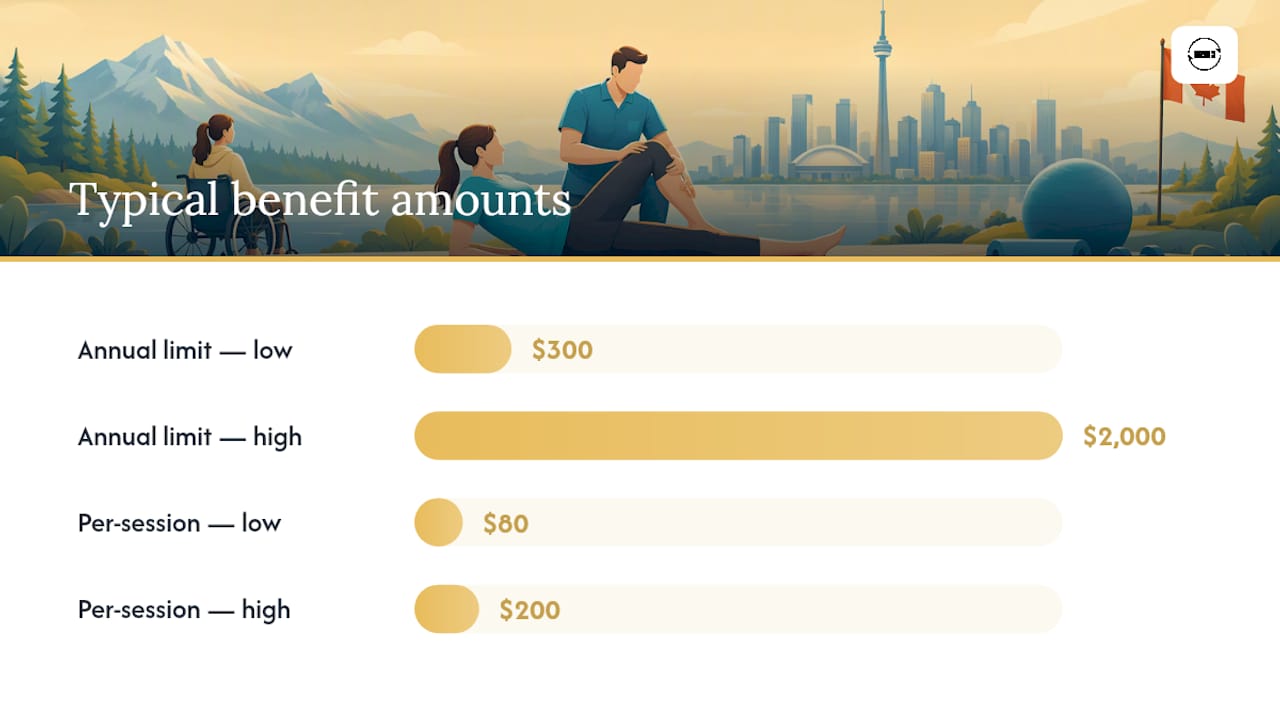
Reimbursement mechanics vary by insurer. Annual limits on paramedical benefits commonly range from $300 to $2,000, with per-session reimbursement between $80 and $200, depending on the plan tier and employer contribution. Many plans package therapy under a shared paramedical bucket rather than a dedicated mental health benefit, which matters more than people realize.
Some insurers offer direct billing, where the clinic submits the claim and you pay only the difference. Others require you to pay upfront and submit a claim with a receipt, typically through an online portal or mobile app, for reimbursement within one to two weeks.
How Do I Check If My Insurance Plan Covers Therapy?
Before booking a session, pull up your benefits booklet or online portal and check four things. This single check avoids most of the unpleasant surprises that come from assuming coverage exists when it doesn't.
- Eligible provider types. Some plans reimburse only psychologists; others include registered psychotherapists, clinical social workers, or marriage and family therapists.
- Annual maximum. This is the total dollar ceiling your plan pays per calendar or benefit year, not per session.
- Per-visit reimbursement rate. Plans often cover a percentage (commonly 70 to 100 percent) up to a dollar cap per visit.
- Referral requirements. A few plans require a physician referral before they'll reimburse psychotherapy, though most do not for non-physician providers.
Once you've confirmed those four items, ask your therapist for a receipt containing the practitioner's full legal name, professional designation (Registered Psychotherapist, Registered Social Worker, Psychologist), license or registration number, date of service, and fee charged. Insurers and the CRA both use these details to verify the claim, and a receipt missing any one of them is a common reason reimbursements get rejected or delayed. Our own guide to receipt requirements walks through exactly what to request.
If your clinic doesn't offer direct billing, submit the receipt through your insurer's app or web portal along with your policy number, and keep a copy for your own tax records.
Pro Tip: Before your first appointment, email your insurer's support line and ask them to confirm in writing whether your specific therapist's designation is covered. A saved email confirmation is far more useful than a verbal answer if a claim gets disputed later.
How Much Does Therapy Cost and How Far Does Coverage Go?
Private therapy in Canada generally runs anywhere from $120 to $250 per session, with psychologists typically charging more than registered psychotherapists or social workers because of longer training requirements and provincial fee guidelines. Specialized services, couples work, trauma therapy, or sex therapy, often sit at the higher end of that range.
With annual paramedical limits commonly between $300 and $2,000 and per-session reimbursement in the $80 to $200 range, a $500 cap reimbursed at $100 per session funds roughly five sessions a year, well short of the 12 to 20 sessions many evidence-based treatments recommend.
That math changes fast if your paramedical benefit is shared with massage therapy, physiotherapy, or chiropractic care rather than dedicated to mental health specifically. A plan that looks generous on paper can leave far less for therapy once other services draw from the same pool. A practical budgeting approach: use EAP-funded sessions for an initial assessment or crisis support, then transition to private-pay or benefit-reimbursed sessions for longer-term work, as our Ontario cost breakdown outlines in more detail.
Can I Claim Therapy on My Taxes, and Does GST/HST Apply?
Unreimbursed therapy costs can often be claimed under the federal Medical Expense Tax Credit when the practitioner appears on the CRA's list of authorized medical practitioners. That list varies by province, psychologists are recognized nationally, while registered psychotherapists qualify in some provinces but not others, so it's worth checking the CRA's practitioner table before assuming your sessions qualify.
Separately, effective June 20, 2024, psychotherapy and counselling therapy services became eligible for a GST/HST exemption when the practitioner meets provincial licensing requirements and the service qualifies as a health-care supply under Schedule V of the Excise Tax Act. In practice, that means many clients now pay less sales tax on qualifying sessions than they did before mid-2024.
Two things insurers and the CRA both want to see:
- A receipt naming the practitioner, their designation, license number, and the exact service date.
- Confirmation that the exemption or credit applies to that specific practitioner type in your province, since eligibility isn't automatic just because the service is psychotherapy.
Where Can I Find Low-Cost Therapy Options in Canada?
If your coverage falls short, a few paths keep quality care within reach without draining your budget. University-affiliated training clinics, run by graduate psychology or social work programs, offer supervised sessions at a fraction of standard rates. Community mental health centers and non-profits often run sliding-scale programs tied to income, and many private clinics offer their own sliding-scale spots for a limited number of clients.
EAPs remain useful for short-term needs. Access is typically confidential, your employer never sees who used the program or why, and most offer between three and eight sessions per issue per year at no direct cost to you. That's enough for an initial assessment or crisis support, but rarely enough for sustained treatment of anxiety, depression, or relationship conflict.
Virtual therapy is now widely accepted by insurers, provided the clinician holds an active license in the province where the client is physically located at the time of the session, not necessarily where the clinician is based. Always confirm that licensing detail before booking online.
- Check university clinics and non-profits for sliding-scale rates.
- Use EAP sessions for short-term or crisis needs, not long-term treatment.
- Verify a virtual therapist's provincial license matches your location.
- Blend free or low-cost sessions with occasional private-pay visits for continuity.
Pro Tip: Ask any sliding-scale clinic directly what income documentation they require. Some ask for a pay stub, others simply take your word, and knowing this in advance saves an awkward first call.
Does Insurance Coverage Transfer Between Provinces?
Moving provinces complicates therapy coverage more than most people expect. Provincial public health insurance doesn't transfer automatically. When you relocate, you typically need to apply for coverage in your new province, and there's often a waiting period, commonly up to three months, before your new provincial plan takes effect. During that gap, your old province's coverage may or may not extend temporary coverage, so checking with both provincial health ministries before a move matters.
Private employer benefits behave differently. If you work for a national employer with a group plan administered by a major insurer, your paramedical and mental-health benefits usually continue uninterrupted regardless of which province you live in, since the plan is tied to your employment, not your provincial residency. Personal extended-health plans purchased individually are less consistent. Some insurers offer coverage that follows you nationwide; others are province-specific and require a new application if you relocate permanently.
This matters especially for therapy continuity. Switching provinces mid-treatment can also affect which practitioner types are eligible for reimbursement, since provincial recognition of registered psychotherapists and social workers isn't uniform. A therapist whose designation qualifies for coverage in Ontario might not carry the same recognition in a different province. If you're planning a move, contact your insurer before you go to confirm whether your existing coverage travels with you or whether you'll need to requalify.
What Should I Look for When Comparing Private Insurance Plans?
Not all "mental health coverage" on a benefits brochure means the same thing. The single most important term to find is whether therapy sits under a dedicated mental health benefit or a shared paramedical benefit that also covers massage, physiotherapy, and chiropractic care. A plan advertising $1,500 in paramedical coverage sounds generous until you realize $1,000 of it typically goes to massage therapy for most claimants, leaving little for ongoing counseling.
Beyond that distinction, compare plans on:
- Per-session cap versus percentage reimbursement. A flat $100 per-session cap on a $200 session leaves you paying $100 out of pocket every time, while a 100 percent reimbursement up to the annual max behaves differently once you hit that ceiling.
- Eligible provider list. Confirm whether psychologists only, or psychologists plus registered psychotherapists and social workers, qualify.
- Referral requirements. Some plans, though not most, require physician sign-off before paying claims.
- Family coverage terms. If you're insuring a household, check whether each family member gets an individual maximum or shares one pooled amount.
If you're self-employed or between jobs, personal extended-health plans vary widely on these same terms, and it's worth requesting a full benefits grid, not just a marketing summary, before signing up.
What If You Have No Insurance or Limited Coverage?
Roughly the gap between what public plans cover and what private insurance requires is where a lot of Canadians fall through. Research on access barriers consistently points to reliance on private insurance and out-of-pocket payment as a primary driver of unequal access to mental health care, since people without employer benefits, the self-employed, gig workers, part-time employees, and those between jobs, often face the full private-pay rate with no cushion at all.
If that's your situation, a few realistic options exist. Community mental health centers and non-profits in most cities offer reduced-fee counseling, though wait lists can run several weeks to a few months depending on the region and demand. Sliding-scale private practitioners set fees based on income, and many clinics reserve a portion of their caseload specifically for this purpose. Provincial crisis lines and same-day walk-in mental health clinics, where available, provide free, immediate support for urgent situations even without any coverage at all.
Combining approaches often works better than waiting for one perfect solution: start with a lower-cost or public option for stabilization, then add private-pay sessions once you've budgeted for them, or once workplace benefits kick in after a probation period. Our funding routes guide breaks down several of these paths in more detail for Ontario residents specifically.
How Do I Submit an Insurance Claim for Therapy?
Most claims follow a similar sequence regardless of insurer, though exact portals and timelines differ. First, pay for the session, unless your clinic offers direct billing, in which case this step happens automatically at the front desk. Second, request an itemized receipt from your therapist immediately after the session, before you leave, so nothing gets forgotten later.
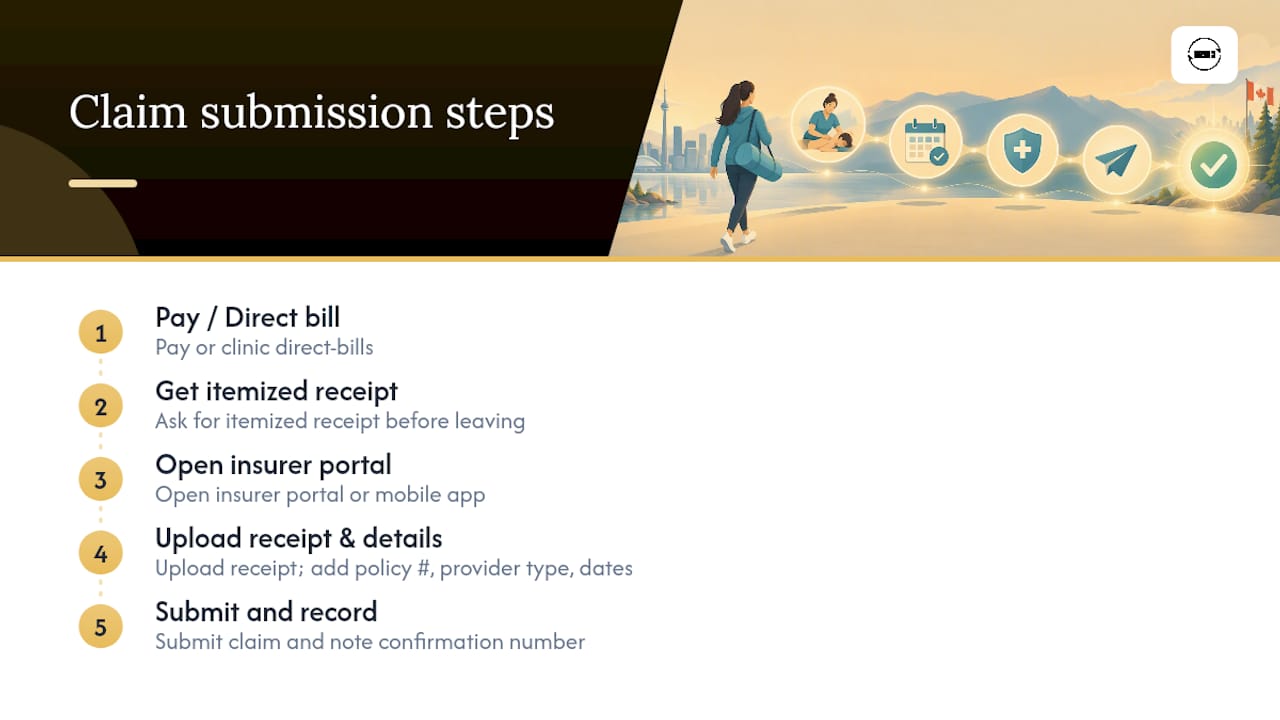
Third, log in to your insurer's online portal or mobile app and locate the claims submission section, usually under "health spending" or "paramedical claims." Fourth, upload a clear photo or scan of the receipt along with the requested details: your policy number, the practitioner's designation, and the date range of treatment if you're batching several sessions into one claim. Fifth, submit and note the confirmation number provided.
Processing timelines vary by insurer, but most major Canadian benefits providers process straightforward claims within five to ten business days, with funds deposited directly to your bank account if you've set up direct deposit. If a claim is rejected, the most common reasons are a missing license number on the receipt, a provider type not listed as eligible, or exceeding the annual maximum. Keep copies of every receipt and confirmation for at least six years, matching CRA recordkeeping requirements for medical expense claims, in case you also plan to claim the unreimbursed portion at tax time.
What Dewy Counselling Sees When Clients Check Their Coverage
Clients almost always underestimate how much their paramedical benefit is shared with other services until they actually call their insurer. That single phone call, five minutes, usually saves months of confusion later.
We help clients prepare receipts that list full designation and license details up front, precisely because a missing field is the most common reason a claim bounces back. When coverage runs short, we're candid about it rather than pretending a plan covers more than it does. There are real options either way, sliding-scale timing, membership pricing, or spacing sessions to match what a benefit year actually funds.
— Wayne Dewhurst
Ready to Start Therapy? Here's How Dewy Counselling Fits Your Coverage
Therapy can be matched to whatever your plan actually funds, rather than forcing a one-size-fits-all format that burns through a paramedical cap in three visits. Sessions run $175 per hour in-person or online, with a Prepaid Annual Membership at $1,750 per year for clients who want predictable costs once benefit dollars run dry, plus Self-Help Modules at $499 per module for structured work between sessions.

Receipts typically list the practitioner's full legal name, professional designation, and license number, which insurers and the CRA commonly require for claims or Medical Expense Tax Credit deductions. If you're weighing individual therapy, couples counseling, or a corporate wellness session, our psychotherapy services page lists formats and lets you book directly. Check your benefits portal first, then reach out and we'll help you fit sessions around whatever coverage you have.
This article is general information, not a substitute for advice from a qualified doctor. Consult a qualified healthcare professional about your own circumstances before acting on anything here.
Sources
- Medical expenses: What you can claim on your tax return (CRA)
- What mental health services are covered in Canada? (Canadian Medical Association)
FAQ
What Mental Health Conditions Are Covered by Insurance?
Public health plans cover psychiatric treatment for any diagnosed condition when delivered by a psychiatrist or in a hospital setting. Private insurance plans typically don't restrict coverage by diagnosis, anxiety, depression, trauma, relationship conflict, and addiction are usually all eligible, but they do restrict which provider types and session counts qualify for reimbursement.
Can I Claim Therapy Expenses on My Taxes in Canada?
Yes, unreimbursed therapy costs can be claimed under the Medical Expense Tax Credit when your practitioner appears on the CRA's authorized list for your province. Keep an itemized receipt showing the practitioner's designation, license number, and service date to support the claim.
How Much Does a Therapy Session Typically Cost in Canada?
Private therapy sessions generally range from $120 to $250, depending on the practitioner's designation, training, and location. Dewy Counselling's in-person and online sessions are priced at $175 per hour.
Are Therapy Sessions Free in Canada?
Therapy is free only in specific circumstances: hospital-based mental health programs, psychiatrist visits under provincial health insurance, and select community or crisis-line services. Private-practice psychotherapy is generally not free unless covered by an EAP, sliding-scale program, or fully reimbursed private insurance.