
Yes, therapy is often tax deductible in Canada when a CRA-recognized practitioner provides it, but the eligibility hinges on details most people skip past. The RC4065 medical expenses guide lists therapy as an eligible medical expense under specified conditions, and you claim it on your T1 through the Canada Revenue Agency's medical expense framework. If your therapy connects to a Disability Tax Credit claim, stricter statutory rules under the Income Tax Act apply, and those trip up more claimants than the basic rules ever do.
TL;DR:
- Therapy costs paid to CRA-recognized practitioners are deductible only if the practitioner is listed by the CRA for the province and the service meets specific medical criteria.
- Claims are subject to a threshold of 3% of net income or a fixed CRA dollar amount, with expenses exceeding that being deductible; reimbursement reduces claimable amount.
- For disability-related claims, strict requirements include prescribed and supervised therapy, payment to non-spouse individuals, and inclusion of the payee’s SIN on receipts.
- Accurate documentation, including detailed receipts with practitioner registration numbers and service descriptions, is essential to avoid review or rejection of claims.
- Only therapy from licensed, Canadian-recognized health professionals counts, while unregulated practitioners like life coaches generally do not qualify for tax deductions.
Therapy Tax Deductible in Canada: How CRA Eligibility Actually Works
Where you enter therapy costs depends entirely on whose expenses you're claiming. You report eligible medical expenses for yourself, your spouse or common-law partner, and dependent children under 18 on line 33099. Expenses paid for other dependants, like an adult child or a parent you support, go on line 33199. Mixing the two lines up is one of the more common filing errors, and it can delay processing while CRA sorts out which household member the expense belongs to.
RC4065 lists "therapy" as eligible when a qualified practitioner delivers it and the service meets CRA's definition of a medical expense. That's a narrower bar than "any counselling session." The practitioner's profession has to appear on CRA's authorized list for the province where you received care, a point worth flagging now because the next section builds on it.
Before any of this matters, your total eligible medical expenses need to clear a threshold. You can only claim the amount above the lesser of 3% of your net income or a CRA-set dollar figure that changes annually. Say your net income is $50,000 and your therapy plus other medical expenses total an amount above the threshold set by CRA. You can claim the portion exceeding that threshold.
A few practical notes carry real weight here:
- Therapy paid to a provider outside Canada can still qualify if the practitioner and service meet CRA's eligibility conditions.
- The credit is non-refundable, meaning it reduces tax owed rather than generating a refund on its own.
- Combining spouses' medical expenses on one return, usually the lower-income spouse, typically produces a larger credit because the 3% threshold is smaller.
Quick math check: if your net income sits at a moderate level, your 3% threshold will be calculated accordingly. Anything you spent on eligible therapy above that amount becomes claimable, subject to the CRA-set maximum ceiling for that tax year.
DTC-Linked Therapy: Where the Rules Get Stricter
When you claim therapy remuneration in connection with a Disability Tax Credit, section 118.2 of the Income Tax Act imposes conditions that go well beyond a standard medical expense claim. This is the area where well-intentioned claimants lose their deduction, usually because the paperwork doesn't match what the statute actually demands.
The therapy must be prescribed and, in many cases, supervised by a specific type of practitioner depending on the impairment:
- For a mental impairment, the therapy generally needs to be prescribed by a medical doctor, psychologist, or nurse practitioner.
- For a physical impairment, an occupational therapist or another recognized specialist may fill that supervisory role.
- The individualized therapy plan itself needs to reflect ongoing, structured intervention, not a single consultation.
Payee restrictions matter just as much. The person you pay for the therapy cannot be your spouse or common-law partner, and if the payee is an individual rather than a clinic, that person must be 18 or older at the time of payment. When the payee is an individual, the receipt needs to include their Social Insurance Number, a requirement that catches people off guard because standard medical receipts almost never ask for it.
One more wrinkle: these specific payee and prescription rules took effect for expenses paid after September 7, 2017. If you're amending a return from before that date, different conditions may have applied, so don't assume today's checklist retroactively governs older claims.
How to Document and Claim Therapy on Your Tax Return
Good documentation is what separates a smooth claim from a CRA letter asking for backup. A compliant receipt should show the payee's name, the amount paid, the date of service, a description confirming the service was psychotherapy or counselling by a named profession, and the SIN when the payment went to an individual rather than a clinic.
Calculating your claim follows a consistent sequence:
- Add up all eligible medical expenses for the calendar year, therapy included.
- Subtract the lesser of 3% of your net income or the CRA-set threshold for the year.
- Enter the remaining amount on line 33099 (or line 33199 for other dependants).
If your employer or insurer reimbursed part of the cost, you can only claim the portion you paid out of pocket. Claiming a reimbursed amount is one of the fastest ways to trigger a review, since insurers and CRA can cross-reference benefit statements.
Worked example: Sarah pays $3,200 for individual psychotherapy over the year and receives $1,000 back through her employer's health plan. Her out-of-pocket cost is $2,200. Her net income is $45,000, so her threshold is $1,350 (3% of $45,000). She claims $850, the difference, on line 33099.
CRA generally recommends keeping receipts and supporting documents for six years in case your return gets selected for review. If that happens, a clear paper trail resolves most inquiries within one exchange of correspondence.
Pro Tip: Ask your clinic to itemize each session's date and fee separately rather than issuing one lump annual total. A single combined receipt is harder to reconcile against a partial-year reimbursement or a mid-year rate change.
When Counselling, Coaching, or Online Therapy Falls Into a Gray Zone
Not every helping professional counts for CRA purposes, and the distinction usually comes down to regulation. Practitioners like psychologists, psychiatrists, and nurse practitioners are consistently recognized, while life coaches and general wellness coaches typically don't qualify because they aren't regulated health professionals in most provinces.
- Registered social workers can qualify in provinces where the profession is CRA-recognized, but that recognition varies by jurisdiction.
- Teletherapy and online sessions are treated the same as in-person care, provided the practitioner is authorized and the service meets CRA's medical expense definition.
- A title alone doesn't guarantee eligibility. "Counsellor" and "therapist" aren't protected terms everywhere in Canada, so the credential behind the title matters more than the label on the door.
If you're unsure whether your provider counts, ask directly for their registration number and professional college before you pay for a block of sessions.
Verifying Your Therapist Qualifies as a CRA-Authorized Practitioner
CRA publishes an authorized medical practitioners list organized by province and profession, and checking it before you commit to a course of therapy saves you from an unpleasant surprise at tax time.
- Search the CRA list for your province and confirm the practitioner's profession appears on it.
- Cross-check that profession against the relevant provincial regulatory college, since a registration number there confirms active, licensed status.
- Ask the clinic directly whether the receipt will state the practitioner's designation and registration number.
Three questions resolve most ambiguity fast: "What's your professional designation and registration number?", "Is your profession on CRA's authorized practitioners list for this province?", and "Will my receipt include the service description CRA expects?"
Pro Tip: Provincial regulatory colleges post public registries online. A two-minute search by name confirms whether a license is active, which is faster than waiting on a callback from the clinic's front desk.
A Practical Checklist for Ontario Clients
Keep a running file with the following for every therapy expense you plan to claim:
- The provider's full name, professional designation, and registration number.
- Session dates, individual fees, and a running annual total.
- A receipt line confirming the service was "psychotherapy" or "individual psychotherapy," not just "session" or "consultation."
- Proof of any partial reimbursement from insurance or an employer plan.
| What to keep | Why it matters |
|---|---|
| Itemized receipts by session | Matches CRA's documentation expectations for medical expenses |
| Practitioner registration number | Confirms authorized-practitioner status if CRA reviews the claim |
| Insurance reimbursement statements | Lets you isolate the out-of-pocket portion you can actually claim |
For Ontario readers weighing costs before committing to a course of treatment, Dewy Counselling's guide to budgeting two to three months of therapy and its overview of mental health funding routes both walk through what out-of-pocket costs tend to look like before insurance and public options are factored in.
How Therapy Deductions Interact With Other Credits and Benefits
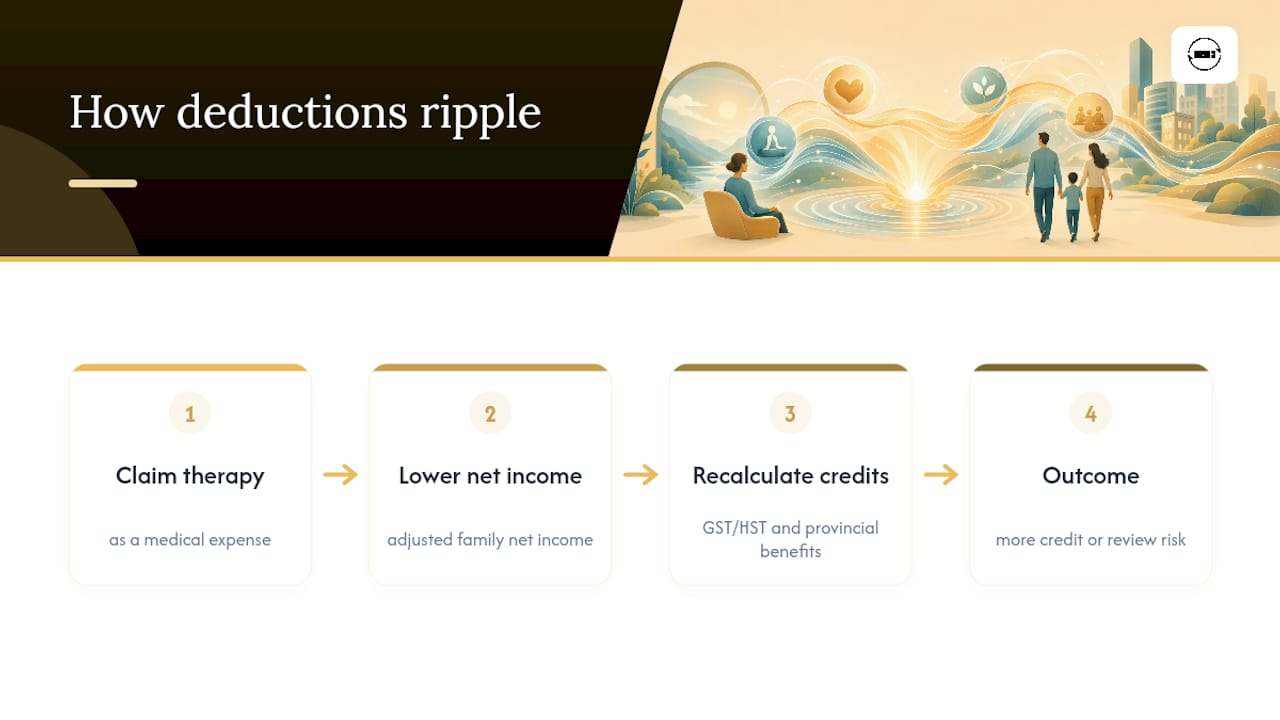
Claiming therapy as a medical expense doesn't just lower your taxable income calculation. It can ripple into other credits tied to net income. The GST/HST credit, for instance, is calculated using your adjusted family net income, so a lower net income after deductions can modestly increase that credit for lower and middle-income households.
Provincial tax credits that phase out based on income thresholds work the same way. Ontario's Trillium Benefit and similar income-tested provincial programs recalculate based on net income figures from your return, so a properly claimed medical expense deduction can indirectly support eligibility for those benefits too.
This is why claiming therapy correctly matters beyond the federal credit itself. Underclaiming leaves money on the table in more than one place, while overclaiming (say, by including a reimbursed amount) can flag your return for review and potentially affect income-tested benefits calculated from an inflated or later-corrected net income figure. The medical expense tax credit is non-refundable, so it won't generate a refund on its own if you have no tax payable, but it still reduces your bottom-line tax owing and feeds into these secondary calculations.
Common Reasons Therapy Claims Get Flagged for Review
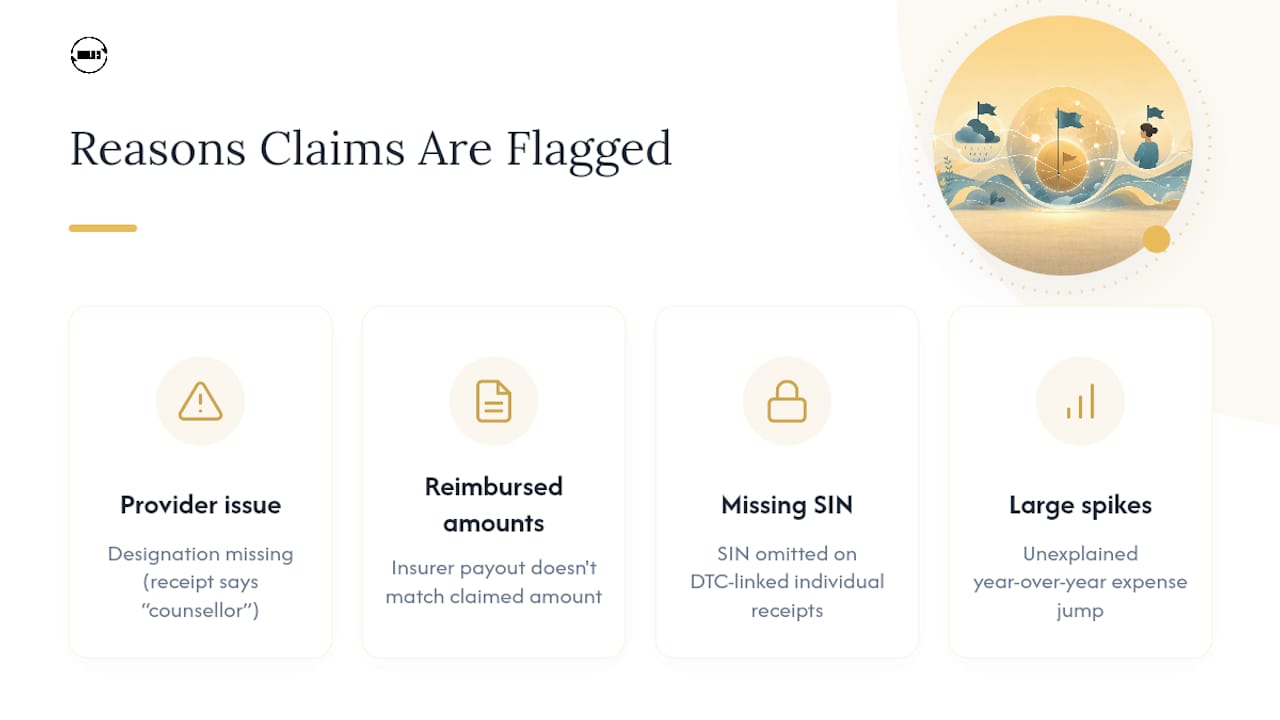
CRA reviews aren't random. Certain patterns in therapy claims consistently draw a second look, and most of them are avoidable with better paperwork upfront.
Claiming a provider whose profession doesn't clearly appear on the authorized practitioners list is the single biggest trigger. If your receipt just says "counsellor" with no designation, CRA has no easy way to confirm eligibility, and that ambiguity often prompts a request for supporting documents.
Claiming reimbursed amounts is the second common issue. If your insurer's records show a payout that doesn't match the amount you claimed, the mismatch surfaces during automated cross-checks.
Missing SIN information on DTC-linked therapy receipts, when the payee is an individual, is a frequent gap. The statutory requirement under section 118.2 is specific, and clinics that don't routinely handle DTC-linked cases sometimes omit it.
Large year-over-year jumps in claimed medical expenses without a corresponding explanation can also draw attention, simply because the change is statistically unusual relative to your filing history.
The fix for all four is the same: request itemized, designation-specific receipts, keep your insurance statements, and confirm SIN requirements apply before your first DTC-linked payment.
Eligible vs. Ineligible Therapy: Real-World Scenarios
A client seeing a registered psychologist weekly for anxiety, paying out of pocket with no insurance coverage, has a clean claim. The receipt shows the designation, the amount, and the service description, and the full out-of-pocket cost above the 3% threshold is claimable on line 33099.
A client paying a life coach for goal-setting sessions, even if the sessions feel therapeutic, generally has no claim. Life coaching isn't a regulated health profession recognized on CRA's authorized list, regardless of how the invoice is worded.
A client with a DTC certificate paying for a structured individualized therapy plan, prescribed by a psychiatrist and delivered by a supervised clinician, has a claim, but only if the receipt includes the payee's SIN (when paid to an individual) and the payee isn't their spouse.
A client whose insurer reimbursed 80% of session costs can only claim the remaining 20% they paid personally.
Filing Therapy Expenses on Your T1: The Actual Steps
Start by gathering every therapy receipt for the calendar year and confirming each one lists the practitioner's designation. Enter your total eligible medical expenses, including therapy, into the medical expenses section of your software or the paper T1 form.
Decide whose return should carry the claim. Then confirm the claim lands on line 33099 for yourself, your spouse, or minor children, or line 33199 if the expense was for another dependant you supported. Keep every receipt and supporting document for six years, since CRA can request them well after your return is processed.
Why Clear Receipts Change Everything for Clients
Clinics that issue vague receipts create real tax headaches for clients who did nothing wrong except trust their provider's paperwork. A receipt that just says "session" without confirming "individual psychotherapy" and the clinician's designation leaves a claimant guessing whether CRA will accept it. The fix is simple: ask your provider to state the service type, the designation, and the registration number on every receipt. Some clinics structure receipts with exactly that language in mind, and clients with questions are welcome to reach out directly.
— Wayne Dewhurst
Book Therapy in Ontario With CRA-Ready Receipts
Some practices provide receipts built with CRA's documentation expectations in mind from the first session, not scrambled together at tax time. As an alternative to guessing whether your provider's paperwork will hold up under review, some counsellors offer in-person and online psychotherapy for individuals, couples, and families, with practitioner designations and service descriptions included on every receipt.

Whether you're starting individual sessions for anxiety or looking into couples counselling, the same documentation standard applies. If you're not sure where to start, Dewy Counselling's guide on starting therapy for the first time in Ontario walks through what to expect from intake to your first invoice. Visit the psychotherapy services page to book a session and see exactly what your receipt will include.
This article is general information, not a substitute for advice from a qualified doctor. Consult a qualified healthcare professional about your own circumstances before acting on anything here.
Sources
- Canada
- Income Tax Act — Section 118.2 (therapy remuneration and individualized therapy plan) - Justice Laws
FAQ
Is therapy tax deductible in Canada?
Yes, therapy can be claimed as an eligible medical expense under RC4065 when a CRA-authorized practitioner provides it and your total medical expenses exceed the required threshold.
Are psychology fees tax deductible?
Yes, fees paid to a registered psychologist are generally eligible, since psychologists consistently appear on CRA's authorized medical practitioners list across provinces.
What is the most overlooked tax deduction in Canada?
Therapy and counselling costs rank among the most overlooked medical expenses, largely because claimants don't realize non-hospital mental health services qualify under RC4065's conditions.
What is the new $7,500 tax credit in Canada?
That figure isn't tied to therapy or medical expense claims covered by RC4065 or lines 33099/33199; check CRA's current credits and benefits pages directly for details on any program using that specific amount.