Many people stop drinking without ever entering a residential program. They do it with a plan, a medical check when one is needed, and steady support afterward. The part that decides whether it works is usually the support, not the willpower. In Ontario, that means a conversation with a doctor about withdrawal risk first, then regular therapy to deal with the reasons you drink. At Dewycounselling we provide that second part, in person or online.
This guide walks through how to decide whether you can stop at home, what a safer plan looks like, and what to do about cravings, low mood and slips.
TL;DR
- Stopping suddenly after heavy, long-term drinking can be dangerous. Help With Drinking advises making a plan with a health care provider first.
- Many people at low or medium risk can manage withdrawal at home or through an outpatient clinic, with check-ins from a clinician.
- Withdrawal is a short bridge. Lasting change comes from ongoing care: therapy, peer support and, for some people, medication prescribed by a doctor.
- A relapse is not a failure. It is information you use to adjust the plan.
- Our therapists offer individual sessions at $175 per hour, in person or online.
Is it safe to stop drinking on your own?
For some people it is. For others it is not, and the difference is how your body has adapted to alcohol.
When someone who drinks heavily every day stops abruptly, the brain, which has adjusted to alcohol's constant presence, becomes overactive. That is withdrawal. Help With Drinking explains that severe withdrawal can cause seizures and delirium tremens (DTs), a state of confusion, fever, heavy sweating, fast heart rate, high blood pressure and hallucinations that can be life-threatening.
Who is more likely to have withdrawal
CAMH's clinical guidance lists signs that withdrawal should be suspected:
- Drinking six or more drinks a day (a lower amount in older adults)
- Drinking that starts at a predictable time in the morning or afternoon
- Sweating or tremor, and symptoms that are quickly relieved by alcohol
- A past history of medically treated withdrawal or withdrawal seizures
The same guidance notes that withdrawal needing treatment is rare in people who drink fewer than six drinks a day, except in older adults. If you are unsure which group you fall into, that uncertainty is the reason to speak to a doctor, nurse practitioner or pharmacist before your quit date.
The timeline to expect
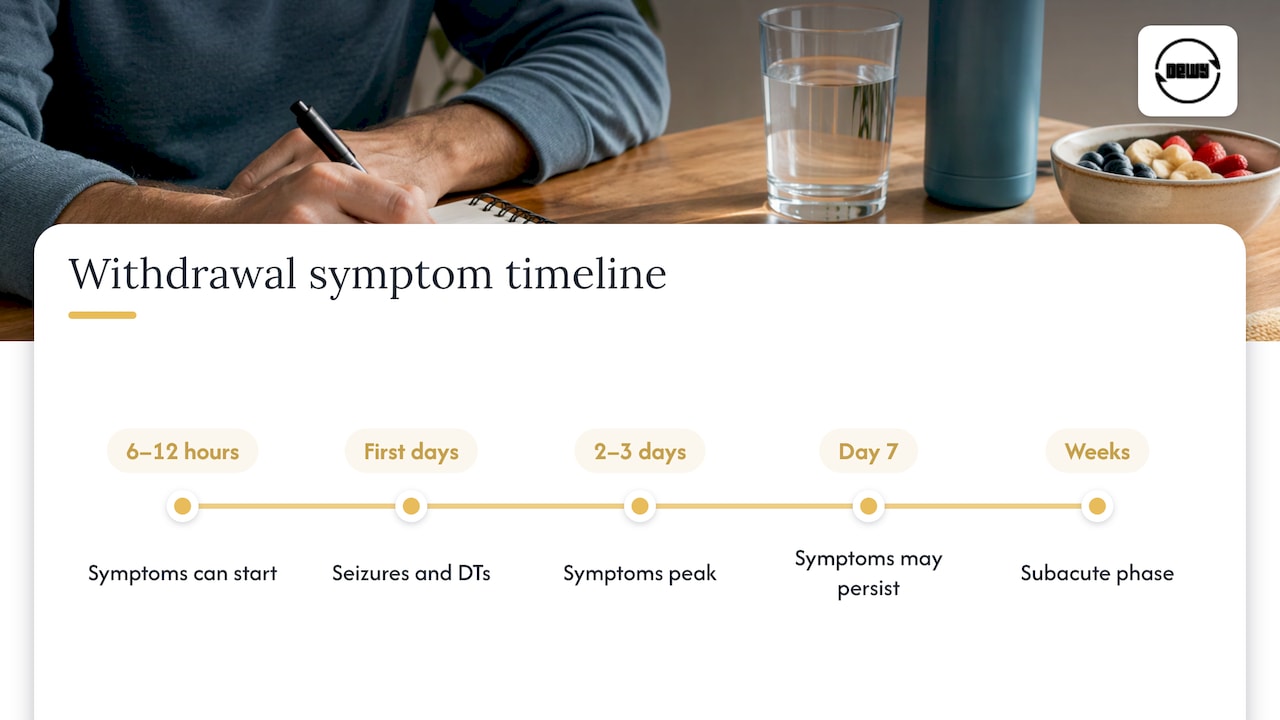
Symptoms can start as early as 6 to 12 hours after the last drink, peak at around 2 to 3 days and can last up to 7 days, according to CAMH. CAMH also describes a subacute phase that can last weeks, with poor sleep, irritability and cravings. Help With Drinking says the most severe complications, seizures and DTs, tend to appear in the first few days.
That later phase matters. Many people feel proud of getting through the first week, then feel blindsided by weeks of restlessness and cravings. Knowing in advance that this is a recognized stage, not a sign that you are failing, makes it easier to get through.
When to get urgent medical help
Call 911 or go to an emergency department if you have a seizure, confusion, hallucinations, a high fever, a racing heart or severe shaking after stopping. Do not wait to see whether it passes. If you are thinking of suicide, the same applies, and CAMH notes that alcohol use combined with suicidal thoughts raises the risk and warrants serious consideration of an emergency psychiatric assessment.
How to make a medically safer plan at home
"Without rehab" should not mean "without medical input." It can mean outpatient care, which is how many Canadians now get through withdrawal.
The 2023 Canadian guideline on high-risk drinking and alcohol use disorder recommends that clinicians assess risk using past seizures or DTs and a short checklist called the Prediction of Alcohol Withdrawal Severity Scale (PAWSS). Based on the result:
- Lower risk: clinicians can consider non-benzodiazepine medications such as gabapentin, carbamazepine or clonidine for outpatient withdrawal management.
- Higher risk: clinicians should offer short-term benzodiazepines, ideally in a hospital or treatment setting, or as an outpatient only if monitoring is close.
Help With Drinking adds that people at low or medium risk can safely manage withdrawal at home or at an outpatient clinic, with phone or in-person check-ins and virtual care options, while higher-risk people will likely need a hospital or treatment centre. Only a clinician can prescribe any of these medications, so do not take someone else's or improvise a dose.
What a home plan needs
British Columbia's provincial guideline, which adopts the national one, spells out what makes someone a good candidate for outpatient withdrawal management: no conditions that rule it out, the ability to attend daily medical visits (or remote follow-up) for the first 3 to 5 days, the ability to take oral medication, and stable housing with a reliable person who can help monitor symptoms. Ontario emergency department guidance from PHI Ontario likewise treats safe housing and someone to help with monitoring as conditions for going home to manage withdrawal.
Put simply, a safer home plan has four parts:
- A conversation with a health care provider before you stop, in which you are completely honest about how much you drink.
- A named person who will be there for the first several days.
- A way to reach care quickly. You can call 811 in Ontario for 24/7 health advice, and the toll-free Hope for Wellness Helpline at 1-855-242-3310 serves Indigenous people across Canada, both listed by Help With Drinking.
- A plan for what happens after the first week.
If you live in Niagara, Niagara Health describes Rapid Access to Addiction Medicine (RAAM) clinics that offer walk-in assessments without a physician referral. Many other Ontario communities have a similar walk-in clinic, which your local public health unit or 811 can point you to.
Your first steps once the decision is made
The provincial health advice from Alberta Health Services is simple and practical. Set a date to stop. Write down your reasons. Decide how you will check progress, daily, weekly or monthly. Try the plan in 1-day, 7-day or 30-day blocks, so the goal never feels endless.
Here is how that looks in practice.
Name your reasons in specific terms
"I want to be healthier" fades by Thursday night. "I want to wake up without dreading what I said" or "I want my partner to trust me with the car keys again" holds up better. Keep the list where you will see it at the hour you usually drink.
Pick the hours that are hardest
For most people, drinking clusters around a few triggers: after work, after an argument, late at night alone. Help With Drinking suggests planning activities for your usual drinking times, doing something physical when you are bored or stressed, avoiding the bar after work and limiting time with friends who drink heavily. If evenings are the problem, our 20-minute plan for alcohol cravings at night is built for exactly that window.
Tell one person
Quitting in secret is the hardest way to quit. One trusted person who knows your date and checks in is worth more than a drawer full of self-help books. If your drinking has strained a relationship, that conversation is often the hardest and the most useful one, and a therapist can help you have it.
Expect a slip, and plan for it
Alberta Health Services states that a relapse does not mean failure: you start again and use what you learned to improve the plan. We would add that the question to ask after a slip is "what was happening in the hour before?" rather than "what is wrong with me?" Our guide to the warning signs of addiction relapse shows what that early pattern often looks like.
Cravings: what actually helps
Cravings rise and fall. Most pass in minutes if you give them something else to do. Practical habits that replace a drink include a strong non-alcoholic drink in your usual glass, a walk, a shower, a phone call, or a task that needs both hands. Eating regular meals also matters, since hunger and tiredness make cravings louder.
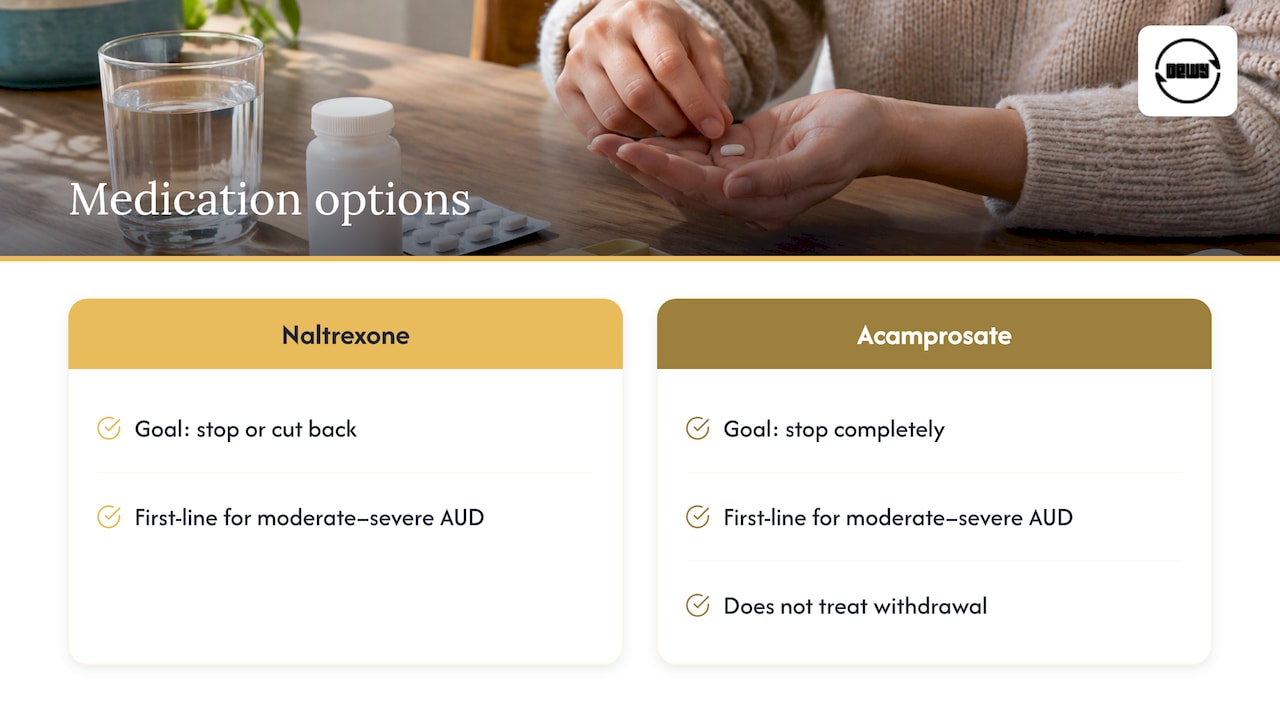
Some people also benefit from medication. The 2023 Canadian guideline recommends that adults with moderate to severe alcohol use disorder be offered naltrexone or acamprosate as first-line medication, with a strong recommendation and high-certainty evidence. Naltrexone can be used if your goal is to stop or to cut back. Acamprosate is aimed at people who want to stop completely. Ontario's emergency department recommendations from PHI Ontario note that naltrexone is available on the Ontario Drug Benefit formulary under a limited-use code. Ask your doctor whether either one suits you, and what it would cost under your coverage.
Help With Drinking's acamprosate handout makes a point worth remembering: it does not treat withdrawal, and some people find it works better combined with therapy or mutual-support groups. Medication quiets the craving, and counselling helps you with what the craving was about. Our article on psychosocial therapy plus naltrexone explains how the two fit together.
Why the first week is not the whole job
The Canadian guideline committee, quoted in the BC provincial guideline, describes withdrawal management as a short-term intervention that does not resolve the medical, psychological or social issues behind alcohol use disorder. It is a bridge to continuing care, and everyone completing withdrawal should be offered that ongoing care.
This is where people who quit on their own most often struggle. The drinking was doing a job: easing anxiety, numbing grief, softening conflict at home, helping you fall asleep. When the alcohol goes, the job is still there. Ongoing care means finding other ways to do it.
The national guideline recommends specialist-led psychosocial interventions for mild to severe alcohol use disorder, along with referrals to peer-support groups and other recovery-oriented community services. Peer groups such as AA and SMART Recovery suit many people, and therapy can run alongside them. Our overview of core addiction therapy approaches used in Canada explains what the main methods involve.

Low mood and anxiety after you stop
Many people ask whether quitting alcohol will cure depression. Sometimes it lifts a great deal, and sometimes it reveals something that was there all along.
CAMH describes a four-week test: avoid alcohol for four weeks and watch your mood. If symptoms fully resolve, the depression was likely alcohol-induced. If significant symptoms remain beyond sleep trouble, depression and alcohol use disorder are probably both present and are best treated at the same time. PHI Ontario's primary care guide says a mood or anxiety disorder caused by alcohol is likely to settle within a few weeks of abstinence or reduced drinking, and that persistent symptoms after four weeks are worth discussing with your doctor.
Two practical points follow. First, mood symptoms that persist are treatable, and you should not read them as evidence that quitting failed. Second, anxiety and depression feed each other, so addressing both is part of staying sober. Our piece on when depression and anxiety overlap is a useful place to start if this sounds familiar. And a caution for anyone who feels hopeless: if you are having thoughts of ending your life, call 911, go to an emergency department, or call or text 9-8-8, Canada's suicide crisis helpline.
Quitting when your relationship is part of the story
Alcohol rarely affects only the person drinking. Couples often describe a cycle: arguments, drinking to cope with the tension, more arguments, and eventually trust that feels broken. When one partner stops, the other may feel relief and grief at once. Both are normal.
That is why we offer couples and family sessions alongside individual therapy. Rebuilding communication while the drinking stops gives the change something to stand on. Sobriety fixes the drinking. Repairing what the drinking did to the relationship is separate work, and it goes better when you do it together with a therapist guiding the conversation.
Perspective
In more than 20 years of working with individuals, couples and families, we have come to believe that the quit date is the easy part to plan and the hardest part to live after. People ask us whether they can do this without rehab. Often the honest answer is yes, provided a doctor has looked at the withdrawal risk first and provided you do not try to do the long stretch alone.
Our approach rests on evidence-based methods, and we draw on several therapy modalities because no single approach fits every person. Some clients need to understand what drinking was soothing. Some need to rebuild a marriage. Some need a place to say out loud what they have never said. All of them need regular, unhurried time with someone who knows how this unfolds.
That is why we offer sessions in person at two locations and online, and why we offer sliding scale pricing: continuity matters more than any single appointment. A prepaid annual membership is there for people who want to commit to that rhythm for a full year.
Wayne Dewhurst
How therapy fits into a plan without rehab
Once your doctor has cleared you to stop, therapy gives the plan its structure. In sessions with us you can map your triggers, practise what to say when someone offers you a drink, work through the anxiety or low mood that tends to surface, and talk through the relationship strain that drinking created. It gives you a regular appointment and a place to say what you actually think, which is something many people find they have been missing.
If you are also looking after your own wellbeing while you recover, our practical guide to self-care in recovery covers the daily habits that support it.
Start with a session
We provide individual, couples and family psychotherapy for addiction, depression, anxiety and relationship conflict. An in-person or online session is $175 per hour, and a mobile session is $225 per hour. If you want steady support through the first year, the prepaid annual membership is $1,750 per year. You can see all options on our services page, or read about individual psychotherapy. If a partner is part of the picture, our couples counselling page describes how we work with both of you.

See your doctor about withdrawal risk first if you drink heavily every day, then book your first session so that support is already in place on day one.
FAQ
Can I stop drinking on my own at home?
It depends on how much and how long you have been drinking. If you drink heavily every day, Help With Drinking advises making a plan with a health care provider first, because sudden withdrawal can cause seizures. If you drink less, withdrawal that needs treatment is uncommon, but a doctor can confirm which group you are in.
What are the first steps to sobriety?
Set a quit date, write down your reasons, decide how you will track progress, and try the plan in 1-, 7- or 30-day blocks, as Alberta Health Services suggests. Tell one person, and book a medical check if you drink heavily. Line up regular counselling before the date arrives.
Can quitting alcohol cure depression?
Sometimes. CAMH says that if depression fully resolves after four alcohol-free weeks, it was likely alcohol-induced. If significant symptoms remain, depression and alcohol use are probably both present and should be treated together, so speak to your doctor and consider therapy.
What helps with alcohol cravings?
Change what you do at your hardest hours: eat regularly, keep a non-alcoholic drink in hand, move your body and call someone. Naltrexone and acamprosate are first-line medications for moderate to severe alcohol use disorder, according to the Canadian guideline, and a doctor can tell you whether either is right for you.
What if I slip?
A slip is a reason to adjust the plan, not to abandon it. Note what happened in the hour before, tell your support person, and restart. If the pattern repeats, bring it to your therapist or doctor, because that is what ongoing care is for.
Sources
- Alcohol Problems: How to Stop Drinking, Alberta Health Services
- How to reduce drinking safely, Help With Drinking
- Alcohol Use: Managing alcohol withdrawal, CAMH
- Canadian guideline for the clinical management of high-risk drinking and alcohol use disorder, 2023
- ED Toolkit for Alcohol-Related Presentations, PHI Ontario, 2025
- Recommendations on the Management of Selected Substance Use Disorders in the ED, PHI Ontario, 2023
- Primary care management of substance use, PHI Ontario, 2024
- Addiction is treatable, and help is available in Niagara, Niagara Health
- Acamprosate patient handout, Help With Drinking, 2023
- Alcohol Use: Treating co-occurring alcohol use disorders and depression, CAMH