
If your heart is racing, your chest feels tight, and you're struggling to catch your breath at your desk, this is very likely a panic attack, not a heart attack or a sign you're failing. Name it silently or under your breath: "This is a panic attack, it will pass." Take one slow breath with a long exhale, and if you can, step away for a few minutes with a simple line like "I need five minutes, I'll be right back."
TL;DR:
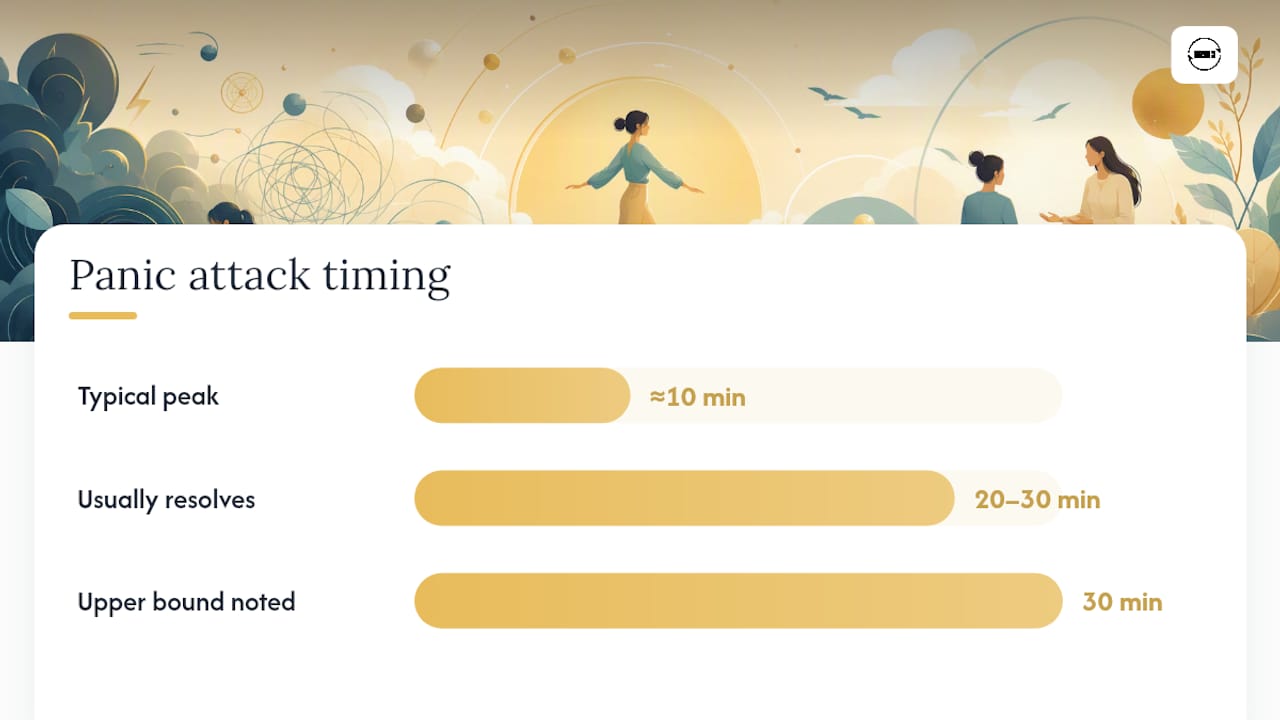
- Most panic attacks peak within 10 minutes and usually resolve within 20 to 30 minutes without intervention, making them manageable at work with proper techniques.
- Practicing a pre-made sequence of labeling, breathing, grounding, and physical relaxation is essential for effective self-management during episodes.
- Disclosing a panic attack to a manager can facilitate workplace support, such as requesting a quiet space or flexible breaks, which helps prevent recurrence.
- Building a personalized panic plan during calm moments reduces decision-making during attacks and increases the chance of quick recovery.
- Regular habits like maintaining sleep, limiting caffeine, and incorporating daily movement are crucial for reducing overall anxiety and attack frequency.
How to Recognize a Panic Attack at Work
A panic attack shows up fast and physically. You might notice a racing heart, shortness of breath, chest tightness, dizziness, trembling hands, or a strange sense of unreality, like you're watching yourself from outside your body. That last one, called derealization, catches a lot of people off guard the first time it happens, because it feels less like anxiety and more like something is seriously wrong with your mind.
Here's what tends to happen physically during an episode:
- Heart pounding or racing, sometimes with a skipped-beat sensation
- Shortness of breath or a feeling of choking
- Tight chest or pressure that can mimic cardiac symptoms
- Dizziness, lightheadedness, or tingling in the hands and face
- A wave of dread or the sense that something terrible is about to happen
According to the University of Pennsylvania's clinical guidance on panic symptoms, a panic attack typically peaks within about 10 minutes and usually resolves within 20 to 30 minutes, even without any intervention. That timeline matters. Knowing the worst of it is short and finite makes it easier to ride out rather than fight.
Not every chest sensation is panic, though. Sustained chest pain, fainting, numbness on one side of the body, or slurred speech are red flags that warrant emergency care, not a breathing exercise. NHS guidance on panic disorder stresses ruling out medical causes first if you have any doubt, particularly if this is your first episode or the pattern of symptoms has changed. Common workplace triggers include high-stakes presentations, tense one-on-ones with a manager, tight deadlines stacked on top of each other, and open-plan offices that leave no private space to decompress. Early warning signs, like a tight jaw, restless legs, or a sudden urge to leave the room, often show up minutes before the full episode.
A Step-by-Step Way to Calm Down at Work
You don't need a quiet room or twenty minutes to interrupt a panic attack. You need a sequence you can run through at your desk, in a bathroom stall, or in a stairwell, and you need to have practiced it before you're mid-attack, because that's not the moment to be improvising.
- Name it. Say to yourself, "This is a panic attack, not an emergency. It will peak and pass." Labeling the experience reduces the fear-of-fear loop that makes panic spiral.
- Breathe with a long exhale. Inhale for a count of four, hold briefly, exhale for a count of six or seven. Harvard Health's guidance on grounding techniques points to diaphragmatic, long-exhale breathing as one of the most reliable ways to shift your nervous system out of a fight-or-flight state.
- Ground yourself with your senses. Try the 5-4-3-2-1 method: notice five things you see, four you can touch, three you hear, two you smell, one you taste. Press your feet flat into the floor and your palms against the desk. Physical anchoring gives your brain something concrete to hold onto besides the panic itself.
- Release the tension physically. Clench your fists for five seconds, then release. Roll your shoulders back. A short walk to the water cooler or a flight of stairs works too, since movement burns off some of the adrenaline your body just released.
- Step away if you can, and re-enter when ready. Even ninety seconds of privacy changes the trajectory of an attack.
If you're mid-meeting, you don't owe anyone a full explanation. A simple line does the job: "Sorry, I need to step out for a minute, I'll be right back," or "Can we pause for five, I need a quick break." When you return, ease back in rather than apologizing repeatedly. Something like "Thanks, I'm good, where were we?" resets the room without dwelling on what happened.
Pro Tip: Keep a small index card or a note in your phone with your breathing count and grounding steps written out. In the middle of an attack, your working memory takes a hit, and reading a script is far easier than trying to recall one.
This sequence overlaps with what clinicians and practical guides on managing panic attacks without medication generally recommend: name it, breathe, ground, relax, step away if needed. The order matters less than doing all five in some form.
Telling a Manager or Coworker What's Happening
You don't have to disclose anything to anyone. But if you work closely with a manager or a small team, a short, factual message often prevents awkward speculation and opens the door to real support. Something like this works: "I had a panic attack earlier and needed to step out. I'm okay now, just wanted to give you context." You don't need to diagnose yourself or explain the cause.
If you want accommodations, ask for them plainly rather than hoping someone notices. Useful requests include:
- A quiet space or empty office you can use for a few minutes when needed
- Advance notice or agendas before high-stakes meetings, so there are fewer surprises
- Flexibility to take short breaks without needing to justify each one
- Temporary adjustments to your schedule, like starting later or working from home on demanding days
The Job Accommodation Network's guidance on workplace panic attacks points out that flexible breaks, advance notice, and access to a private space genuinely reduce distress and speed recovery after an episode. That's not a workplace being generous; it's a workplace being functional.
For coworkers wondering how to help, the most useful thing to do is ask directly: "What would help right now?" Resist the instinct to hover, minimize ("it's probably nothing"), or ask a string of questions in the moment. If attacks are becoming frequent or affecting your ability to do your job, that's a reasonable point to loop in HR or an occupational health contact, not because you're in trouble, but because formal accommodations under workplace disability protections often start with that conversation.
Building a Panic Plan and Reducing Future Attacks
A panic plan is a short, written document you create when you're calm, so you're not making decisions from a panicked state later. It doesn't need to be complicated. List a safe location in your building (a stairwell, an empty conference room, your car), one emergency contact, and your personal breathing or grounding sequence. Add a note for the next 24 hours: hydrate, eat something, avoid stacking another high-stress task right after, and get to bed at a normal hour rather than pushing through exhaustion.
Daily habits that lower your baseline sensitivity matter more than most people expect:
- Protect your sleep window, since sleep deprivation lowers your threshold for panic
- Watch caffeine intake, particularly after midday, since it can mimic and amplify panic symptoms
- Build in micro-breaks between meetings instead of running back to back all day
- Move your body daily, even a short walk, to metabolize stress hormones
Simply Psychology's overview of managing anxiety at work points to cognitive behavioral therapy and behavioral approaches, like gradual exposure and reframing anxious thoughts, as effective for reducing the avoidance patterns that keep workplace anxiety alive. Somatic approaches that focus on the body's stress response can complement that work, and medication is a legitimate option for some people when prescribed and monitored by a physician.
| Signal | What it suggests | Reasonable next step |
|---|---|---|
| One isolated episode during a stressful week | Situational stress response | Use grounding tools, monitor for recurrence |
| Recurring attacks, two or more per month | Building sensitivity pattern | Consider a therapy consult |
| Avoiding meetings, tasks, or the office entirely | Avoidance is reinforcing the fear | Prioritize professional support soon |
| Physical symptoms with no clear anxiety trigger | Possible medical cause | Rule out with a doctor first |
If you're avoiding tasks, dreading the commute, or dreading work itself because of panic, that's a clear signal it's time for more than self-help. A checklist for telling stress apart from an anxiety disorder can help you figure out where you land before you decide your next step.
What a Therapist Actually Does With Panic Attacks
Early sessions with a therapist usually focus on safety and stabilization first, not digging into the root cause. That means learning to recognize your specific warning signs, building a personalized regulation routine, and confirming there's no undiagnosed medical issue contributing to the symptoms. Only after that groundwork does a clinician typically start working on the deeper patterns, the thoughts, memories, or life stressors that keep the nervous system on high alert.
A clinician will often help you build a genuine panic plan collaboratively rather than handing you a generic script. That plan usually includes:
- A short list of your personal early warning signs
- Your go-to regulation sequence, tailored to what actually works for your body
- A workplace accommodation request you feel comfortable making, if you choose to disclose
Clinicians who create these plans in advance find that having the steps pre-decided lowers the decision-making burden during an actual attack, which in turn reduces the odds of a second wave of panic on top of the first. That's the whole point of a plan: it does your thinking for you when your thinking is the thing under attack.
A clinician-endorsed micro-routine you can practice right now combines a CBT reframe ("this is uncomfortable, not dangerous") with a 60-second grounding sequence. If you want a version of that broken down step by step, this CBT grounding routine walks through a similar sixty-second sequence originally built for social anxiety, and the mechanics translate directly to a workplace panic response.
Pro Tip: Practice your grounding sequence when you're calm, not just when you're panicking. Rehearsal outside of crisis moments is what makes the routine automatic when you actually need it.
Why I Don't Think Panic at Work Is a Personal Failure
Most people I've seen work through this carry a private belief that having a panic attack at your desk means you're not cut out for the pressure. That belief is backwards. A panic attack is your body's alarm system firing, often after weeks of stress you've been managing just fine on the surface. It says nothing about your competence.
What actually helps afterward is small and unglamorous: rest if you can, drink some water, text one person you trust rather than posting about it or holding it in alone. Jot down what happened while it's fresh, what the trigger might have been, how long it lasted, what helped. That note becomes real data if you ever sit down with a therapist. You're not weak for having one. You're paying attention to something your body has been trying to tell you for a while.
— Wayne Dewhurst
Getting Support When Panic Keeps Showing Up at Work
If panic attacks are becoming a regular part of your workday, waiting it out on your own usually isn't the fastest path back to feeling steady. Dewycounselling offers a lower barrier of entry than committing to open-ended weekly therapy right away: a single in-person or online session at $175 per hour lets you build a personalized panic plan with a clinician without any long-term obligation.

If you'd rather work through it independently first, the Self-Help Modules at $499 one-off give you structured, self-paced tools for managing anxiety symptoms. Teams and managers looking to build panic-aware workplace culture can also look into Corporate Team Building sessions. If you're unsure which fits, start with a single psychotherapy session and let the clinician guide the next step from there.
Sources
- Panic symptoms (University of Pennsylvania)
- Panic disorder (NHS)
- Managing anxiety at work (Simply Psychology, 2026)
FAQ
What should I do if I have a panic attack during a work meeting?
Excuse yourself briefly with a simple line like "I need five minutes, I'll be right back," then run through a breathing and grounding sequence privately. Most panic attacks peak within about 10 minutes and resolve within 20 to 30, so stepping away briefly is usually enough to return steady.
Can stress at work cause panic attacks?
Yes, chronic workplace stress lowers your threshold for panic, even if a specific meeting or deadline is just the trigger rather than the root cause. Behavioral approaches like CBT address both the immediate symptoms and the underlying stress patterns that make attacks more likely.
Should I quit my job if it gives me panic attacks?
Not necessarily. Many workplace triggers are addressable through accommodations, a panic plan, or therapy before quitting becomes the only option, though a job that consistently triggers severe symptoms with no room for change is a different conversation. A therapist can help you evaluate whether the issue is situational or something more pervasive.
What to do if you get a panic attack at work and can't leave your desk?
Stay seated, plant your feet flat on the floor, and use a long-exhale breathing pattern, inhaling for four counts and exhaling for six or seven. Pair it with the 5-4-3-2-1 grounding method, silently naming things you can see, hear, and touch, which works discreetly even in an open office.
How much does professional support for panic attacks cost?
Dewycounselling offers in-person or online sessions at $175 per hour, with self-paced Self-Help Modules available at $499 one-off for those who prefer to start independently.